


This article discusses best AI agents for financial analysis tools. These tools utilize AI technology for their data processing and analysis capabilities and advanced forecasting and investment analysis.
These tools assist financial analysts and investors in making timelier and more accurate financial decisions. These tools examine large financial datasets and spot financial trends to enhance financial performance in the extreme competitiveness of modern financial markets.
What Are AI Agents for Financial Analysis?
AI Agents for Financial Analysis are sophisticated AI programs used for gathering, analyzing, and interpreting extensive financial information to enhance investment and business finance decision-making.
Such agents employ machine learning, natural language processing, and predictive analytics for examining market/company trends and moves, financial statements, and real-time news. Users can avoid the tedious task of examining multifaceted datasets. Instead, they can use the AI tools to provide insights, make forecasts, and conduct risk analysis in a matter of seconds.
The AI Agents for Financial Analysis Tools optimize the capacity of investors, analysts, and companies to identify opportunities and minimize risks within the context of the ever-fluctuating financial markets.
Key Benefits of AI Financial Analysis Tools
Rapid Data Analysis – Financial analysis that would take hours or days can be completed in seconds.
Reduced Inaccuracy – Facilitates increased accuracy of financial analysis and predictions by removing the inaccuracy of human elements.
Latest Market Data – Provides fresh analysis by constantly recording and analyzing the market, the latest news, and the performance of various stocks.
Informed Financial Decisions – Creates an environment in which financial decisions made by investors and financial analysts are well thought out and based on relevant data.
Reporting Automation – Removes the need for human involvement in the creation of financial analysis, reports, dashboards, and summaries.
Proactive Risk Assessment – Uses analytics and trends to identify potentially harmful financial situations and trends to give sufficient time to prepare risk assessment.
Reduced Analysis Costs – Significantly reduces the costs of financial analysis by reducing the need for large research staff and analysis teams.
Cutting-Edge Trends – Uses groundbreaking techniques to find the trends and the latest opportunities for financial investments and analysis.
Research Efficiency – Finds the analysis of financial data, news, and the data you need at the speed of thought.
Strategic Edge – Creates the ability to incorporate new financial strategies that are well thought and based on data faster than your competitors.
Use Cases of AI Agents in Financial Analysis
Market Analysis – AI tools guide investment choice based on market data.
Investment Study – Investment Study AI tools assist investors through analysis of data.
Risks and Returns – AI tools help investors and managers identify and assess the exposure to risks of potential investment opportunities.
Investment & Wealth Management – AI tools help inform users on management and creation of diverse investment portfolios.
Financial Crime Prevention – AI tools allow for the improved identification of financial crime.
Business Intelligence – AI tools create improved business intelligence for the user through the prediction and analysis of market data.
Real-Time Financial Analytics – AI tools help the user in the generation of real-time financial analytics.
Credit Analysis – AI tools assist in the evaluation and assessment of the credit of natural and legal persons.
Automated Reporting – AI tools help automate reporting for the user.
Macroeconomic Studies – AI tools assist in the study of macroeconomic data.
Limitations of AI Financial Tools
Data Quality Contingent – AI applications have issues with faulty data. The quality of AI financial services will hinge on the precision of the data you’re able to provide.
No Intuition – AI can’t understand context. Consider a complex financial situation that may require a number of factors and prior experiences that only a seasoned individual may understand. AI may get that wrong.
Volatile Markets – Financial markets fluctuate and can be crisis impacted. AI can not fully comprehend or predict the full scope of variables.
High Cost of Advanced Financial AI – Sophisticated AI financial systems can be cost prohibitive to small businesses or individual investors.
Erosion of Critical Thinking – An over dependence on AI to the exclusion of other techniques can diminish human critical thinking.
Opaque Structures – Numerous AI models can be difficult to understand and interpret how outcomes may have been reached.
Data Vulnerability – Financial data that is processed by AI systems may be susceptible to breaches or hacks.
Legislative Compliance – Financial decisions made by AI need to comply with changing financial regulations.
Inequitable Systems – AI models can exhibit inequities due to nonexistent or inadequate training data.
Difficult to Incorporate – AI tools can be cumbersome to include in existing financial systems and operations.
Key Point & Best AI Agents for Financial Analysis Tools
- BloombergGPT 2.0 – Advanced finance-focused LLM designed for market data analysis, forecasting, and institutional-grade financial insights.
- AlphaSense – AI-powered search platform that extracts insights from financial documents, earnings calls, and market research reports.
- Energent.ai – Predictive analytics AI that delivers energy and financial market forecasting using real-time data modeling.
- Kensho (S&P Global) – Machine learning platform that analyzes complex financial datasets for risk, trends, and investment insights.
- FinChat.io – Conversational AI assistant that provides real-time financial data, company analysis, and stock insights.
- Databox – Business analytics platform that consolidates financial KPIs and visual dashboards for performance tracking.
- Kavout – AI-driven investment platform that ranks stocks using machine learning models and quantitative analysis.
- Browse AI – No-code web scraping AI that extracts financial and market data from websites for analysis automation.
- Castmagic – AI tool that converts audio, meetings, and podcasts into structured financial insights and summaries.
- Claude Analyst – AI assistant specialized in interpreting financial data, reports, and documents with deep analytical reasoning.
10 Best AI Agents for Financial Analysis Tools 2026
1. BloombergGPT 2.0
As a finance and capital markets large language model, BloombergGPT 2.0 is a powerful tool for financial analysts thanks to its advanced training on extensive financial datasets. Reports, news, market data, and many more datasets assist this model’s ability to understand the financial landscape.
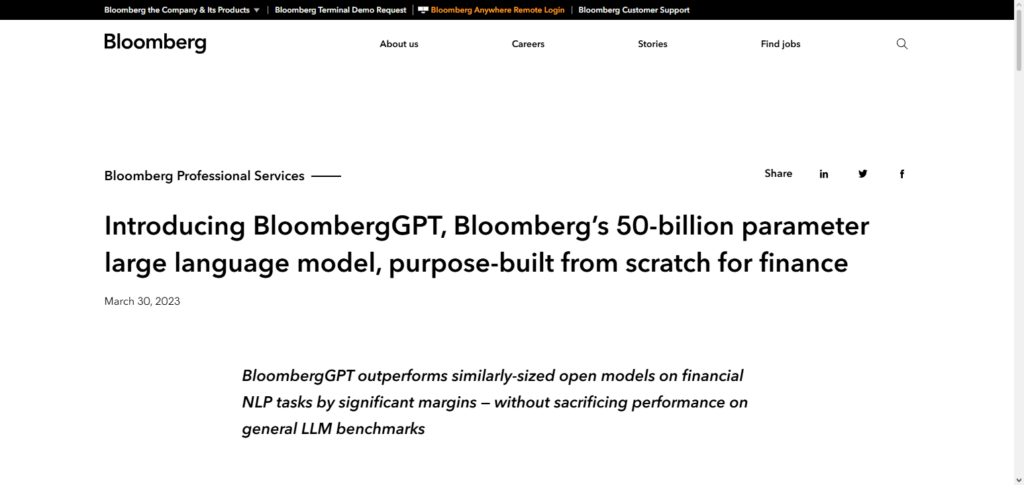
This model can help analysts assess and interpret earnings, evaluate risk, and forecast trends in the financial market.
Where general AI tools may miss the mark in financial analysis, BloombergGPT 2.0 was developed to fill that gap. For many of the tools available for analysts in the Best AI Agents for Financial Analysis Tools, this model is by far the most advanced.
BloombergGPT 2.0
| Attribute | Details |
|---|---|
| Type | Financial Large Language Model (LLM) |
| Use Case | Market analysis, forecasting, financial reasoning |
| Data Source | Bloomberg terminal datasets, news, filings |
| Users | Banks, hedge funds, analysts |
| Advantages | Disadvantages |
|---|---|
| Extremely accurate financial insights | Very expensive enterprise access |
| Built specifically for finance domain | Not available for retail users |
| Strong real-time market understanding | Requires Bloomberg ecosystem |
| High-quality predictive capabilities | Limited customization outside finance |
2. AlphaSense
AlphaSense is an AI financial search and intelligence tool that captures insight dispersed across millions of documents. These documents can include anything from earnings calls to SEC filings to research reports.
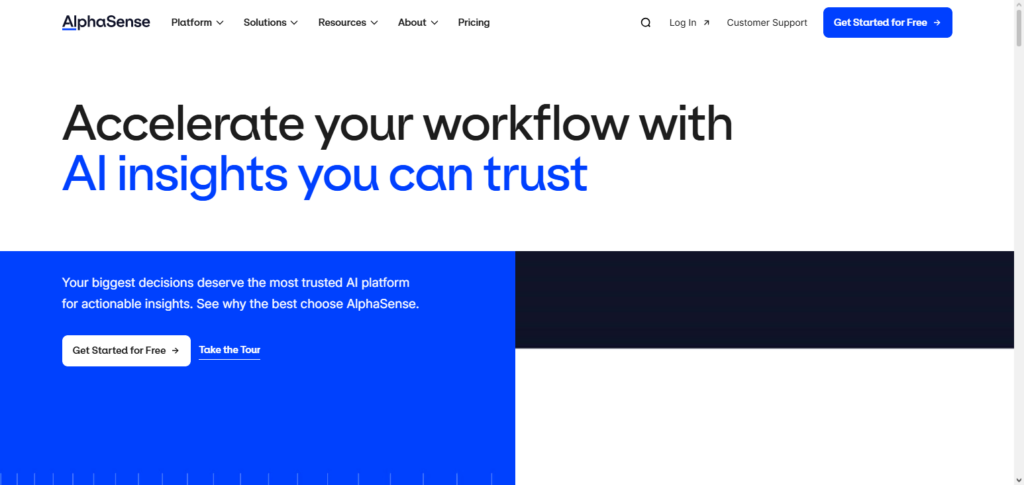
This tool, through its use of natural language processing, helps analysts quickly and efficiently find relevant data in a sea of paperwork.
For research-intensive workflows in a time-sensitive environment, as a standout among the Best AI Agents for Financial Analysis Tools, AlphaSense reduces time spent on manual research and can find the answer you seek in context from both structured and unstructured data sources.
AlphaSense
| Attribute | Details |
|---|---|
| Type | AI financial search engine |
| Use Case | Research, document analysis, insights extraction |
| Data Source | Earnings calls, SEC filings, reports |
| Users | Analysts, investment firms |
| Advantages | Disadvantages |
|---|---|
| Fast document search across millions of sources | Subscription cost is high |
| Strong NLP-based insights | Learning curve for beginners |
| Excellent for competitive research | Limited trading execution tools |
| Saves research time significantly | No direct portfolio management |
3. Energent.ai
Energent is an automated analytics tool that utilizes artificial intelligence for predictive analytics in energy and financial markets. The primary modeling tools combine machine learning and real-time analytics to build forecasts for pricing, demand, and market changes.
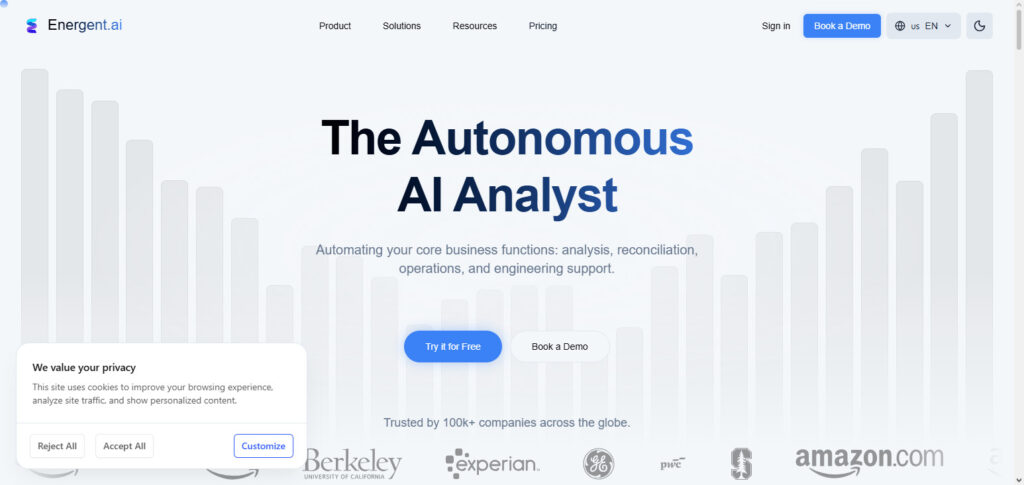
The primary users of this platform are energy traders, as well as financial strategists, to manage investment and market risks. Within the Best AI Agents for Financial Analysis Tools,
Energent.ai, with its distinctive and predictive ability in volatile markets, is the clear leader in the financial and energy sectors. This tool helps businesses improve the quality of decisions in financial and commodity markets by identifying hidden patterns within complex datasets.
Energent.ai
| Attribute | Details |
|---|---|
| Type | Predictive analytics AI |
| Use Case | Energy + financial forecasting |
| Data Source | Market data, energy trends, macro indicators |
| Users | Traders, energy firms |
| Advantages | Disadvantages |
|---|---|
| Strong predictive forecasting | Narrow industry focus (energy-heavy) |
| Real-time analytics | Not ideal for general investors |
| Good for commodity pricing insights | Requires technical understanding |
| AI-driven trend detection | Limited public accessibility |
4. Kensho (S&P Global)
Kensho, the analytical tool of S&P Global, offers powerful artificial intelligence to analyze financial and economic data at an unprecedented scale and level of detail. Machine learning, which analyzes the behavior of the macro economy, its corporate constituents, and the financial markets, is the backbone of the platform.

Financial institutions employ Kensho for scenario building, risk assessment, and portfolio optimization. One of the Best AI Agents for Financial Analysis Tools, Kensho provides the institutional intelligence necessary to drive informed financial decisions and forecasts.
Because of its integration with S&P Global data, its reliability is beyond question, and it is widely used by hedge funds, banks, and investment management firms requiring high-level analytical intelligence.
Kensho (S&P Global)
| Attribute | Details |
|---|---|
| Type | AI analytics platform |
| Use Case | Risk analysis, macroeconomic insights |
| Data Source | S&P Global datasets |
| Users | Banks, institutions |
| Advantages | Disadvantages |
|---|---|
| Highly reliable institutional data | Expensive enterprise solution |
| Strong risk modeling tools | Not beginner-friendly |
| Deep macroeconomic analysis | Limited retail access |
| Backed by S&P Global credibility | Complex setup process |
5. FinChat.io
FinChat.io is a financial assistant that uses conversational AI to deliver real-time analysis on companies and stocks. FinChat can break down complex data and deliver succinct answers. FinChat designed its AI to be user-friendly and answer questions in a conversational format.

FinChat boasts the AI and design capabilities to deliver answers instantaneously. FinChat differentiates itself in the financial AI space with the speed and convenience it provides to its users. FinChat allows its users to analyze financials faster and make investment decisions with precision and confidence.
FinChat.io
| Attribute | Details |
|---|---|
| Type | Conversational financial AI |
| Use Case | Stock Q&A, company insights |
| Data Source | Market data APIs, financial reports |
| Users | Retail investors, traders |
| Advantages | Disadvantages |
|---|---|
| Easy conversational interface | Limited advanced analytics |
| Real-time stock insights | Depends on external data sources |
| Beginner-friendly | Not for institutional modeling |
| Fast answers to financial queries | May lack deep forecasting |
6. Databox
Databox is a performance tracking and business analytics system that uses integrated dashboards to display financial data. Databox users can customize dashboards to monitor KPIs and other metrics in real-time. Databox users can integrate data sources and build custom dashboards.
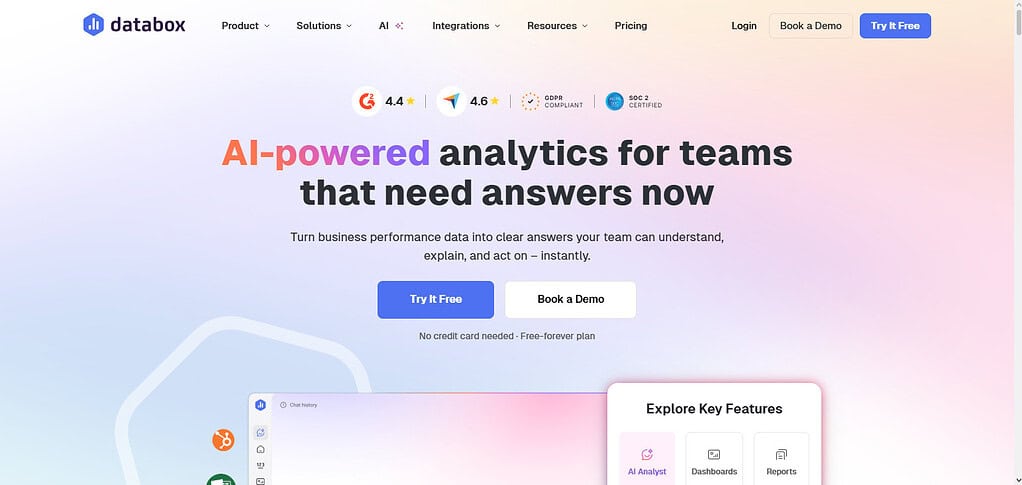
Databox is favored by executives and finance personnel for its ease of centralized reporting. Databox provides companies a clear view to aid strategic decisions. Databox helps improve accountability and operational effectiveness across an organization.
Databox
| Attribute | Details |
|---|---|
| Type | Business analytics dashboard tool |
| Use Case | KPI tracking, financial reporting |
| Data Source | CRM, spreadsheets, APIs |
| Users | Businesses, finance teams |
| Advantages | Disadvantages |
|---|---|
| Great visual dashboards | Not a predictive AI tool |
| Easy KPI tracking | Limited deep financial modeling |
| Multiple integrations | Requires setup time |
| Real-time reporting | Less useful for traders |
7. Kavout
Kavout is an AI-driven investment intelligence platform that uses machine learning to rank stocks and generate predictive investment signals. It analyzes financial statements, market data, and alternative datasets to create a “K Score” for stock evaluation.
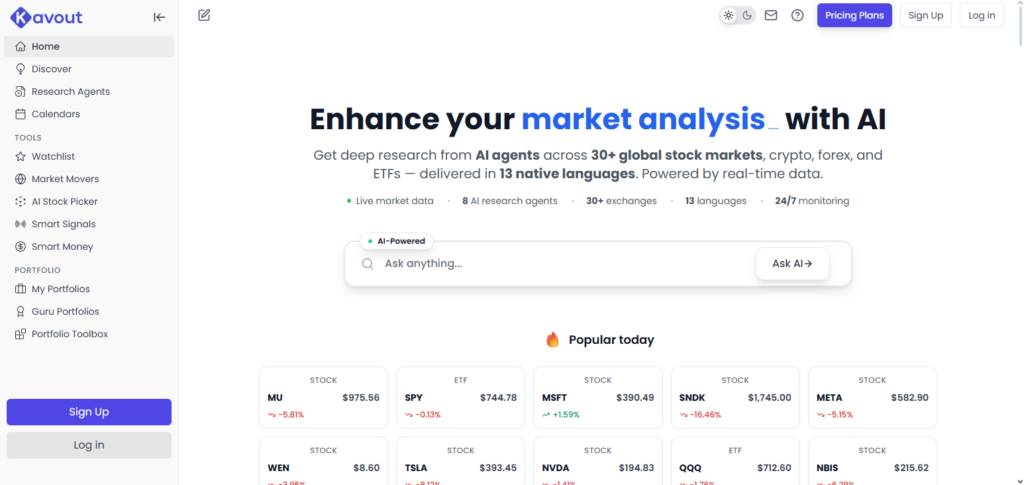
Investors use Kavout to identify high-potential opportunities and manage portfolio risk effectively. Within the category of Best AI Agents for Financial Analysis Tools,
Kavout is highly regarded for its quantitative investment approach. It helps both institutional and retail investors make data-backed decisions, reducing emotional bias and improving long-term investment performance through AI-powered stock selection models.
Kavout
| Attribute | Details |
|---|---|
| Type | AI stock ranking system |
| Use Case | Investment scoring, stock picking |
| Data Source | Financial statements, market data |
| Users | Investors, portfolio managers |
| Advantages | Disadvantages |
|---|---|
| AI-based stock scoring (K Score) | Not fully transparent algorithm |
| Strong quantitative analysis | Limited qualitative insights |
| Good for portfolio selection | May lag during volatility |
| Reduces emotional bias | Requires financial understanding |
8. Browse AI
Browse AI is a tool that automates the financial web scraping and data extraction process via a simple user interface, making web scraping more accessible. Within the category of Best AI Agents for Financial Analysis Tools, Browse AI empowers users to create their own market bots to monitor prices and financials as well as competitive updates.
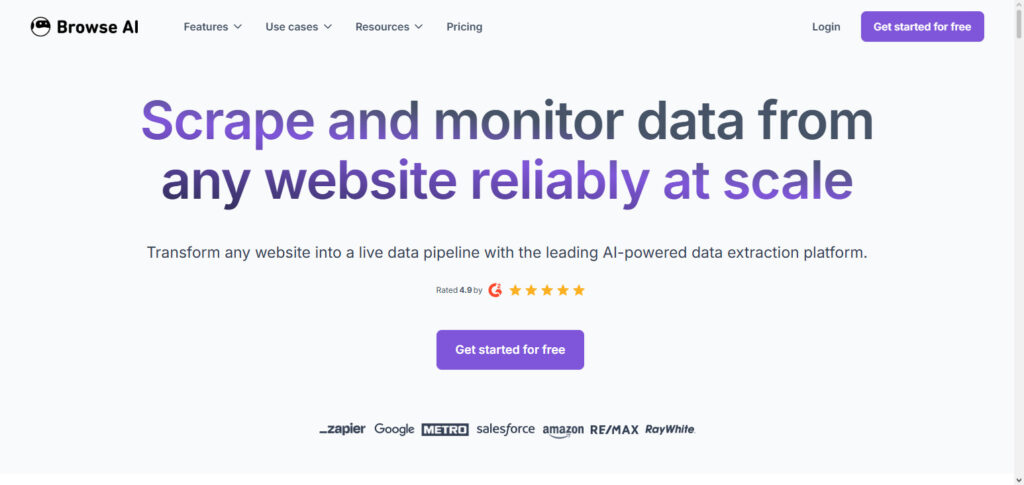
Once this bot gathers the data, it can be integrated into analysis, reporting, and process automation. Browse AI is excellent for helping financial researchers build tailor-made datasets and helps optimize decision-making by continuously offering free financial data and improving process automation.
Browse AI
| Attribute | Details |
|---|---|
| Type | No-code web scraping AI |
| Use Case | Data extraction automation |
| Data Source | Websites, online financial portals |
| Users | Researchers, analysts |
| Advantages | Disadvantages |
|---|---|
| No coding required | Depends on website structure |
| Automates data collection | Limited analytical capability |
| Easy workflow setup | Data cleaning required |
| Good for custom datasets | Not financial-specific AI |
9. Castmagic
Castmagic is an AI content intelligence tool. It turns audio recordings and transcripts into organized summaries. It is particularly useful for finance professionals because it collects the main points of audio calls, recordings, and transcripts.
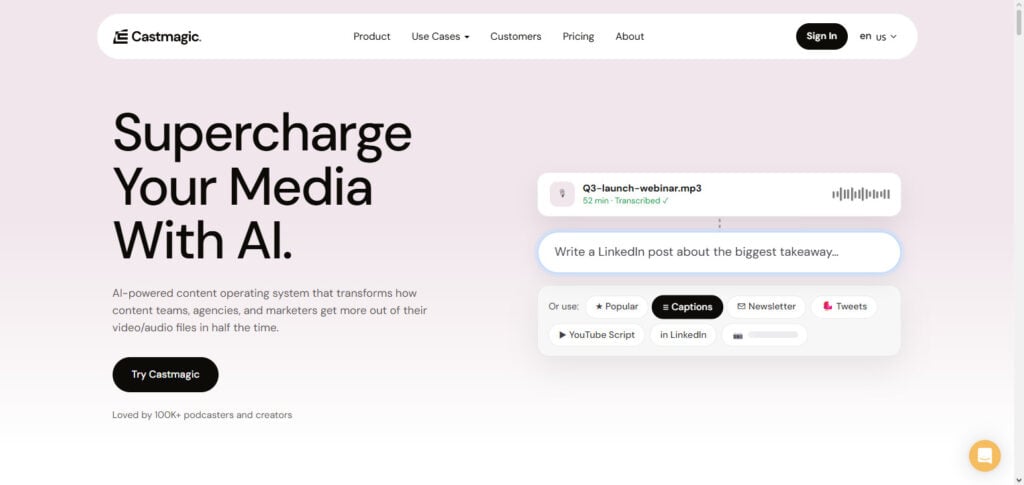
As one of the Best AI Agents for Financial Analysis Tools, Castmagic optimizes employees’ time because it does analysis for you by structuring the information you need. The tool helps analysts and investors make calls and form conclusions without the need for subjective audio analysis. Castmagic optimizes the transcript-audio gap with timely results.
Castmagic
| Attribute | Details |
|---|---|
| Type | AI content intelligence tool |
| Use Case | Audio → insights extraction |
| Data Source | Podcasts, meetings, calls |
| Users | Analysts, marketers |
| Advantages | Disadvantages |
|---|---|
| Converts audio into insights | Not a core financial analytics tool |
| Saves transcription time | Limited market forecasting |
| Useful for earnings calls | Depends on audio quality |
| Easy summarization | Not for trading decisions |
10. Claude Analyst
Claude Analyst is an AI assistant that is tailored for advanced reasoning, data analysis, and structured financial analysis. Claude Analyst offers users the ability to do investment research, future predictions, and the analysis of different possible outcomes based on available data.
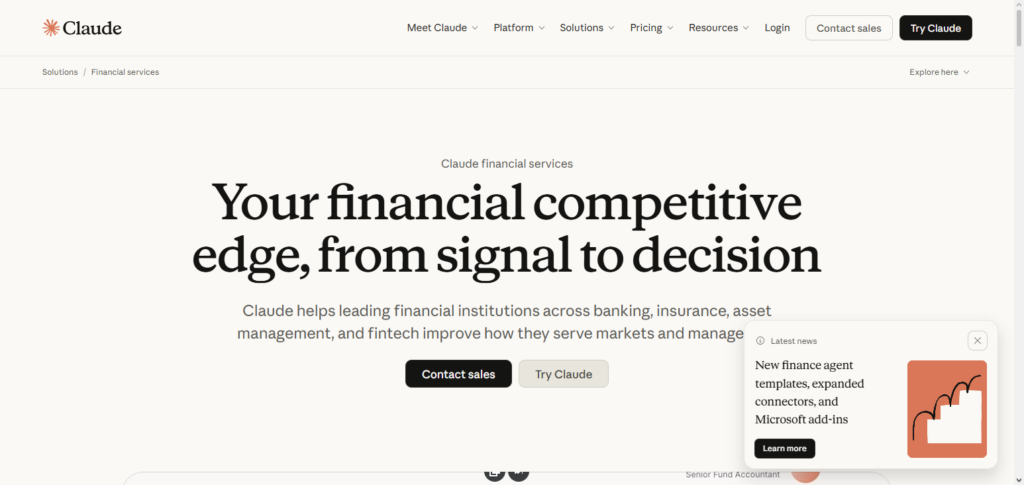
Compared to other tools in the category of Best AI Agents for Financial Analysis Tools, Claude Analyst is appreciated for his reasoning skills and his ability to think and explain financial thinking processes clearly. It serves as a financial analyst and enables users to draw their own conclusions about actual outcomes based on thorough analysis.
Claude Analyst
| Attribute | Details |
|---|---|
| Type | AI reasoning assistant |
| Use Case | Financial analysis, report interpretation |
| Data Source | User input, documents |
| Users | Analysts, researchers |
| Advantages | Disadvantages |
|---|---|
| Strong reasoning ability | No direct market data feed |
| Excellent for report analysis | Depends on user-provided data |
| Explains complex finance clearly | Not real-time trading tool |
| Flexible across tasks | Requires verification |
Conclusion
The Best AI Agents for Financial Analysis are tools that perform financial analysis in a way that is quicker, more accurate, and more data driven. Analysts, investors, and businesses harnessing the power of AI tools such as BloombergGPT 2.0, AlphaSense, Kensho, FinChat.io, and Kavout have the ability to analyze massive financial datasets with ease.
These tools minimize the need for manual research, provide an output that is more accurate, and provide insights in real time that encourage more rational investing.
There is more impact that these tools provide in the way that analytics can be predictive and research can be automated. These tools provide the user an advantage over their competition in understanding the markets and the ecosystem they operate in to provide the user a better return on investment.
FAQ
What are the Best AI Agents for Financial Analysis Tools?
The Best AI Agents for Financial Analysis Tools are AI-powered platforms like BloombergGPT 2.0, AlphaSense, Kensho, FinChat.io, Kavout, and Databox that help analyze financial data, predict market trends, and support investment decisions using machine learning and automation.
How do AI agents help in financial analysis?
AI agents process large volumes of financial data, identify patterns, generate forecasts, and provide actionable insights. This helps analysts and investors make faster, more accurate, and data-driven financial decisions with reduced manual effort.
Who can use AI financial analysis tools?
These tools are used by financial analysts, traders, portfolio managers, investment firms, researchers, and even individual retail investors who want better insights into markets and stocks.
Are AI financial analysis tools accurate?
Yes, they are highly accurate when trained on quality financial data. However, they should be used as decision-support tools rather than sole sources of investment decisions, as market conditions can change rapidly.
What is the main benefit of using AI agents in finance?
The main benefit is speed and efficiency. These tools provide real-time insights, reduce research time, improve forecasting accuracy, and help users make more informed financial decisions.