
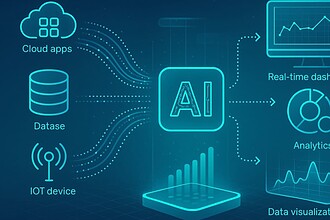


I will analyze new demands regarding proactive autopilot workers in enterprises, with a focus on the way intelligent AI systems are reshaping business operations. In terms of task anticipation, autonomous and collaborative AI agents provide the workforce with decision support and real-time AI-driven observability.
These sophisticated systems help enterprises improve their processes, provide a robust infrastructure, employ advanced business process automation, and accelerate the enterprise digital transformation process in a highly competitive business market.
What Are Proactive Autopilot Workers?
Proactive autopilot workers manage, monitor, and refine business activities using advanced AI technology and even less human intervention. Most simply automated systems perform actions when prompted, but traditional automation requires explicit instructions. Proactive autopilot workers have advanced automation capabilities.
They are able to anticipate requirements, recognize opportunities, identify defects, and apply countermeasures autonomously. They utilize real-time data, machine learning, predictive analysis, and natural language processing.
These systems reinforce functions even further, as they can organize workflows, help make decisions, validate their output, and even work together with systems in different departments within the enterprise.
Key Benefits of Proactive Autopilot Workers
More Work Gets Done – Repetitive tasks can be completed by machines, and employees can be redeployed to do important work.
Decisions Are Made More Quickly – Because the system understands the context and can analyze the underlying data, the system can make recommendations.
Lower Labor Costs – Less manual work is required, and resources are allocated more efficiently.
Higher Quality Work – Self-checking and self-correcting systems make fewer mistakes.
Proactive Detection of Issues – Systems can self-monitor and report issues.
Increased Flexibility – Systems are able to accommodate larger workloads without an increased investment in staff and systems.
Greater Operational Efficiency – Workflow connections tend to streamline and simplify inter workflow communication.
Better Security and Regulatory Compliance – Systems can self-audit to ensure regulations are being met.
Always Available – Systems can complete tasks at any time, without any interruptions.
Better Service – Systems can respond to requests in a more timely, personalized, and consistent manner.
Key Point & New Demands for Proactive Autopilot Workers in Enterprise
| Demand Area | Key Point |
|---|---|
| Autonomous Task Anticipation | AI workers predict upcoming tasks and take action before human intervention is required. |
| Self-Verification Loops | Systems continuously validate outputs, detect errors, and correct mistakes automatically. |
| Multi-Agent Collaboration | Multiple AI agents work together, sharing information and coordinating complex workflows. |
| Zero-Trust AI Security | Every AI action, access request, and data exchange is continuously authenticated and monitored. |
| Cross-Departmental Orchestration | AI connects workflows across finance, HR, operations, and IT for seamless automation. |
| Low-Latency Decision Support | Real-time analytics enable AI workers to make and recommend decisions instantly. |
| Proof-of-Solvency AI Audits | Automated auditing systems verify financial integrity, compliance, and operational transparency. |
| Composable Autopilot Architectures | Modular AI components can be combined and customized for different enterprise needs. |
| Multi-Modal Reasoning | AI processes text, images, audio, video, and structured data simultaneously for better insights. |
| AI-Driven Observability | Intelligent monitoring detects anomalies, tracks performance, and optimizes enterprise systems proactively. |
1. Autonomous Task Anticipation
Intelligent systems that translate beyond classical task automation are now an integral part of many emerging enterprises. These knowledge systems study task history, analyze the operational process, understand the available time constraints, and comprehend the corporate goals.

Thus, they are able to predict the task and assign it proactively to their human counterparts. In the transition to New Demands for Proactive Autopilot Workers in Enterprise, corporations expect AI agents to recognize workflow constraints, allocate resources, design reports, and even start the workflow automation all by themselves.
This self-initiated functionality facilitates the removal of latency in corporate productivity. As corporate multifunctional systems grow in complexity, autonomous task prediction fulfills the capability to proactively deal with operational constraints and manage the corporate environment with optimal productivity and task response time.
Features of Autonomous Task Anticipation
- Ability to predict future tasks.
- Capability to self-schedule.
- Ability to identify potential constraints on workflows.
- Ability to self-initiate workflows.
- Capability to understand demand patterns and adapt.
Autonomous Task Anticipation Benefits & Drawbacks
| Benefits | Drawbacks |
|---|---|
| Predicts tasks before they arise. | Incorrect predictions may trigger unnecessary actions. |
| Reduces manual workload. | Requires large amounts of quality data. |
| Improves operational efficiency. | Complex implementation and maintenance. |
| Prevents workflow bottlenecks. | Potential overreliance on AI decisions. |
| Enhances productivity and responsiveness. | May struggle with unexpected situations. |
2. Self‑Verification Loops
Self-Verification Loops are the autonomous task prediction systems designed to evaluate and adjust their actions and outputs before their results are presented. These systems do not solely depend on human feedback.

They can conduct internal audits, and compare the outcome with the defined goals and identify deviations and gaps. In the scope of New Demands for Proactive Autopilot Workers in Enterprise, corporations demand AI that verifies the results of financial reports, compliance documents, the feedback and interactions with customers, and even operational decisions.
This demand inherently elevates confidence in the automation of such enterprise processes. Self-verification loops not only enhance accuracy, but also safeguard the self-initiated functionality of autonomous systems in high-risk enterprise environments.
Features of Self-Verification Loops
- Ability to self-check outputs for correctness and precision.
- Capability to identify and correct errors.
- Ability to self-verify and ensure quality.
- Capability to self-correct.
- Ability to produce verification documentation.
Self-Verification Loops Benefits & Drawbacks
| Benefits | Drawbacks |
| Improves accuracy of AI outputs. | Additional processing can increase latency. |
| Reduces human review requirements. | Verification models may contain biases. |
| Detects and corrects errors automatically. | Higher computational resource usage. |
| Increases trust in automation. | Complex validation frameworks are needed. |
| Supports regulatory compliance. | Not all errors can be detected automatically. |
3. Multi‑Agent Collaboration
The term Multi-Agent Collaboration describes the union of multiple artificial intelligence employees to complete complicated tasks set by the enterprise. While each agent can focus on separate tasks (namely, tasks in data, customer, and cybersecurity, as well as tasks in the management of the workflow), they are still able to communicate and will communicate to the other agents.

In the context of New Demands for Proactive Autopilot Workers in Enterprise, companies will begin to require asynchronous AI systems from the companies to handle and manage inter-department activities. Distributed agents tackle workflow division, manage problems and control a given process in a more holistic way.
This becomes much more advantageous as it shows a clear improvement and edge in the overall scalability and capacity of the system, as well as the overall quality of decisions within the enterprise to handle operations on a massive level, while being able to consistently and effectively carry out the most critical business operations within the enterprise.
Features of Multi-Agent Collaboration
- Ability to work toward a common goal with other AI agents.
- Capability to assign tasks to agents.
- Ability to facilitate communication among AI agents.
- Capability to manage workflows across diverse functions.
- Ability to solve problems.
Multi-Agent Collaboration Benefits & Drawbacks
| Benefits | Drawbacks |
| Handles complex tasks efficiently. | Coordination between agents can be difficult. |
| Enables specialization among AI agents. | Increased system complexity. |
| Improves scalability. | Communication overhead may reduce performance. |
| Accelerates problem-solving. | Debugging multi-agent systems is challenging. |
| Supports enterprise-wide automation. | Requires robust governance mechanisms. |
4. Zero‑Trust AI Security
Zero trust AI security says that every single AI action, request or communication spells out a fundamental shift in security, and will require every single enterprise to adopt this measure.
The model of relinquishing trust on every user, device or AI agent (including those on the internal network) has especially been a cornerstone of security in the increasingly adoptive environment of New Demands for Proactive Autopilot Workers in Enterprise.

In a zero-trust security environment, there no longer are limitations on who or what can be subjected to authentication (especially those accessing sensitive data and business processes).
The cumulative effects of a zero-trust security environment greatly reduce risk and enhance the regulatory compliance posture of the enterprise. As enterprise automation continues to grow, the zero-trust security will function as the bedrock of a secure trust automation environment.
Features of Zero-Trust AI Security
- Ability to continually verify users and AI.
- Capability to enforce secure access.
- Ability to evaluate actions for potential security issues.
- Capability to keep data safe.
- Ability to follow security protocols.
Zero-Trust AI Security Benefits & Drawbacks
| Benefits | Drawbacks |
| Strengthens cybersecurity protection. | Can increase operational complexity. |
| Reduces unauthorized access risks. | Higher implementation costs. |
| Improves regulatory compliance. | Additional authentication may affect speed. |
| Enhances data protection. | Requires continuous monitoring. |
| Supports secure AI deployment. | User experience may become more restrictive. |
5. Cross‑Departmental Orchestration
Cross-Departmental Orchestration allows the collection of AI workers across most business functions, including finance, human resources, operations, sales, and customer service. Instead of acting in isolation, intelligent systems connect and integrate departmental workflows.

In answer to the New Demands for Proactive Autopilot Workers in Enterprise, companies are employing fully automated systems to eliminate information silos and to provide for a more effective and efficient organization. AI-driven orchestration empowers and increases the productivity of the enterprise.
It smooths the flow of tasks and requests in addition to the movement of data and enterprise resources. This provides the organization greater operational and strategic insight and increases the speed of the decisions that the enterprise makes. Cross-departmental orchestration and intelligent workflow systems allow an organization to pursue its strategic objectives more effectively.
Features of Cross-Departmental Orchestration
- Ability to interconnect different department workflows.
- Capability to remove communication barriers.
- Ability to automate departmental workflows.
- Capability to provide an overview of all workflows.
- Ability to optimize workflows.
Cross-Departmental Orchestration Benefits & Drawbacks
| Benefits | Drawbacks |
| Eliminates organizational silos. | Integration across systems can be difficult. |
| Improves workflow coordination. | Legacy systems may limit compatibility. |
| Enhances enterprise visibility. | Requires standardized data structures. |
| Accelerates business processes. | Organizational resistance may occur. |
| Increases operational efficiency. | Complex governance requirements. |
6. Low‑Latency Decision Support
Low-Latency Decision Support systems are designed to assist enterprise users in the timely evaluation of business conditions and the formulation of responsive decisions. The constant stream of data that is evaluated and refined by an enterprise’s collection of AI systems provides the enterprise with the operational/strategic guidance needed to cover the full spectrum of decisions, including the most immediate and time-sensitive.

The New Demands for Proactive Autopilot Workers in Enterprise deals with the critical need for rapid and responsive business decisions across a vast array of business functions. Low-latency services provide the information and intelligence needed to operate and optimize the enterprise’s supply chain, customer operations, and cyber/digital/financial business functions in a timely and effective manner.
Real-time decision-making improves business competitiveness and reduces business risk, while providing the enterprise with an intelligence capability that is highly valued by the enterprise’s customer base.
Features of Low-Latency Decision Support
- Ability to provide immediate insights and recommendations.
- Capability to analyze large volumes of data instantly.
- Ability to keep up with changes in the enterprise.
- Capability to improve the quality of decisions with full analytics.
- Cuts down delay for critical business operations.
Low-Latency Decision Support Benefits & Drawbacks
| Benefits | Drawbacks |
| Enables real-time decision-making. | Requires powerful infrastructure. |
| Improves responsiveness to market changes. | High operational costs. |
| Enhances customer experiences. | Data quality issues impact accuracy. |
| Reduces delays in critical processes. | Real-time processing can be resource-intensive. |
| Supports competitive advantage. | Increased system complexity. |
7. Proof‑of‑Solvency AI Audits
Proof-of-Solvency AI Audits utilize Greenfield’s cutting-edge automation to ensure financial integrity, asset availability, and compliance throughout enterprise systems. These AI-based audits operate in real-time and examine transactional, financial, and operational records to maintain a culture of accountability and transparency.

With the proliferation of the New Demands for Proactive Autopilot Workers in the Enterprise, organizations are on the lookout for automated solutions that validate business performance with minimal manual input and intervention.
Proof-of-solvency systems offer validated outputs of the solvency of an organization, resulting in increased stakeholder confidence and reduced time and cost of traditional auditing. This capability supports the organization’s compliance with regulations and business practice and enables the organization to operate in volatile business environments while maintaining financial integrity.
Features of Proof-of-Solvency AI Audits
- Checks financial assets and liabilities on an ongoing basis.
- Automates auditing and compliance steps.
- Issues clear financial validation audit reports.
- Finds errors and discrepancies.
- Monitors financial position on an ongoing basis.
Proof-of-Solvency AI Audits Benefits & Drawbacks
| Benefits | Drawbacks |
| Improves financial transparency. | Complex audit models may be difficult to validate. |
| Reduces manual auditing costs. | Regulatory acceptance may vary. |
| Detects anomalies quickly. | Dependence on accurate financial data. |
| Enhances stakeholder trust. | Implementation can be expensive. |
| Supports continuous compliance monitoring. | Requires ongoing model maintenance. |
8. Composable Autopilot Architectures
Composable Autopilot Architectures empower enterprises to create flexible AI ecosystems from modular and reusable enterprise components.

Rather than being forced to utilize a single large and rigid system, enterprises can combine specialized AIs to meet specific operational needs. As New Demands for Proactive Autopilot Workers in Enterprise continue to evolve, flexible, scalable systems that can adapt to, and integrate with, previously implemented technologies are critical.
Composable systems are flexible to the customer’s needs and simplify the integration of new technologies. The improved flexibility systems design and simplification of integration supports enterprise innovation while maintaining viable business automated processes.
Features Of Composable Autopilot Architectures
- Employs modular AI for adaptive deployments.
- Makes rapid implementation easy.
- Enhances the customization of business workflows.
- Permits modular AI upgrades.
- Improves adaptability and scalability.
Composable Autopilot Architectures Benefits & Drawbacks
| Benefits | Drawbacks |
| Highly flexible and customizable. | Integration challenges between modules. |
| Easier system upgrades. | Increased architectural complexity. |
| Supports rapid innovation. | Requires strong interoperability standards. |
| Scales efficiently with business growth. | Governance can become difficult. |
| Reduces vendor lock-in risks. | More testing is needed across components. |
9.Multi‑Modal Reasoning
Multi-Modal Reasoning is the ability of an AI worker to comprehend and analyze data across various formats such as text, images, audio, video and structured data. It offers the AI system a contextual edge as it is able to integrate and analyze data from many formats.

Referring to New Demands for Proactive Autopilot Workers in Enterprise, the complexity of the information that employees handle is enormous, and organizations anticipate that intelligent agents will handle and analyze information of this complexity.
For instance, AI may analyze and integrate customer emails along with recorded customer interactions, as well as verbal presentation slide decks and operational data. Improved comprehension of challenges translates to better and high-level automated solutions. For advanced enterprise intelligence and optimal workflow automation, Multi-Modal Reasoning is a must.
Features Of Multi-Modal Reasoning
- Scan and analyze text and recordboth audio and video simultaneously.
- Synthesizes varying data for enriched insight.
- Boosts understanding of complex and multi-faceted situations.
- Assists analysts in both advanced research and the execution of decisions.
- Improves the precision of findings through a multi-faceted data scan and research.
Multi-Modal Reasoning Benefits & Drawbacks
| Benefits | Drawbacks |
| Improves contextual understanding. | Requires extensive computational resources. |
| Processes diverse data types simultaneously. | Data integration can be challenging. |
| Enhances decision quality. | Higher model training costs. |
| Supports advanced analytics. | Increased system complexity. |
| Delivers richer business insights. | Risk of inconsistent interpretation across modalities. |
10. AI‑Driven Observability
AI-Driven Observability offers automated continuous assessment of systems, applications, networks, and workflow across the enterprises. Traditional monitoring tools rely on humans to observe system performance.
In contrast, AI-powered observability provides a level of proactivity where systems will signal and/or take corrective actions on anticipated system availability issues that have not even occurred yet.

In response to New Demands for Proactive Autopilot Workers in Enterprise, AI observability provides the visibility needed to automatically evaluate and respond to performance issues, operational inefficiencies, security threats, and infrastructure issues.
It not only improves the performance of the applications, but also reduces the downtime and optimizes resource utilization. In a fast-paced digital world, this monitoring lends efficiency and adaptability to enterprise operations.
Features Of AI-Driven Observability
- Conducts unattended surveillance on systems and the infrastructure, apps, and networks.
- Automatically identifies exceptions and degradation in performance.
- Foresees disruptions in system operations.
- Monitors business operations and provides insights in a time-bound manner.
- Proposes interventions for system efficiency.
AI-Driven Observability Benefits & Drawbacks
| Benefits | Drawbacks |
| Detects issues before failures occur. | Generates large volumes of monitoring data. |
| Reduces downtime and disruptions. | Can produce false-positive alerts. |
| Improves system performance. | Requires continuous tuning and optimization. |
| Provides real-time operational insights. | Infrastructure costs may increase. |
| Enables proactive maintenance strategies. | Skilled personnel may still be required for oversight. |
Conclusion
The New Demands for Proactive Autopilot Workers in Enterprise are influencing the intersection of automation, productivity, and decision-making within organizations. The modern enterprise focuses on the need for intelligent workers, not AI systems that simply perform a series of predetermined actions.
Intelligent workers must be able to anticipate needs and collaborate across divisions, audit their own outputs, and act in a secured fashion across multi-faceted domains.
Increasingly, organizations engaging in digital transformation efforts will find that their enterprise systems must be capable of multi-modal reasoning, low-latency decision support, AI-driven observability, and flexible systems integration.
The continued evolution of AI will find autopilot workers at the center of many organizations focused on the imperative of operational improvement, cost and error reduction, and competitive differentiation.
FAQ
What are proactive autopilot workers in enterprise environments?
Proactive autopilot workers are AI-powered systems that can independently manage business tasks, anticipate operational needs, make decisions, and execute workflows with minimal human intervention. Unlike traditional automation, they actively identify opportunities, risks, and required actions before being instructed.
Why are enterprises demanding more advanced AI autopilot workers?
Enterprises are facing increasing operational complexity, large volumes of data, and the need for faster decision-making. Advanced autopilot workers help improve efficiency, reduce manual workloads, enhance accuracy, and support business growth through intelligent automation.
What is Autonomous Task Anticipation?
Autonomous Task Anticipation is the ability of AI systems to predict upcoming tasks and initiate actions before requests are made. By analyzing historical data, schedules, and workflow patterns, AI workers can proactively support business operations.
How do Self-Verification Loops improve AI reliability?
Self-Verification Loops enable AI systems to review and validate their own outputs before execution. This reduces errors, improves accuracy, and increases trust in automated processes by ensuring that tasks meet predefined standards and business rules.
What role does Multi-Agent Collaboration play in enterprises?
Multi-Agent Collaboration allows multiple AI systems to work together on complex tasks. Different agents can specialize in specific functions while sharing information and coordinating actions to achieve enterprise goals more efficiently.