



In this article, we will review the best vendor risk management software of 2026. With the growing reliance on third-party providers, it is important for organizations to manage risks related to supplier ecosystems.
These software programs provide automation and continuous monitoring to help organizations mitigate a variety of risks. Furthermore, these programs assist organizations in meeting compliance requirements. In this article, we review leading vendor risk management software. Based on our review, organizations can select the software that best meets their risk management and compliance requirements.
What Is Vendor Risk Management Software?
Vendor Risk Management Software allows companies to assess the risks posed by outsourcing to other companies. The software automates the vendor application process and the completion of security questionnaires.
The software helps assess risks by continuously monitoring the security and compliance of vendors. In addition, the software helps evaluate risks associated with the loss of sensitive data and intellectual property by vendor companies.
The software helps companies assess risks involved by a vendor’s failure to comply with data privacy laws. The software helps companies collect documentation to prove that due diligence has been undertaken in the evaluation of vendor companies. The software can help provide transparency to audit agencies by generating audit reports.
Why Businesses Need Vendor Risk Management Software in 2026
Regulatory Requirements
Your business will have to demonstrate that its vendors satisfy requirements set by various regulations (SOC 2, ISO 27001, HIPAA, GDPR, ESG, etc.)
Cybersecurity
You can use services such as UpGuard, BitSight, or SecurityScorecard to track real time breaches and leaks.
Supply Chain
Prewave and Sphera offer real time alerts for risks in the supply chain, including conflicts, ESG, and sustainability.
Other Risks
There are services that will also help your business quickly prepare for an audit and provide other automation that improves business processes and speeds up vendor onboarding.
Improvement
Process improvement and automation will allow your team to focus on other tasks and utilize its time and effort more productively.
Key Points
| Software | Best For | Key Strengths |
|---|---|---|
| Hyperproof | Audit-ready reporting | Evidence-to-decision traceability, coverage gap reporting |
| Vendict | Procurement & security teams | Traceable evidence collection tied to questionnaires |
| Drata | Ease of use | Automated security questionnaires + monitoring |
| Riskonnect | Enterprise workflows | Integrated suite with remediation tracking |
| Whistic | Trust documentation sharing | Guided vendor reviews, evidence exchange |
| UpGuard | Ongoing monitoring | Security ratings, data leak detection |
| BitSight | Continuous monitoring | Portfolio risk triage, evidence capture |
| SecurityScorecard | Cyber risk visibility | Third-party monitoring, scoring framework |
| Prewave | Supply-chain monitoring | AI-driven real-time disruption & ESG tracking |
| Sphera (riskmethods) | Broad supply-chain risk | Enterprise resilience, compliance, ESG |
1. Hyperproof
Hyperproof is a company founded in 2018 that specializes in helping their clients with compliance and vendor risk management. Hyperproof charges subscriptions and, as is typical with an enterprise client, will scale their services to meet the client’s needs. Pricing typically starts at mid-tier SaaS rates.
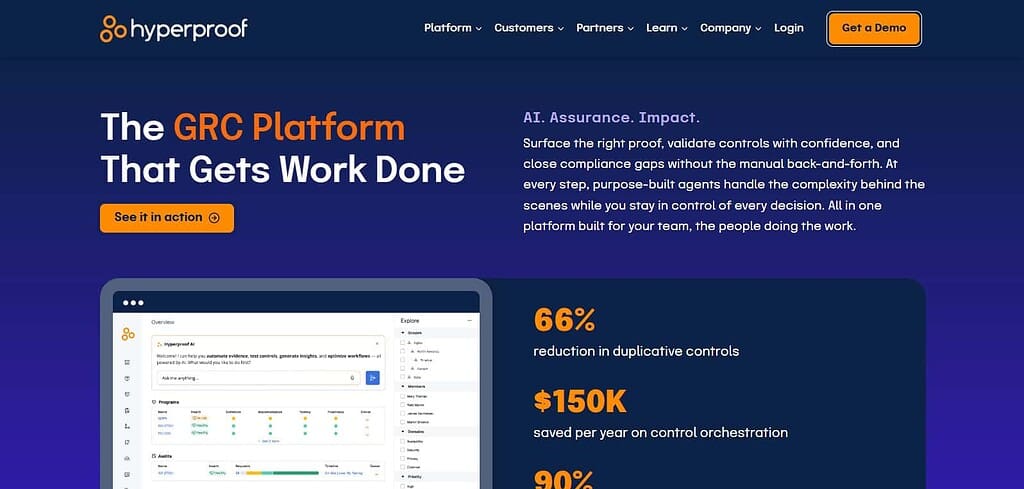
Hyperproof’s automation suites help their clients collect the evidence needed to be compliant and reduces the amount of work required during audits. Hyperproof helps clients with compliance for SOC 2 and ISO 27001, as well as other compliance needs.
Audit readiness is one of the stronger Suites that Hyperproof offers. Automation helps alleviate the burdens of compliance, and Hyperproof helps their clients achieve a high level of readiness. Hyperproof helps their clients gather the evidence they need and prepares the case for remediation for auditors and other stakeholders.
Hyperproof Key Features
- Automates collection of evidence and Builds mapping of controls
- SOC 2, ISO 27001 and other frameworks
- Reporting, traceability, and audit readiness
- Integrations
- Reduces time to complete task
Hyperproof Pros & Cons
Pros
- Hyperproof provides thorough audit-ready reports.
- The software automates collecting Evidences.
- Hyperproof assists with numerous compliance needs, including SOC 2, ISO, GDPR and HIPAA.
- The software can integrate with several cloud and ticketing applications.
- Regulatory officials can trace evidence with Hyperproof.
Cons
- SMEs can find Hyperproof to be cost-prohibitive.
- The software can be complex for teams less than 10 members.
- Hyperproof is more advantageous for compliance needs as opposed to the Supply Chain.
- The software is rather complicated, and therefore, usability requires training.
- Hyperproof does not assist with ESG requirements.
2. Vendict
Founded in 2020, Vendict offers an AI-based platform to automate the generation of vendor risk management questionnaires. Questionnaires can be purchased for a SaaS fee based on the number of vendors and questionnaires required. Thus, the cost is low enough to be attractive to SMEs and large enough to be purchased by large enterprises.
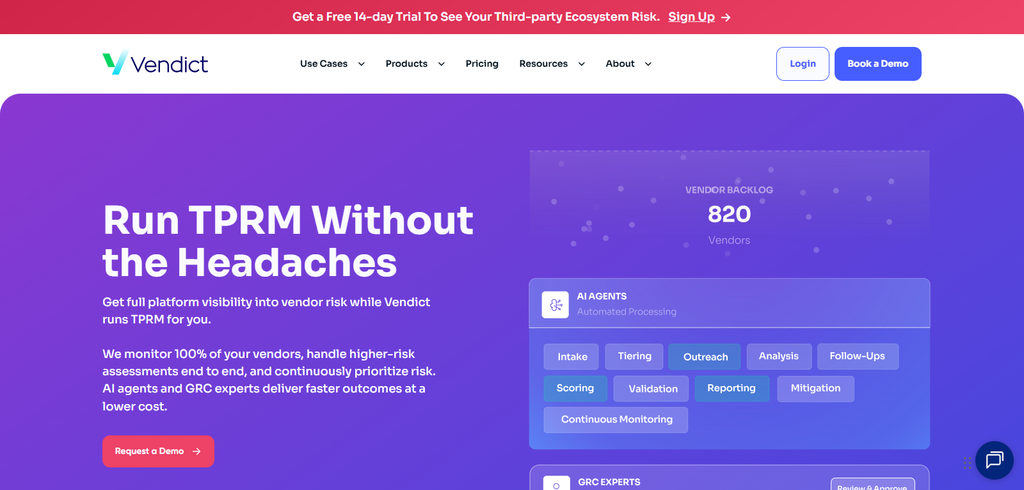
Vendict’s platform offers automation at multiple levels to assist the procurement process. Positive feedback has been provided for the platform in assisting procurement to conform to various compliance frameworks. For the vendor risk management process,
Vendict primarily helps procurement with respect to vendor onboarding and security with respect to risk management. Evidence required to support frameworks and compliance can be directly linked to vendor questionnaires. This facilitates a streamlined process for the procurement and security divisions of an organization.
Vendict Key Features
- Automates questions for vendors
- Integrates with procure to pay
- Automates evidence
- SOC 2, ISO, and others
- Rapid vendor onboarding
- Automation for procure to pay
Vendict Pros & Cons
Pros
- Vendict utilizes Artificial Intelligence to simplify vendor questionnaires.
- The software provides Secure Procure to Vendor process.
- Evidential requirements are directly linked to workflows.
- Vendict offers SaaS at affordable rates.
Cons
- Vendict does not provide continuous monitoring.
- The software focuses on vendor questionnaires.
- Enterprise integrations may not be as advanced as other software.
- Compliance needs are supported less compared to Hyperproof.
- Costs to employ Vendict’s services are directly tied to the number of vendors supported.
3. Drata
Drata is known for its intuitive software for managing compliance and vendor risk, which launched in 2020. Drata has subscription-based pricing and, as such, is considerate of the needs of growing companies. The core of Drata’s product is automation.
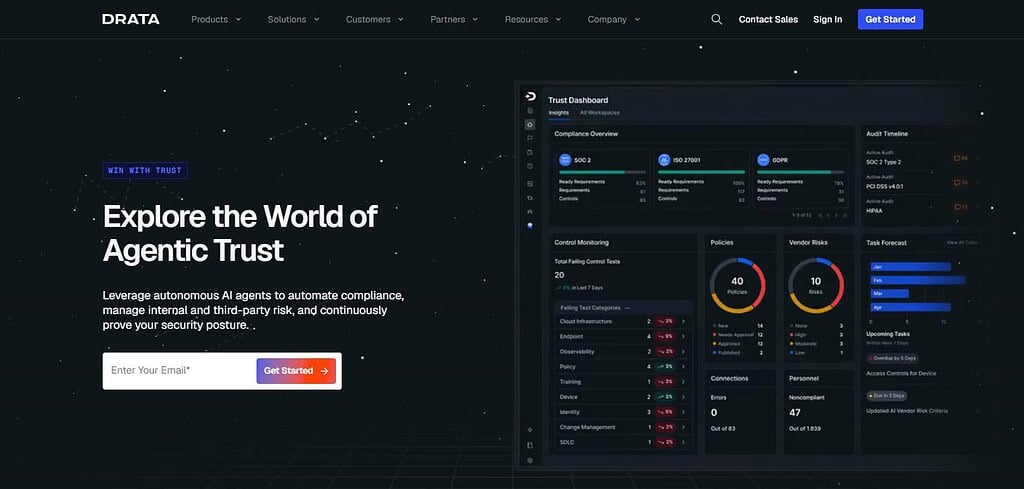
Drata offers automation for a variety of control and evidence needs. Drata supports a range of compliance frameworks and helps companies operating in various industries and sectors with risk management and compliance needs.
Drata’s software is robust enough to allow its users to not only manage their company’s compliance needs but also assess their vendors’ risk management and compliance needs. Drata’s automation limits the need for its users to perform manual tasks. Overall, Drata is a great option for companies seeking a comprehensive, yet easy to use platform.
Drata Key Features
- Automates vendor questionnaires and evidence collection
- Support for SOC 2, ISO 27001, HIPAA and GDPR
- User interface suitable for all customers
- Real time view of compliance
Drata Pros & Cons
Pros
- High-level of automation.
- User interface is simple to use.
- Supports continuous monitoring of controls.
- Support for a variety of frameworks (SOC 2, ISO, HIPAA, GDPR, and others).
- Appropriate for organizations of all sizes.
Cons
- The vendor risk management module is less developed.
- Support for the supply chain is lacking.
- Focused on IT/Security related vendors only.
4. Riskonnect
Riskonnect has been in business since 2007 and offers enterprise ERM solutions with vendor risk solutions. Pricing is for the enterprise level, with quotes being the only source of cost information. Automation and workflows cover the vendor risk management lifecycle.
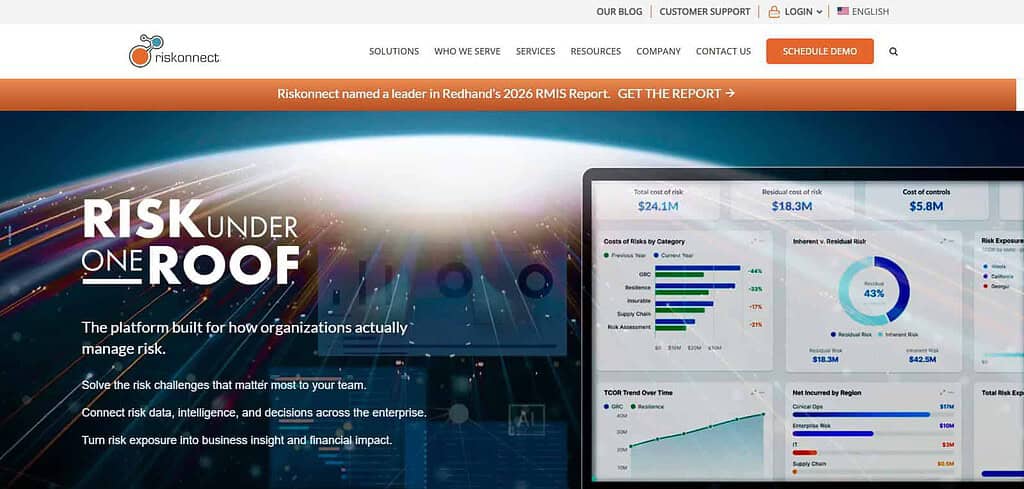
Riskonnect supports a variety of regulations and compliance standards (i.e. ISO and SOC) and helps users interpret and respond to compliance needs. Their strength in vendor risk management is integration with other lines of business.
Riskonnect is well-positioned to provide a single, integrated solution to manage business risks. Vendor risks are managed in the context of an organization’s total business operations risk and compliance. Riskonnect’s solution is best for large and complex organizations to gain integrated oversight of business risks.
Riskonnect Key Features
- Modules for vendor management within a large enterprise risk management solution
- Quote based pricing for large customers
- Automates risk and remediation workflows
- Supports compliance for SOC, ISO and industry verticals
Riskonnect Pros & Cons
Pros
- Comprehensive enterprise risk management solution.
- Integrates remediation activities with risk management.
- Support a variety of compliance areas.
- Appropriate for large/enterprise organizations.
Cons
- Complex to implement.
- May not be cost effective for smaller organizations.
- Over-arching solution and may not be required for smaller organizations.
- Less automation than Drata
- Needs specific risk teams
5. Whistic
Whistic is a vendor security trust documentation company founded in 2015. Similar to other SaaS companies, Whistic charges an annual subscription based on the number of vendors and the level of trust documentation required to be shared.
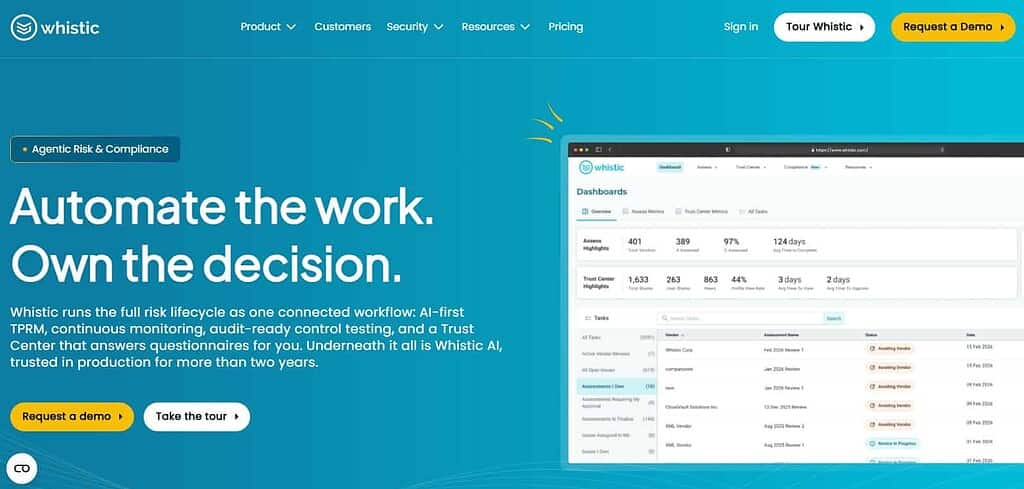
Whistic’s main automation feature is the ability for customers to send vendor assessment questionnaires (VA) to vendors, and capture and/or upload security control evidence. Whistic offers customers the ability to add policies and controls to satisfy the requirements of the SOC 2, ISO, and GDPR.
Whistic’s Trust Catalog allows vendors to upload and share their security documentation, and therefore helps to eliminate the backlog of security assessments. Whistic is considered a mid-market company and is focused on building a larger customer base in the vendor trust and transparency space.
Whistic Key Features
- Catalog of vendor assurance statements
- Automates assessment and screening of vendors
- Support for SOC 2, ISO and GDPR
- SaaS model with scalable pricing
- Focus on transparency and trust
Whistic Pros & Cons
Pros
- Trust Catalog for automated document management
- Vendor review tool
- Transparent vendor assessment tool
- SaaS model with different plan levels
- Alignment to regulatory frameworks and standards
Cons
- Limited automation
- No continuous monitoring
- Focus on trust and documentation
- Possible lack of advanced business processes
- Unsuitable for advanced supply chain management
6. UpGuard
Founded in 2012, UpGuard provides both continuous monitoring and vendor risk ratings. Pricing is based on subscription and broadly tied to the size of the client’s risk management program, making it accessible to small- and large-sized businesses.
Automation enables real-time monitoring of risks introduced by vendors, including exposure of confidential data and violation of regulations. Among others, UpGuard supports frameworks and regulations including SOC 2, ISO, HIPAA and GDPR. Compared to other vendors in this space,
UpGuard’s strength is in detecting risks and vulnerabilities of its clients’ and vendors’ ecosystem and providing real-time alerts, as opposed to relying on vendors to fill out questionnaires. This make the solution more appropriate for organizations that are focused on active risk management, as opposed to relying on stale assessments.
UpGuard Key Features
- Continuous monitoring of vendor security
- Alerts for security incidents and breaches
- Support for SOC 2, ISO and HIPAA
- Pricing based on expected portfolio size
- High automation with workflows for automatic remediation
UpGuard Pros & Cons
Pros
- Continuous monitoring of vendor risk
- Real time notifications of threats
- Guidance for compliance
- Different plan levels
- Automation for case-to-case prioritization
Cons
- Focus on cyber risk
- Inadequate integration for procurement processes
- Higher pricing for larger risk/vendor management
- Less focus on ESG risks
- More complex for SMEs
7. BitSight
BitSight was founded in 2011 and was the first company to offer security ratings for vendor risk management. The company focuses on the enterprise market and sets high quote-based prices based on the value it believes it offers. Automation at BitSight is high. BitSight monitors vendors continuously, and, along with network vulnerabilities, tracks a vendor’s overall risk posture.
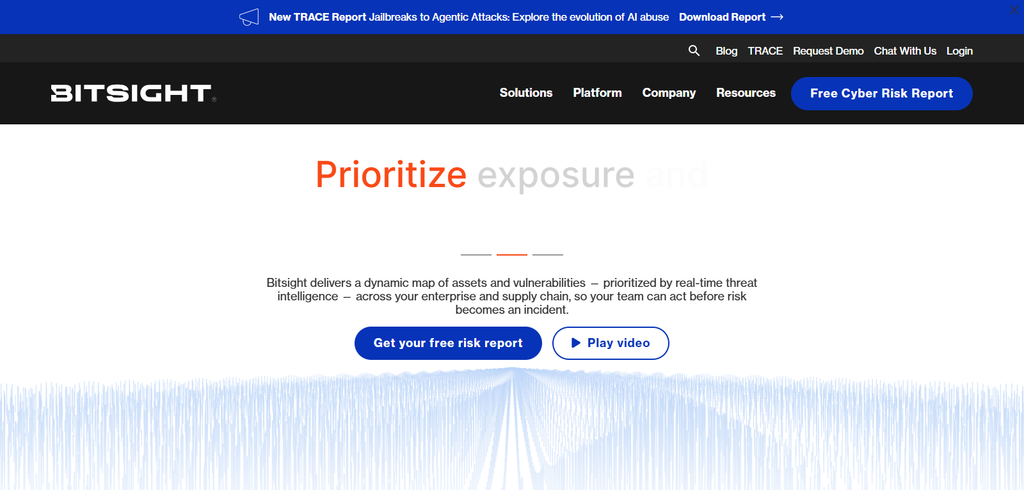
BitSight supports reporting on vendor risk management with type II SOC 2 reports, ISO, and GDPR. With its rating system, vendors can be triaged for risk and resources prioritized for remediation. Large and medium-sized companies use BitSight to monitor risk with large, vendor-diverse portfolios.
BitSight Key Features
- Security ratings for vendor risk
- Real time threat and vulnerability monitoring
- SOC 2, GDPR and other frameworks support
- Enterprise price quotations
- Automated risk analysis for portfolio
BitSight Pros & Cons
Pros
- Security ratings and ratings for organizations and platforms
- Continuous threat intelligence
- Integration with various compliance frameworks
- Flexible to large vendor/customer threat environments
- Automation for case prioritization
Cons
- Premium pricing
- Focused on cyber threat intelligence
- Limited procurement integration
- ESG threats coverage
- Complex for SMEs
8. SecurityScorecard
SecurityScorecard was started in 2013 and offers services to assess third party risk and vendors. Prices are determined by the number of vendors and level of access requested. Automation allows for continuous evaluation of risks and vendor workflows. Frameworks supported are SOC 2, ISO, HIPAA and GDPR. SecurityScorecard has a proprietary scoring mechanism to assess vendors.
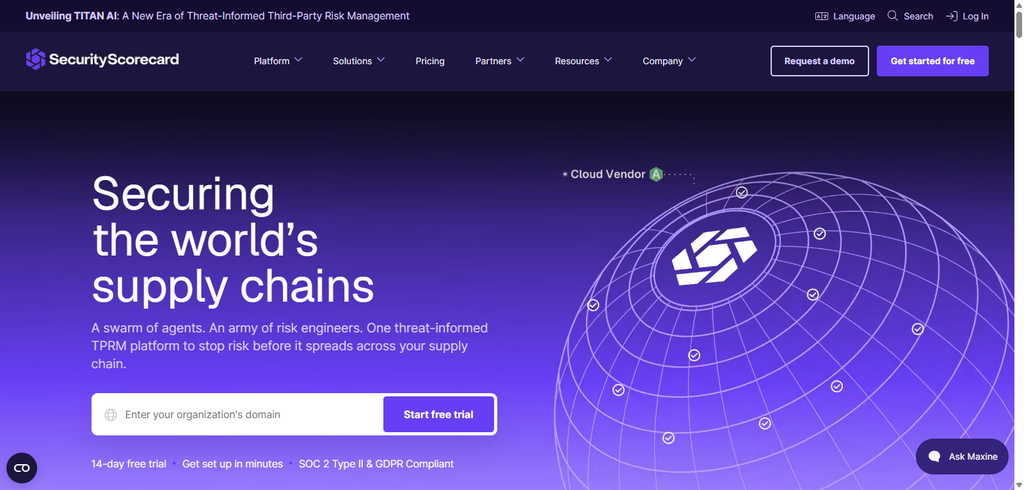
Its strength has helped in risk assessment and vendor evaluation. It is used across various industries. The product helps in risk and vendor evaluation at scale and is appropriate for large corporations and enterprises.
Security Scorecard Key Features
- Risk scoring for vendors
- Real time risk monitoring and automated remediation
- SOC 2, GDPR and other frameworks support
- Subscription pricing based on depth of vendor coverage
- Automated vendor risk monitoring
SecurityScorecard Pros & Cons
Pros
- Strong cyber risk scoring framework
- Continuous monitoring and remediation
- Broad compliance support
- Scalable subscription pricing
- High automation for vendor oversight
Cons
- Focused mainly on cyber posture
- Limited supply‑chain visibility
- May require integrations for procurement workflows
- Pricing scales with vendor count
- Less emphasis on ESG compliance
9. Prewave
Founded in 2017, Prewave leverages AI technology to analyze supply chains for risks and disruptions. Its clientele is primarily made up of large and/or well-established businesses and organizations. Rates are quoted on a case-by-case basis. Prewave’s main competitive edge is its AI technology and automation. This allows the company to proactively monitor and identify risks within supply chains. These risks may be a result of social or environmental factors, or geopolitical situations.
The technology has the potential to continuously monitor and identify risks in a supply chain. Prewave is most beneficial to companies that have highly intricate supply chains and wish to have proactive risk management systems in place.
Prewave Key Features
- Supply chain risk monitoring
- Real time risk intelligence
- ESG and industry regulations support
- Enterprise pricing
- Supply chain risk monitoring
Prewave Pros & Cons
Pros
- AI‑driven supply‑chain monitoring
- Real‑time ESG and geopolitical alerts
- Strong compliance with ESG standards
- Enterprise‑grade analytics
- High automation for global supply chains
Cons
- Quote‑based pricing is high
- Focused mainly on supply‑chain risks
- May lack deep IT compliance features
- Complex for SMEs
- Requires dedicated risk teams
10. Sphera (riskmethods)
Sphera, with its acquisition of riskmethods, has built an end-to-end enterprise risk and resilience solution. Although Sphera quotes enterprise customers based on specific requirements, it is believed that the company sets a premium on its solutions. The automation in Sphera’s solutions is moderate to high. It offers workflow capabilities to monitor supply chain risk, compliance, and ESG.
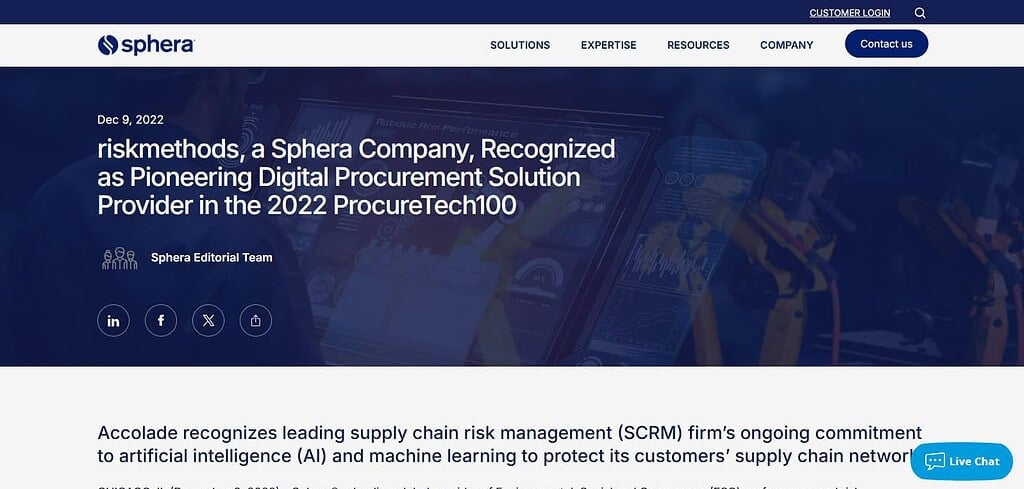
Sphera is able to integrate with various third-party solutions, and thus, is able to offer end-to-end solutions to monitor vendor, first-party, and third-party risks. The vendor risk management solution offered by Sphera is ideal for large enterprises. The solution enables large enterprises to monitor their vendor risks as part of their overall enterprise risk and compliance program.
RiskMethods (sphera) Key Features
- Supply chain and vendor risk suite
- Enterprise pricing
- ESG and other frameworks support
- Automated workflows for supply chain and risk management
- Resilience framework automation
Sphera (riskmethods) Pros & Cons
Pros
- Integrated enterprise resilience suite
- Broad compliance support (ISO, ESG)
- Strong supply‑chain monitoring
- Scalable for large organizations
- Moderate to high automation
Cons
- Quote‑based pricing is premium
- Complex implementation process
- Overkill for smaller companies
- Moderate automation compared to Drata/UpGuard
- Requires dedicated compliance teams
Conclusion
The vendor risk management software market for 2026 shows the integration of technology to automate vendor risk management processes. Hyperproof and Vendict are great options for automating vendor risk management processes and procure-to-pay tasks.
Drata offers an easy to use solution for small and growing businesses. Riskonnect and Sphera, with their focus on enterprise risk management, help clients automate and integrate vendor risk management processes.
Other mentioned vendors help clients gain real-time visibility, focus on supply chain trust and transparency. Clients have the ability to automate their vendor risk management process, gain visibility into their vendor risk management process and integrate it with other business processes.
FAQ
What is vendor risk management software?
Vendor risk management software helps organizations assess, monitor, and mitigate risks associated with third‑party vendors. It automates questionnaires, compliance checks, and continuous monitoring to ensure vendors meet security and regulatory standards.
Which industries use these platforms?
Industries like finance, healthcare, technology, and manufacturing rely heavily on vendor risk tools. Platforms such as Hyperproof and Riskonnect are popular in regulated sectors, while Prewave and Sphera are widely used in supply‑chain‑heavy industries.
How is pricing structured?
Pricing varies: SaaS platforms like Drata, Vendict, and Whistic offer tiered subscriptions, while enterprise suites like Riskonnect, BitSight, and Sphera use quote‑based pricing depending on vendor count and monitoring depth.