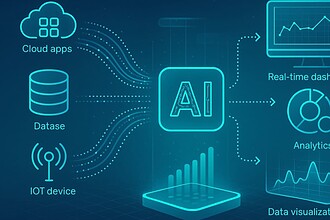


This article will cover the top open-source AI agent frameworks that assist developers to easily create smart, self-sufficient, and scalable AI applications. AI agent, automation workflow, multi-agent, and LLM integration features are a few inherent capabilities offered by these frameworks.
We will analyze the frameworks’ key features, pros, and cons, and the applicable scenarios to determine which frameworks can best support different AI development requirements.
What is Open-Source AI Agent Frameworks?
Open-source AI agent frameworks are publicly available software development frameworks that contain the tools, libraries, and coded structures that allow for the development of intelligent, AI-based agents. Such frameworks give AI agents the capability to comprehend tasks, make decisions, employ external tools, access data, and automate processes with little human oversight.
Compared to closed AI platforms, open-source frameworks supply flexibility, customization, and transparency.
Consequently, developers can change the designed system to suit their requirements. These frameworks are built to be compatible with the latest advancing AI capabilities, such as large language models (LLMs), and retrieval-augmented generation (RAG), as well as any collaborative multi-agent and workflow automation technologies.
Why Choose Open-Source AI Agent Frameworks in 2026?
Increased Customization and Flexibility: AI agents can be designed for specific businesses, industries, and use cases by tailoring open-source AI agent frameworks.
Affordable AI Development: Open-source AI agent frameworks make AI development considerably less expensive for businesses because development resources are free, meaning that many AI frameworks can be built with little or no cost.
More Control over Data: Organizations can run AI systems on their own premises and can open-source AI agent frameworks, resulting in better data privacy and security control.
Sophisticated Multi-Agent Systems: More advanced multi-agent systems can be designed by open-source AI frameworks, resulting in sophisticated automation and even advanced research and problem-solving.
Great Community Engagement and Development: Community involvement in open-source AI agent frameworks creates new development opportunities by adding new features, and fixing existing problems and dependencies.
Flexible Integrations: Open-source AI agent frameworks can be easily integrated with other AI models, APIs, systems, and anything necessary to help create effective and large scale AI solutions.
Accelerated AI Development: Development of Automated systems and AI assistants, including enterprise solutions, can be rapidly developed due to the presence of reusable components, extensive libraries, and multiple workflows.
Freedom of Choice: Without dependence on a certain vendor, open-source frameworks enable organizations to select the models, systems, and ways to deploy.
Increased Use in Corporations: In 2026, open-source AI agent frameworks are used more by corporations for developing automated systems, business applications, and intelligent workflows.
Future-Ready AI Development: These frameworks will be beneficial to upcoming AI developments due to their support of new trends like autonomous agents, RAG systems, AI automation, and collaborative AI ecosystems.
Benefits of Using Open-Source AI Agent Frameworks
Reduced Costs: Open source AI agent frameworks allow development of AI solutions with community-supported frameworks, source code, and libraries, lowering the cost of development.
Greater Customization: Specialized AI Agents and workflows can be designed and built when customizable frameworks are modified to meet specific business requirements.
Improved Data Security and Privacy: Hosting and managing your AI systems in-house promotes better protection of your sensitive data, especially if there is a reliance on third-party solutions.
Accelerated Development of AI: Frameworks that include components, templates, and many integrations speed up the development of AI agents and chatbots solutions.
Innovation through Community Contribution: Active and large open source communities ensure continuous improvements of frameworks through the addition of features, bug fixes, and adoption of new AI-supported technologies.
Collaboration of Multiple Agents: Advanced automation and the solution of complex problems is possible with frameworks that support interaction of multiple AI Agents.
Model Flexibility: Developments using open source frameworks are flexible, as these frameworks allow the integration of varied LLMs, AI tools, databases, APIs, and many more.
Freedom from Vendor Dependence: Organizations are not limited to a single vendor, as they are free to select their desired AI models and choose their environments and methods of Hosting and deploying.
Enterprise Ready and Scalable: The open source AI Frameworks are easily adaptable and extensible to support requirements for large scale AI in corporate and enterprise environments.
Fostering AI Solutions and Improvement: Experimentation with the development of AI solutions and infrastructure is easily done and actively encouraged, as the community is engaged to make and even greater improvements.
Best Open-Source AI Agent Frameworks & Key Points
- LangChain – Popular framework for developing AI agents with LLM integration, memory management, tool usage, and workflow automation.
- LlamaIndex – Data-focused AI agent framework that connects large language models with private data sources and knowledge bases.
- AutoGen – Microsoft-developed framework for creating multi-agent AI systems where agents collaborate to solve complex tasks.
- Haystack – Open-source framework for building AI search engines, retrieval-augmented generation (RAG) applications, and intelligent assistants.
- CrewAI – Agent orchestration framework that enables multiple AI agents to work together with defined roles and responsibilities.
- CAMEL – Multi-agent research framework designed for creating cooperative AI agents that communicate and complete advanced tasks.
- SuperAGI – Open-source platform for building, managing, and deploying autonomous AI agents with monitoring and workflow control.
- AGiXT – Extensible AI agent automation framework supporting custom agents, integrations, plugins, and task execution.
- OpenAgents – Framework for developing open-source AI agents that interact with tools, APIs, and real-world applications.
- Dify – Low-code AI application development platform for building AI agents, chatbots, RAG systems, and LLM-powered workflows.
10 Best Open-Source AI Agent Frameworks in 2026
1. LangChain
LangChain is a prominent member of the Best Open Source AI Agent Frameworks. It includes a set of tools that allow AI agents to interact with the world by connecting them to data, APIs, and databases. It also includes tools for memory, prompt design, retrieval-augmented generation (RAG), and managing autonomous agents.
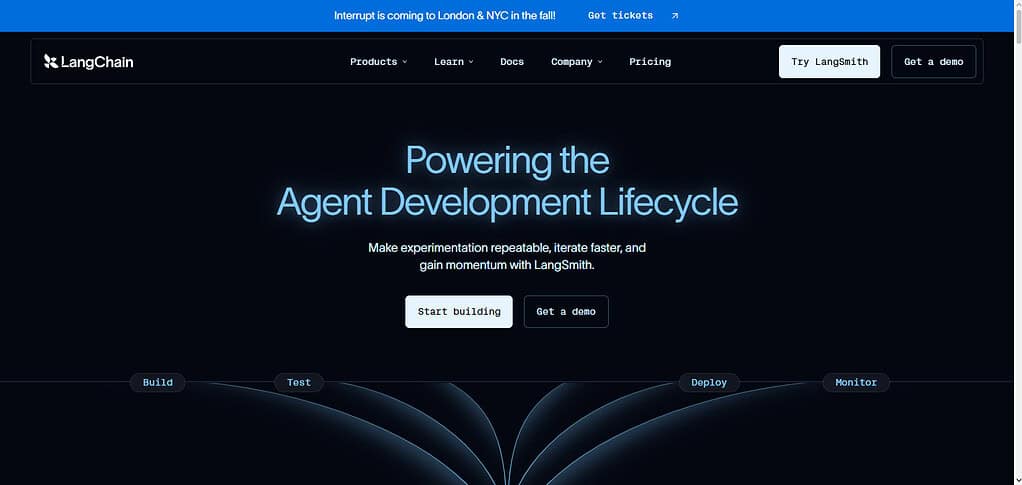
The modular design and extensive community support make LangChain a great choice for building AI assistants and chatbots, automation, and research agents. It is also a great choice for building applications that require a production-ready AI agent and can easily scale.
Why LangChain is Important
- Developers can make advanced AI apps by creating connections for LLMs to tools, external sources, APIs and databases.
- Makes AI agent creation easier by using modular pieces, automation, and memory workflows.
- Used for RAG systems to give AI services the ability to answer more accurately using more recent and private data.
- Uses many compatible tools, UI and vector databases, and lots of integrations.
- Provides a way for companies to develop advanced scalable AI assistants, agent-based chatbots, and intelligent automation.
LangChain Details
| Category | Details |
|---|---|
| Features | LLM application development, AI agent creation, memory management, prompt templates, tool integration, RAG support, chain-based workflows, API connectivity, vector database support, and multi-model compatibility. |
| Stars (GitHub) | 100K+ GitHub stars (approximately, changes frequently) |
| Language | Python, JavaScript, TypeScript |
| License | MIT License |
| Best For | Building AI agents, chatbots, RAG applications, automation workflows, AI assistants, and enterprise LLM applications. |
| Limitations | Can become complex for beginners, frequent updates may require adjustments, debugging large chains can be challenging, and advanced customization requires strong development knowledge. |
2. LlamaIndex
LlamaIndex is also one of the Best Open-Source AI Agent Frameworks and is a data-centric framework. It excels at combining large language models with private and enterprise data. It is ideal for building AI agents that need to access, understand, and process the information from documents, databases, APIs, and knowledge repositories.
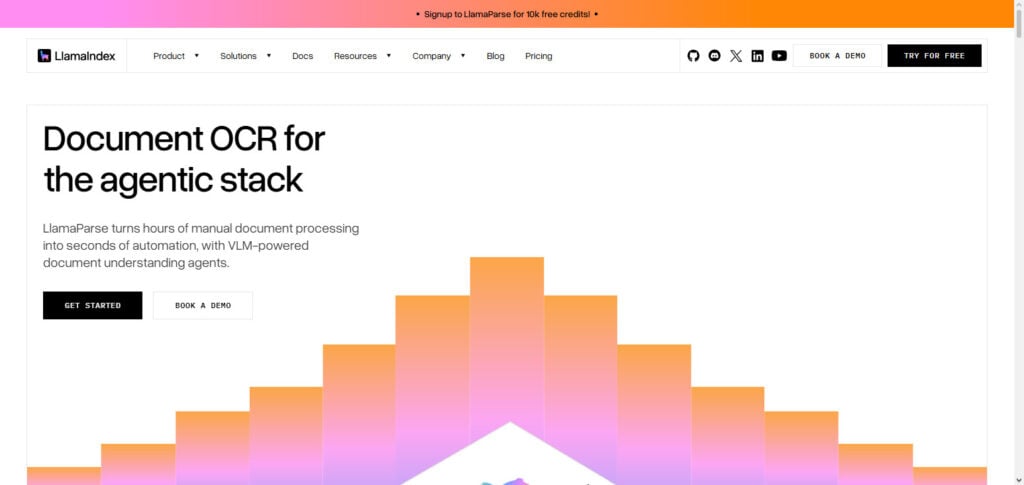
Its focus on RAG-based applications has also made great advancements in indexing, retrieval, and context management. Many businesses have opted to use LlamaIndex for building highly responsive and relevant AI-based applications, AI knowledge assistants, and intelligent search systems.
Why LlamaIndex is Important
- Connects large language models to the private data of companies more easily.
- Used for advanced encapsulation, answer retrieval, and data-based AI services and improves the quality of responses.
- RAG based AI services greatly rely on LlamaIndex.
- Lets companies create AI-based knowledge systems that make their documents, databases, and files searchable.
- Developers are easily able to create customized AI systems that can answer based on the information in a given domain.
LlamaIndex Details
| Category | Details |
|---|---|
| Features | Data indexing, RAG pipelines, document processing, knowledge retrieval, data connectors, vector search integration, query engines, agent tools, and LLM-powered data applications. |
| Stars (GitHub) | 40K+ GitHub stars (approximately, changes frequently) |
| Language | Python, TypeScript |
| License | MIT License |
| Best For | Building knowledge assistants, enterprise search systems, RAG applications, document-based AI agents, and private data integration. |
| Limitations | More focused on data retrieval than general automation, requires proper data preparation, and complex projects may need additional frameworks. |
3. AutoGen
An open-source, Microsoft-funded framework, AutoGen is also one of the Best Open Source AI Agent Frameworks evaluated because it creates an environment for building multi-agent AI systems. From a software developer’s viewpoint, AutoGen is the framework to use to build intelligent agents on the roles of their choice. This includes research agents, coding agents, and decision-making assistants.
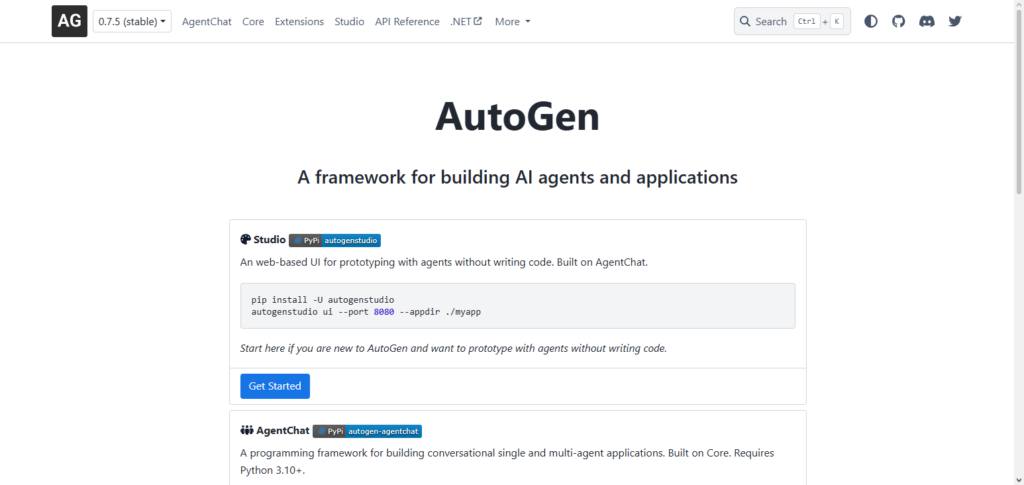
AutoGen integrates tool support, conversation workflows, and agent behavior customizations. AutoGen’s use cases encompass the automation of business processes, advanced AI experiments, and software development, and intelligent agents cooperate to analyze data.
Why AutoGen is Important
- AI systems can collaborate more easily to accomplish complex tasks without much human involvement.
- Highly autonomous systems for coding, research, analysis and task/business automation are easily created.
- Communication between agents is flexible.
- AI systems can plan, carry out, and iterate tasks to improve themselves.
- A new generation of multi-agent AI systems can be created to address automation problems.
AutoGen Details
| Category | Details |
|---|---|
| Features | Multi-agent collaboration, autonomous conversations, agent communication, human-in-the-loop workflows, tool usage, code execution, and customizable AI agent roles. |
| Stars (GitHub) | 40K+ GitHub stars (approximately, changes frequently) |
| Language | Python |
| License | MIT License |
| Best For | Multi-agent AI systems, research automation, coding agents, complex problem-solving workflows, and AI teamwork applications. |
| Limitations | Requires programming knowledge, agent management can become complicated, and resource usage increases with multiple agents. |
4. Haystack
Open source and enterprise-ready, Haystack is regarded by many as one of the Best Open Source AI Agent Frameworks for building QA systems and AI search engines and Retrieval-Augmented Generation applications. Haystack is a highly modular framework as it houses all the essential components as pipelines for Retrieval, Generation, Ranking, and Processing.
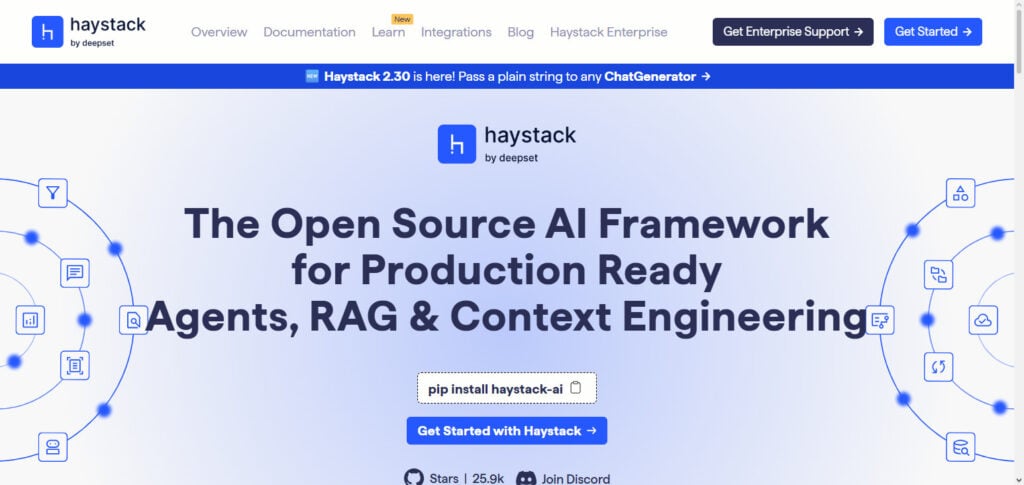
Haystack is one of the many LLMs and vector databases, thus an agent framework readily supports multiple AI projects. With Haystack, organizations are able to build knowledge management systems, AI assistants, and enterprise search systems with context-relevant and accurate responses.
Why Haystack is Important
- A solid basis for enterprise AI-based search and answer systems is provided.
- Retrieval of information is highly improved when LLMs are embedded with documents supplemented with structured data.
- assists in developing trustworthy RAG applications with more precision and contextual information.
- empowers AI customer support, AI-driven knowledge management, and AI-based research, with scalability in mind.
- provides multiple AI models, databases, and deployment flexibility.
Haystack Details
| Category | Details |
|---|---|
| Features | RAG pipelines, semantic search, document retrieval, question answering, LLM integration, vector database support, AI search systems, and modular AI workflows. |
| Stars (GitHub) | 20K+ GitHub stars (approximately, changes frequently) |
| Language | Python |
| License | Apache 2.0 License |
| Best For | Enterprise search, AI knowledge bases, RAG applications, customer support assistants, and document intelligence systems. |
| Limitations | Requires technical expertise, setup can be complex for beginners, and smaller projects may find it feature-heavy. |
5. CrewAI
CrewAI is the best choice for designing autonomous AI agent teams, and appears on our ten best open-source AI agent frameworks, because it empowers developers to craft uniquely designed autonomous agents. Developers specify the agents’ roles, objectives, and responsibilities.
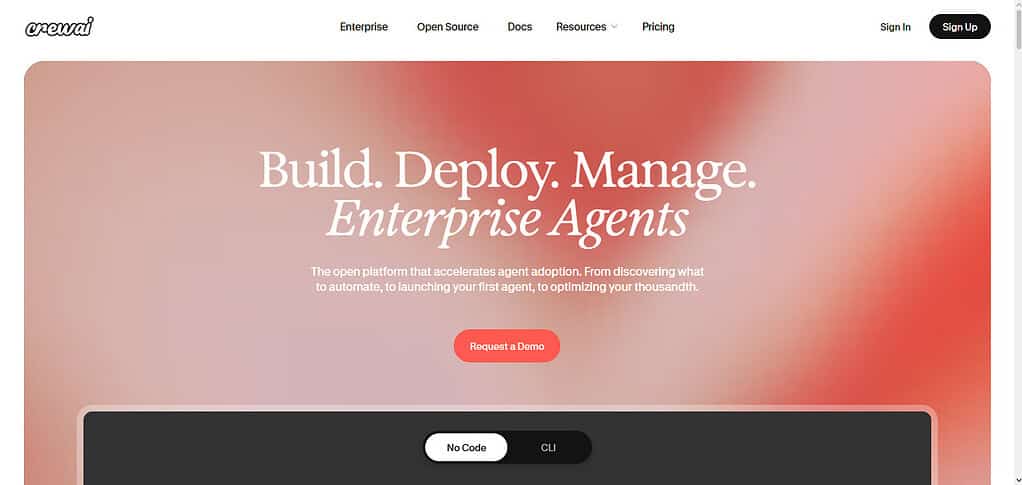
CrewAI is best for designing multi-agent workflows for research, content generation, business analysis automation and other activities. It is the best framework for developers attempting to design business workflows involving agents to automate complex problems and answer difficult questions.
Why CrewAI is Important
- enables the development of collaborative AI systems by simplifying the assignment of distinct roles for each agent.
- allows highly complex business functions to be automated through synced AI workflows.
- allows organizations to build specialized AI teams for Research, Marketing, Analytics, and Operations.
- allows specialization of AI agents to enhance productivity.
- allows relatively easy construction of collaborative autonomous AI systems.
CrewAI Details
| Category | Details |
|---|---|
| Features | Role-based AI agents, task delegation, multi-agent collaboration, workflow orchestration, agent memory, tool integration, and autonomous task execution. |
| — | — |
| Stars (GitHub) | 30K+ GitHub stars (approximately, changes frequently) |
| Language | Python |
| License | MIT License |
| Best For | AI agent teams, business automation, research workflows, content generation, and collaborative AI systems. |
| Limitations | Still evolving, debugging agent interactions can be difficult, and complex workflows may require manual optimization. |
6. Camel
CAMEL (Communicative Agents for Mind Exploration of Large Scale Language Models) is the best framework to use when your goal is to study or build a cooperative AI agent, and makes our ten best open-source AI agent frameworks.
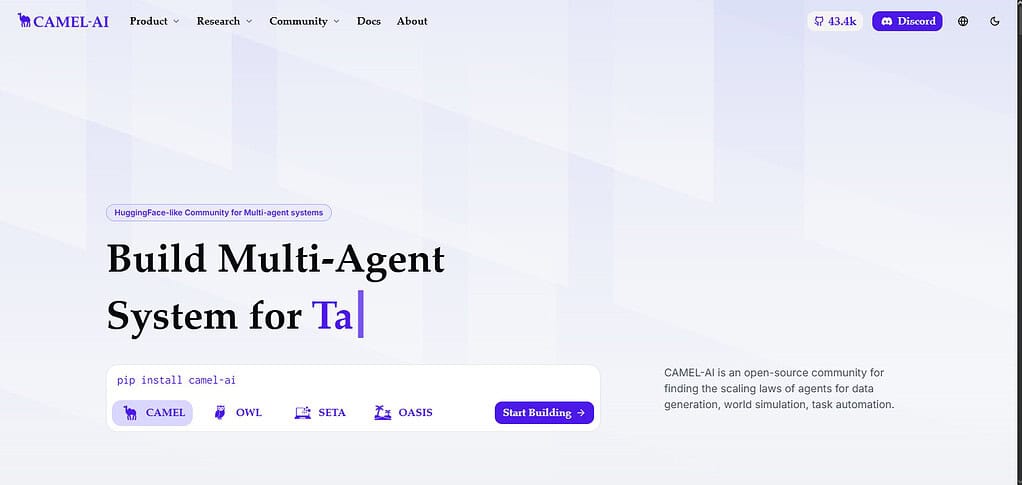
This framework is the most agent-to-agent communicative of the frameworks on our list of ten best open-source AI agent frameworks, and is focuses on role, and autonomous, problem-solving. CAMEL is most useful when there are a number of interacting autonomous AI agents working to complete the same task, and brings many benefits to research, simulations and the experimental side of AI.
This framework explores the many methods communicative AI agents can use to collaboratively solve difficult problems and perform complex tasks.
Why CAMEL is Important
- pushes the AI research frontier by studying the ability of multiple AI agents to discuss and cooperate.
- helps the developer community understand the extent to which autonomous agents can work together.
- allows role-oriented simulations for the study of advanced AI behaviors.
- fosters creativity in collaborative systems with AI agents and multi-step reasoning.
- gives a first step in the design of future cooperative AI systems.
CAMEL Details
| Category | Details |
|---|---|
| Features | Multi-agent communication, role-playing agents, cooperative AI systems, task simulation, agent reasoning, and AI research experimentation. |
| — | — |
| Stars (GitHub) | 15K+ GitHub stars (approximately, changes frequently) |
| Language | Python |
| License | Apache 2.0 License |
| Best For | AI research, multi-agent experiments, simulations, collaborative reasoning systems, and academic projects. |
| Limitations | More research-focused than production-focused, requires technical expertise, and may need additional tools for deployment. |
7. SuperAGI
SuperAGI sits on the list of the Best Open-Source AI Agent Frameworks as it is an open-source platform for creating, managing, and deploying autonomous AI agents. It comes with agent development, workflow management, monitoring, and performance features.
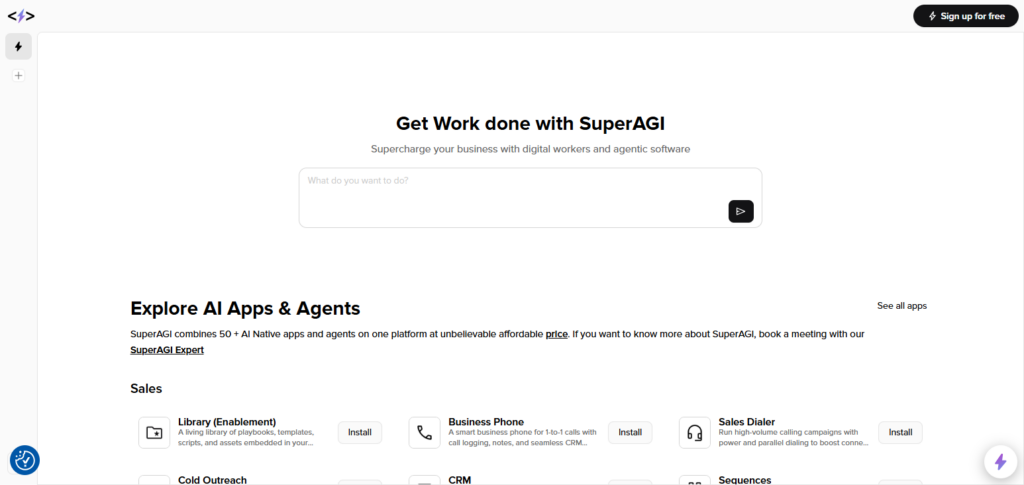
It is easy for agents to perform functions and tasks with the help of various AI models, APIs, and tools through SuperAGI’s integrations.
It is even easy to build agents for marketing, research, automation, and business intelligence. SuperAGI’s friendly UI and management features allow teams to experiment with autonomous AI and even employ scalable solutions.
Why SuperAGI is Important
- allows the development and management of autonomous AI agents in the real world for the developer community.
- offers features for monitoring and controlling agents.
- enables the easy deployment of workflows for AI Automation.
- encourages the use of integrations for additional agent capabilities.
- allows organizations to safely and efficiently explore autonomous AI systems.
SuperAGI Details
| Category | Details |
|---|---|
| Features | Autonomous AI agents, agent management dashboard, workflow automation, tool integration, performance monitoring, and deployment support. |
| — | — |
| Stars (GitHub) | 15K+ GitHub stars (approximately, changes frequently) |
| Language | Python |
| License | MIT License |
| Best For | Building autonomous agents, business automation, AI experiments, and managing multiple AI workflows. |
| Limitations | Development activity changes over time, setup can be complex, and production scaling may require additional infrastructure. |
8. AGiXT
This open-source framework is among the Best Open-Source AI Agent Frameworks for its easy adjustability when building automated AI agents. AGiXT makes it easy to build agents for task execution and API connections. Also, it is simple to equip agents with tools, extensions, and AI models.
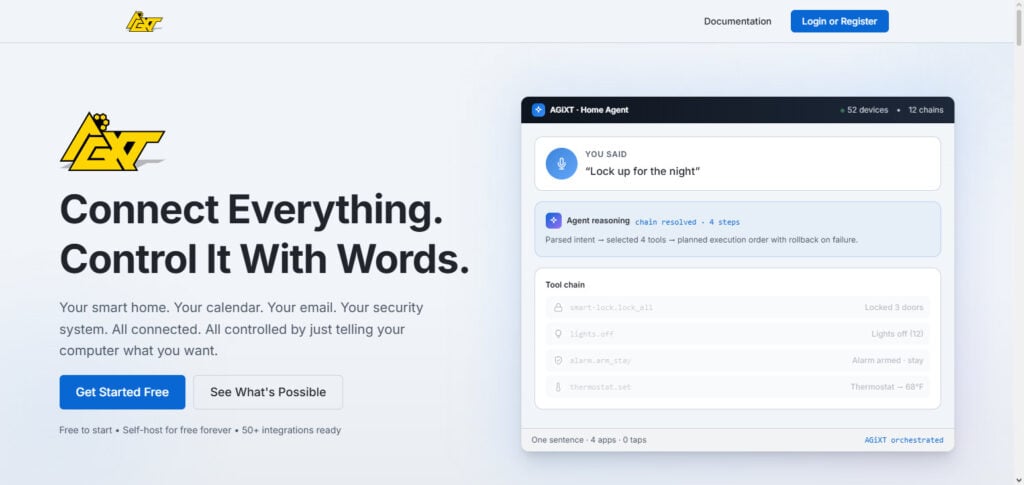
AGiXT emphasizes on stretchable design, making it easy to adapt behavior for different business requirements. Furthermore, it is easy to build automated systems, assistants, and even productivity tools. AGiXT utilizes a plugin-centered design, making it easy for developers to establish unique automated systems and empowers AI agents.
Why AGiXT is Important
- offers a degree of customization to the developer community to build agents that fulfill specific purposes.
- provides means of task automation through the use of plugins and integrations.
- Empowers developers to design custom AI assistants and intuitive AI workflows.
- Provides support for multiple AI models.
- Offers businesses the ability to develop scalable AI systems with bespoke features.
AGiXT Details
| Category | Details |
|---|---|
| Features | Custom AI agents, plugin system, automation workflows, API integration, multi-model support, memory handling, and task execution capabilities. |
| — | — |
| Stars (GitHub) | 10K+ GitHub stars (approximately, changes frequently) |
| Language | Python |
| License | MIT License |
| Best For | Custom AI assistants, automation tools, personalized agents, and developer-focused AI solutions. |
| Limitations | Smaller ecosystem compared with LangChain, requires technical knowledge, and advanced customization may need coding skills. |
9. OpenAgents
OpenAgents is an open-source software based on the AI Agent Framework which gets high ranks among the Best Open Source AI Agent Frameworks. This framework allows the user to build AI agents that have the ability to interact with real world applications and external tools.
OpenAgents is a framework that enables developers to build deploy and test agents that can operate away from simple task. OpenAgents is a framework that is designed to simplify the development and increase the usability of AI agents to developers and researchers.
This framework is designed with the flexibility of tool use and APIs and the ability to create custom workflows for agents. This framework can be used to develop real world automation solutions, intelligent assistants and AI based solutions even frameworks that can operate in real world situations.
Why OpenAgents is Important
- Makes the development of AI agents that interact with real world tools more meaningful.
- Provides developers the ability to create open and flexible autonomous AI systems.
- Aids the development of intelligent agents that can perform tasks of value without help.
- Promotes the development of AI agents using open source tools and methods.
- Offers the potential of building AI assistants that work with external systems and APIs.
OpenAgents Details
| Category | Details |
|---|---|
| Features | Open-source AI agent development, tool usage, API interaction, agent workflows, real-world task execution, and customizable agent environments. |
| — | — |
| Stars (GitHub) | 10K+ GitHub stars (approximately, changes frequently) |
| Language | Python |
| License | MIT License |
| Best For | Research projects, AI assistants, tool-using agents, and experimental autonomous AI applications. |
| Limitations | Less mature ecosystem, limited enterprise adoption, and requires technical expertise for customization. |
10. Dify
Dify is a low-code platform that is evaluated as one of the Best Open-Source AI Agent Frameworks. It is an open-source platform that helps to create AI-based applications, chatbots and task automation workflows.
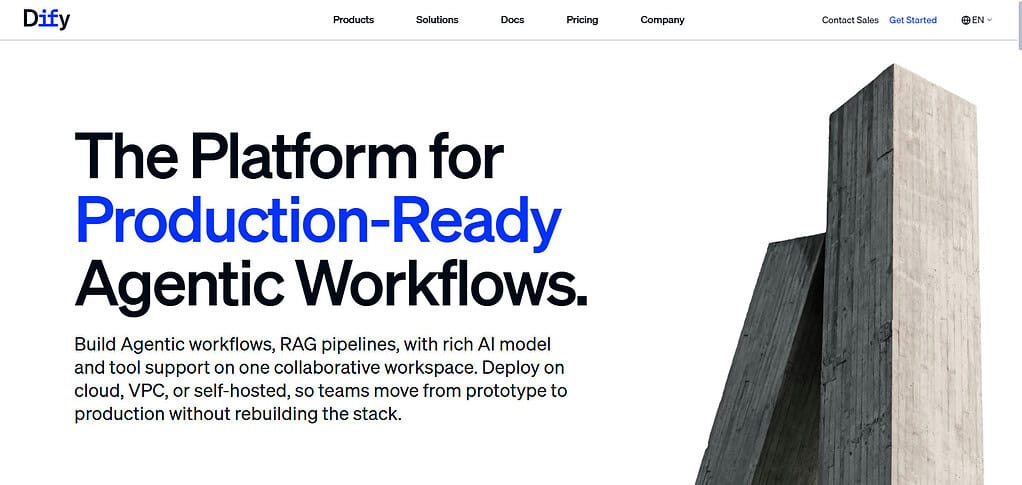
Dify has a user friendly interface to create applications that are based on LLM with a low coding necessity. Dify has support for AI agents and RAG systems as well as prompt management, model integrations and workflow automation.
With this framework, developers and companies can create customer service bots, knowledge assistants and AI based solutions to Enterprises. Dify has a user friendly interface to create reliable and scalable AI applications. Dify has support for numerous AI models and flexible deployment options.
Why Dify is Important
- Lowers the barrier of entry for developing AI applications by using a low-code approach.
- Allows companies to efficiently create chatbots, AI assistants, and automated workflows.
- Eases the connection of LLMs, RAG systems, and other external knowledge.
- Provides the ability to create AI applications that are ready for production and helps teams that are not AI experts to engage in AI initiatives.
Dify Details
| Category | Details |
|---|---|
| Features | Low-code AI app builder, AI agents, RAG workflows, chatbot creation, prompt management, model integration, workflow automation, and API deployment. |
| — | — |
| Stars (GitHub) | 100K+ GitHub stars (approximately, changes frequently) |
| Language | TypeScript, Python |
| License | Apache 2.0 License |
| Best For | Building AI applications quickly, business chatbots, enterprise assistants, RAG systems, and low-code AI workflows. |
| Limitations | Less control than fully custom frameworks, advanced customization requires coding, and large-scale deployments need proper infrastructure. |
Comparison Table: Best Open-Source AI Agent Frameworks in 2026
| Framework | Key Features | Language | License | Best For |
|---|---|---|---|---|
| LangChain | LLM integration, AI agent development, memory management, RAG support, tool integration, prompt engineering, workflow automation | Python, JavaScript, TypeScript | MIT License | Building AI assistants, chatbots, RAG applications, and enterprise AI workflows |
| LlamaIndex | Data indexing, knowledge retrieval, document processing, RAG pipelines, vector search, data connectors, query engines | Python, TypeScript | MIT License | Private data AI applications, knowledge assistants, enterprise search, and document-based agents |
| AutoGen | Multi-agent conversations, autonomous workflows, agent collaboration, human-in-the-loop support, code execution | Python | MIT License | Multi-agent systems, AI research, coding agents, and complex task automation |
| Haystack | RAG pipelines, semantic search, question answering, LLM integration, document retrieval, AI search workflows | Python | Apache 2.0 License | Enterprise search systems, AI knowledge bases, and customer support assistants |
| CrewAI | Role-based AI agents, task delegation, agent collaboration, workflow orchestration, automation tools | Python | MIT License | AI agent teams, business automation, research, and collaborative workflows |
| CAMEL | Multi-agent communication, role-playing agents, AI simulations, cooperative reasoning, research tools | Python | Apache 2.0 License | AI research, multi-agent experiments, and collaborative AI systems |
| SuperAGI | Autonomous agents, agent management dashboard, workflow automation, tool integration, performance monitoring | Python | MIT License | Building and managing autonomous AI agents for business applications |
| AGiXT | Custom AI agents, plugin support, API integration, automation workflows, multi-model support, memory handling | Python | MIT License | Personalized AI assistants, automation solutions, and developer-focused AI projects |
| OpenAgents | Tool-using AI agents, API interaction, customizable workflows, real-world task execution, open AI development | Python | MIT License | AI assistants, research projects, and experimental autonomous agents |
| Dify | Low-code AI development, AI agents, RAG workflows, chatbot creation, prompt management, LLM integration | TypeScript, Python | Apache 2.0 License | Building AI applications, business chatbots, enterprise assistants, and workflow automation |
Conclusion
The Best Open-Source AI Agent Frameworks allow developers to create highly sophisticated, autonomous, and scalable AI Applications. Frameworks like LangChain, LlamaIndex, AutoGen, Haystack, and CrewAI assist developers to create complex AI Agents that include automation, data, and multi-agent collaboration.
Whether the developer’s goal is the creation of AI Assistants, Enterprise Applications, Research Tools, or Workflow Automation Applications, the open-source Frameworks provide adequate flexibility and customization.
With the rapid pace of AI technology development in 2026, the open-source agent frameworks will be integral in developing new AI applications that are highly sophisticated, autonomous, and scalable, and will allow businesses to create more innovative applications faster and will aid other developers to use AI more effectively.
FAQ
What are Open-Source AI Agent Frameworks?
Open-source AI agent frameworks are development platforms that help create, manage, and deploy intelligent AI agents using freely available source code.
Which are the Best Open-Source AI Agent Frameworks in 2026?
Some of the best frameworks include LangChain, LlamaIndex, AutoGen, Haystack, CrewAI, CAMEL, SuperAGI, AGiXT, OpenAgents, and Dify.
Why use Open-Source AI Agent Frameworks?
They provide flexibility, customization, cost efficiency, community support, and the ability to build AI applications without depending on closed platforms.
Which Open-Source AI Agent Framework is best for beginners?
Dify and CrewAI are beginner-friendly because they offer simple interfaces and easier workflows for building AI applications.
Which framework is best for building multi-agent AI systems?
AutoGen, CrewAI, and CAMEL are popular choices for creating multiple AI agents that collaborate and complete complex tasks.