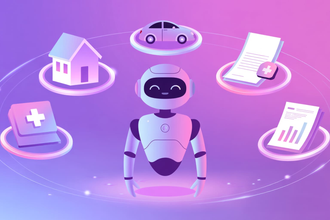


In this article I will discuss the Best AI Agents for Routing Insurance Inquiries to the Right Broker. I will highlight platforms that help insurance businesses automate lead qualification, identify customer requirements, and assign inquiries to appropriate brokers. We will go over their key features, CRM integrations, communication channels, supported insurance categories, workflow automation, pricing, and standard analytics in order to help businesses select the best solution.
Why Choose AI Agents for Routing Insurance Inquiries to the Right Broker
Faster Query Distribution: AI agents automatically classify incoming insurance queries and assign them to the right brokers, removing delays in manual assignment and ensuring customers get quick responses.
Better broker matching: These agents take into account insurance needs, customer location, broker expertise and broker availability. This helps link customers with the most suitable brokers.
Automated Lead Qualification: AI agents gather customer information, evaluate coverage needs, gage insurance preferences, and classify lead details before passing queries to brokers.
Improved Customer Experience: Real-time automated responses and quicker inquiry handling allow customers to connect with the right insurance specialists without waiting or repeating themselves.
Reduced administrative burden: Insurance teams can automate routine tasks like categorizing inquiries, collecting information, and organizing and assigning leads, freeing up employees to tackle more complex customer needs.
Multi-Channel Query Handling: AI agents can take and handle queries from websites, emails, phone calls, messaging platforms and other supported communication channels.
Better Lead Management: Centralized records of inquiries, automated follow-ups, and duplicate lead detection allow insurance businesses to keep their customer information organized and reduce missed opportunities.
Analytical & Performance Tracking: Reporting tools help businesses track inquiry volumes, assignment activity, broker response times, lead conversion and overall customer-service performance.
Key Points
- Leena AI: Enterprise AI automation, intelligent inquiry classification, workflow automation, CRM integration, and customer request management.
- Zendesk AI: Automated ticket classification, intelligent inquiry routing, AI customer support, omnichannel communication, and ticket analytics.
- Ada: AI-powered customer conversations, inquiry handling, customer intent recognition, workflow automation, and human agent handoff.
- NiCE Cognigy: Insurance inquiry automation, claims intake, policy information assistance, intelligent routing, voice AI, and digital communication.
- Decagon: Autonomous AI agents, customer intent detection, automated email handling, CRM integration, voice automation, and conversation analytics.
- Guidewire Agentic Framework: Insurance-native AI agents, policy data access, claims workflow automation, underwriting assistance, agent orchestration, and AI governance.
- Duck Creek Agentic AI Platform: Insurance workflow automation, multi-agent orchestration, reusable business rules, open integrations, AI governance, and scalable deployment.
- Bevaya (formerly Roots Automation): Insurance document processing, claims automation, underwriting data extraction, data validation, workflow automation, and human review support.
- Salesforce Financial Services AI Agents: Agentforce automation, insurance inquiry management, intelligent case routing, lead qualification, CRM integration, and customer analytics.
- NTT DATA AI for Insurance: Insurance-specific AI agents, document processing, lead qualification, underwriting automation, workflow orchestration, and enterprise system integration.
10 Best AI Agents for Routing Insurance Inquiries to the Right Broker
1. Leena.ai
Leena AI is an enterprise agentic AI platform that automates business requests, workflows and interactions across connected enterprise systems. It integrates with Salesforce, Microsoft Dynamics, Zendesk and other business applications to connect customer information and automate configured workflows.
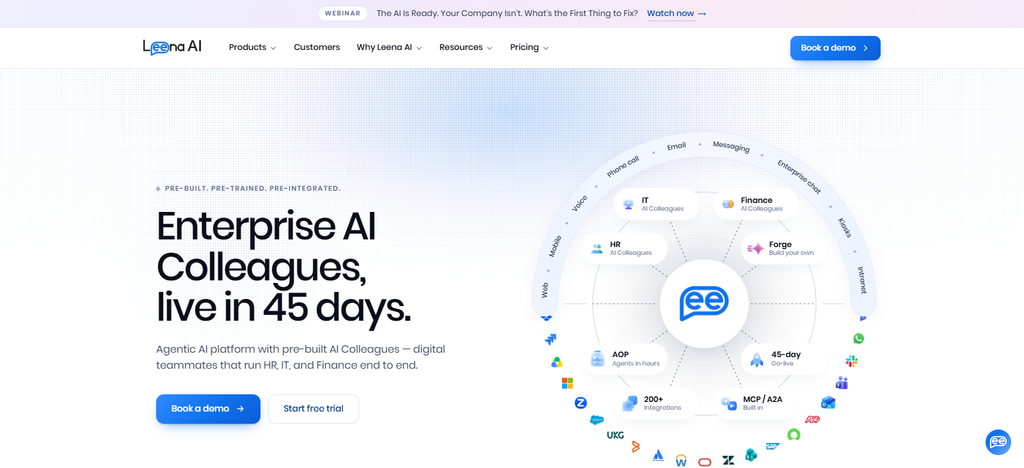
Best for Insurance organizations wanting to build centralized inquiry-handling processes with enterprise integrations instead of a dedicated insurance broker-routing product. Properly configured, it can be used to classify requests, retrieve information, execute workflows and perform system handoffs.
Insurance categories, broker licensing checks, lead qualification and routing rules would require appropriate integrations and customizations. Analytics and governance support enterprise operations. Pricing to be confirmed with vendor.
| Key Features | Explanation |
|---|---|
| Intelligent Inquiry Classification | Identifies employee and customer requests, categorizes incoming information and supports configured workflows for handling different inquiry types. |
| Workflow Automation | Automates repetitive business processes, request handling and task assignments across connected enterprise applications. |
| CRM Integration | Connects with enterprise systems such as Salesforce and Microsoft Dynamics to access relevant customer and business information. |
| AI-Powered Assistance | Uses conversational AI to understand requests, retrieve information and provide contextual responses. |
| Enterprise Analytics | Helps organizations monitor workflow activity, automation performance and operational efficiency. |
| Knowledge Management | Uses connected enterprise knowledge sources to provide relevant information during automated interactions. |
| Multi-System Connectivity | Supports integrations with business applications to coordinate information and workflow activities. |
| Human Handoff | Allows configured workflows to transfer complex requests to human teams for additional handling. |
2. Zendesk AI
Zendesk AI helps insurance companies manage customer queries by automating conversations, intelligently categorizing tickets and creating customer-service workflows. Its AI agents support messaging, email, web forms and voice and intelligent triage can categorize tickets with topics, sentiment, language and customer information.
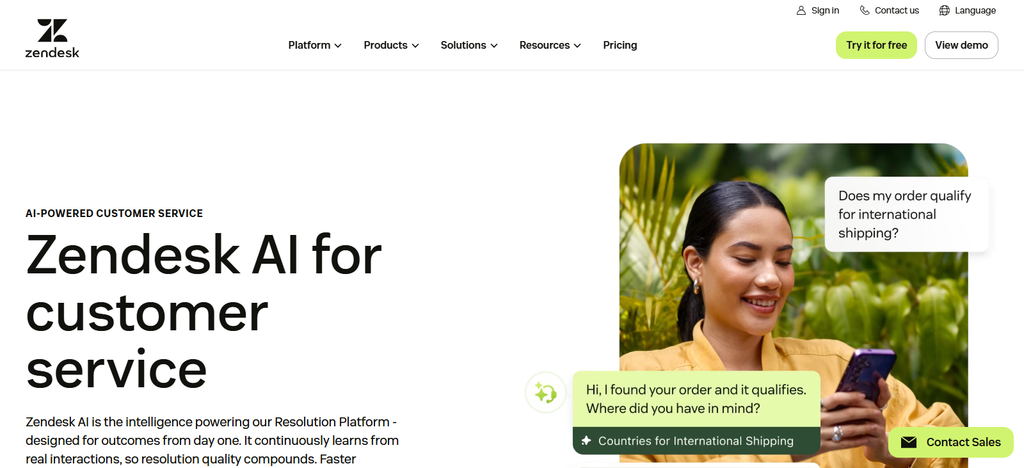
Best for insurance agencies and service teams who get lots of questions about policies, claims, renewals and coverage. It can gather missing information, categorize queries and direct tickets to suitable support teams using configured routing rules.
CRM integrations and reporting help teams to manage customer interactions and service performance. Additional configuration is required for insurance-specific broker matching and license validation. Pricing is dependent on the chosen Zendesk plan and AI usage.
| Key Features | Explanation |
|---|---|
| Intelligent Ticket Classification | Automatically identifies inquiry topics, intent, language and sentiment to organize incoming customer requests. |
| AI-Powered Customer Support | Handles common customer questions and provides automated responses using connected knowledge and business information. |
| Automated Ticket Routing | Helps direct customer inquiries to appropriate teams using ticket fields, business rules and routing configurations. |
| Omnichannel Communication | Supports customer interactions through messaging, email, voice and other supported service channels. |
| CRM and System Integration | Connects customer-service workflows with external business applications through integrations and APIs. |
| Agent Copilot | Provides human support representatives with customer context, suggested responses and assistance during conversations. |
| Reporting and Analytics | Tracks ticket volumes, resolution activity, customer-service performance and operational trends. |
| Security and Data Protection | Offers administrative permissions, privacy controls and sensitive-data protection features for customer interactions. |
3. Ada
Ada is an AI-powered customer experience platform that automates conversations via voice, messaging and email. It has a single inference engine for consistent responses and conversation management tools that allow for multilingual customer interaction and automated service workflows.

Best for insurance providers who want to manage repetitive questions, gather initial customer information and improve digital customer support across various communication channels. Businesses can integrate Ada with their existing systems through APIs and developer tools, so that customer requests can trigger configured workflows and human handoffs.
It can handle scenarios of health and property insurance services, but broker specialization, licensing-based assignment and insurance lead qualification require custom integrations. Analytics and performance optimization tools help to track agent outcomes. Prices are usually quoted by the vendor.
| Key Features | Explanation |
|---|---|
| AI Reasoning Engine | Understands customer requests and supports dynamic conversations instead of depending entirely on predefined chatbot scripts. |
| Automated Inquiry Handling | Responds to common customer questions and handles configured service requests through AI-powered conversations. |
| Omnichannel Communication | Supports automated customer interactions across messaging, email and voice experiences. |
| Customer Intent Recognition | Identifies customer requirements and conversation context to provide relevant responses and trigger appropriate workflows. |
| Workflow Automation | Connects conversations with business processes to automate information collection and configured customer-service actions. |
| CRM Integration | Connects with supported CRM and customer-service applications to access customer records and maintain interaction context. |
| Human Agent Escalation | Transfers complex customer conversations to human representatives through supported contact-center integrations. |
| Performance Analytics | Helps organizations evaluate automated conversations, identify service gaps and improve customer experience. |
4. NiCE Cognigy
NiCE Cognigy provides conversational AI agents for insurance customer service, claims intake and policy-related queries. Capabilities include first notice of loss (FNOL), document collection, identity verification, coverage questions, product recommendations and smart routing.
It enables insurers to manage customer requests across digital and contact center channels, supporting both voice and text communication. Best for Insurance companies and large brokerages needing to deal with automated inquiries, communication related to claims and smooth transfers to human representatives.
Integration capabilities help link customer conversations to existing enterprise systems. The insurance categories are property, casualty and other policy related service work flows. Analytics can be used to measure service performance. Pricing is dependent on deployment requirements and vendor agreements.
| Key Features | Explanation |
|---|---|
| Insurance-Specific AI Agents | Supports insurance workflows such as first notice of loss, claims processing, document collection and policy coverage inquiries. |
| Intelligent Inquiry Routing | Uses conversational context and configured routing workflows to direct customer requests to appropriate automated or human service teams. |
| Voice and Digital Automation | Handles customer interactions across voice, chat and digital messaging channels. |
| Claims Intake Automation | Collects initial claim information and supports document gathering during insurance claims processes. |
| Policy Information Assistance | Helps customers access policy-related information and receive answers to common coverage questions. |
| Enterprise Integrations | Connects with CRM, contact-center and back-office systems through prebuilt integrations and APIs. |
| Human Agent Handoff | Transfers conversations to human representatives with relevant interaction context when additional assistance is needed. |
| AI Analytics and Evaluation | Provides conversation insights, performance tracking and testing capabilities to evaluate agent behavior. |
5. Decagon
Decagon is an enterprise AI agent platform that automates customer support conversations and integrates with CRM, helpdesk and communication systems. It integrates with Salesforce, Zendesk, Intercom and voice infrastructure like Amazon Connect and RingCentral. It also offers automated e-mail routing, escalation workflows, and access to customer data.
Best for insurance companies looking to automate policy inquiries, customer-service requests and initial lead conversations with configurable AI agents. It can move its financial-services capabilities to insurance workflows, but broker matching and insurance licensing checks are not standard features.
Conversation simulations, performance analytics and configurable operational procedures help teams to elevate the service quality. Prices are largely geared to the needs of enterprises.
| Key Features | Explanation |
|---|---|
| Autonomous AI Agents | Automates customer conversations and configured service workflows using enterprise AI agents. |
| Customer Intent Detection | Understands customer questions and identifies the appropriate response or workflow based on conversation context. |
| Automated Email Handling | Supports automated email responses, inquiry management and configured customer-service processes. |
| CRM Integration | Connects with Salesforce and other supported enterprise applications to access customer information. |
| Voice Automation | Supports voice-based customer interactions through compatible telephony and contact-center integrations. |
| Workflow Customization | Allows businesses to configure AI procedures, escalation rules and automated customer-service actions. |
| Human Escalation | Transfers complicated inquiries to human representatives when automated assistance is insufficient. |
| Conversation Analytics | Helps teams review interaction quality, identify automation opportunities and monitor customer-service performance. |
6. Guidewire Agentic Framework
Guidewire Agentic Framework is an insurance-specific environment for creating, connecting, deploying and governing AI agents across property and casualty insurance operations. Through the Guidewire ecosystem, it can access relevant policy, claims and billing information, supporting customer-service, underwriting and claims workflows.
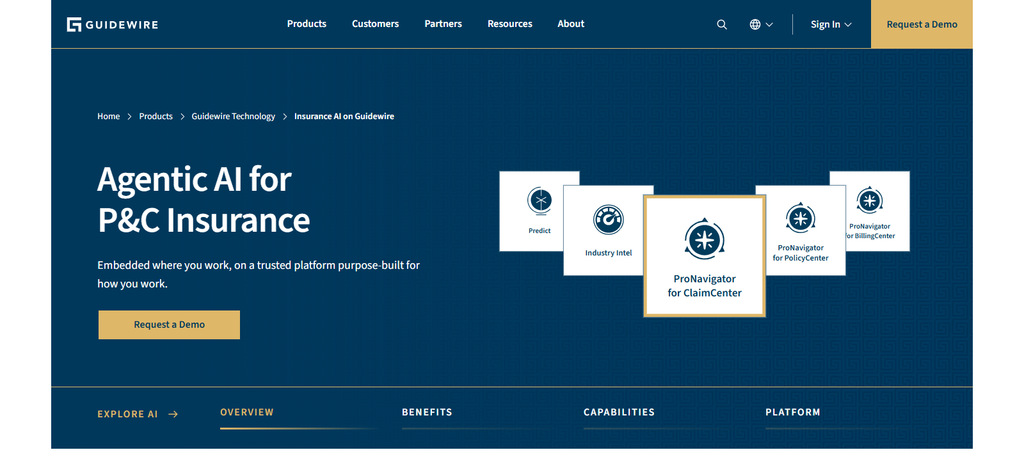
Best for: Existing insurance carriers and brokerages that already use Guidewire applications and want deeper automation and insurance-specific data access. The framework supports custom and third-party agents, model flexibility, integrations and audit tracing.
It can help classify policyholder requests and route them to the right service workflows, but direct external broker distribution has to be configured. Oversight is supported by analytics, governance and evaluation capabilities. The cost will depend on the Guidewire products you choose and the implementation.
| Key Features | Explanation |
|---|---|
| Insurance-Native AI Framework | Provides an environment for developing AI agents around property and casualty insurance operations. |
| Policy Data Access | Connects AI workflows with relevant policy information and insurance records within the Guidewire ecosystem. |
| Claims Workflow Automation | Supports AI-assisted claims processes, information handling and connected operational activities. |
| Underwriting Assistance | Helps automate selected underwriting-related tasks using connected insurance information and configured workflows. |
| Agent Orchestration | Coordinates different AI agents and business processes to handle multi-step insurance operations. |
| Enterprise Integration | Connects agents with Guidewire applications and supported external systems. |
| AI Governance | Supports oversight, controlled deployment and management of AI agents across insurance workflows. |
| Workflow Extensibility | Allows insurers to develop and adapt AI agents for specific business processes and operational requirements. |
7. Duck Creek Agentic AI Platform
Duck Creek’s Agentic AI Platform allows insurance companies to build and orchestrate AI agents across policy administration, claims, underwriting and billing operations. Its insurance-specific context, reusable business rules, and agent orchestration capabilities support complex workflows that pull information from multiple systems.
Best For Property and casualty insurers who want to automate inquiry processing but maintain control of insurance-specific decisioning and operational workflows. The platform features open integrations, different AI models, explainability and oversight by humans.
When tied to customer-service and distribution work flows, it can help with inquiry classification and routing. CRM connectivity, analytics and reporting depend on implementation ecosystem. Insurance types include property, casualty, claims and policy servicing. The pricing is usually based on the needs of the enterprise deployment.
| Key Features | Explanation |
|---|---|
| Insurance-Native Context | Uses insurance-related knowledge across policy administration, claims, underwriting and other insurance operations. |
| Multi-Agent Orchestration | Coordinates specialized AI agents across complex insurance workflows and business processes. |
| Prebuilt AI Workflows | Helps organizations accelerate AI adoption through reusable workflows and low-code development capabilities. |
| Open Integration Architecture | Connects with existing insurance applications, external systems, AI models and technology partners. |
| Reusable Business Rules | Uses reusable models, data, logic and business rules to support consistent workflow execution. |
| AI Governance and Security | Provides oversight, transparency, observability and controls for enterprise AI deployments. |
| Workflow Customization | Supports different agent frameworks and models to accommodate specific insurance requirements. |
| Scalable Deployment | Helps insurance organizations expand AI automation across multiple operational functions and workflows. |
8. Bevaya
Bevaya, formerly Roots Automation, offers insurance-focused AI agents for claims, underwriting and policy servicing workflows. The company’s platform uses specialized insurance AI models to read documents, extract information, validate records, and prepare data for existing insurance systems.
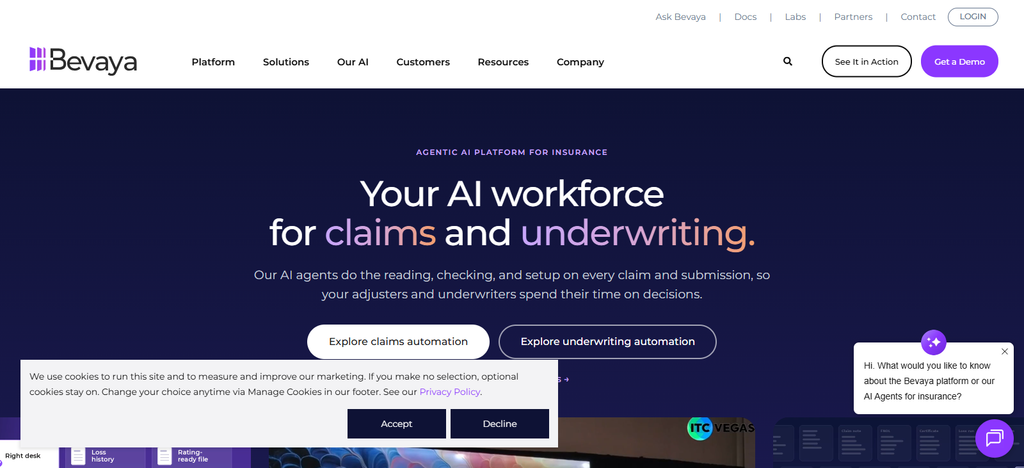
Best for Insurance carriers, brokers and third-party administrators who want to automate document-heavy inquiry processing and submission intake. It integrates with Guidewire, Salesforce Industries and Duck Creek, enabling organizations to connect automated workflows to existing systems.
Insurance applications include property and casualty submissions, claims documents and underwriting information. Analytics and confidence scoring help shape the review process, under supervision by humans to handle low-confidence decisions. The cost will depend on the scope of deployment and the needs of the workflow.
| Key Features | Explanation |
|---|---|
| Insurance Document Processing | Uses AI to extract and organize information from insurance documents, forms and submissions. |
| Claims Automation | Supports document-heavy claims workflows by processing information and preparing records for review. |
| Underwriting Data Extraction | Extracts relevant information from insurance submissions and supporting documents to assist underwriting operations. |
| Insurance System Integration | Connects automated workflows with insurance platforms and enterprise applications. |
| Data Validation | Helps identify missing, inconsistent or incomplete information within processed insurance records. |
| Workflow Automation | Automates repetitive administrative tasks involving document processing and insurance information handling. |
| Human Review Support | Supports review and intervention when extracted information requires additional validation. |
| Operational Monitoring | Helps organizations monitor automated processing workflows and evaluate operational performance. |
9.Salesforce Financial Services AI Agents
Financial Services Cloud AI Agents use Agentforce and Financial Services Cloud to enable insurance customer service, relationship management and workflow automation. Its Insurance Service Assistance agent can summarize policyholder portfolios, insurance quotes, and proof-of-insurance documents using Salesforce’s insurance data model.
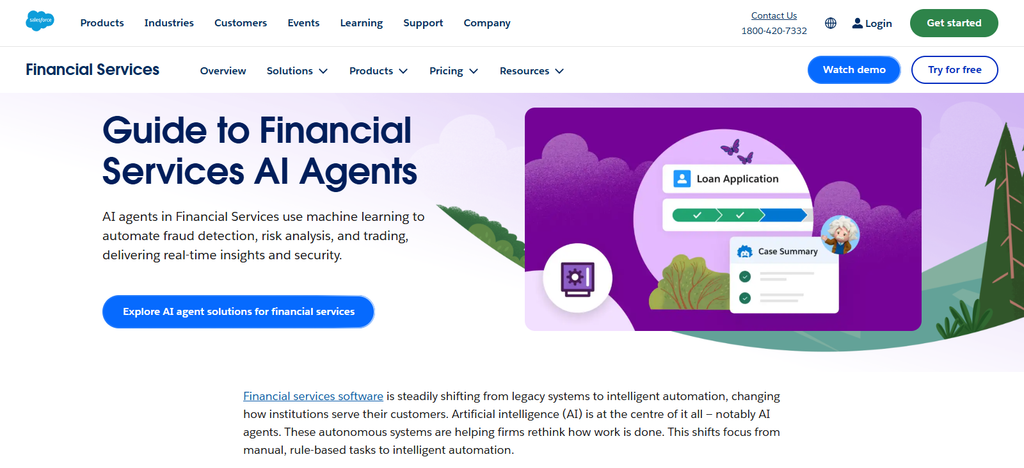
Best for Insurance agencies and financial service organizations already managing customer relationships with Salesforce CRM. Its case-routing capabilities can route requests to specialists, based on skills, capacity and complexity of the requests . Insurance categories Life, property, casualty and other insurance workflows supported based on configuration.
CRM records, customer interactions, service analytics and reporting help in handling queries. Processes for communication and lead qualification can be customized. The price depends on the Salesforce editions, add-ons and Agentforce usage.
| Key Features | Explanation |
|---|---|
| Agentforce AI Automation | Uses AI agents to automate customer-service activities and configured financial-services workflows. |
| Insurance Inquiry Management | Supports insurance-related customer inquiries using connected CRM records and insurance information. |
| Intelligent Case Routing | Helps assign service requests to appropriate representatives based on configured rules, skills and availability. |
| Financial Services Cloud Integration | Connects customer information, relationship records and insurance-related business data within Salesforce. |
| Lead Qualification | Supports customer information collection, lead management and configured follow-up processes. |
| Customer 360 View | Provides a consolidated view of customer interactions, records and relevant relationship information. |
| Workflow Automation | Automates service tasks, customer communications and business processes through connected Salesforce applications. |
| Analytics and Reporting | Helps monitor customer-service performance, lead activity, agent productivity and business operations. |
10. NTT DATA AI for Insurance
NTT DATA AI for Insurance is an enterprise agentic AI solution to automate insurance operations in distribution, underwriting, claims, and customer services. It leverages its AIVista platform to combine specialized AI agents, insurance-specific data models, workflow orchestration and governance controls.
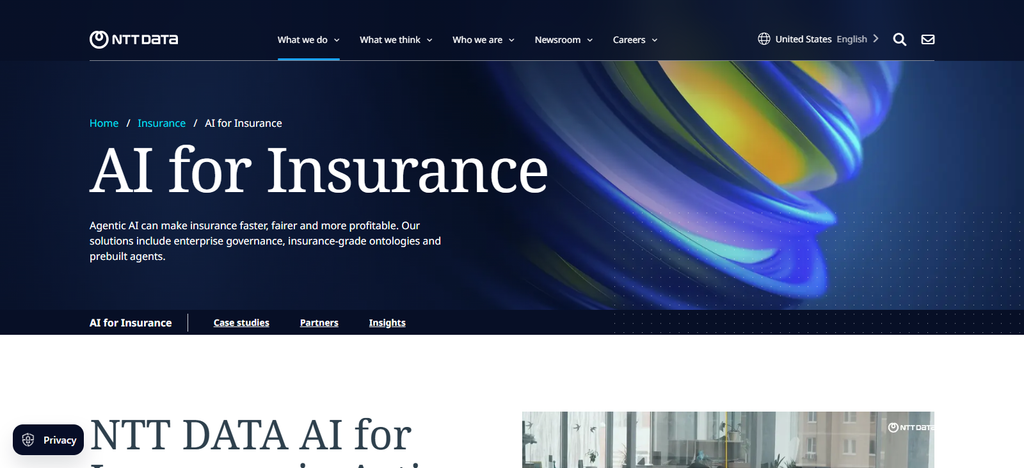
Best for large insurance carriers and enterprise-level companies needing custom automation for complex insurance operations. It can read unstructured documents, understand submissions, extract policy information and make intelligent recommendations for insurance workflows.
Its open integration architecture connects to existing enterprise systems, while oversight by humans and auditability support regulated operations. Prices, CRM implementation, communication channels and analytics setups depend on the deployment model. The applications are insurance applications for life, commercial property, casualty and claims operations.
| Key Features | Explanation |
|---|---|
| Insurance-Specific AI Agents | Supports specialized AI agents for insurance operations, including distribution, underwriting, claims and customer service. |
| Intelligent Document Processing | Analyzes insurance documents and extracts relevant information to support operational workflows. |
| Lead and Submission Qualification | Helps interpret incoming insurance submissions and organize information for further assessment. |
| AI Workflow Orchestration | Coordinates different AI agents and enterprise processes across insurance business functions. |
| Enterprise System Integration | Connects AI workflows with existing insurance applications, enterprise systems and data environments. |
| Human-in-the-Loop Controls | Supports human oversight for decisions and activities requiring additional review or approval. |
| AI Governance | Provides governance and operational controls to support responsible enterprise AI deployment. |
| Analytics and Operational Insights | Supports analysis of insurance processes and operational information to help organizations evaluate workflow performance. |
Conclusion
To summarize, the 10 best AI agents for insurance inquiry routing in 2026 assist insurance companies and brokerages to communicate better with customers, automate lead qualification and manage inquiries more efficiently. Salesforce, Guidewire, Duck Creek and NiCE Cognigy offer insurance-related workflow capabilities, while Zendesk AI, Ada and Decagon focus more on customer interaction automation.
Leena AI, Bevaya and NTT DATA add enterprise automation opportunities. Businesses should consider broker matching capabilities, CRM integration, communication channels, insurance category support, analytics, pricing and data security when choosing a platform to select a solution that suits their operational needs.
FAQ
What Are AI Agents for Insurance Inquiry Routing?
AI agents for insurance inquiry routing are intelligent software systems that classify customer questions, collect relevant information and direct inquiries to suitable insurance brokers, agents or service departments.
How Do AI Agents Route Insurance Inquiries to the Right Broker?
They analyze customer requirements, insurance categories, geographic location and broker availability to identify suitable recipients. Configured routing rules and integrations help automate inquiry assignment.
What Are the Best AI Agents for Insurance Inquiry Routing in 2026?
Some notable platforms include Leena AI, Zendesk AI, Ada, NiCE Cognigy, Decagon, Guidewire Agentic Framework, Duck Creek Agentic AI Platform, Bevaya, Salesforce Financial Services AI Agents and NTT DATA AI for Insurance.
Can AI Agents Automatically Qualify Insurance Leads?
Yes. Configured AI agents can collect customer information, identify coverage requirements, classify insurance interests and prepare lead records before transferring inquiries to brokers or agents.