


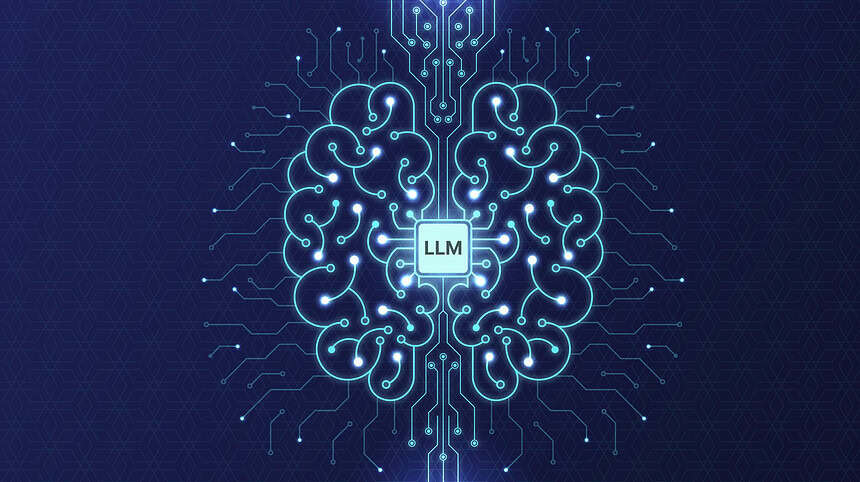
This article will examine the SLMs Running Locally Without GPUs, addressing the optimal usage of small-scale, advanced, and lightweight AI models.
These models facilitate and empower users and businesses to run advanced AI applications on their personal computer systems, thus not requiring large and expensive graphics processing unit (GPU) clusters.
This article will describe the different features and benefits of these models, some of the popular models, and their use cases and future local AI deployment.
What is Small Language Models?
Small Language Models are AI models that are much smaller than Large Language Models, or LLMs. Language Models help AI process human language. In general, SLMs need fewer computing resources to run than LLMs. SLMs, because of the smaller size, are much easier to run on mobile, personal computers, and edge devices than LLMs.
Since SLMs are easier to run, they can help organizations to run AI language applications locally. This helps with data privacy. This also helps organizations reduce the need to pay for services that give access to large clusters of GPUs, or graphical processing units, that assist with data processing.
Benefits Of Small Language Models (SLMs) Running Locally Without GPUs
Reduction in Infrastructure Spending: Deploying Small Language Models (SLMs) reduces costs associated with AI technologies. SLMs consume less memory and mass storage, while requiring less computational power. As such, they can be deployed on standard laptops and desktops, or local servers, without the need for costly GPU clusters and/or Cloud-based AI services.
Better Data Privacy and Security: When SLMs run locally, they keep data on the user’s device. Running models locally is appropriate for those industries that manage and/or process confidential business documents, personal information, and proprietary data.
AI Accessibility Without a Network Connection: If SLMs run locally, users are able to access the AI model any time and anywhere. This is especially advantageous for models used in remote locations, private environments, and models that are expected to operate in cases where a continuous connection to the Cloud is absent.
Local Model Response is Speedier: By eliminating the time lost in network delays, SLMs that run locally provide a better user experience when AI is deployed in automation, assistive technologies, and especially in real time AI applications.
Consumer Device Deployment is Simplified: Because SLMs are purposely built to run on everyday hardware (PCs and Laptops) and Edge devices, they can be deployed without the need for specialized infrastructure or highly advanced technical resources.
Greater Customization and Control: Having SLMs run locally means that organizations can easily implement changes, and tune and customize the models to meet their specific demands. This means organizations have greater control over the model and the specific domain knowledge, and the behavior of the model and the application.
Energy Efficiency: SLMs are better for the environment and for saving battery since they consume substantially less energy than large AI models. They use fewer parameters with less intensive computing.
Scalable Edge AI Applications: Since SLMs are small, they allow the deployment of scalable AI systems on smart devices, IoT, and mobile and embedded applications, without the reliance of centralized cloud computing.
Less Cloud Reliance: Local deployment of AI models enables businesses and developers to break free of the cloud computing cost and third-party service model. This supports more self-reliance and savings in the long run.
Enhanced Development Accessibility: Open source SLMs have provided the opportunity for more researchers, startups, and developers to use more affordable systems to engage in AI. This has promoted the ability to create and refine ideas with more advanced AI, and develop resources, to a broader range of individuals.
Popular Small Language Models (SLMs) Running Locally Without GPUs You Can Try Today
- Phi-3 Mini – Microsoft’s lightweight 3.8B parameter SLM designed for efficient local AI tasks, reasoning, and coding without large GPU requirements.
- Mistral 7B – Open-source 7B model offering strong performance, fast inference, and advanced language understanding for local deployments.
- Gemma 2B – Google’s compact 2B model optimized for low-resource devices, privacy-focused AI, and lightweight applications.
- LLaMA 3 1B – Meta’s small-scale language model providing fast responses, improved instruction following, and efficient edge AI performance.
- GPT4All – Local AI platform that enables users to run multiple open-source language models privately on personal computers.
- Alpaca 7B – Stanford’s instruction-tuned model built on LLaMA, focused on human-like responses and research experimentation.
- Vicuna 7B – Conversational AI model fine-tuned for better dialogue quality, chatbot development, and assistant applications.
- Falcon 1B – Lightweight Falcon model designed for low-cost AI deployment, embedded systems, and efficient text generation.
- TinyLLaMA – Ultra-small 1.1B parameter model built for running AI applications on limited hardware environments.
- Dolly 3B – Databricks’ instruction-following model designed for business assistants, document tasks, and enterprise AI solutions.
10 Small Language Models (SLMs) Running Locally Without GPUs
1. Phi‑3 Mini
Phi-3 Mini is one of the most capable Small Language Models (SLMs) Running Locally Without GPUs developed by Microsoft. With 3.8 billion parameters, Phi-3 Mini is highly efficient, so it is able to offer strong capabilities in reasoning, math, coding, and following directions.
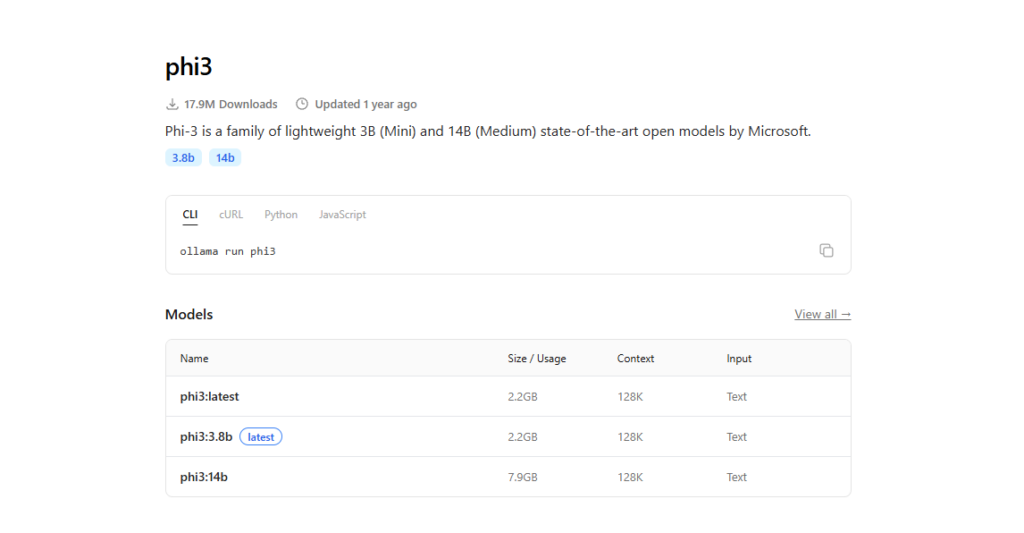
Phi-3 Mini is designed with long-context processing in mind, and is able to run on laptops and desktops. Unlike many other large language models, Phi-3 Mini is able to run on edge devices without the deployment of costly GPU clusters.
These design qualities also make Phi-3 Mini a good model choice for private AI assistants and offline applications. Additionally, AI enterprise tools and locally deployed systems for software development, inference, and AI, are all areas where Phi-3 Mini would have a positive impact on both cost and data privacy.
| Feature | Details |
|---|---|
| Developer | Microsoft |
| Model Type | Small Language Model (SLM) |
| Parameters | 3.8 Billion Parameters |
| Architecture | Transformer-based optimized architecture |
| Local Running Support | Runs efficiently on laptops, desktops, and edge devices without GPUs |
| Context Length | Supports long-context understanding for complex tasks |
| Main Strength | Strong reasoning, coding, mathematics, and instruction-following abilities |
| Performance | Provides high-quality responses with lower computational requirements |
| Use Cases | AI assistants, coding tools, research, automation, and enterprise applications |
| Key Advantage | High intelligence-to-size ratio with privacy-focused local deployment |
Why Should You Use Phi-3 Mini
- Local AI that works efficiently: Phi-3 Mini provides excellent reasoning and language capabilities, and with minimal computing requirements, it is easily run AI locally without the need for GPU clusters.
- Less Expense: This small model allows businesses and developers to run the model at the cost of standard laptops and edge devices.
- AI with Privacy: This model allows users to avoid using cloud AI services and allows the users to keep their data private and handle it locally.
2. Mistral 7B
Created by Mistral AI, Mistral 7B is an open-source language model that is even larger than many of its competitors, with 7 billion parameters. Even though it is a smaller model, it utilizes advanced transformer technology such as sliding-window attention and grouped-query attention.
Compared with so many larger models, Mistral 7B is stronger in reasoning, first language capabilities, and even generation of code and text in a number of different languages. It runs efficiently on consumer grade hardware without the need for GPUs.
Mistral 7B is a model of choice for a large number of applications, including but not limited to: AI assistants, chatbots, and highly scalable AI in enterprise applications. Content generation and creativity, as well as research endeavors are all typical applications of Mistral 7B.
| Feature | Details |
|---|---|
| Developer | Mistral AI |
| Model Type | Open-source Small Language Model |
| Parameters | 7 Billion Parameters |
| Architecture | Transformer architecture with Sliding Window Attention |
| Local Running Support | Can run locally on consumer hardware with optimized versions |
| Main Strength | Excellent reasoning, text generation, and coding performance |
| Efficiency | Faster inference compared to many larger language models |
| Customization | Supports fine-tuning for specific business requirements |
| Use Cases | Chatbots, content creation, programming assistants, enterprise AI |
| Key Advantage | Powerful performance with relatively low resource consumption |
Why Should You Use Mistral 7B
- Small Size, but High Capability: Mistral 7B has only 7 billion Parameters yet provides high quality text generation and reasoning and is among the best in the field of generation and coding.
- Cost Friendly Design: Its highly efficient design allows powerful AI applications to be run locally without costly GPU requirements.
- Open for Everyone: Mistral 7B can be modified or fine-tuned based on the needs so it can be easily used in varied applications.
3. Gemma 2B
Developed by Google DeepMind, Gemma 2B is a compact Small Language Models (SLMs) Running Locally Without GPUs model, housing 2 billion parameters. The model is focused on performance for AI applications on resource-constrained devices.
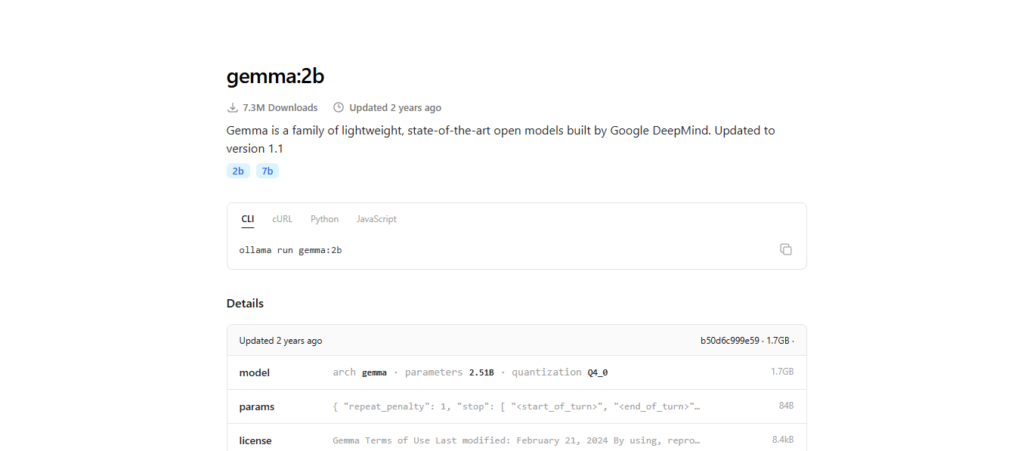
Built on the Google Gemini research, Gemma 2B is dedicated toward the responsible use of AI, enhanced language model capabilities, and expedited inference. The model also has low memory overhead and supports a variety of applications ranging from text generation and questions answering/summarization to conversation.
Gemma 2B can be run locally on personal computers, edge devices, and even inexpensive and lightweight servers. For these reasons, the model is also ideal for privacy-preserving AI and cost-effective AI solutions.
| Feature | Details |
|---|---|
| Developer | Google DeepMind |
| Model Type | Lightweight Open Language Model |
| Parameters | 2 Billion Parameters |
| Architecture | Transformer-based model inspired by Gemini research |
| Local Running Support | Designed for local devices and edge deployment |
| Main Strength | Efficient text generation and language understanding |
| Security | Built with responsible AI and safety-focused training |
| Performance | Provides strong results with limited computing resources |
| Use Cases | Mobile AI apps, research, chat assistants, automation |
| Key Advantage | Compact size with Google-level AI optimization |
Why Should You Use Gemma 2B
- Light, but High Capability AI: Compared to larger models, Gemma 2B can be run on systems with smaller configurations, yet provides high quality language comprehension.
- Perfect for Edge: It is portable on personal systems thus can be used in mobile and offline AI based apps.
- Developing AI Responsibly: AI experiments and deployments can be done responsibly and reliably with use of Gemma due to AI safety centric model designed by Google.
4. LLaMA 3 1B
Meta’s LLaMA 3 1B is a Small Language Models (SLMs) Running Locally Without GPUs model. At about 1 billion parameters in size, it is a small, efficient model in the LLaMA 3 family. Compared to previous small models in the family, this model demonstrates greater instruction following and response accuracy as well as support for multiple languages.
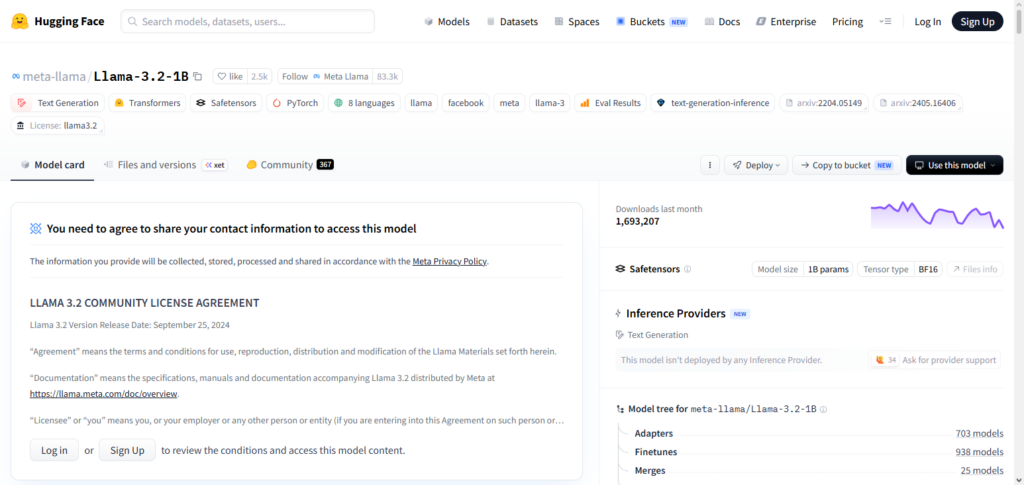
LLaMA 3 1B is designed for use on personal computers and mobile devices because of the lack of large GPUs. The model is great for use in the privacy-preserving AI assistant and automation tool space. Additionally, it supports offline research and faster processing applications.
| Feature | Details |
|---|---|
| Developer | Meta AI |
| Model Type | Compact LLaMA 3 Language Model |
| Parameters | 1 Billion Parameters |
| Architecture | Transformer-based LLaMA architecture |
| Local Running Support | Optimized for local computers and edge devices |
| Main Strength | Fast inference and improved instruction following |
| Language Support | Supports multilingual AI applications |
| Efficiency | Requires less memory and computing power |
| Use Cases | Personal assistants, automation, research, offline AI |
| Key Advantage | Lightweight model with advanced LLaMA 3 capabilities |
Why Should You Use LLaMA 3 1B
- Fast Responses: LLaMA 3 1B is perfect for general AI service use due to fast responses and the need for minimal hardware.
- Personal AI Designed Locally: LLaMA 3 1B is perfect for developing personal automation and assistant services as it negates the need for cloud services.
- More Advanced Language Capability: Even with its compact design, it has a greater ability to follow instructions and handle multiple languages.
5. GPT4All
Developed by Nomic AI and the open-source community, GPT4All is an ecosystem for Small Language Models (SLMs) Running Locally Without GPUs. As an ecosystem, GPT4All contains many tiny language models. These models are capable of running on end-user computers.
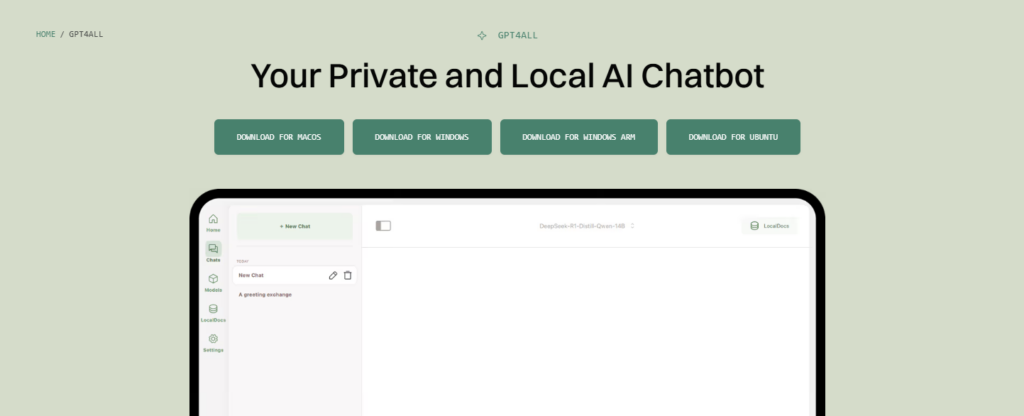
GPT4All solves offline AI conversations and document writing by allowing users to create chatbots without sending data to AI cloud services. GPT4All aims to be more accessible, letting users with standard laptops and CPUs run AI technologies, and helping users without large computer clusters. Its privacy-focused approach provides researchers, developers, and businesses with secure local AI.
| Feature | Details |
|---|---|
| Developer | Nomic AI and Open-Source Community |
| Model Type | Local AI Platform and Model Ecosystem |
| Parameters | Depends on selected integrated models |
| Local Running Support | Runs completely offline on personal computers |
| Main Strength | Privacy-focused AI conversations |
| Compatibility | Supports Windows, macOS, and Linux systems |
| Performance | Provides access to multiple open-source AI models |
| Use Cases | Chatbots, document analysis, personal AI assistants |
| Key Advantage | Easy local AI access without cloud dependency |
Why Should You Use GPT4All
- Fully Offline AI Tool: Now, people can use multiple AI models within their computers, all without the need to ping external servers.
- Better Privacy: AI remains conversational and document safe, as everything stays on the personal computer.
- More Accessibility: AI can now be used on everyday computers, without the need for a more expensive, high-end GPU.
6. Alpaca 7B
Developed by Stanford University researchers, Alpaca 7B is an instruction-tuned model with 7 billion parameters based on the LLaMA architecture by Meta. Being an instruction-tuned model means that it is highly capable of understanding and executing the requests of humans in the form of commands.
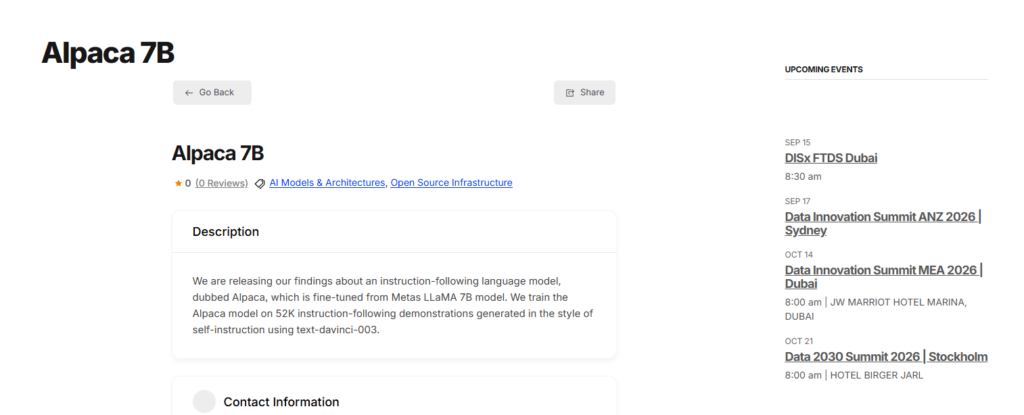
Alpaca 7B is capable of advanced human-like text generation, summarization, and question answering with even basic reasoning. Being fairly smaller as a model, Alpaca 7B is highly accessible and deployable, which has made it highly popular among the AI research and education communities as well as experimental chatbot communities.
| Feature | Details |
|---|---|
| Developer | Stanford University |
| Model Type | Instruction-Tuned Language Model |
| Parameters | 7 Billion Parameters |
| Base Model | Built on Meta LLaMA architecture |
| Local Running Support | Runs locally with optimized configurations |
| Main Strength | Human-like instruction understanding |
| Training Focus | Fine-tuned using instruction-following datasets |
| Performance | Generates helpful and conversational responses |
| Use Cases | Research, education, AI assistants, experiments |
| Key Advantage | Simple and effective instruction-based AI model |
Why Should You Use Alpaca 7B
- Good with Following Instructions: Unlike most small models, Alpaca 7B manages to give more reasonable and human-like responses.
- Good for Experimenting: More and more people are using it to experiment and to develop custom language models.
- Inexpensive AI Use: Compared to most language models, it has a smaller footprint, meaning it can be used without expensive resources.
7. Vicuna 7B
The Vicuna 7B model is a conversational Small Language Model (SLMs) Running Locally Without GPUs designed by the LMSYS organization. It has 7 billion parameters and has had fine-tuning from the LLaMA architecture.
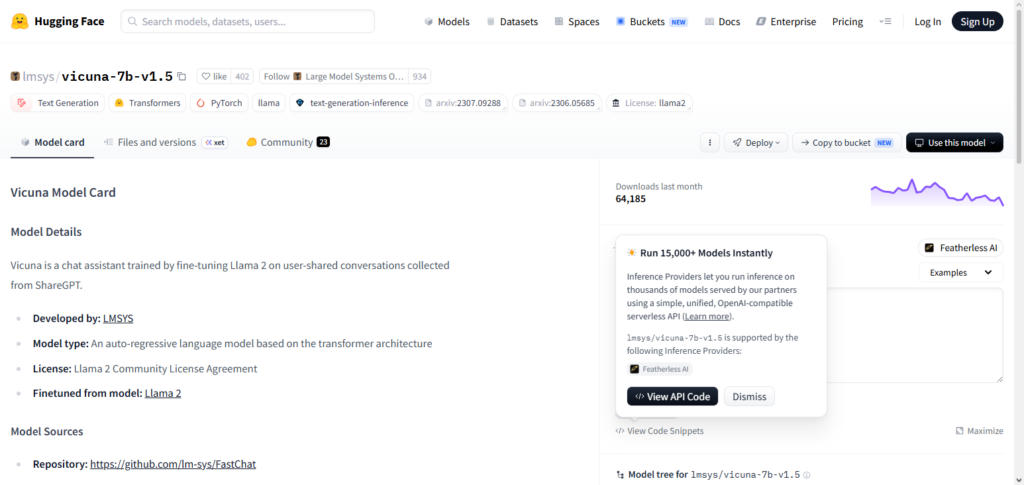
This model is designed to create conversations that are natural and human-like while also having a better understanding of dialogue and instructions. This model can be run on a local machine for a variety of applications including (but not limited to) a chatbot, a virtual assistant, customer support, and for research purposes.
Being able to run this model without the need of a high-end GPU cluster makes this model tailored for a variety of organizations who want a private conversational AI.
| Feature | Details |
|---|---|
| Developer | LMSYS Organization |
| Model Type | Conversational Language Model |
| Parameters | 7 Billion Parameters |
| Base Architecture | Based on LLaMA model |
| Local Running Support | Can operate locally without GPU clusters |
| Main Strength | Natural conversations and chatbot performance |
| Training Focus | Fine-tuned with conversational datasets |
| Performance | Provides human-style dialogue responses |
| Use Cases | Customer support, virtual assistants, chat applications |
| Key Advantage | Strong conversational ability at smaller model size |
Why Should You Use Vicuna 7B
- Good with Conversations: Thanks to its human-like chatting, it can easily be used for conversational interfaces.
- Building Private Chatbots: Developers can build their own conversational AIs without the use of APIs.
- Open Development Model: It’s community based, meaning it’s customizable and improvable.
8. Falcon 1B
The Falcon 1B model is another conversational Small Language Model (SLMs) Running Locally Without GPUs. This model is also designed by the Technology Innovation Institute (TII). This model has 1 billion parameters and is designed for the cost-efficient AI applications that require minimal computing power. While remaining memory-efficient,
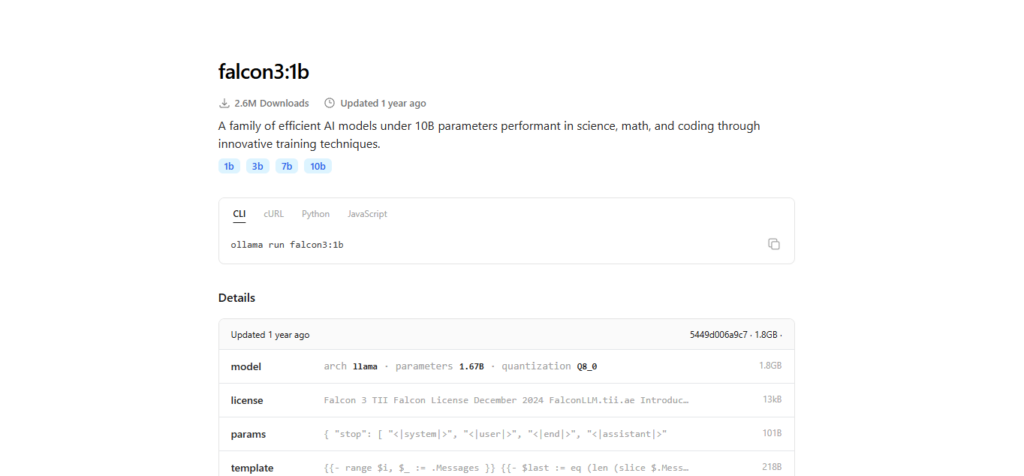
Falcon 1B provides robust capabilities for text generation, language comprehension, and learning. Models this small are able to run on laptops, edge devices, and small servers, all without a dedicated GPU. This model is perfect for embedded artificial intelligence, educational, and research related projects.
| Feature | Details |
|---|---|
| Developer | Technology Innovation Institute (TII) |
| Model Type | Lightweight Language Model |
| Parameters | 1 Billion Parameters |
| Architecture | Transformer-based Falcon architecture |
| Local Running Support | Designed for low-resource local deployment |
| Main Strength | Fast text generation with minimal hardware |
| Efficiency | Low memory usage and quick processing |
| Use Cases | Edge AI, research, embedded applications |
| Performance | Provides reliable NLP capabilities for small systems |
| Key Advantage | Suitable for affordable AI implementation |
Why Should You Use Falcon 1B
- Lightweight on Resources: Falcon 1B is designed for lightweight AI tasks, and can run of computers with minimal resources.
- Lightweight and Fast: Small size makes fast and efficient use and responsive enough for local use.
- Good with Edge AI: Small enough for small applications, AI tasks and experiments.
9. TinyLLaMA
TinyLLaMA is a highly efficient Small Language Models (SLMs) Running Locally Without GPUs model based on Meta’s LLaMA architecture. Developed by the TinyLLaMA community, the model features roughly 1.1 billion parameters and is a smaller, more compact difficult language model.
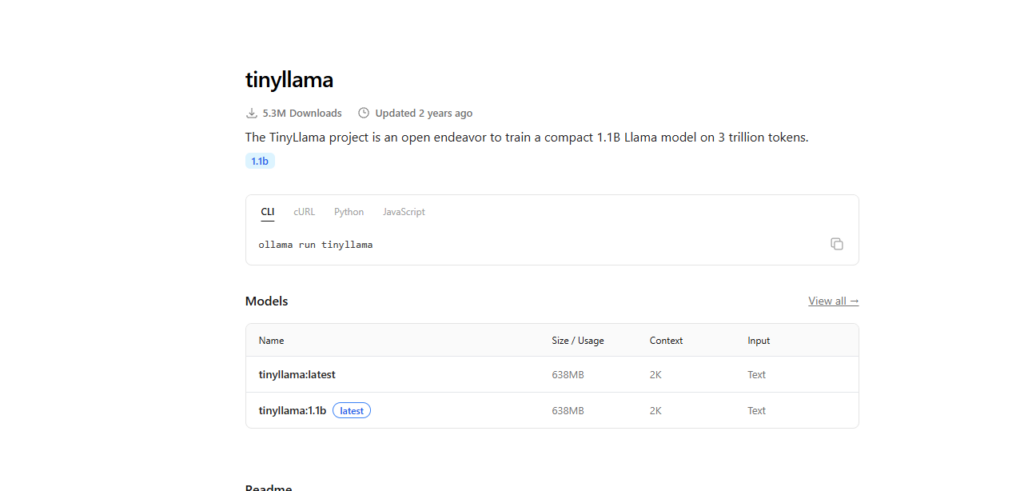
The aim of TinyLLaMA is to address the difficulty of resource constrained environments by providing the ability to generate and understand language in a resource efficient manner.
TinyLLaMA is accessibly designed to function on personal computers, as well as a myriad of low powered devices and edge environments, without the need of GPU clusters. Its lightweight design and accessibility gives TinyLLaMA the ability to function in a myriad of environments, making it ideal to aid research, testing, and the informal learning of AI for developers.
| Feature | Details |
|---|---|
| Developer | TinyLLaMA Project Community |
| Model Type | Ultra-Lightweight Language Model |
| Parameters | 1.1 Billion Parameters |
| Architecture | Based on LLaMA architecture |
| Local Running Support | Runs on basic computers without GPUs |
| Main Strength | Extremely low-resource AI operation |
| Efficiency | Requires minimal memory and processing power |
| Use Cases | AI research, testing, education, prototypes |
| Performance | Provides useful language generation in a compact format |
| Key Advantage | One of the smallest LLaMA-based local AI models |
Why Should You Use TinyLLaMA
- Super Small AI Model: TinyLLaMA is perfect for people who need a small language model for local use.
- Basic Hardware Compatibility: Requires no demanding hardware.
- Ideal for Testing: Useful for research, experimentation, and practice with AI models.
10. Dolly 3B
Dolly 3B, developed by Databricks, has 3 billion parameters. An instruction following small language model (SLM), Dolly 3B was developed to further conversational skills on the basis of datasets containing human instructions. Dolly 3B was developed for enterprise applications, like document processing and business content and assistant automation.
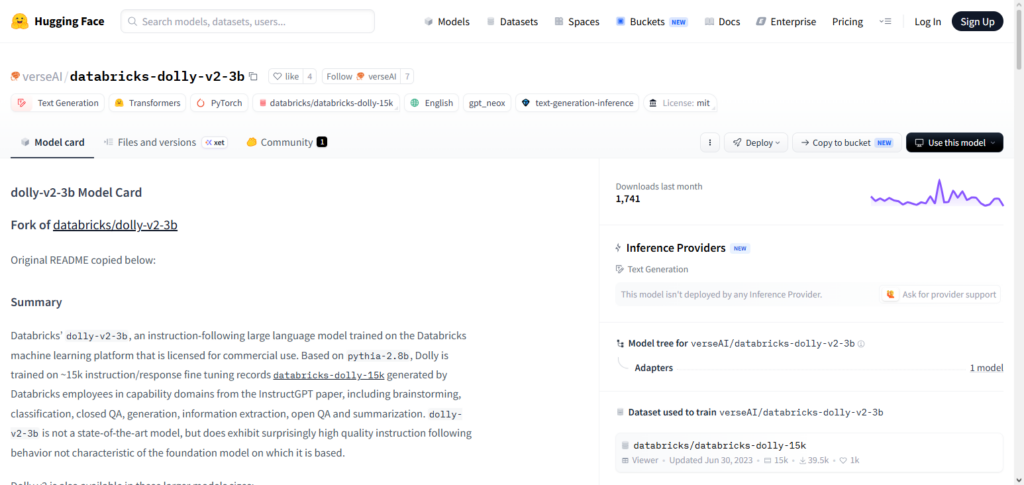
Its smaller size means Dolly 3B is deployable on enterprise services locally and doesn’t require costly external GPU clustering or the cloud. For small to medium business and enterprise needs Dolly 3B is private, customizable, and budget friendly.
| Feature | Details |
|---|---|
| Developer | Databricks |
| Model Type | Instruction-Following Language Model |
| Parameters | 3 Billion Parameters |
| Architecture | Transformer-based model |
| Local Running Support | Supports local deployment with optimized setups |
| Main Strength | Business-focused AI responses |
| Training Data | Trained using human-generated instruction examples |
| Performance | Handles text generation and productivity tasks |
| Use Cases | Enterprise assistants, document processing, workflow automation |
| Key Advantage | Practical AI model for business applications with lower costs |
Why Should You Use Dolly 3B
- Designed for Business Use: Targets enterprise needs like automating workflows and processing documents.
- Easy to Deploy Locally: Companies wishing to have more control over their data and cut costs can run this model on their own servers.
- Trained to Follow Instructions: Well-suited to address common business questions and execute various tasks.
Conclusion
The use of Small Language Models (SLMs) Running Locally Without GPUs is revolutionizing AI. No longer must individuals, developers, and businesses write expensive language processing integrations themselves. Locally processing language models is inexpensive due to SLMs.
Models processing language in smaller scales, like Phi-3 Mini, Mistral 7B, and Gemma 2B, do not require the use of large and expensive GPU clusters. Language models are also improving privacy and decreasing the cost of operations. Processing offline is rapidly improved by SLMs.
Further, SLMs integrate easily with laptops, desktops, and edge devices. Industries will be able to adopt SLMS Local processing of language models as security and optimization of hardware continue to improve. SLMS will also allow industries to personalize their applications of Artificial Intelligence.
FAQ
What are Small Language Models (SLMs) Running Locally Without GPUs?
Small Language Models (SLMs) Running Locally Without GPUs are lightweight AI models designed to operate on personal computers, laptops, and edge devices without requiring powerful GPU hardware. These models use fewer parameters and optimized architectures to provide text generation, reasoning, coding, and conversational AI capabilities while reducing infrastructure costs.
Can Small Language Models run efficiently without a GPU?
es, many Small Language Models (SLMs) can run efficiently without GPUs because they are optimized for CPU-based inference. Models like Phi-3 Mini, Gemma 2B, TinyLLaMA, and Falcon 1B require less memory and computing power, allowing users to deploy AI applications on standard consumer devices.
What are the benefits of running SLMs locally without GPUs?
Running SLMs locally provides several advantages, including improved data privacy, lower operational costs, offline accessibility, faster response times, and reduced dependency on cloud AI services. Businesses can maintain control over sensitive information while developers can build customized AI solutions.
Which Small Language Models can run locally without GPUs?
Popular Small Language Models that can run locally without GPUs include Phi-3 Mini, Mistral 7B, Gemma 2B, LLaMA 3 1B, GPT4All, Alpaca 7B, Vicuna 7B, Falcon 1B, TinyLLaMA, and Dolly 3B. These models are optimized for efficient deployment on consumer hardware.