




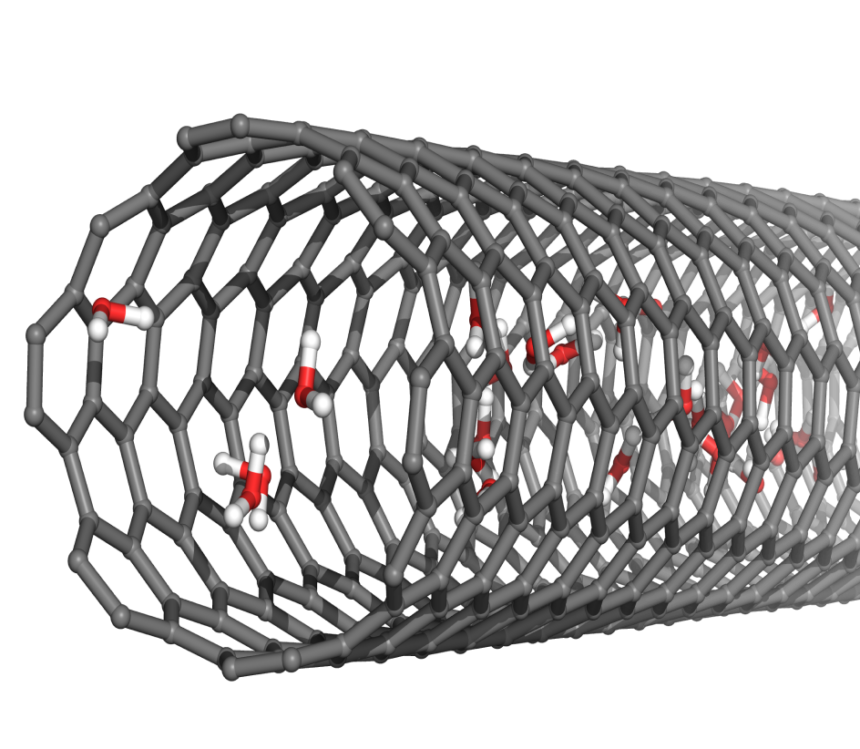
Computational Chemistry tools serve as integral support systems for scientists and engineers in the field of materials science.
With the advent of new systems, researchers can visualize the arrangement of atoms and molecules and simulate the properties of new materials.
In the following article, I will describe the leading Computational Chemistry tools with a focus on the features, pros and cons, and how each system supports the advancement of research in nanotechnology, semiconductor and energy storage technologies, and modern manufacturing.
Key Point & Best Computational Chemistry Platforms for Material Science
| Platform | Key Point |
|---|---|
| Gaussian | Industry-leading quantum chemistry software for molecular structure optimization, spectroscopy, and reaction pathway analysis. |
| Quantum ESPRESSO | Open-source package widely used for density functional theory (DFT) calculations and materials property simulations. |
| LAMMPS (Sandia National Labs) | High-performance molecular dynamics simulator designed for large-scale materials and atomic-level modeling. |
| GROMACS | Fast molecular dynamics software optimized for biomolecules, polymers, and nanoscale material simulations. |
| CP2K | Versatile computational chemistry platform supporting DFT, molecular dynamics, and condensed matter simulations. |
| NWChemEx | Next-generation computational chemistry framework built for scalable quantum chemistry and high-performance computing environments. |
| Molpro | Specialized quantum chemistry software known for highly accurate electronic structure and correlation calculations. |
| Schrödinger Materials Science Suite | Commercial platform combining molecular modeling, machine learning, and materials design workflows. |
| TURBOMOLE | Efficient quantum chemistry package focused on rapid DFT and ab initio calculations for large molecular systems. |
| ASE (Atomic Simulation Environment) | Python-based toolkit that streamlines the setup, automation, and analysis of atomistic simulations across multiple engines. |
1. Gaussian
Gaussian can simulate the electronic properties of a molecule and the chemical reactions it can undergo. It has a variety of advanced quantum chemistry tools, such as DFT and post-Hartree-Fock theories. Because of its powerful features, it is one of the most used computational chemistry tools.
Simulating the structures and energies of the molecules and the reactions can be done before the actual chemistry work is done. It is one of the Best Computational Chemistry Platforms for Material Science.
Gaussian is very useful for scientists and engineers who work on the design of advanced materials, such as catalysts, nanomaterials, and semiconductors. It is very popular among academic institutions and research and development laboratories. Its powerful and accurate computational models help support advanced ideas.
Gaussian Characteristics, Advantages & Disadvantages
Characteristics
- Powerful quantum chemistry.
- Supports DFT and Hartree methods as well as their extensions.
- Geometry optimization.
- Spectroscopy and pathway analysis.
- Prediction of properties of interest.
Advantages
- Excellent accuracy for all electronic calculations.
- Important tool for chemists.
- Comprehensive method library.
- Good documentation and support.
- Excellent tool for studying materials at the molecular level.
Disadvantages
- Costly.
- Difficult to learn.
- Requires a lot of computing power.
- Limited flexibility for open-source competitors.
- Long calculations for large systems.
2. Quantum ESPRESSO
Quantum ESPRESSO is a free and open source software package for performing electronic structure calculations and the modeling of materials at the atomic level.
It is one of the Best Computational Chemistry Platforms for Material Science and is highly regarded for its ability to scale. Quantum ESPRESSO is popular among researchers for its ability to accurately model the electronic structure of crystalline solids and nanostructures.
With considerable efficiency, its high performance architecture allows for research of a wide variety of advanced materials, such as battery materials and semiconductors. Quantum ESPRESSO is often found in the field of computational chemistry for its active support by the scientific community.
Quantum ESPRESSO Characteristics, Advantages & Disadvantages
Characteristics
- Open-source DFT materials.
- Plane-wave methods with pseudopotentials.
- Electronic structure computation.
- Computational analysis of material properties.
- Parallel computing.
Advantages
- Free and open-source.
- Great for periodic crystals.
- Strong support from the scientific community.
- Good performance when computed on HPC.
- Rapidly developing tool.
Disadvantages
- Command line can be difficult.
- Needs a lot of computing resources.
- Difficult to install.
- Limited graphical interfaces.
- Advanced features require a lot of knowledge.
3. LAMMPS (Sandia National Labs)
LAMMPS has Sandia National Labs as the developer and is one of the finest molecular dynamics simulations with possible modeling at various levels with particles, atoms, and molecules. With the inclusion of various force fields and methods of simulations, LAMMPS has made the simulation of metals, polymers, ceramics, and biological materials possible.
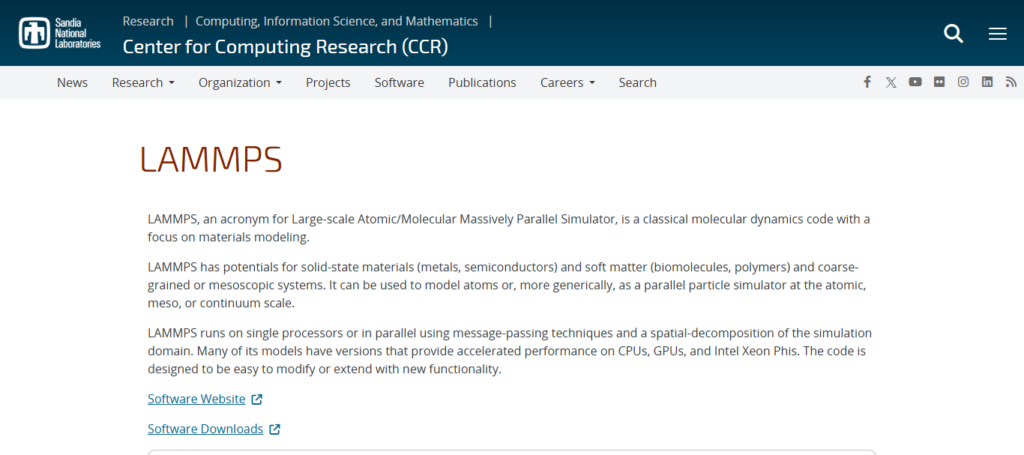
LAMMPS is one of the Best Computational Chemistry Platforms for Material Science as it can be used to study a material’s mechanical properties, thermal properties, behavior and processes of diffusion, and the deformation of the material. LAMMPS is exceptionally scalable and can be used to simulate millions of atoms. Its open nature with extensive customizability adds to the fame of LAMMPS.
LAMMPS (Sandia National Labs) Characteristics, Advantages & Disadvantages
Characteristics
- Scalable molecular dynamics.
- Multiple supported force fields.
- Parallel processing.
- Simulation of phases of matter.
- Custom scripting.
Advantages
- Highly scalable for large systems.
- Open-source and free.
- Extensive simulation options.
- Active development community.
- Suitable for multi-scale modeling.
Disadvantages
- Difficult for beginners.
- Requires force field expertise.
- Limited built-in visualization.
- Complex Input Configuration.
- Output Analysis Could Require Additional Tools.
4. GROMACS
GROMACS has been one of the fastest and most efficient at simulating molecular dynamics with a focus on transports and molecular interactions at the nanoscale. GROMACS can now be found in material sciences, with its origins in the simulation of biochemical systems.
GROMACS has been used to study membranes, polymers, nanomaterials, and complex molecular assemblies. GROMACS has been noted, as one of the Best Computational Chemistry Platforms for Material Science, with being able to offer highly accurate simulations at a lower computational cost due to its effective algorithms.
The parallelization of GROMACS also aids simulations of a larger scale with the use of supercomputers. GROMACS is noted to be an excellent tool with its advanced documentation and extensive user base.
GROMACS Characteristics, Advantages & Disadvantages
Characteristics
- Molecular Dynamics Engine
- GPU Acceleration
- Fast Trajectory Analysis
- Multiple Force Fields
- Extensive Tools for Simulation
Advantages
- Fast
- Free and Open-source
- Excellent Scalability
- Good Community Support
- Good Tutorials
Disadvantages
- Molecular Systems Focused
- Limited Quantum Chemistry
- Difficult Advanced Workflows
- External Visualization Required
- Low Specialization for Solid-State
5. CP2K
CP2K is a software package used in computational chemistry and solid-state physics that incorporates several aspects of computations, such as density functional theory, molecular dynamics, and quantum calculations.
CP2K is ideal for the simulation of condensed matter, liquids, interfaces, and large molecular systems. As one of the Best Computational Chemistry Platforms for Material Science, CP2K enables the efficient modeling of complicated materials.
This package uses a hybrid quantum-classical approach and can perform accurate calculations on the properties of materials and the events of chemical reactions. The strength of CP2K lies in its ability to deal with large atomistic systems, especially with the research of energy materials, catalysts, and nanotechnology.
CP2K Characteristics, Advantages & Disadvantages
Characteristics
- Integrated DFT and MD
- Hybrid Quantum-Classical
- A Framework for Condensed Matter
- Supports Large Systems
- Efficient Mixed Gaussian and Plane-Wave
Advantages
- Large Systems
- Many Materials
- Open-source
- Good Performance on HPC
- Good Condensed Matter Simulations
Disadvantages
- Complicated Setup
- Advanced Computing Needed
- Poor GUI
- High Learning Curve
- Advanced Documentation
6. NWChemEx
NWChemEx is a new computational chemistry software that is an extension of the traditional modular quantum chemistry software with the incorporation of high-performance computing. It has an innovative approach for the electronic structure methods and large molecular frameworks.
As one of the Best Computational Chemistry Platforms for Material Science, NWChemEx allows the computational chemistry community to perform accurate calculations on materials and molecular frameworks of great complexity.
This software is tailor-made for the latest accomplishments in supercomputing, and as such, presents a notable increase in efficiency and scaling. Its current usage includes materials discovery, the prediction of molecular properties, and the exploration of chemical phenomena.
NWChemEx Characteristics, Advantages & Disadvantages
Characteristics
- Modular Software Architecture
- Modern Electronic Structure
- Designed for HPC
- Scalable Simulations
- Plugin Architecture
Advantages
- Built for Supercomputers of the Future
- Large Calculations
- Flexible Design
- Open-source
- Leading Edge Research
Disadvantages
- Small community
- Few Tutorials
- Newer Software
- Limited Commercial Support
- High Technical Barrier
7. Molpro
Molpro is a powerful program for the computation of electronic structures. The software is especially useful for developing advanced wavefunction methods for precise calculations of the interactions and bonds that exist in a molecule.
Molpro is excellent for studying reaction pathways and mechanisms, excitations, and advanced systems with high demands on accuracy and precision.
Other notable features of Molpro, which are especially useful for studying the electronic structures of materials, include its capability to study materials at a deeper level when conventional DFT methods fail to do so. For these reasons, Molpro is best suited for theoretical chemists and materials scientists, especially those doing foundational work in the field.
Molpro Characteristics, Advantages & Disadvantages
Characteristics
- Wavefunction methods that provide high accuracy.
- Advanced methods to calculate correlation.
- Simulations of excited states.
- Analysis of electronic structures.
- Quantum chemistry methods that provide high accuracy.
Advantages
- High quality calculations.
- Excellent for theoretical chemistry.
- Benchmarks are reliable.
- Superior electronic calculations.
- Good reputation in scientific fields.
Disadvantages
- Cost of commercial licensing.
- High cost of calculations.
- Poor scalability for large systems.
- Difficult to learn.
- Poor for day-to-day simulations.
8. Schrödinger Materials Science Suite
The Schrödinger Materials Science Suite is a commercial software package that combines modeling, simulation, data analysis, and machine learning techniques in a single framework.
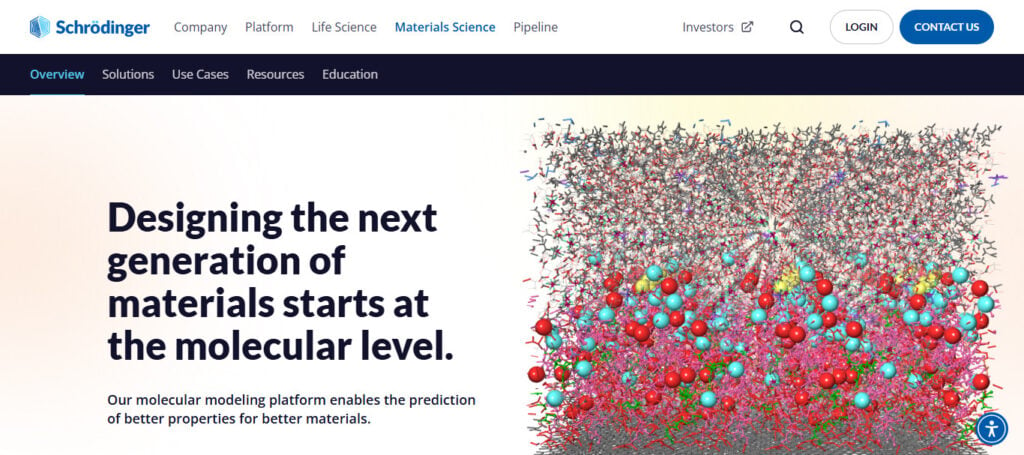
Advanced and physics-based simulations of materials are integrated with innovative computational workflows to make the first steps in the material discovery process more efficient. Prominent features of this software include significant assistance in the investigation of polymers, catalysts, batteries, semiconductors, and nanomaterials.
The simpler advanced simulation interface of the software provides a balance between reduced complexity and rigor. Several companies in the pharmaceutical, chemical, electronic, and energy industries have adopted the suite to promote the optimization of material properties and to reduce the costs and duration of development.
Schrödinger Materials Science Suite Characteristics, Advantages & Disadvantages
Characteristics
- Materials modeling suite.
- Workflows that incorporate machine learning.
- Enhanced visualization.
- Prediction of properties.
- Considers ease of use.
Advantages
- Excellent fusion of workflows.
- High quality technical assistance.
- Easy to use graphical interface.
- Reduces time to make materials.
- Widespread use in industry.
Disadvantages
- High cost of subscription.
- Proprietary software.
- Requires expensive computing power.
- Customization limited in comparison to open-source.
- Some users experience licensing issues.
9. TURBOMOLE
TURBOMOLE is a fine Quantum Chemistry software that performs rapid calculations of electronic structures. TURBOMOLE is recognized for performing rapid calculations for density functional theory and Ab initio calculations. It is used by researchers for rapid analysis of molecular structures, spectroscopy, and reaction pathways.
TURBOMOLE is listed as one of the Best Computational Chemistry Platforms for Material Science. TURBOMOLE further provides very low computational cost. It is used in both academic and industrial research for the rapid response needed for research and development of new products in the field of materials science.
TURBOMOLE Characteristics, Advantages & Disadvantages
Characteristics
- Rapid DFT.
- Ab initio methods in quantum chemistry.
- Properties of spectra and quantum chemistry.
- Tools for geometry optimization.
- Parallel computing.
Advantages
- Speed of calculations.
- Quantitative results of high accuracy.
- Good use of resources.
- Large systems are solvable.
- Widespread use in academic settings.
Disadvantages
- Need to purchase commercial license.
- Poor graphical interface.
- Small user base.
- Difficult setup for advanced users.
- Poor integration of workflow steps.
10. ASE (Atomic Simulation Environment)
ASE stands for Atomic Simulation Environment. It is a Python package that provides a user-friendly way to create, manage and automate atomistic simulations. ASE is not a simulation package by itself. It provides a way to connect several simulation packages and workflows in computational chemistry.
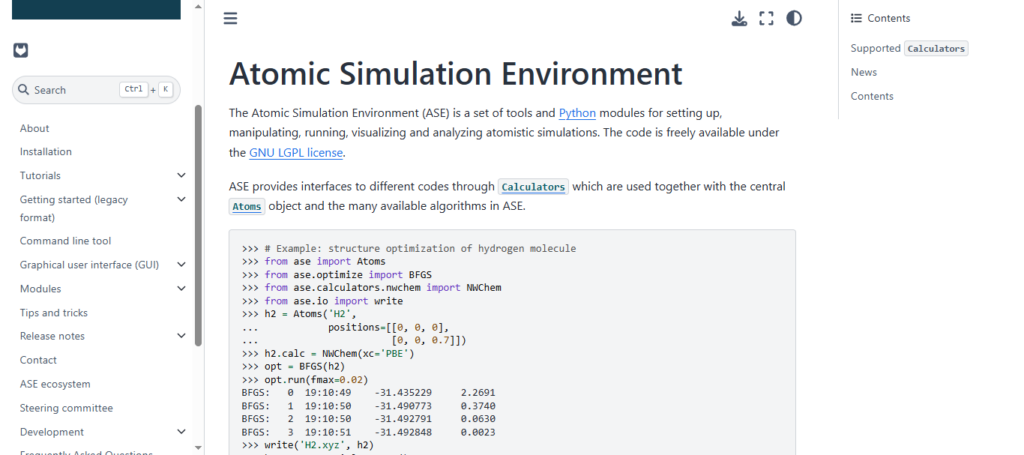
It is regarded as one of the Best Computational Chemistry Platforms for Material Science. ASE provides the ability to construct complicated workflows, automate and analyze calculations. It is extensively used in the fields of high throughput simulation, discovery of new materials, and machine-learning-based materials research.
ASE (Atomic Simulation Environment) Characteristics, Advantages & Disadvantages
Characteristics
- Simulation framework built with Python.
- Automation of workflow.
- Many different simulation engines are supported.
- Rapid capacity testing.
- Variable scripting
Advantages
- Simple inclusion in Python processes.
- Available to the public without cost.
- Offers numerous personalizations.
- Perfect for automated systems.
- Compatible with machine learning.
Disadvantages
- Cannot run independent simulations.
- Users must be able to program.
- Needs additional software.
- Built-in visualization is primitive.
- Speed relies on external simulation integrations.
Conclusion
Computational chemistry for material science simulation tools should provide researchers with the ability to model behaviors and analyze the structures of materials at the atomic and molecular levels.
Gaussian, Quantum ESPRESSO, LAMMPS, GROMACS, CP2K, NWChemEx, Molpro, the Schrödinger Materials Science Suite, TURBOMOLE, and ASE all have specializations from quantum chemistry to large-scale molecular dynamics.
The specific application of these tools to different fields of research to further drive the development of new materials and allow scientists to manage the costs associated with material research and experimentation, especially in energy storage, electronics, and advanced manufacturing, will depend on the computational resources available and the desired level of precision.
FAQ
What are computational chemistry platforms for material science?
Computational chemistry platforms are software tools that use mathematical models, quantum mechanics, and molecular simulations to study the structure, properties, and behavior of materials. They help researchers predict material performance before conducting physical experiments, saving both time and resources.
Which is the best computational chemistry platform for material science research?
The best platform depends on the research objective. Gaussian is excellent for quantum chemistry studies, Quantum ESPRESSO is widely used for density functional theory calculations, LAMMPS is ideal for large-scale molecular dynamics, and CP2K is highly effective for simulating complex condensed matter systems.
Why are computational chemistry platforms important in material science?
These platforms allow scientists to model materials at the atomic level, predict physical and chemical properties, optimize material designs, and accelerate innovation. They reduce experimental costs and help researchers identify promising materials before laboratory testing.
Are there any free computational chemistry platforms available?
Yes. Quantum ESPRESSO, LAMMPS, GROMACS, CP2K, NWChemEx, and ASE are open-source platforms that can be used without licensing fees. They are widely adopted by academic researchers and industrial scientists worldwide.