


In this article, I will cover the Best AI Synthesizers for High-Fidelity Mock Data Testing. These systems help businesses create high quality, realistic synthetic data for the purposes of testing, training, and running analytics on AI systems and other research, while keeping data privacy intact.
These systems focus on the key components of secure, scalable, privacy-preserving, and regulatory compliant systems.; thus, I will cover their key attributes, along with their benefits, and the limitations these systems pose.
Criteria for Selecting the Best AI Synthesizers for High-Fidelity Mock Data Testing
Realism of Data – Evaluating how closely the synthetic data has been aligned with the statistical properties of data that is actually observed.
Privacy Protection – Exposure of sensitive or PII should be prevented while strong synthetic data has been implemented.
Quality and Accuracy of Data – Data generated should be consistent and should display relationships between the various fields of data.
Multiple Data Types– The solution should be capable of generating Data in the formats of; tabular, relational, text, image, time-series, and other data structures.
Scalable – generation of data should be easy for any amount of data required.
Compliance – Support and agreement of standards for generation of data, such as GDPR, HIPAA, CCPA, and other data privacy standards.
AI and ML Readiness – Generated synthetic data should easily integrate and be used in training, validating, and testing AI Models.
Integration Readiness – Should be ready to integrate with data bases, testing tools, and development tools.
Custom Features – Users should be able to define Data generation rules, constraints, distributions, and other parameters.
Synthetic Data Generation Speed – should allow for fast testing of data for ease of use.
Retention of Data Relationships – Should retain any relationships present in the original data.
Security – Enterprise security and customizable access controls.
Easy to use – Simpler User interfaces encourage updates.
Cloud and On-Premises Deployment – Organizations can fulfill their infrastructure needs with versatile deployment options.
Cost and Licensing Model – Cost and scalability options should reflect those of the organization.
Analytics and Validation Tools – Tools provided to assess data quality, privacy risk, and dataset evaluation are incredibly useful.
Industry-Specific Support – Enhanced functionalities for healthcare, finance, retail, manufacturing, etc. can improve support.
Vendor Support and Community – Good technical support and documentation, coupled with a helpful user community, can ensure longevity.
Benefits Of Best AI Synthesizers for High-Fidelity Mock Data Testing
Boosts Data Privacy – Allows for the generation of mock data sets without the risk of revealing any sensitive customer, patient, or business data.
Enhances Compliance – Makes it easier for businesses to meet regulations that protect data like GDPR, HIPAA, and CCPA.
Greater Efficiency – Allows businesses to focus less on the collection, storage, and protection of large data sets.
Shorter Development Times – Businesses can access test data during the development and quality assurance (QA) of the application.
Better AI Training Data – Generates complex, meaningful data sets that help with the training of real-world AI applications.
Unlimited Data Generation – Generates all the data an organization needs for large-scale testing.
Dates Integrity – Maintains the structure and integrity of data relationships.
Less Threats to Data Security – Removes the risk of confidential data being revealed during testing.
Multiple Data Type Support – Synthesizes data sets of tables, text, images, etc.
Data Privacy Frameworks – Allows organizations to maintain data privacy while providing test data.
Better Testing – Provides edge or testing cases that are difficult to recreate with actual data.
Fosters Creativity and Data Science – Provides the data needed to inspire software development and creativity.
Decreased Bias – Reduces bias in the data when used for analytics.
Supports Cloud and DevOps – Integrates with new methodologies readily.
Key Point & Best AI Synthesizers for High-Fidelity Mock Data Testing
- MOSTLY AI – Generates privacy-safe synthetic data while preserving complex relationships and statistical accuracy.
- Gretel – Uses generative AI models to create realistic synthetic datasets for testing, analytics, and machine learning.
- K2View – Produces entity-based synthetic data that mirrors production systems while maintaining compliance.
- Synthetic Data Vault (SDV) – Open-source framework for generating high-quality synthetic tabular, relational, and time-series data.
- Synthea – Creates realistic synthetic healthcare records for medical research, testing, and training purposes.
- YData Synthetic – Automates synthetic data generation for AI development, privacy protection, and data augmentation.
- Mostly Generative Sandbox – Provides a secure environment for creating and validating realistic synthetic datasets.
- Hazy – Generates privacy-preserving synthetic data for regulated industries such as finance and healthcare.
- MDClone – Enables healthcare organizations to create synthetic patient data for research and analytics.
- DataGen – Produces large-scale synthetic datasets, particularly for computer vision and AI model training.
10 Best AI Synthesizers for High-Fidelity Mock Data Testing
1. MOSTLY AI
MOSTLY AI synthesizes realistic datasets without compromising privacy. Most data generation methods capture the underlying statistics of data without including the data themselves. Therefore, this method is entirely safe and applicable in the banking, healthcare, insurance, and telecom industries.
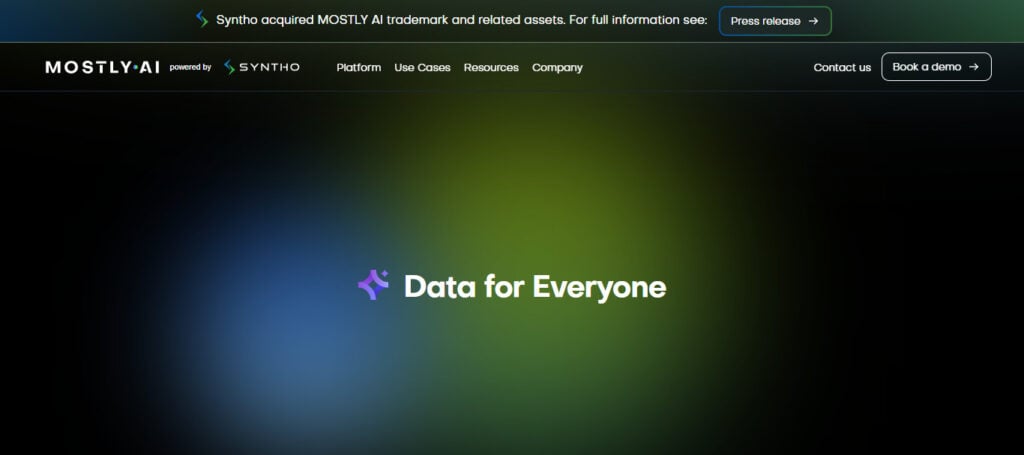
MOSTLY AI’s platform focuses on business analytics and machine learning while ensuring data privacy, facilitating the regulatory compliance process, and providing high data utility. For these reasons, MOSTLY AI is one of the Best AI Synthesizers for High-Fidelity Mock Data Testing.
MOSTLY AI Features, Pros & Cons
| Features | Pros | Cons |
|---|---|---|
| Advanced synthetic data generation | Excellent data realism | Premium pricing for enterprises |
| Privacy-preserving AI models | Strong GDPR compliance support | Learning curve for beginners |
| Multi-table relational data support | Preserves complex data relationships | Resource-intensive for large datasets |
| Cloud and on-premises deployment | Enterprise-grade scalability | Limited free-tier options |
| Automated data quality validation | High accuracy for AI training | Setup can be complex |
2. Gretel
Gretel synthesizes privacy-preserving datasets with a focus on realism. Like MOSTLY AI, Gretel eliminates personally identifiable information through the use of generative models, which capture the structure and distribution of the original data. Gretel supports structured tabular, textual, and time-series data. For this reason, it provides data generation for a variety of use cases.
Gretel is also one of the Best AI Synthesizers for High-Fidelity Mock Data Testing. Gretel’s cloud-based features, along with its privacy and automation controls, make the large-scale generation of synthetic data simple for users.
Gretel Features, Pros & Cons
| Features | Pros | Cons |
|---|---|---|
| AI-powered synthetic data generation | Easy-to-use platform | Advanced features require paid plans |
| Text, tabular, and time-series support | Strong developer tools | Large datasets may increase costs |
| Built-in privacy testing | Good API integrations | Customization can be challenging |
| Cloud-based infrastructure | Fast deployment | Dependence on cloud services |
| Synthetic NLP data generation | Suitable for AI projects | Enterprise support may be costly |
3. K2View
K2View focuses on developing entity-based synthetic data and provides a balance between modeling production environments and maintaining privacy. The platform builds complete business entities and retains all inter-entity relationships.
As one of the Best AI Synthesizers for High-Fidelity Mock Data Testing, K2View develops synthetic business data on a scale and fidelity that allows organizations to confidently perform DevOps, validate business workflows, and develop AI models. K2View develops synthetic business data within complex and highly distributed data ecosystems and integrates with existing data management and testing frameworks.
K2View Features, Pros & Cons
| Features | Pros | Cons |
|---|---|---|
| Entity-based data generation | Excellent for enterprise systems | Higher implementation complexity |
| Production-like test data creation | Maintains business relationships | Requires technical expertise |
| Real-time data provisioning | Supports large-scale environments | Premium enterprise pricing |
| Compliance and masking features | Strong security controls | Longer deployment time |
| Multi-source data integration | Ideal for DevOps testing | Overkill for small organizations |
4. Synthetic Data Vault (SDV)
SDV is a freely available framework for generating synthetic data in a manner that closely matches real data. It is easily applicable to a spectrum of data modalities from tabular to hierarchical relational and time series data. It supports a variety of user groups from researchers and developers to enterprises.
SDV integrates advanced machine learning techniques to synthesize data while ensuring privacy and data distributions and relationships.
It is widely considered one of the Best AI Synthesizers for High-Fidelity Mock Data Testing as it provides realistic data for a variety of use cases, such as software testing and analytics frameworks, as well as for AI research. The flexibility and customization of the open-source framework is also appealing for academic research and enterprise development.
Synthetic Data Vault (SDV) Features, Pros & Cons
| Features | Pros | Cons |
|---|---|---|
| Open-source synthetic data framework | Free and flexible | Requires coding knowledge |
| Relational database support | Highly customizable | Limited enterprise support |
| Time-series data generation | Active community development | Setup can be time-consuming |
| Multiple generative models | Suitable for research projects | Less user-friendly interface |
| Python integration | Transparent model control | Performance varies by dataset |
5. Synthea
Synthea was designed as a synthetic patient data generator for healthcare. It produces electronic health records with real patients’ demographics, diagnoses, and clinical histories.
Synthea is used by healthcare providers, researchers, and software developers to assess healthcare systems without the ethical burden of working with real patients. As one of the Best AI Synthesizers for High-Fidelity Mock Data Testing,
Synthea provides an avenue for organizations to meet regulations around privacy and conduct healthcare scenario simulations accurately. The framework is open-source, which allows users to modify and extend it; consequently, Synthea is highly used in the fields of medical research and health IT, as well as for teaching.
Synthea Features, Pros & Cons
| Features | Pros | Cons |
|---|---|---|
| Synthetic healthcare records generation | Completely free and open source | Focused mainly on healthcare |
| Patient journey simulation | Realistic medical datasets | Limited non-medical use cases |
| EHR-compatible output formats | Useful for healthcare testing | Requires healthcare knowledge |
| Disease progression modeling | Strong research capabilities | Less flexible outside healthcare |
| Community-supported development | Easy access for researchers | Smaller feature set than commercial tools |
6. YData Synthetic
YData Synthetic is one of the AI Synthesizers which creates high-fidelity mock data. YData Synthetic’s unique selling point is the application of state-of-the-art generative models to create synthetic datasets for the domains of machine learning, testing and business analytics, while safeguarding privacy and confidentiality.
YData Synthetic is one of the Best AI Synthesizers for High-Fidelity Mock Data Testing. The platform provides organizations with the ability to create mock datasets that meet the privacy concerns associated with providing their clients with real data.
The platform is used extensively in highly regulated industries due to the mock datasets which it provides that retain realism and serve the functional needs of the clients to support their data-driven business models.
YData Synthetic Features, Pros & Cons
| Features | Pros | Cons |
|---|---|---|
| Automated synthetic data creation | User-friendly interface | Enterprise features may be expensive |
| AI-driven data quality assessment | Strong privacy controls | Limited open-source functionality |
| Machine learning integration | Good model training support | Learning curve for advanced features |
| Data drift monitoring | Scalable deployment options | Some customization limitations |
| Synthetic data benchmarking | High-quality generated data | Cloud dependency in some deployments |
7. Mostly Generative Sandbox
Mostly Generative Sandbox offers companies a safe setting to make and use synthetic data. Users can make datasets that look and act like real data but keep important data safe. The Sandbox helps in development and testing of privacy-focused AI and data sharing initiatives.

Named one of the Best AI Synthesizers for High-Fidelity Mock Data Testing, Mostly Generative Sandbox lets teams use realistic data and aids them in testing and validating applications and algorithms without the need for access to production data. With its intuitive UI, design for compliance, and scalability, it helps enterprises with their trust in synthetic data.
Mostly Generative Sandbox Features, Pros & Cons
| Features | Pros | Cons |
|---|---|---|
| Secure synthetic data experimentation | Easy testing environment | Limited compared to full enterprise suites |
| Privacy-focused dataset generation | Reduces compliance risks | Fewer advanced analytics tools |
| Interactive data exploration | Fast dataset validation | May not support all data formats |
| Sandbox deployment model | Good for proof-of-concept projects | Scalability limitations |
| Data utility evaluation tools | Simplifies synthetic data adoption | Enterprise integrations can be limited |
8. Hazy
Hazy generates synthetic data with the help of preprocessing and advanced ML and AI techniques. Highly privacy-focused, Hazy is a big hit in data-sensitive sectors like finance, health, and insurance. Hazy generates synthetic data that is as useful and valuable as data that exist, but without the privacy risk.

Hazy is one of the Best AI Synthesizers for High-Fidelity Mock Data Testing, and aids development of AI, compliance, and test analytics. Its privacy and enterprise defenses make it one of the safe bets for clients needing synthetic data.
Hazy Features, Pros & Cons
| Features | Pros | Cons |
|---|---|---|
| Privacy-first synthetic data platform | Excellent regulatory compliance | Premium enterprise pricing |
| AI-powered data synthesis | Strong data utility preservation | Limited public documentation |
| Structured data generation | Suitable for financial institutions | Requires onboarding support |
| Enterprise security controls | Reduces privacy risks significantly | Less accessible for small businesses |
| Compliance reporting tools | Supports secure data sharing | Custom deployment may be complex |
9. MDClone
MDClone’s synthetic data platform is made for building research tools and conducting data analyses. MDClone has the power to create real-world patient data sets with clinical integrity, all while safeguarding patient data. MDClone gives researchers and clinicians the opportunity to analyze data and run tests and research without the concern of data privacy.

MDClone is one of the Best AI Synthesizers for High-Fidelity Mock Data Testing because of it’s ability to provide the healthcare sector with safe access to realistic clinical data sets. MDClone is able to simulate data in a way that allows companies to meet data compliance and privacy needs.
MDClone Features, Pros & Cons
| Features | Pros | Cons |
|---|---|---|
| Synthetic healthcare data generation | Designed for medical research | Primarily healthcare-focused |
| Self-service data exploration | High-quality patient simulations | Limited use outside healthcare |
| Clinical data modeling | Supports regulatory compliance | Enterprise licensing costs |
| Research collaboration tools | Accelerates healthcare innovation | Requires domain expertise |
| Privacy-preserving patient records | Strong healthcare analytics support | Smaller ecosystem than broader platforms |
10. DataGen
DataGen is focused on creating artificial data sets for the AI, computer vision, robotics, and autonomous systems industries. DataGen is able to create high-fidelity images, simulated situations, and environments that help train AI systems in a data efficient manner.
DataGen is one of the Best AI Synthesizers for High-Fidelity Mock Data Testing because it’s ability to create simulated environments of virtually any scale with the fidelity needed to train AI systems. The simulated data environments help decrease time to innovate, increase the accuracy of AI, and decrease overall AI development costs.
DataGen Features, Pros & Cons
| Features | Pros | Cons |
|---|---|---|
| Synthetic visual data generation | Ideal for computer vision AI | Less suitable for tabular data |
| 3D environment simulation | Reduces real-world data collection costs | High computational requirements |
| AI training dataset creation | Generates highly diverse datasets | Can be expensive at scale |
| Autonomous system testing | Improves model robustness | Requires graphics expertise |
| Large-scale scenario generation | Accelerates AI development | Specialized use case focus |
Comparison of the Best AI Synthesizers for High-Fidelity Mock Data Testing
| Platform | Primary Use Case | Data Types Supported | Privacy Protection | Deployment | Best For |
|---|---|---|---|---|---|
| MOSTLY AI | Enterprise synthetic data generation | Tabular, relational, transactional | Excellent | Cloud & On-Premises | Large enterprises and regulated industries |
| Gretel | AI-powered synthetic data creation | Tabular, text, time-series | Excellent | Cloud | Developers and AI teams |
| K2View | Entity-based test data management | Relational, enterprise data | Excellent | Cloud & On-Premises | Complex enterprise systems |
| Synthetic Data Vault (SDV) | Open-source synthetic data generation | Tabular, relational, time-series | Good | Self-hosted | Researchers and developers |
| Synthea | Synthetic healthcare records | Healthcare and EHR data | Excellent | Open Source | Healthcare testing and research |
| YData Synthetic | AI and machine learning datasets | Tabular, time-series | Excellent | Cloud & Hybrid | Data science and AI projects |
| Mostly Generative Sandbox | Synthetic data experimentation | Structured enterprise data | Excellent | Cloud | Testing and proof-of-concept projects |
| Hazy | Privacy-preserving enterprise data | Structured and financial data | Excellent | Cloud & Enterprise | Finance and compliance-focused organizations |
| MDClone | Healthcare analytics and research | Clinical and patient data | Excellent | Cloud | Medical research and healthcare analytics |
| DataGen | Computer vision synthetic data | Images, 3D scenes, video | Good | Cloud | Computer vision and autonomous systems |
| Platform | Ease of Use | Scalability | Compliance Support | Open Source | Overall Rating |
|---|---|---|---|---|---|
| MOSTLY AI | High | Excellent | GDPR, HIPAA | No | 9.5/10 |
| Gretel | High | Excellent | GDPR, CCPA | No | 9.3/10 |
| K2View | Medium | Excellent | Enterprise Compliance | No | 9.1/10 |
| SDV | Medium | Good | Basic Privacy Controls | Yes | 8.8/10 |
| Synthea | High | Good | Healthcare Standards | Yes | 8.7/10 |
| YData Synthetic | High | Excellent | GDPR, Enterprise Standards | No | 9.2/10 |
| Mostly Generative Sandbox | High | Good | Enterprise Compliance | No | 8.9/10 |
| Hazy | Medium | Excellent | GDPR, Financial Regulations | No | 9.3/10 |
| MDClone | High | Excellent | HIPAA, Healthcare Compliance | No | 9.4/10 |
| DataGen | High | Excellent | Enterprise Security Controls | No | 9.0/10 |
Conclusion
The Best AI Synthesizer For High Fidelity Mock Data Testing assists companies in developing realistic and privacy-compliant data sets designed for software testing, artificial intelligence, model building, analytics and research. Platforms like MOSTLY AI, Gretel, K2View, SDV, Synthea, Ydata Synthetic, Mostly Generative Sandbox, Hazy, MDClone, and DataGen provide unique capabilities.
Privacy concerns and compliance with privacy legislation inhibit the rapid deployment of innovations. There are numerous types of selective data that comply with privacy laws. When selecting an AI synthesizer, consider the type of data, compliance needs, and the purpose of the tests. These considerations will yield optimal results for even the most current, data-centric exercises.
FAQ
What is an AI synthesizer for mock data testing?
An AI synthesizer for mock data testing is a tool that uses artificial intelligence and machine learning to generate synthetic datasets that closely resemble real-world data. These datasets can be used for software testing, AI training, analytics, and research without exposing sensitive information.
Why is synthetic data important for testing?
Synthetic data allows organizations to test applications, train AI models, and validate systems without using actual customer or patient data. This improves privacy, reduces compliance risks, and provides access to large volumes of realistic test data.
Which industries benefit most from AI synthetic data platforms?
Industries such as healthcare, finance, insurance, telecommunications, retail, and government benefit significantly from synthetic data platforms because they often handle sensitive or regulated information.
What are the best AI synthesizers for high-fidelity mock data testing?
Some of the leading solutions include MOSTLY AI, Gretel, K2View, Synthetic Data Vault (SDV), Synthea, YData Synthetic, Mostly Generative Sandbox, Hazy, MDClone, and DataGen.