





This article will cover the most effective AI Real Estate Valuation Tools geared towards multi-family housing. I will focus specifically on how contemporary artificial intelligence systems are disrupting the traditional means of property analysis and the subsequent investment decisions based on the analysis.
I will also cover several tools that possess the capability to furnish precise property valuations, forecasts for rental income, and a predictive analysis of the rental housing market so that multi-family housing real estate market investors are able to make more effective rational investment decisions.
Why Choose AI Real Estate Valuation Tools for Multi-Family
More Accurate Valuations – Unlike manual valuations, AI has the ability to look at a great deal of data, such as sales history, rental incomes and trends within the market, to provide a more accurate property value.
Increased Efficiency – Investors are able to analyze all multi-family property options in a fraction of the time that the traditional process spends on research and appraisal.
Increased Profitability – Cap rates and rental yields are easily calculated with the help of AI, which allows investors to analyze the best investment options.
Decreased Risk – Before the process of valuation begins, advanced algorithms are able to analyze the risk of the investment, as well as determine if the market is too volatile and if pricing is too high.
Real-Time Data – The AI is able to provide investors with information in real time, and helps determine what the demand and pricing trends in a given neighborhood are.
Enhanced Management – Investors are easily able to manage a great number of multi-family properties, and AI helps investors determine which properties are not performing.
Future Valuation Trends – Investors are able to analyze rental and property valuation trends to help determine long-term investments.
Risk & Considerations
Data Accuracy Dependency: AI real estate valuations are only as good as the underlying data. Inaccurate or missing data will lead to incorrect estimates.
Market Unpredictability: AI models are unlikely to capture all the unpredictable changes to the economy and/or the local market, including sudden changes in regulations.
Limited Property-Specific Insights: AI models might not capture the unique conditions of a specific property, including renovations, structural concerns, or neighborhood micro factors.
High Subscription Costs: Increased costs of advanced AI valuations might pose an issue for smaller or newer investors.
Over-Reliance on Automation: Valuation estimates should guide, not eliminate, the human component of investment decisions.
Gaps in Regional Data: AI Tools may have robust data in some countries/cities but significantly poorer data in others.
Complexity for Beginners: Without sufficient training, many of the advanced analytical features of these valuation tools may be overly complicated for a new user to understand.
Key Point & Best AI Real Estate Valuation Tools for Multi-Family
| Platform | Key Points |
|---|---|
| HouseCanary Value AI | Advanced predictive valuation models, strong data accuracy, nationwide property coverage, useful for investment forecasting |
| Cherre AI Valuation | Integrates fragmented real estate data, strong enterprise analytics, API-first platform for data-driven valuation workflows |
| Reonomy AI Insights | Focus on commercial property intelligence, ownership data mapping, AI-driven lead discovery for investors |
| CoreLogic Valuation AI | Industry-grade property data, trusted mortgage and appraisal analytics, high reliability for institutional users |
| PropStream AI Valuation | Real estate lead generation + valuation tools, great for wholesalers and investors, strong property search filters |
| Mashvisor AI Analytics | Focus on rental property ROI, Airbnb vs long-term rental analysis, ideal for residential investment decisions |
| Redfin AI Valuation Engine | Consumer-friendly home estimates, real-time market comparisons, strong residential pricing accuracy in many U.S. areas |
| CoStar Multifamily AI | Premium commercial real estate data, deep multifamily property insights, widely used by institutional investors |
| CREXi Intelligence AI | Market listing intelligence, property valuation support for CRE deals, strong deal discovery and analytics |
| Valcre AI Appraisal Platform | Appraisal-focused workflow automation, commercial valuation reports, designed for professional appraisers and firms |
1. HouseCanary Value AI
HouseCanary Value AI offers powerful predictive real estate analytics. Using AI, machine learning, and extensive housing market data, it generates accurate property value estimates. Along with historical value trends and neighborhood analytics, it incorporates the potential for value appreciation through rental income, as well as pertinent economic indicators.

Many lenders, investors, and institutions rely on HouseCanary for estimating the future value of real estate assets. For this reason, HouseCanary is our pick among the Best AI Real Estate Valuation Tools for Multi-Family.
HouseCanary Value AI Features, Advantages & Disadvantages
Features
- Predictive models for property valuation
- Extensive property data, nationwide
- Forecasting for market changes
- Rental income evaluation
- Risk and investment analytics
Advantages
- Valuation models with high accuracy
- Strong, institutional data
- Useful for forecasting
- Analysis for large portfolio is easy
- Investors and lenders can rely on it
Disadvantages
- Individual users pay a lot
- Learning is necessary
- Tools for beginners are lacking
- Heavily data focused
- Designed for enterprises
2. Cherre AI Valuation
AI Valuation by Cherre employs a more focused approach by attempting to combine the dispersed and segmented data sets of the real estate industry. Its proprietary automated data integration uses an AI backbone and stitches together property, ownership, and market and performance data.

Cherre is particularly strong at the enterprise level with the automation of data and integration of APIs. For these reasons, it has been placed in the category of Best AI Real Estate Valuation tools for Multi-Familyand represents a more advanced methodology for providing property intelligence to help companies overcome data fragmentation and construct more effective decision-making frameworks.
Cherre AI Valuation Features, Advantages & Disadvantages
Features
- Platform for integrating real estate data
- Analytics via API
- Intelligence dashboards for portfolio
- Data cleansing and normalization
- Tools for enterprise level reporting
Advantages
- No data fragmentation
- Designed for enterprises
- Improved speed for business decisions
- API offers many options
- Good data management
Disadvantages
- Steep learning curve
- Technical setup for use
- Costly for enterprise use
- Valuation UI lacking for self use
- External data source dependent
3. Reonomy AI Insights
Reonomy AI Insights is a platform for analyzing commercial real estate data. Its focus is on ownership information, property records, and analyzing market behaviors. Users can harness the platform’s AI to discover potential investment opportunities, assess value, and analyze changes in ownership.

This tool is popular for deal sourcing and risk analysis within commercial real estate. In the category of Best AI Real Estate Valuation Tools for Multi-Family, Reonomy is appreciated for its extensive real estate maps, investor targeting capabilities, and discovery of off-market opportunities.
Reonomy AI Insights Features, Advantages & Disadvantages
Features
- Intelligence commercial property
- Ownership and transaction data
- AI for lead generation
- Mapping for markets
- Systems for tracking assets
Advantages
- Deal sourcing is easy
- Good ownership data
- Strong focus on commercial
- Off market deals easy to find
- Good tools for property discovery
Disadvantages
- Residential deals are hard
- Subscription costs are high
- Data is inconsistent in various regions
- Interface is complex for beginners
- Valuation is not great precision compared to AVMs
4. CoreLogic Valuation AI
For banks, lenders, and real estate professionals, Core Logic Valuation AI is the top choice for property data analysis. Core Logic offers automated valuation models (AVMs), property risk scores, and predictive market assessments.
The foundation for these analyses is the vault of real estate transactions that Core Logic has aggregated. For the category of Best AI Real Estate Valuation Tools for Multi-Family, Core Logic is valued for its strong predictive scores and data assurance for analytics that aid the assessment of large scale commercial real estate portfolios, underwriting, and investing.
CoreLogic Valuation AI Features, Advantages & Disadvantages
Features
- Advanced Automated Valuation Models (AVMs)
- Mortgage and lending analytics
- Risk scoring for property
- Nationwide real estate data
- Market prediction
Advantages
- Data accuracy is the best
- Used by banks and lenders
- High compliance
- Sophisticated risk scoring
- National real estate data
Disadvantages
- Costs a ton to use
- Very complex
- UI inflexibility
- Long onboarding
- Only for big companies
5. PropStream AI Valuation
If you need a platform that helps real estate wholesalers, investors, and agents get property valuations quickly, look no further than PropStream AI Valuation. It has automated property valuation features, property listing tools, and detailed property reports that include equity, mortgage info, and property comps.

Property listings can be filtered by user defined investment strategies and evaluated for income potential. PropStream is one of the Best AI Real Estate Valuation Tools for Multi-Family because it is easy to use, affordable, and focuses on investment opportunities for residential and multifamily properties.
PropStream AI Valuation Features, Advantages & Disadvantages
Features
- Search and filter for property
- Automated property valuation
- Lead generation
- Ownership and mortgage data
- Investment analysis
Advantages
- Cheap for investors
- User friendly
- Good for wholesalers
- Quick property research
- Good lead generation
Disadvantages
- Valuation not as accurate
- Not many analytics
- Some areas have data gaps
- Not for big companies
- Basic predictive analytics
6. Mashvisor AI Analytics
Investors looking at income from rental properties, particularly those looking to invest in properties that will be used to house short-term (such as Airbnb) renters or looking at properties that will be used to house long term renters, should look at Mashvisor AI Analytics.
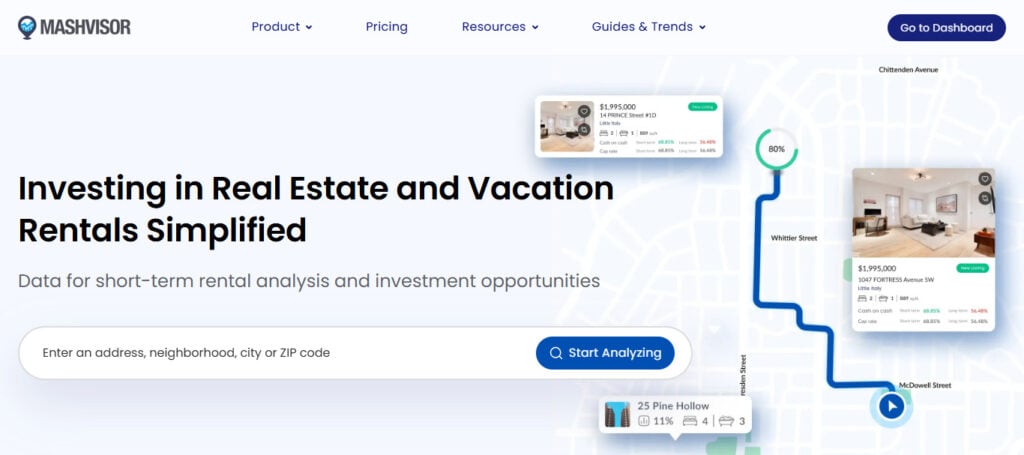
This platform uses artificial intelligence to determine the best rental strategy, the expected occupancy and the return on investment for multi-family properties. It helps potential investors determine where the best investment opportunities are by analyzing neighborhoods with the expected cash flows as well as occupancy projections.
Mashvisor is one of the Best AI Real Estate Valuation Tools for Multi-Family because it helps investors utilize the best rental markets in order to maximize their rental income.
Mashvisor AI Analytics Features, Advantages & Disadvantages
Features
- Rental property ROI
- Cash flow comparison of short-term vs. long-term rentals
- Rental occupancy predictions
- Neighborhood valuation
- Cash flow analysis
Advantages
- Excellent for rental investors
- Good insights for ROI
- User friendly
- Maximizes rental income
- Good market analysis
Disadvantages
- Commercial properties not covered
- Subscription required for full features
- Data accuracy inconsistent
- Not for big investors
- Rental focus
7. Redfin AI Valuation Engine
One of the most popular automated valuation model systems in residential real estate is the Redfin AI Valuation Engine. It looks at transactions, market conditions, and neighborhood data to evaluate home values in real time.
Because of the consumer focus, many people use it to estimate home values and compare properties. In the segment, “Best AI Real Estate Valuation Tools for Multi-Family” Redfin gives useful and easy to use valuation estimates. Redfin’s valuation estimates allow market participants to make better and faster decisions on pricing in a competitive environment.
Redfin AI Valuation Engine Features, Advantages & Disadvantages
Features
- Automated Valuation Model (AVM)
- Instant market comparisons
- Continuous tracking of housing prices
- Listing aggregation
- Neighborhood analytics
Advantages
- Cost free
- Value estimates generated rapidly
- Easy navigation
- Robust data
- Ideal for on-the-fly decisions
Disadvantages
- Inaccurate in less populated areas
- Lack of commercial emphasis
- Not geared towards investments
- Shallow analytics
- Errors in estimates are likely
8. CoStar Multifamily AI
CoStar Multifamily AI is a high-end, commercial real estate analytic tool with a lot of data on multifamily housing. It gives users analytics on multifamily properties, rental trends, and vacancy data, and provides investment comparison tools.

Because of the rich and detailed data, a lot of institutional investors and commercial brokers use it for very important investment decisions. In the segment, “Best AI Real Estate Valuation Tools for Multi-Family” CoStar Group has advanced and rich data for multifamily investment, making it a very reliable tool for most users.
CoStar Multifamily AI Features, Advantages & Disadvantages
Features
- Deep analytics for multifamily housing
- Rental and occupancy metrics
- Commercial analytics
- Investment benchmarking*
- Property profiles
Advantages
- The most accurate in the industry
- Targeted towards institutional investors
- Comprehensive multifamily data
- Superior analytics
- Commercial market data is extensive
Disadvantages
- High cost of access
- Difficult for entry-level users
- Complex interface
- Learning required
- Designed for larger corporations
9. CREXi Intelligence AI
CREXi Intelligence AI is a commercial real estate marketplace with a great suite of analytics tools. The tools use data and machine learning to help with the valuation of property, deal and listing intelligence, and aid in the discovery of deals.

Users can evaluate the attractiveness of an opportunity and compare assets. In the segment, “Best AI Real Estate Valuation Tools for Multi-Family”, CREXi is a highly reliable tool and offers useful data to participants. This helps investors and real estate professionals complete deals more quickly and confidently.
CREXi Intelligence AI Features, Advantages & Disadvantages
Features
- Commercial listings
- AI Enhanced Deal Analysis
- Analytics Dashboard
- Automated Buyer/Seller Match
- Investment Benchmarks
Advantages
- Deal sourcing made easy
- Clear marketplace
- Efficient for Brokers and Investors
- Fast transactions
- Robust Listings
Disadvantages
- Lack of extensive valuation models
- Commercial only
- Data is hit or miss
- Poor forecasting
- Requires active market participation
10. Valcre AI Appraisal Platform
Designed for professional appraisers and valuation firms, the Valcre AI Appraisal Platform automates workflows, report generation, and property analysis through AI-based data processing. The platform enables appraisal practices to bolster accuracy, consistency, and efficiency in the valuation of commercial property.

Because of its widespread use in institutional appraisal practices, Valcre is considered one of the Best AI Real Estate Valuation Tools for Multi-Family. Valcre creates a solution that is structured, compliant, and scalable to support the production of professional valuation reports for multifamily and commercial assets.
Valcre AI Appraisal Platform Features, Advantages & Disadvantages
Features
- AI-powered appraisal workflows
- Automated valuation reporting
- Commercial property analysis
- Compliance-ready reports
- Data integration tools
Advantages
- Highly efficient for appraisers
- Improves report accuracy
- Saves time in valuations
- Strong compliance features
- Enterprise-grade reliability
Disadvantages
- Not for casual investors
- Requires training
- Limited residential use
- Subscription-based pricing
- Focused mainly on appraisal firms
Conclusion
Multi-family property analysis and investment has drastically changed in today’s data-centric real estate market. Leveraging AI, the best valuation tools let users predict risk exposure and returns with better accuracy. Some popular AI valuation tools real estate professionals often use include HouseCanary, CoreLogic, CoStar, and Mashvisor.
Each valuation service has a distinct target audience. However, the services are essential for improving the profitability and efficiency of multi-family property investment by lowering risk exposure and illuminating quality investment options.
FAQ
What are AI real estate valuation tools for multi-family properties?
AI real estate valuation tools are software platforms that use machine learning, big data, and predictive analytics to estimate the value of multi-family properties. They analyze market trends, rental income, location data, occupancy rates, and historical sales to generate accurate property valuations and investment insights. These tools help investors reduce guesswork and make data-driven decisions in the multi-family real estate market.
Why are AI valuation tools important for multi-family investments?
Multi-family properties involve complex financial metrics such as cash flow, cap rates, and occupancy risks. AI valuation tools simplify this process by providing fast, accurate, and data-backed insights. They help investors identify profitable properties, forecast rental income, and reduce investment risk. This makes them essential for both beginner and institutional real estate investors.
Which is the most accurate AI real estate valuation platform?
Accuracy depends on the data quality and use case. Platforms like CoreLogic, HouseCanary, and CoStar are known for high institutional-grade accuracy due to their large datasets and advanced modeling systems. However, tools like Redfin are better for quick residential estimates, while Mashvisor focuses more on rental income and ROI analysis.
Can AI tools predict future property values?
Yes, many AI valuation platforms use predictive analytics to estimate future property value trends. They analyze historical price movements, economic indicators, demand-supply patterns, and neighborhood growth to forecast potential appreciation or depreciation. While not 100% guaranteed, these predictions help investors plan long-term strategies more effectively.