




The Best Predictive Pathology AI Software for Cancer Screening will be the focus of this article. These products aim to enhance the accuracy of diagnoses, streamline pathology workflows, and improve the prospects of the early detection of cancer.
By facilitating the automated analysis of tissue samples, these software solutions, which are built around AI and contemporary digital pathology, are capable of identifying anomalous features and implementing advanced precision oncology. This in turn supports faster diagnostic processes and optimal healthcare outcomes for patients.
Key Point & Best Predictive Pathology AI Software for Cancer Screening
| Software | Key Points |
|---|---|
| Paige AI Pathology | AI-powered digital pathology platform for cancer detection, assists pathologists with slide analysis, supports biomarker discovery, improves diagnostic consistency, and accelerates pathology workflows. |
| PathAI Predictive Oncology | Uses machine learning for cancer diagnosis and treatment insights, enhances tissue analysis accuracy, supports clinical research, provides predictive biomarkers, and improves patient stratification. |
| Ibex Medical Analytics Galen™ | Real-time cancer detection assistance, identifies abnormalities in pathology slides, reduces diagnostic errors, integrates into existing workflows, and supports prostate and breast cancer screening. |
| Philips IntelliSite Pathology AI | Digital pathology solution with AI-assisted image analysis, enables remote pathology review, streamlines laboratory operations, supports collaboration, and enhances diagnostic efficiency. |
| Roche Navify Digital Pathology AI | Combines digital pathology with AI analytics, supports cancer diagnostics, integrates pathology data management, improves workflow automation, and aids precision medicine initiatives. |
| Aiforia AI Pathology | Cloud-based AI platform for pathology image analysis, customizable deep learning models, supports research and diagnostics, automates tissue quantification, and enables large-scale image processing. |
| Proscia Concentriq AI | AI-driven pathology workflow platform, facilitates digital slide management, supports algorithm deployment, improves collaboration, and enhances pathology productivity. |
| Sectra Digital Pathology AI | Enterprise digital pathology system with AI integration, supports high-volume slide review, enables remote diagnostics, improves data accessibility, and streamlines pathology operations. |
| DeepBio AI Pathology | Deep learning-based pathology analysis software, automates cancer detection tasks, improves diagnostic speed, supports pathology screening programs, and enhances reporting accuracy. |
| Lunit INSIGHT Pathology AI | Advanced AI for tissue and cancer analysis, provides biomarker quantification, supports precision oncology, improves pathology interpretation, and assists in treatment decision-making. |
1. Paige AI Pathology
Paige AI Pathology helps pathologists detect and analyze cancerous tissues with an advanced AI system and is among the leading cancer diagnostic software. This software uses deep learning algorithms to look for abnormalities within millions of patient pathology images.
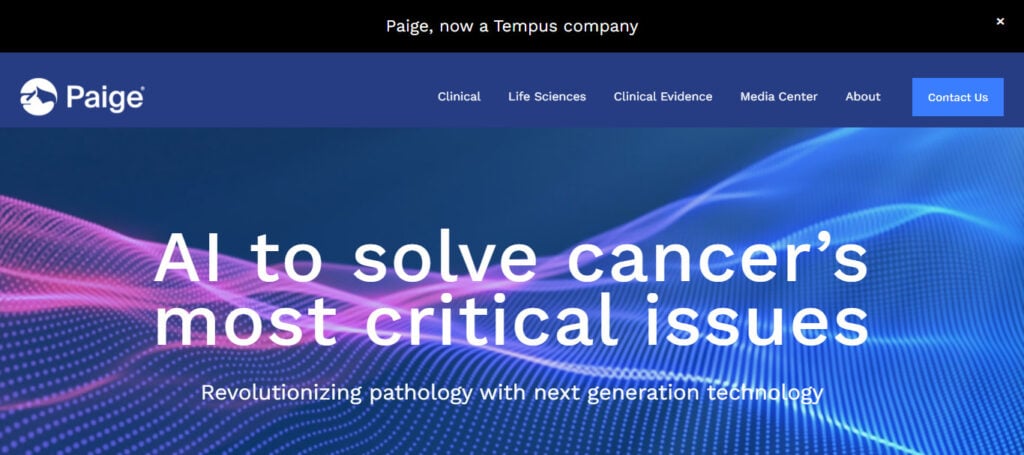
This software is particularly useful for abnormalities that are hard to capture during a routine diagnostic analysis. Paige is considered one of the Best Predictive Pathology AI Software for Cancer Screening. This software also helps pathologists diagnose cancer faster, decreases the amount of variance when different pathologists diagnose the same patient, and speeds up the time it takes to review slides.
Paige AI Pathology helps diagnose multiple cancer types including breast cancer, prostate cancer, and colorectal cancer among others. Pathologists also use this software to streamline their digital pathology system to improve patient outcomes.
Paige AI Pathology Importance
- Employs advanced deep learning to enhance accuracy of cancer detection.
- Aids pathologists in finding abnormalities in tissue samples.
- Minimizes variability of diagnosis between pathologists.
- Improves efficiency of pathology workflow and slide review.
- Facilitates early detection of cancer and improves patient prognosis.
Paige AI Pathology
| Pros | Cons |
|---|---|
| High cancer detection accuracy | May require significant investment |
| Supports multiple cancer types | Dependent on digital pathology infrastructure |
| Reduces diagnostic variability | Learning curve for new users |
| Improves pathology workflow efficiency | Regulatory approvals vary by region |
| Strong AI-driven decision support | Requires high-quality scanned images |
2. PathAI Predictive Oncology
PathAI Predictive Oncology is a software system that combines AI with the expertise of pathology to perform advanced tissue diagnostics and develop predictive models to improve the diagnosis and treatment of cancer.
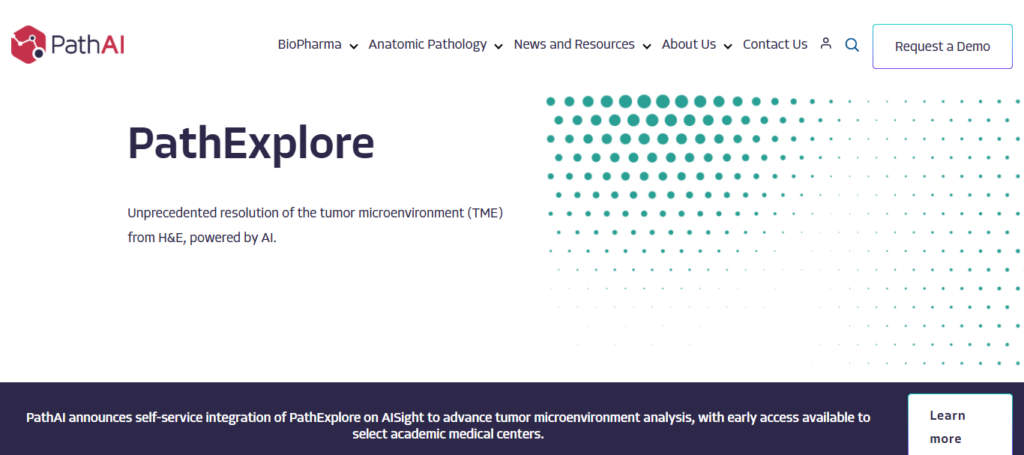
This software uses machine learning algorithms to analyze histopathology slides and detect biomarkers that indicate the progression of a disease and the likely therapeutic response. PathAI is also recognized among the Best Predictive Pathology AI Software for Cancer Screening.
This software helps pharmaceutical companies with their sponsored research, clinical trials, and the development of personalized medicine.
This software provides pathologists with advanced decision-making analytics and helps reduce the inconsistency of diagnosis. PathAI is a leader in personalized oncology and helps improve patient outcomes through advanced cancer detection and better patient stratification.
PathAI Predictive Oncology Importance
- Offers predictive analytics for oncology pathology and treatment.
- Promotes accuracy of biomarker and tissue analyses.
- Advances tailored medicine and targeted cancer treatment.
- Assists drug developers in more efficient clinical trial design.
- AI-based analysis reduces pathology review errors.
PathAI Predictive Oncology
| Pros | Cons |
| Advanced biomarker analysis | Can be expensive for smaller labs |
| Supports precision medicine initiatives | Requires integration with existing systems |
| Enhances treatment decision-making | Dependent on data quality |
| Useful for clinical trials and research | Specialized training may be needed |
| Improves diagnostic consistency | Limited functionality without digital workflows |
3. Ibex Medical Analytics Galen™
Ibex Medical Analytics Galen™ employs AI to help detect cancer from tissue samples. The application uses digital pathology technology to analyze tissue samples automatically. It highlights problem areas for pathologists to review.

Because Ibex Galen™ is one of the Best Predictive Pathology AI Software for Cancer Screening, it is heavily used for screening breast, prostate, and gastric cancer.
The software improves case detection and support for decisions made in a diagnostic process, and it easily integrates into a laboratory’s workflow. Because of this, the software increases the efficiency of a laboratory and the safety of patients.
Ibex Medical Analytics Galen™ Importance
- Offers in-situ, real-time, AI assistance in Pathology.
- Complements manual identification of cancer lesions.
- Provides a needed assurance of quality in pathology.
- Builds confidence in pathology diagnosis.
- Supports more efficient and effective cancer screening.
Ibex Medical Analytics Galen™
| Pros | Cons |
| Real-time cancer detection assistance | Requires digital pathology adoption |
| Reduces risk of missed diagnoses | Initial setup can be complex |
| Integrates into laboratory workflows | May need workflow adjustments |
| Improves quality assurance processes | Ongoing maintenance requirements |
| Supports multiple cancer screening applications | Subscription and licensing costs |
4. Philips IntelliSite Pathology AI
Philips IntelliSite Pathology AI decouples slide imaging and management from the AI analysis of the images. Therefore, it helps pathologists review and diagnose cases even when they are not physically present in the same location as the images.
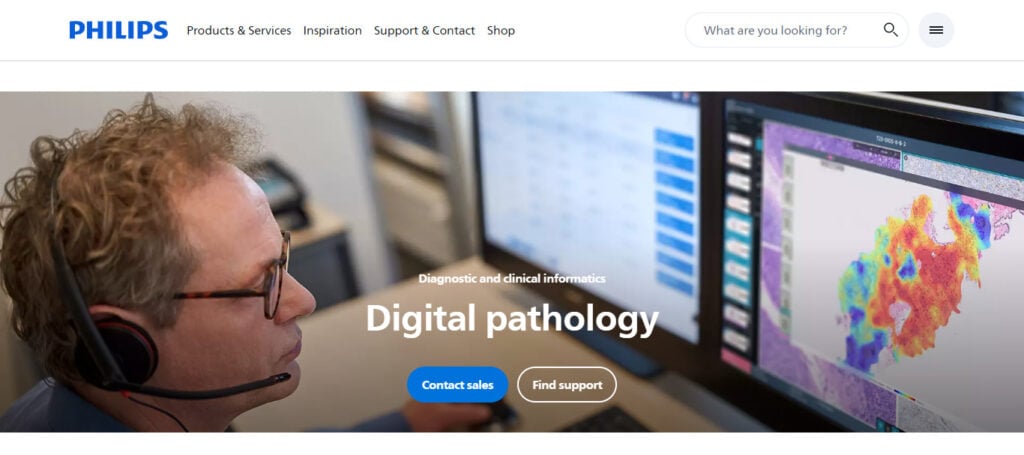
Because IntelliSite is one of the Best Predictive Pathology AI Software for Cancer Screening, it helps cancer diagnostics by significantly improving pathology throughput and interactivity and flexibility for the pathology work flow in hospitals, diagnostic labs, and research labs.
The digitization of pathology work flow, combined with AI assistance, brings a marked improvement in productivity and efficiency in health care, as well as greater consistency and reliability in diagnostics.
Philips IntelliSite Pathology AI Importance
- Supports digital pathology in all healthcare organizations.
- Provides remote pathology reviews and telepathology.
- Benefits all medical teams by improving communication.
- Promotes efficiency in labs and speed of case reviews.
- Utilizes AI to enhance cancer detection.
Philips IntelliSite Pathology AI
| Pros | Cons |
| Comprehensive digital pathology platform | High implementation cost |
| Enables remote pathology review | Requires robust IT infrastructure |
| Supports large-scale laboratory operations | Hardware investments may be necessary |
| Improves collaboration among specialists | Training required for effective use |
| AI-assisted image analysis capabilities | Complex deployment in smaller facilities |
5. Roche Navify Digital Pathology AI
Roche Navify Digital Pathology AI provides an AI and imaging-integrated digital pathology ecosystem focused on cancer. It enables pathologists to collect and examine data and even share it in real time, and uses AI to enhance the accuracy of diagnoses.
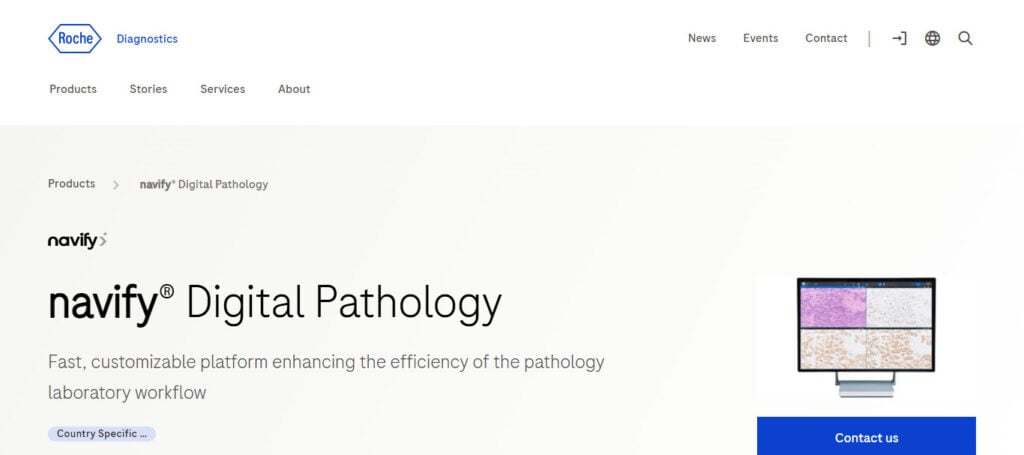
It was rated one of the Best Predictive Pathology AI Software for Cancer Screening. Navify’s capability to discover biomarkers and identify malignant cells and support precision oncology makes it invaluable.
Its software connects laboratory information systems (LIS) and digital pathology systems (DPS) to build a seamless workflow. By centering on data-driven pathology, the software helps clinicians improve the accuracy of their diagnosis and develop more advanced treatment plans for patients.
Roche Navify Digital Pathology AI Importance
- Merges Digital Pathology and AI analysis.
- Enhancements in both Pathology and Oncology will drive Precision Based Pathology and Biomarker Based decisions.
- Improves the availability of data across healthcare.
- Automated Pathology increases Diagnostic Confidence and Consistency.
Roche Navify Digital Pathology AI
| Pros | Cons |
| Strong integration with pathology ecosystems | Premium pricing structure |
| Supports precision oncology workflows | May require Roche-compatible infrastructure |
| Advanced data management features | Implementation can take time |
| Enhances diagnostic accuracy | Technical expertise may be needed |
| Facilitates collaborative diagnostics | Customization options may vary |
6. Aiforia AI Pathology
Aiforia AI Pathology is a digital pathology platform built on the cloud. It allows pathologists and researchers alike to create, modify, and implement AI for digital imaging. It provides the automation of the detection, classification, and quantification of cells and tissues that can be customized for many different types of cancer.

Furthermore, as one of the Best Predictive Pathology AI Software for Cancer Screening, it provides highly customizable deep learning frameworks. Aiforia’s cloud-based infrastructure is scalable and provides users the ability to work with high volumes of digital pathology images.
Aiforia’s combination of simplified workflows and encouraged analytical depth serves to improve clinical and research diagnostics in biomedicine.
Aiforia AI Pathology Importance
- Automates various tasks for complex tissue image analysis
- Custom AI models can be created for specific studies
- Cuts down time spent on quantifying pathology images
- Aids in the pathology and biomedical research of varying scales
- Speeds the cancer screening and diagnosis workflows
Aiforia AI Pathology
| Pros | Cons |
| Cloud-based and scalable platform | Dependence on internet connectivity |
| Customizable AI models | Custom model development can be time-consuming |
| Supports research and diagnostics | Subscription costs may increase over time |
| Automates image analysis tasks | Requires validated datasets |
| Handles large image volumes efficiently | Learning curve for advanced features |
7. Proscia Concentriq AI
Proscia Concentriq AI is a digital pathology platform with artificial intelligence focused on improving cancer detection and analysis embedded directly into enterprise level pathology workflows.

It consolidates slide management, image viewing, and team collaboration along with AI into a single environment. As one of the Best Predictive Pathology AI Software for Cancer Screening, Concentriq AI is designed to help pathologists discover anomalies more rapidly, and improves productivity and workflow.
The software also enables remote consultations and large-scale pathology quality assurance programs. Thanks to its interoperability with laboratory and AI systems, healthcare organizations can rapidly advance their pathology workflows and offer improved diagnostic services.
Proscia Concentriq AI Importance
- Integrates AI with centralized digital pathology data
- Strengthens teamwork of pathologists and the wider clinical team
- Increases the efficiency of work through the automation of tasks
- Allows an elastic implementation of digital pathology
- Promotes quicker and more precise diagnosis of cancer
Proscia Concentriq AI
| Pros | Cons |
| Centralized pathology workflow management | Initial deployment complexity |
| Supports third-party AI integrations | Cost may be high for smaller labs |
| Enhances collaboration and productivity | Requires digital pathology infrastructure |
| Scalable enterprise solution | Training needed for full utilization |
| Streamlines slide management | Dependence on system integration quality |
8. Sectra Digital Pathology AI
Sectra Digital Pathology AI is a sophisticated pathology software system designed to accommodate high-volume diagnostic workflows and AI-driven cancer screenings.

Featuring rapid slide access and secure image management with advanced analytics to assist pathologists for even the most challenging cases, it is easy to see why it is ranked as one of the Best Predictive Pathology AI Software for Cancer Screening. Sectra helps pathologists and healthcare providers improve diagnosis and design pathology workflows with reduced turnaround times.
The software is designed to facilitate pathology services and collaboration remotely, across multiple departments and even geographic locations. Integrated with AI, Sectra identifies dangerous patterns earlier, even when they are hard to find, and improves pathology workflows along with service to patients.
Sectra Digital Pathology AI Importance
- Provides an advanced digital pathology framework that is both safe and efficient
- Offers rapid access to images and reports
- Supports extensive workflows in digital pathology and cancer screening
- Makes pathology diagnosis more consistent regardless of location
- Makes remote diagnosis and reviews by specialists possible
Sectra Digital Pathology AI
| Pros | Cons |
| Secure digital pathology environment | Higher implementation expenses |
| Supports high-volume pathology operations | Requires compatible scanning systems |
| Enables remote diagnostics | IT support requirements can be significant |
| Improves workflow efficiency | Integration may take time |
| Facilitates AI-powered pathology review | Advanced features may need additional licensing |
9. DeepBio AI Pathology
DeepBio AI Pathology employs deep learning to provide automated pathology image analysis for enhanced cancer detection. Their platform can recognize abnormal cellular patterns, classify tissue samples, and provide support for diagnostic decisions.

Being one of the Best Predictive Pathology AI Software for Cancer Screening, DeepBio assists pathologists in balancing their workload and preserving diagnostic accuracy. The software can analyze a significant amount of digital pathology slides, which shrinks review time and boosts the overall efficiency of the lab.
The insights provided by the software improve quality control and provide support to the healthcare systems that wish to have a scalable, repeatable, and reliable system for cancer pathology diagnosis and cancer screening.
DeepBio AI Pathology Importance
- Automated cancer detection through deep learning
- Lessens burden on pathology professionals
- Enhances speed and efficiency of pathology reporting
- Helps recognize atypical tissue patterns early
- Creates a more productive lab environment with AI automation
DeepBio AI Pathology
| Pros | Cons |
| Automated pathology image analysis | Limited availability in some regions |
| Reduces workload for pathologists | Requires digital pathology adoption |
| Improves diagnostic speed | AI performance depends on training data |
| Supports early cancer detection | Regulatory acceptance may vary |
| Enhances laboratory productivity | Integration challenges may arise |
10. Lunit INSIGHT Pathology AI
Lunit INSIGHT Pathology AI is a sophisticated artificial intelligence system that aids in the assessment of biomarkers, tumor-based analysis, and specialty areas of oncology. The software focuses on the analysis of pathology and quantification of immuno-and cancer-associated biomarkers that impact decision making.

It is ranked among the Best Predictive Pathology AI Software for Cancer Screening. Lunit INSIGHT is of utmost importance to pathologists and oncologists, as it helps reveal the biology of tumor and the potential response of the patient.
Its algorithms help in the appraisal of tissue and diminish variability in order to assist in the improvement of decisions made in the clinical practice. It helps enhance cancer diagnosis and treatment, thereby improving the delivery of personalized medicine in the field of oncology.
Lunit INSIGHT Pathology AI Importance
- Offers sophisticated analysis of biomarker and tumors
- Supports more accurate path of both oncology and immunotherapy
- Improved analysis of microenvironments
- AI analysis and insights improve diagnosis
- Helps clinicians tailor treatment more effectively to patients
Lunit INSIGHT Pathology AI
| Pros | Cons |
| Advanced biomarker quantification | Premium enterprise-level pricing |
| Supports precision oncology applications | Requires high-quality pathology images |
| Improves treatment planning insights | Training may be required for users |
| Reduces interpretation variability | Dependent on digital pathology systems |
| Strong AI-driven tissue analysis | Integration can be resource-intensive |
Conclusion
The Best Predictive Pathology AI Software for Cancer Screening is changing the structure of healthcare businesses, particularly in the detection, analysis, and diagnosis of cancer.
Products like Paige AI Pathology, PathAI Predictive Oncology, Ibex Galen™, Philips IntelliSite, Roche Navify, Aiforia, Proscia Concentriq, Sectra, DeepBio, and Lunit INSIGHT adopt state-of-the-art artificial intelligence in order to create more accurate diagnostics, minimize human error, and optimize faster pathology.
These products assist pathologists in the detection of cancer and advance the practice of customized medicine. With the active adoption of digital pathology, AI-based pathology software will dictate faster diagnostics, improved cancer screening, and advanced clinical outcomes.
FAQ
What is predictive pathology AI software?
Predictive pathology AI software uses artificial intelligence and machine learning algorithms to analyze digital pathology images, identify cancerous cells, detect abnormalities, and provide predictive insights that support faster and more accurate diagnoses.
How does AI improve cancer screening in pathology?
AI improves cancer screening by automatically analyzing tissue samples, highlighting suspicious regions, reducing human error, increasing diagnostic consistency, and helping pathologists identify cancer at earlier stages.
Which are the best predictive pathology AI software platforms?
Some of the best predictive pathology AI software platforms include Paige AI Pathology, PathAI Predictive Oncology, Ibex Medical Analytics Galen™, Philips IntelliSite Pathology AI, Roche Navify Digital Pathology AI, Aiforia AI Pathology, Proscia Concentriq AI, Sectra Digital Pathology AI, DeepBio AI Pathology, and Lunit INSIGHT Pathology AI.
Can predictive pathology AI replace pathologists?
No. Predictive pathology AI is designed to assist pathologists rather than replace them. AI provides decision-support tools that improve efficiency and accuracy, while final diagnostic decisions remain the responsibility of qualified medical professionals.
What types of cancer can pathology AI software detect?
Many pathology AI platforms support the detection and analysis of cancers such as breast cancer, prostate cancer, colorectal cancer, lung cancer, gastric cancer, and other tumor types, depending on the software’s capabilities.