


I analyze the Best AI RAG APIs for Enterprise Knowledge Systems in this article. RAG APIs help combine retrieval technology with AI models, allowing intelligent applications.
These APIs enhance access to data, automate knowledge discovery, reduce errors associated with AI, and provide accurate enterprise information. I examine the characteristics, benefits, and limitations of the APIs in modern enterprises.
Benefits Of AI RAG APIs for Enterprise Knowledge Systems
Higher Accuracy of Data: AI RAG APIs help lessen data hallucination by retrieving info from a trusted enterprise source before generating a response.
Quicker Access to Knowledge: AI RAG APIs help employees and customers quickly access necessary information from large collections of documents, databases, and enterprise knowledge bases.
Higher Quality AI Responses: Innovative AI RAG APIs help combine retrieval augmented generation with large language models, offering a context-based approach to respond to AI queries.
Enhanced Enterprise Search: AI RAG APIs help reshape enterprise knowledge search by using a vector-based search, allowing employees to access knowledge based on the meaning rather than the presence of keywords.
Lower Hallucination of AI: With AI RAG APIs adding more context to enterprise knowledge, hallucination of responses generated by the Enterprise AI systems will be greatly diminished.
Manage and Scale Knowledge: With more enterprise RAG APIs added to the knowledge management system, companies will be better able to organize the large amounts of both structured and unstructured information.
Faster Customer Service: Using RAG technology, companies can create AI customer service representatives that access the knowledge base to pull company information, FAQs, and pertinent customer data in real time to offer more accurate and faster service.
Improved Data Privacy and Security: Enterprise RAG APIs maintain data security and privacy by providing a secure method of accessing corporate data while meeting organizational access and control requirements.
Automated Business Tasks: RAG APIs help automate the analysis, reporting, research, and sharing of organizational knowledge.
Improved Customer Satisfaction and Trust: With RAG APIs grounded in enterprise data, customers will enjoy improved utility of the systems and services provided, fostering a greater sense of trust.
Key Features Of AI RAG APIs for Enterprise Knowledge Systems
| Key Feature | Description |
|---|---|
| Retrieval-Augmented Generation (RAG) | Combines data retrieval with AI language models to generate accurate and context-aware responses. |
| Semantic Search | Understands the meaning behind user queries and retrieves more relevant information than traditional keyword search. |
| Vector Search Capability | Uses embeddings to find similar data, documents, and knowledge sources quickly and efficiently. |
| Enterprise Data Integration | Connects with databases, cloud storage, documents, APIs, and internal knowledge repositories. |
| AI-Powered Knowledge Retrieval | Helps users access business information faster through intelligent search and retrieval systems. |
| Large Language Model Support | Works with advanced AI models such as GPT, Claude, Gemini, and other foundation models. |
| Document Processing | Supports indexing and analysis of various file formats, including PDFs, reports, and business documents. |
| Context-Aware Responses | Generates answers based on retrieved enterprise information for improved accuracy and relevance. |
| Scalability | Handles large volumes of enterprise data and supports growing AI application requirements. |
| Security & Compliance | Provides data protection, access controls, encryption, and enterprise security features. |
| Real-Time Data Retrieval | Enables AI systems to access updated business information for current and accurate responses. |
| Multi-Source Data Support | Allows integration with multiple data sources, platforms, and applications. |
| AI Application Integration | Supports building chatbots, virtual assistants, search systems, and automated business solutions. |
| Performance Monitoring & Evaluation | Helps track AI response quality, retrieval accuracy, and overall RAG system performance. |
| Developer-Friendly APIs | Provides easy-to-use APIs and SDKs for building customized enterprise AI applications. |
Key Point & Best AI RAG APIs for Enterprise Knowledge Systems
Microsoft Azure Cognitive Search + RAG
- Enterprise-grade AI search with advanced retrieval capabilities
- Supports semantic search and vector-based retrieval
- Integrates with Azure OpenAI models for RAG workflows
- Provides secure data indexing and enterprise compliance
- Ideal for large-scale knowledge management systems
OpenAI RAG Eval API
- Enables evaluation and optimization of RAG-based applications
- Supports LLM-powered retrieval and response quality testing
- Helps measure accuracy, relevance, and hallucination rates
- Integrates easily with OpenAI models and workflows
- Useful for improving enterprise AI assistant performance
Anthropic Claude RAG
- Combines Claude models with external knowledge retrieval
- Handles long documents and complex enterprise data
- Provides accurate context-aware AI responses
- Focuses on safety and reliable AI outputs
- Suitable for business intelligence and knowledge assistants
Google Vertex AI RAG
- Provides managed RAG development tools on Google Cloud
- Supports enterprise search and document retrieval
- Integrates with Gemini AI models for generation tasks
- Offers scalable AI infrastructure and data security
- Helps build customized enterprise AI applications
AWS Bedrock RAG
- Provides access to foundation models for RAG applications
- Supports integration with enterprise data sources
- Works with Amazon vector databases and search services
- Enables secure and scalable AI deployments
- Suitable for business automation and knowledge systems
LlamaIndex RAG API
- Simplifies building data-connected AI applications
- Provides advanced document indexing and retrieval features
- Supports multiple data sources and vector databases
- Optimizes context retrieval for LLM responses
- Designed for enterprise knowledge assistants
LangChain RAG API
- Offers flexible frameworks for building RAG pipelines
- Connects LLMs with external databases and APIs
- Supports document loading, retrieval, and generation
- Provides tools for AI agent development
- Popular among developers creating custom AI workflows
Weaviate RAG API
- Provides vector database capabilities for AI search
- Supports semantic retrieval and hybrid search methods
- Enables fast knowledge retrieval for LLM applications
- Offers scalable cloud and enterprise deployments
- Helps create intelligent AI-powered search systems
Pinecone Vector DB API
- Provides high-performance vector search infrastructure
- Enables real-time similarity search for RAG applications
- Supports scalable storage of enterprise embeddings
- Integrates with popular AI frameworks and LLMs
- Ideal for production-ready AI knowledge systems
Elastic RAG API
- Combines enterprise search with generative AI capabilities
- Supports keyword and vector-based retrieval
- Provides powerful indexing and data analytics tools
- Integrates with major cloud AI platforms
- Helps enterprises build secure AI search solutions
10 Best AI RAG APIs for Enterprise Knowledge Systems 2026
1. Microsoft Azure Cognitive Search + RAG
Microsoft Azure Cognitive Search + RAG is a leading candidate for the Best AI RAG APIs for Enterprise Knowledge Systems with the capability to construct smart searches and knowledge-based applications for organizations.
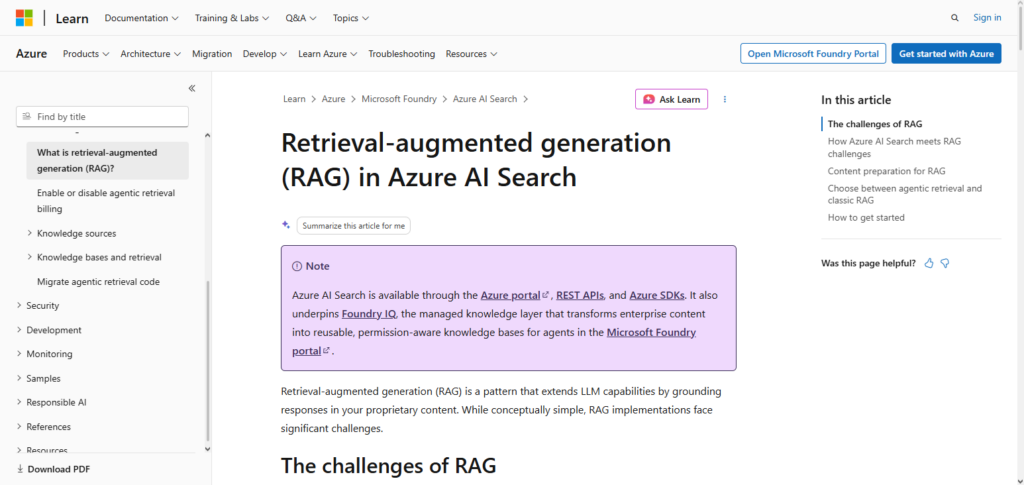
This product integrates retrieval-augmented generation and Microsoft Azure AI Search to develop targeted answers based on enterprise data. This solution provides semantic searches and vector searches as well as support for document indexing and the Azure Open AI model.
This solution integrates internal/enterprise documents and a variety of databases and applications to build secure AI assistants. Its enterprise-grade scale, compliance, and data protection makes appropriate use of this solution for customer support and internal knowledge management and business intelligence (BI).
| Feature | Details |
|---|---|
| Semantic Search | Understands user intent and provides more relevant search results |
| Vector Search | Uses embeddings to retrieve context from enterprise data |
| Azure OpenAI Integration | Connects with advanced language models for RAG workflows |
| Data Security | Provides enterprise-grade security and compliance controls |
| Document Indexing | Organizes and indexes large volumes of business information |
Microsoft Azure Cognitive Search + RAG Benefits & Drawbacks
Benefits:
- Excellent semantic and vector search functionality for enterprise data.
- Seamless integration with Azure OpenAI and Microsoft cloud stacks.
- Excellent security, compliance, and data protection.
- Assists businesses in developing correct AI knowledge assistants.
- Ability to index and retrieve large volumes of documents.
Drawbacks:
- Can be costly for large enterprise scale.
- Requires knowledge of Azure to set up and manage.
- Can be complicated to configure for those unfamiliar.
- Flexibility can be an issue when stepping outside Microsoft clouds.
- More complex features may result in requiring other Azure services.
2. OpenAI RAG Eval API
The OpenAI RAG Eval API would be considered one of the top AI RAG APIs for Enterprise Knowledge Systems, emphasizing the importance of accuracy and certainty in retrieval-based AI. This API assists in the analysis of RAG workflows through the evaluation of response quality and relevance, contextual correctness, hallucination metrics, and more.
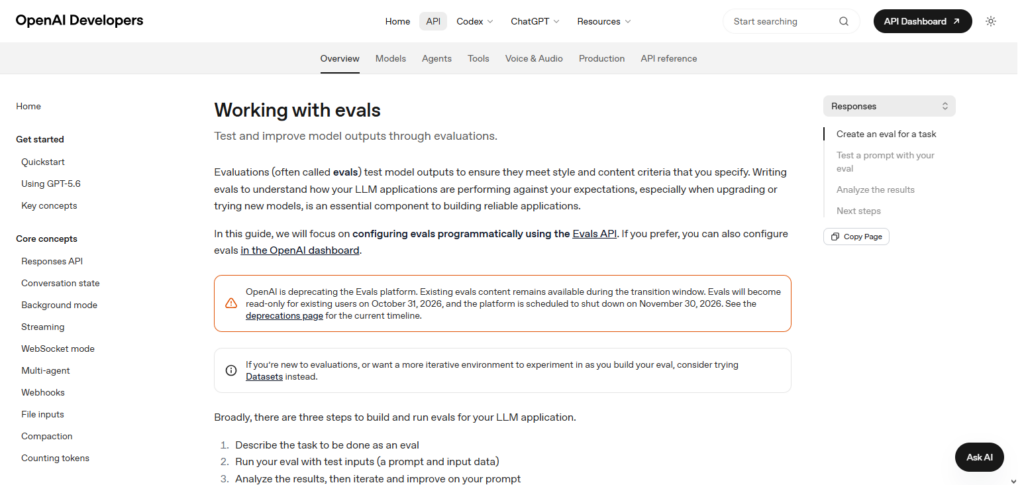
The API’s design enables organizations to validate AI assistants pre-deployment and fine-tune their knowledge retrieval workflows. It is compatible with the OpenAI LLMs and provides high-level evaluative constructs for enterprise AI systems. Organizations can employ the API to assess system performance, refine user interaction, and verify that AI-generated output stems from authoritative organizational content.
| Feature | Details |
|---|---|
| RAG Evaluation | Measures the performance and accuracy of retrieval systems |
| Response Quality Analysis | Evaluates AI-generated answers for relevance and correctness |
| Hallucination Detection | Helps identify unsupported AI responses |
| LLM Integration | Works with OpenAI models for AI application testing |
| Performance Optimization | Helps improve enterprise RAG workflows |
OpenAI RAG Eval API Benefits & Drawbacks
Benefits:
- Evaluates and assists in the enhancement of RAG application performance.
- Evaluates accuracy and relevance of responses as well as quality.
- Aids in identifying hallucinations and retrieval issues.
- Offers seamless integration with the rest of OpenAI AI models.
- Allows further refinement of enterprise AI.
Drawbacks:
- Singularly focuses evaluation, leaving rest of RAG deployment incomplete.
- Cost of implementation can be expensive, especially for large testing.
- Requires technical knowledge to use.
- Strong dependency on the OpenAI ecosystem.
- Incomplete RAG pipeline without additional tools.
3. Anthropic Claude RAG
Anthropic Claude RAG is one of the best AI RAG APIs for enterprise knowledge systems. It provides powerful language models and knowledge retrieval. This is good for companies as it helps build AI assistants and makes them easier to train to a company’s language via documents, policies, etc.
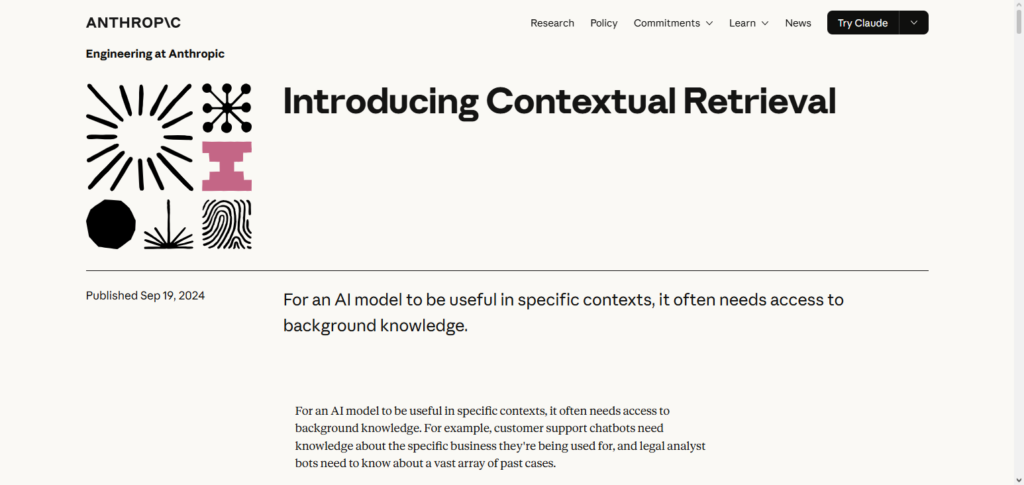
Claude RAG is focused on providing accurate and safe responses, as well as reducing the negative byproducts of AI. It handles long-context inputs, making it a good match for legal documents, support tickets, and knowledge bases.
Companies are able to build AI tools that they are able to trust and that help employees work more efficiently to be able to make better business decisions in multiple departments.
| Feature | Details |
|---|---|
| Long Context Processing | Handles large documents and complex information sources |
| Enterprise Knowledge Retrieval | Connects Claude models with external data sources |
| Safe AI Responses | Focuses on reliable and responsible AI outputs |
| Document Understanding | Analyzes detailed business documents efficiently |
| Context-Aware Generation | Produces answers based on retrieved enterprise knowledge |
Anthropic Claude RAG Benefits & Drawbacks
Benefits:
- Superior context understanding for large documents.
- Provides reliable responses and is very accurate.
- Strong emphasis on safety and control of AI.
- Ideal for large enterprise knowledge systems.
- Supports advanced workflows for analysis of documents.
Drawbacks:
- Limited flexibility compared to open-source RAG.
- Cost becomes prohibitive for larger enterprise use.
- Requires integration with external retrieval systems.
- Some tools offered by competitors may not be available as you work with fewer third-party tools.
- Availability may differ depending on region and platform.
4. Google Vertex AI RAG
Google Vertex AI RAG is one of the best AI RAG APIs for Enterprise Knowledge Systems. Businesses can use this tool to build retrieval-augmented AI applications that are scalable on the infrastructure of the Google Cloud. Vertex AI RAG offers integration with Gemini models, enterprise data, vector databases, and searches. This allows for precise AI replies.
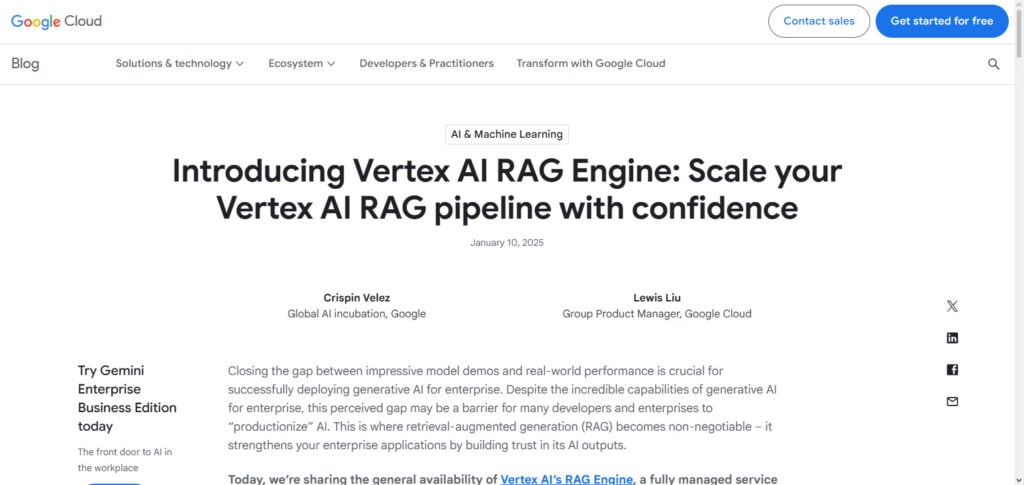
It also offers tools to deal with documents and assist with embedding and knowledge retrieval. Businesses can build their own AI assistants to use for analytics, customer service, and even for AI solutions for internal enterprise resource planning (ERP) systems. Vertex AI RAG also offers cloud scalability and security. If businesses are looking to deploy Google’s enterprise-grade generative AI, this tool is a great choice.
| Feature | Details |
|---|---|
| Gemini Model Integration | Uses Google Gemini models for advanced AI generation |
| Managed RAG Platform | Provides tools for building and deploying RAG applications |
| Enterprise Data Search | Retrieves information from business data sources |
| Vector Search Support | Enables semantic retrieval using embeddings |
| Cloud Scalability | Supports large enterprise AI deployments |
Google Vertex AI RAG Benefits & Drawbacks
Benefits:
- Google Vertex AI RAG provides enterprise-grade tools for developing RAG.
- Uses Google Gemini AI Models.
- Designed for cloud-based AI applications.
- Has advanced search and data processing tools.
- Includes strong Google Cloud security features.
Drawbacks:
- New cloud users may find Google Vertex AI RAG difficult to use.
- Estimating costs for using Google Vertex AI RAG may not be straightforward.
- Google Cloud skills are a must.
- Top features rely on using other Google tools.
- May be time-consuming to use Google Vertex AI RAG.
5. AWS Bedrock RAG
AWS Bedrock RAG is one of the best options for companies creating enterprise knowledge systems using generative AI applications within the AWS ecosystem. RAG systems combine a foundation model and data as streams to produce structured outputs to enhance enterprise applications.
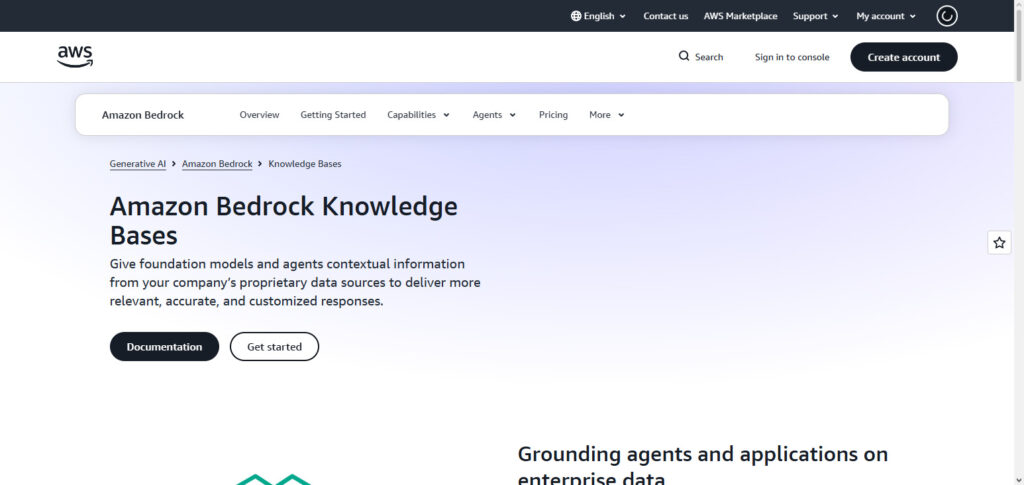
AWS Bedrock integrates several AI models and vector databases and allows secure data links. Companies can create AI assistants, automated workflows, and knowledge management systems. Because of the complexity of the ML infrastructure most companies cannot afford to build, AWS Bedrock is the clear choice for enterprise-grade, RAG systems.
| Feature | Details |
|---|---|
| Foundation Model Access | Provides access to multiple AI models through AWS |
| Knowledge Base Integration | Connects AI models with enterprise data |
| Secure Infrastructure | Offers AWS-level security and compliance |
| Vector Database Support | Enables efficient document retrieval |
| AI Application Development | Helps build enterprise generative AI solutions |
AWS Bedrock RAG Benefits & Drawbacks
Benefits:
- Access to multiple foundation AI models.
- Provides secure enterprise AI infrastructure.
- Works with AWS data and cloud services.
- Makes RAG applications easy to deploy and scalable.
- Less management of AI infrastructure is required.
Drawbacks:
- Knowledge of AWS is a must.
- Costs are difficult to estimate.
- Models may not be as customizable.
- Highly dependant on the AWS cloud.
6. LlamaIndex RAG API
The LlamaIndex RAG API is one of the top AI RAG APIs created for Enterprise Knowledge Systems that aims to connect expansive language models alongside proprietary and enterprise information. It offers incredible features for document retrieval, context management, and data indexing. This flexibility allows AI systems to respond and interact much more coherently.
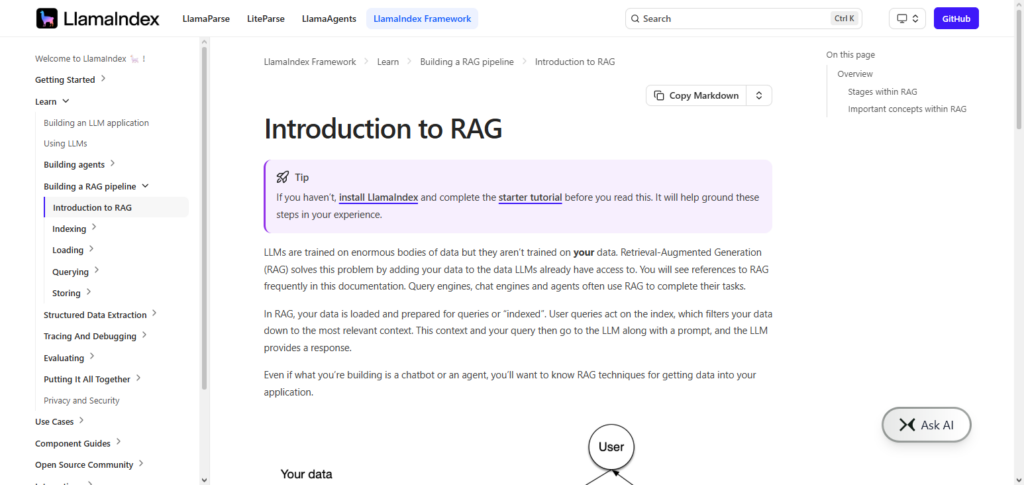
In addition, LlamaIndex allows integration for multiple formats and databases, along with vector storage systems. It has the potential to help enterprises design AI chat interfaces, research assistants, and even knowledge management systems. The framework is created to help developers and offers great resources to help reshape and structure enterprise data into AI solutions.
| Feature | Details |
|---|---|
| Data Connection | Connects LLMs with private and external data sources |
| Advanced Indexing | Creates optimized indexes for faster retrieval |
| Multi-Source Support | Works with documents, databases, and APIs |
| Vector Store Integration | Supports multiple embedding storage systems |
| AI Knowledge Applications | Helps build chatbots and enterprise assistants |
LlamaIndex RAG API Benefits & Drawbacks
Benefits:
- Eases the linking of LLMs with enterprise data.
- Can handle different data types and sources.
- Easily configurable searching and retrieval.
- Compatible with many vector databases.
- Great for custom AI solutions.
Drawbacks:
- Difficult to implement with no programming skills.
- Large scale projects may need added adjustments.
- Difficult to manage complex data pipelines.
- May need a skilled user to understand the documentation.
- May be time-consuming and difficult to use.
7. LangChain RAG API
As one of the best AI RAG APIs for Enterprise Knowledge Systems, the LangChain RAG API offers an extensible framework for building sophisticated AI applications.
It allows developers to interface language models with the external world via databases, documents, APIs, and vector stores. LangChain further bolsters the accuracy of AI responses by incorporating retrieval, prompts, AI agents, and automation.
Enterprises can build intelligent assistants for customer service automation, internal search, or even for business operations. Thanks to its extensive ecosystem and large variety of models, LangChain is favored by developers of custom RAG applications that require advanced control and flexibility.
| Feature | Details |
|---|---|
| LLM Framework | Provides tools for creating AI-powered applications |
| Retrieval Pipeline | Builds customized search and generation workflows |
| Multiple Model Support | Works with different AI providers and models |
| AI Agent Development | Supports intelligent automation and agent workflows |
| API & Database Integration | Connects external systems with AI applications |
LangChain RAG API Benefits & Drawbacks
Benefits
- Allows RAG application customization.
- Allows integration of multiple different LLMs.
- Helpful with the creation of AI agents and automation.
- Supports customizable workflows for retrieval.
- Strong developer support and community.
Drawbacks
- Can be extremely complicated for simple AI projects.
- Coding and technical knowledge are mandatory.
- Constant updates lead to the need for frequent maintenance.
- Debugging complicated chains is a hassle.
- Requires knowledge and experience to optimize performance.
8. Weaviate RAG API
Out of all the enterprise level RAG APIs, the Weaviate RAG API is among the best. It combines vector databases and AI for retrieval. Because of this, it enables enterprises to locate and retrieve data with the semantic understanding that comes from AI, as opposed to keyword search.
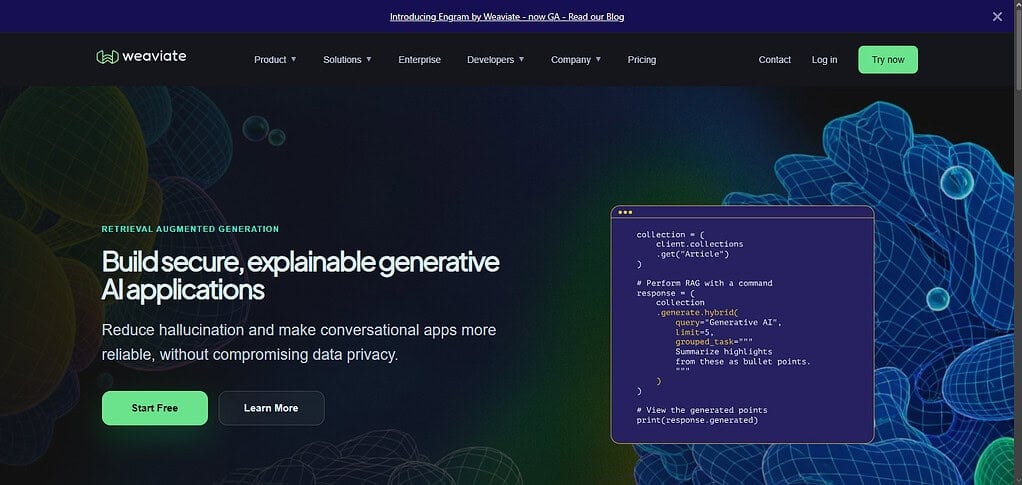
Weaviate also allows hybrid search and vector embedding, as well as integrations to some of the more popular large language models. Because of this companies can build intelligent search engines, assistants, and recommenders.
This is all made possible as a result of its scalability and cloud deployment. With all of these features, enterprises that use the Weaviate RAG API can easily locate information and generate accurate AI responses.
| Feature | Details |
|---|---|
| Vector Database | Stores and retrieves AI embeddings efficiently |
| Hybrid Search | Combines keyword and vector-based search |
| Semantic Retrieval | Finds information based on meaning and context |
| Real-Time Search | Provides fast knowledge retrieval capabilities |
| AI Model Integration | Connects with popular AI platforms and frameworks |
Weaviate RAG API Benefits & Drawbacks
Benefits
- Fast and efficient vector searching.
- Combines keyword searches with semantic searches.
- Built for knowledge applications using AI.
- Provides scalable infrastructure for databases.
- Integrates with leading AI tools and models.
Drawbacks
- Requires knowledge of vector databases.
- May become costly due to enterprise features.
- Inflexible if data is not arranged in a certain way.
- Difficult to manage if unfamiliar with the interface.
- Lacking ecosystem compared to larger cloud services.
9. Pinecone Vector DB API
Pinecone Vector DB API is recognized as one of the Top AI RAG APIs for Enterprise Knowledge Systems as it offers an advanced vector search infrastructure for AI. Pinecone allows enterprises to utilize the embedding data necessary for RAG operations.
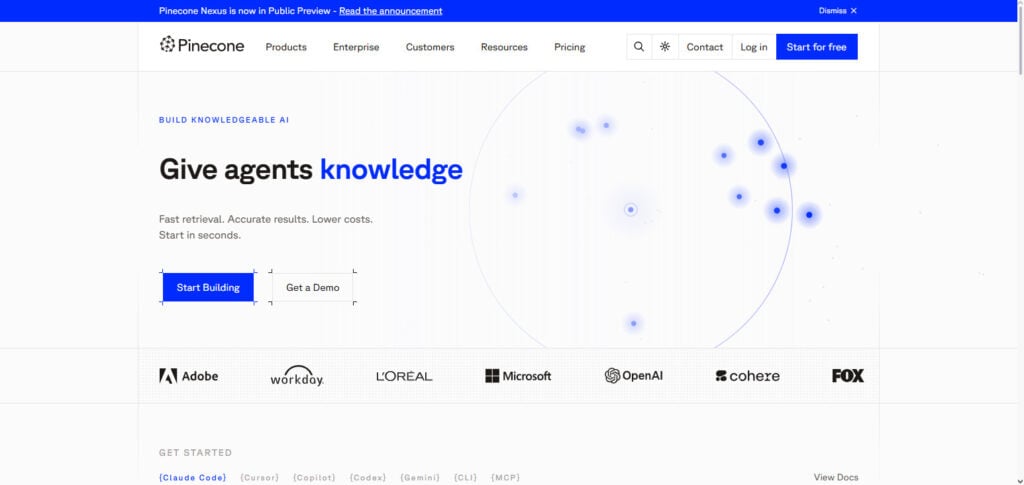
With Pinecone, organizations can run on-demand real-time similarity searches with the ability to scale indexes and integrate with state-of-the-art AI tools and language models. Enterprises can take advantage of AI chatbots, search tools, recommendation engines, knowledge assistants, and other AI functionality.
Moreover, due to the nature of Pinecone’s managed cloud infrastructure, the difficulty behind the managing AI infrastructure is reduced and the rapid retrieval needed to run production AI is guaranteed.
| Feature | Details |
|---|---|
| Vector Similarity Search | Finds related information using AI embeddings |
| High-Speed Retrieval | Provides fast search performance for RAG systems |
| Scalable Infrastructure | Handles large enterprise datasets efficiently |
| Embedding Management | Stores and manages vector representations |
| Developer-Friendly API | Easy integration with AI applications |
Pinecone Vector DB API Benefits & Drawbacks
Benefits
- Fast and efficient vector search.
- Designed to easily scale with large AI applications.
- Significantly lowers the need to manage infrastructure.
- Built around AI and integrates with RAG systems.
Drawbacks
- Pricing quickly inflates with increased data storage.
- Compared to self-hosted databases, offers limited control.
- Mainly focused on vector search and retrieval.
- Really needs a lot of additional tools to be a complete RAG solution.
- Lack of tools and resources outside of what they provide.
10. Elastic RAG API
Elastic RAG API is an excellent AI RAG API that integrates enterprise search with generative AI for Knowledge Systems. This API incorporates keyword search, semantic search, and vector retrieval for comprehensive knowledge discovery. Elastic enables the indexing of documents, provides analytics, and supports the integration of various AI models for building advanced enterprise applications.
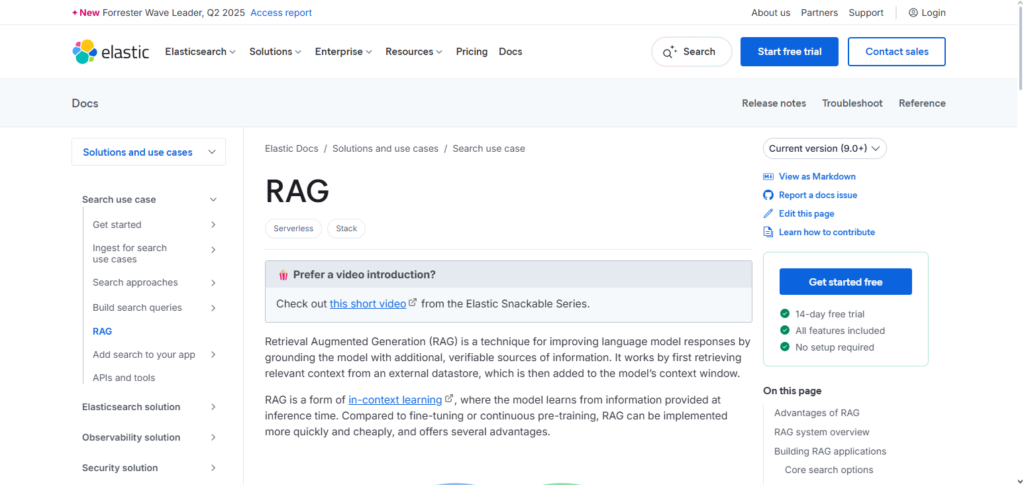
Organizations can leverage Elastic for internal search, customer support automation, safety analytics, and data analysis. Elastic RAG’s advanced search capabilities combined with its robust and extensible design, empower organizations to optimize their data for analysis and discovery and extract meaningful AI insights.
| Feature | Details |
|---|---|
| Enterprise Search | Provides powerful search across business data |
| Hybrid Retrieval | Combines keyword and vector search methods |
| AI Integration | Connects search capabilities with generative AI models |
| Data Analytics | Provides insights through advanced data analysis |
| Secure Knowledge Management | Supports enterprise-level data protection and access control |
Elastic RAG API Benefits & Drawbacks
Benefits:
- Combines traditional search with AI-powered retrieval.
- Supports hybrid keyword and vector search.
- Provides powerful enterprise search capabilities.
- Offers advanced analytics and monitoring tools.
- Works well with large business datasets.
Drawbacks:
- Setup and management can be complex.
- Requires Elasticsearch knowledge for optimization.
- Resource requirements can be high.
- Enterprise features may require paid plans.
- Configuration needs technical expertise.
Conclusion
The Best AI RAG APIs for Enterprise Knowledge Systems focus on getting your internal data digitally channelized to allow the development of fully fledged AI Systems. With platforms available like Azure Cognitive Search, OpenAI, Claude, Vertex AI, AWS Bedrock, LlamaIndex, LangChain, Weaviate, Pinecone, and Elastic, the retrieval generation in the creation of Enterprise AI applications has never been easier. These RAG APIs provide enhanced data access and reduced hallucinations and context-based responses and will allow the development of efficient and effective customer support, knowledge work automation, assistance and structured workflows. When choosing an API, consider the business type, the requirements, how scalable it will be within the operations, how secure the operations will be, and whether it will support the necessary integrations.
FAQ
What are AI RAG APIs for Enterprise Knowledge Systems?
AI RAG APIs are tools that combine retrieval systems with large language models to help enterprises access, analyze, and generate accurate responses from internal data sources such as documents, databases, and knowledge repositories.
Why are AI RAG APIs important for enterprises?
AI RAG APIs help businesses improve information retrieval, reduce AI hallucinations, provide context-aware answers, and build intelligent applications like AI assistants, enterprise search platforms, and automated support systems.
Which are the Best AI RAG APIs for Enterprise Knowledge Systems in 2026?
Some of the best AI RAG APIs include Microsoft Azure Cognitive Search + RAG, OpenAI RAG Eval API, Anthropic Claude RAG, Google Vertex AI RAG, AWS Bedrock RAG, LlamaIndex, LangChain, Weaviate, Pinecone, and Elastic RAG.
How does RAG improve enterprise AI applications?
RAG improves AI applications by allowing language models to retrieve relevant information from trusted company data before generating responses, resulting in more accurate and reliable outputs.