




In this article, I will talk about the Best AI Agents for Multilingual Customer Support that help businesses manage international customer conversations, break the language barrier, and automate support operations. I will share their key features, supported languages, translation capabilities, pricing, knowledge base localization, integrations, pros and cons to help businesses choose the right AI solution for customer service worldwide.
Why Choose Best AI Agents for Multilingual Customer Support
Break Language Barriers Multilingual AI agents enable businesses to communicate with international customers in their preferred languages, making support easier and reducing misunderstandings in customer interactions.
24/7 Customer Support: AI agents offer customer support around the clock in multiple time zones, allowing customers to get answers, solve common problems and get help without waiting for business hours.
Faster queries resolution: Automated replies help to answer repetitive questions, order inquiries, refund requests and account-related issues, which reduces response times and improves customer service efficiency.
Enhanced Customer Experience: Customers can communicate naturally in their preferred language, find the information they need and avoid the frustration of using translation tools or waiting for language-specific representatives.
Lower Operating Expenses AI automation takes over repetitive tasks for support agents and allows businesses to handle more conversations without having to pay for more customer service staff.
Consistent Brand Communication: AI agents use approved knowledge sources, pre-defined guidelines and business policies to provide consistent answers across languages, communication channels and customer interactions.
Scalable Customer Support: Multilingual AI agents can handle increasing volumes of customer interactions via chat, email, voice and messaging channels, and help businesses keep support operations organized.
Key Points
| AI Agent | Key Point |
|---|---|
| Intercom Fin AI | Supports multilingual customer service across chat, email, and help centers with AI-powered automated resolution and real-time language handling. |
| Ada AI | Enterprise-grade AI agent that delivers native multilingual conversations and automates customer support in dozens of languages. |
| Zendesk AI Agents | Provides multilingual self-service, ticket automation, and AI-driven customer engagement for global support teams. |
| Salesforce Agentforce | Combines AI agents with CRM data to deliver personalized multilingual customer support and workflow automation. |
| Yellow.ai | Supports over 100 languages and offers multilingual voice and chat AI agents for customer service operations. |
| Freshworks Freddy AI | Delivers multilingual conversational AI, ticket automation, and customer support assistance across multiple channels. |
| Cognigy.AI | Specialized in multilingual voice and contact-center automation with extensive global language coverage. |
| Google Contact Center AI (CCAI) | Uses Google’s AI and language technologies to support multilingual customer interactions across chat and voice. |
| Haptik AI | Enterprise conversational AI platform offering multilingual customer support, self-service automation, and omnichannel engagement. |
| Crescendo.ai | Provides multilingual AI chat, voice support, email automation, and customer service operations in over 50 languages. |
1. Intercom Fin AI
Intercom Fin AI was built by Intercom in 2011, and it launched its Fin AI Agent in 2023. It supports over 45 languages like English, Hindi, French, German, Spanish, Japanese, Arabic, Chinese and more. Automatic language detection and real-time translation allows customers to receive answers in the language they want.

Fin identifies relevant answers based on multilingual knowledge base articles, PDFs, web pages and support documents. There is no set percentage published for translation accuracy, so businesses should test regional terminology. Pricing is $0.99 per successful AI resolution, plus applicable costs of Intercom plans.
Key Features
| Feature | Description |
|---|---|
| Multilingual Responses | Understands and responds to customer queries in 45+ languages. |
| Real-Time Translation | Automatically detects languages and translates conversations. |
| Knowledge Integration | Uses help articles, PDFs, webpages, and internal support content. |
| AI Procedures | Handles complex customer requests through multi-step workflows. |
| Omnichannel Support | Supports chat, email, voice, WhatsApp, SMS, and social channels. |
| Performance Analytics | Tracks resolution rates, customer experience, and conversation trends. |
Pros
| Advantages | Explanation |
|---|---|
| Broad Language Coverage | Supports customers across numerous international language markets. |
| Flexible Knowledge Sources | Generates answers from multiple public and private information sources. |
| Customizable Responses | Allows businesses to configure response tone, length, and support policies. |
| Existing Helpdesk Compatibility | Can integrate with platforms such as Salesforce, Zendesk, and Freshworks. |
Cons
| Limitations | Explanation |
|---|---|
| Usage-Based Costs | Charges per successful AI outcome, which requires monitoring at high volumes. |
| Knowledge Preparation | Businesses need accurate and updated support information. |
| Advanced Setup | Complex procedures and integrations may require configuration and testing. |
2. Ada AI
Ada AI – Founded in 2016 Ada AI works on automated customer experiences for global businesses. The multilingual AI agent supports messaging and email in 60 languages, and voice in a subset of languages. It automatically detects customer languages, allows you to change languages mid-conversation and generates responses using its reasoning engine.

Ada also processes localized knowledge articles to provide region-specific information, rather than just translated content. Translation accuracy is not presented as a universal percentage. Pricing is typically tailored to enterprise needs based on deployment, usage and business requirements.
Key Features
| Feature | Description |
|---|---|
| Multilingual Conversations | Supports automated customer interactions across multiple languages. |
| Intent Recognition | Identifies customer intentions and directs conversations appropriately. |
| AI Automation | Automates repetitive support questions and service workflows. |
| Knowledge Integration | Uses business support information to generate relevant responses. |
| Channel Management | Supports digital customer service experiences across messaging channels. |
| Human Escalation | Transfers unresolved queries to human support teams. |
Pros
| Advantages | Explanation |
|---|---|
| International Support | Helps businesses serve customers in different language markets. |
| Reduced Manual Work | Automates repetitive customer service interactions. |
| Flexible Workflows | Supports customized conversational journeys and business processes. |
| Enterprise Suitability | Designed for organizations managing large customer interaction volumes. |
Cons
| Limitations | Explanation |
|---|---|
| Custom Pricing | Public pricing is not readily available for straightforward budget comparisons. |
| Implementation Requirements | Connecting knowledge sources and existing systems requires preparation. |
| Language Testing | Businesses should validate translation quality for specialized terminology. |
3. Zendesk AI Agents
Zendesk AI Agents come with Zendesk’s customer service platform, which was founded in 2007. Its AI agents support a wide range of languages like English, Hindi, French, German, Spanish, Japanese, Arabic and Punjabi.

For a limited number of languages, there are automatic AI translations, but other languages may have to be translated manually. Zendesk adds AI-generated answers to its knowledge base, help center, ticketing system and automated workflows. No specific percentage is given for translation accuracy.
Suite Team starts at $55 per agent per month on annual billing, plus usage-based charges for automated resolution.
Key Features
| Feature | Description |
|---|---|
| Multilingual AI Responses | Generates customer responses in supported languages. |
| Automatic Translation | Translates AI agent responses and support content. |
| AI Ticket Management | Classifies, prioritizes, and routes customer tickets. |
| Knowledge Base Integration | Uses help center articles and trusted support content. |
| Workflow Automation | Executes multi-step customer service actions through integrations. |
| Omnichannel Support | Handles messaging, email, web forms, and voice. |
Pros
| Advantages | Explanation |
|---|---|
| Extensive Language Support | Supports a broad range of languages, including Hindi, Punjabi, Arabic, and Japanese. |
| Unified Ticketing | Combines AI conversations with existing customer service tickets. |
| Flexible Automation | Supports custom procedures, APIs, and external system actions. |
| Knowledge Localization | Offers multilingual help center content and AI article translation. |
Cons
| Limitations | Explanation |
|---|---|
| Additional Usage Costs | Extra automated resolutions can increase operating expenses. |
| Plan Restrictions | Some advanced features require higher subscription tiers. |
| Configuration Effort | Complex workflows and integrations need administrative setup. |
4. Salesforce Agentforce
Salesforce launched Salesforce Agentforce, a platform for AI agents, in 2024. It allows businesses to automate customer conversations, access information, perform service actions and handle multilingual customer interactions.
It supports major international languages according to agent type and feature configuration. Adaptive language capabilities and multilingual knowledge retrieval help agents understand customer requests and respond in context.
There is no universal published score that guaranties the accuracy of the translation, and companies need to test their own terminology and workflows. The price is either $2 per conversation or $500 per 100,000 Flex Credits, depending on the usage model you choose.
Key Features
| Feature | Description |
|---|---|
| Agentforce Studio | Builds and configures AI agents using a no-code environment. |
| Multilingual Conversations | Supports customer interactions in 60+ languages. |
| CRM Data Access | Uses customer records and business information for contextual responses. |
| Automated Actions | Handles tasks such as order updates, refunds, and appointment changes. |
| Omnichannel Communication | Supports email, chat, WhatsApp, and social channels. |
| Human Handoff | Transfers complex conversations with relevant customer context. |
Pros
| Advantages | Explanation |
|---|---|
| Deep CRM Integration | Connects customer conversations with Salesforce records and workflows. |
| Action-Oriented Automation | Can execute business tasks instead of only answering questions. |
| Global Customer Coverage | Supports multilingual customer engagement across international markets. |
| Custom Agent Development | Allows businesses to create agents for specific departments and workflows. |
Cons
| Limitations | Explanation |
|---|---|
| Implementation Complexity | Advanced configurations may require technical expertise. |
| Usage-Based Pricing | Conversation and credit-based billing requires cost monitoring. |
| Salesforce Ecosystem Dependency | Businesses outside its ecosystem may need additional integration work. |
5. Yellow.ai
Yellow.ai, which was founded in 2016 as Yellow Messenger, offers conversational AI solutions to automate customer support. It supports multilingual capabilities across languages, regional variations and voice interactions like English, Hindi, Chinese, Arabic and other international languages.

It provides language detection, speech-to-text, text-to-speech, knowledge mining and multi-lingual conversation management, with different capabilities for each language. Its knowledge localization helps businesses organize language-specific information to respond to customers.
Translation accuracy is not guarantyd to the public through a single percentage. pricing is typically based on custom enterprise packages depending on channels, automation requirements and conversation volumes.
Key Features
| Feature | Description |
|---|---|
| Super Agent | Routes queries to specialized AI or rule-based agents. |
| Multilingual Localization | Supports multiple languages and regional variations. |
| Knowledge Base Agent | Retrieves information from documents, FAQs, and external systems. |
| Voice Automation | Supports speech recognition and text-to-speech for configured languages. |
| Contextual Conversations | Maintains context across multi-turn customer interactions. |
| Workflow Automation | Automates bookings, cancellations, refunds, and customer inquiries. |
Pros
| Advantages | Explanation |
|---|---|
| Multi-Agent Architecture | Assigns different customer tasks to specialized agents. |
| Regional Language Support | Offers language and locale configurations for global businesses. |
| Flexible Automation | Combines generative AI with structured workflows. |
| Knowledge-Based Responses | Retrieves business information to support relevant customer answers. |
Cons
| Limitations | Explanation |
|---|---|
| Complex Configuration | Multi-agent workflows can require careful setup. |
| Language Differences | Speech, translation, and analytics features vary by language. |
| Custom Pricing | Businesses may need a sales consultation to understand total costs. |
6. Freshworks Freddy AI
Freshworks launched its artificial intelligence, Freddy AI, in 2018 to automate support processes and increase client engagement. Depending on the function, it can speak multiple languages, including English, French, German, Spanish, Portuguese, Japanese, Korean, Chinese, Italian and others.

Freddy offers live translation, automated responses, conversation summaries, sentiment analysis and knowledge-based recommendations. Its knowledge base connects support articles with AI-generated answers, and localized helpdesk settings support multiple customer languages.
There is no published score for the accuracy of the translation. Freddy AI Copilot costs $29 per agent per month (billed annually) and AI Agent sessions are billed separately on a usage basis.
Key Features
| Feature | Description |
|---|---|
| Freddy AI Agent | Automates customer questions and repetitive support requests. |
| Live Translation | Supports translated customer conversations in available languages. |
| Ticket Summarization | Creates summaries of lengthy customer interactions. |
| Intent Detection | Identifies customer needs and categorizes support requests. |
| Knowledge Suggestions | Recommends relevant solution articles and support information. |
| AI Copilot | Helps human agents prepare responses and manage tickets. |
Pros
| Advantages | Explanation |
|---|---|
| Helpdesk Integration | Works within the Freshworks customer support ecosystem. |
| Multiple AI Capabilities | Combines automated responses, summaries, and sentiment analysis. |
| Language Flexibility | Offers different language capabilities across AI features. |
| Accessible Pricing Options | Provides published subscription plans and AI session add-ons. |
Cons
| Limitations | Explanation |
|---|---|
| Feature-Specific Language Support | Not every Freddy AI feature supports the same languages. |
| Session-Based Billing | Additional AI sessions can increase expenses. |
| Advanced Feature Availability | Some capabilities require specific subscription plans or add-ons. |
7. Cognigy.AI
Cognigy. —Founded in 2016, AI is a leader in enterprise conversational AI and contact center automation. The platform helps global businesses automate service conversations across multiple markets with multilingual client engagement through text and voice experiences.

Language capabilities are dependent on the chosen speech, language understanding, and AI model configurations. Cognigy integrates with enterprise knowledge sources, allowing AI agents to source relevant information and provide contextual responses.
There is no single percentage for the accuracy of translation across the entire platform, so businesses should evaluate each language separately. Pricing is usually customized for enterprises based on deployment size, channels, integrations and automation needs.
Key Features
| Feature | Description |
|---|---|
| Multilingual AI Agents | Supports more than 100 languages for conversational experiences. |
| Voice AI | Automates phone-based customer interactions using conversational voice technology. |
| AI Agent Studio | Builds and manages customized conversational agents. |
| Knowledge AI | Retrieves answers from business documents, websites, and connected systems. |
| Agent Orchestration | Coordinates multiple AI agents and business workflows. |
| Human Handoff | Transfers conversations to human representatives with relevant context. |
Pros
| Advantages | Explanation |
|---|---|
| Extensive Language Coverage | Supports businesses serving customers across numerous language markets. |
| Enterprise Scalability | Designed to manage high-volume customer interactions. |
| Voice and Chat Automation | Supports both telephone and digital customer service operations. |
| Flexible Integrations | Offers prebuilt tools and integrations for enterprise systems. |
Cons
| Limitations | Explanation |
|---|---|
| Enterprise Implementation | Advanced deployments can require technical resources. |
| Custom Pricing | Pricing generally depends on deployment and business requirements. |
| Configuration Requirements | Agent orchestration and complex workflows need careful management. |
8. Google Contact Center AI (CCAI)
In 2018 Google launched Contact Center AI (CCAI), an AI-enabled contact center solution. It uses conversational AI, speech recognition, natural language processing and virtual agents to handle multilingual customer interactions. Languages supported include English, Hindi, French, German, Spanish, Japanese, Korean, Arabic and Chinese. Availability varies by component and channel.

It integrates with Dialogflow and Google Cloud knowledge bases to provide the relevant information for the customer’s queries. Translation quality depends on the selected language models and speech services. Pricing is consistent with usage-based charges for the services and features deployed on Google Cloud.
Key Features
| Feature | Description |
|---|---|
| Dialogflow CX | Builds conversational AI agents for complex customer interactions. |
| Multilingual Virtual Agents | Supports multiple languages and regional language variations. |
| Speech Recognition | Converts customer speech into text for automated processing. |
| Text-to-Speech | Generates spoken responses for voice-based support. |
| Knowledge Integration | Connects customer support agents with business information and data sources. |
| Agent Assist | Provides real-time suggestions and assistance to human representatives. |
Pros
| Advantages | Explanation |
|---|---|
| Advanced Language Technology | Uses Google’s language understanding and speech processing capabilities. |
| Strong Voice Automation | Supports automated phone conversations and voice-based customer service. |
| Customizable Agents | Allows businesses to develop agents for specific customer journeys. |
| Scalable Infrastructure | Uses Google Cloud infrastructure for enterprise deployments. |
Cons
| Limitations | Explanation |
|---|---|
| Technical Expertise | Building advanced agents may require developer resources. |
| Usage-Based Costs | Different Google Cloud services can generate separate charges. |
| Language Feature Differences | Speech recognition, text-to-speech, and other capabilities vary by language. |
| Complex Deployment | Integrating multiple cloud services can increase implementation effort. |
9. Haptik AI
Haptik AI, founded in 2013, offers conversational AI solutions for enterprises handling large volumes of customer conversations. It has a platform that supports 135 languages and provides multilingual virtual assistants for customer service, messaging and automated conversations.
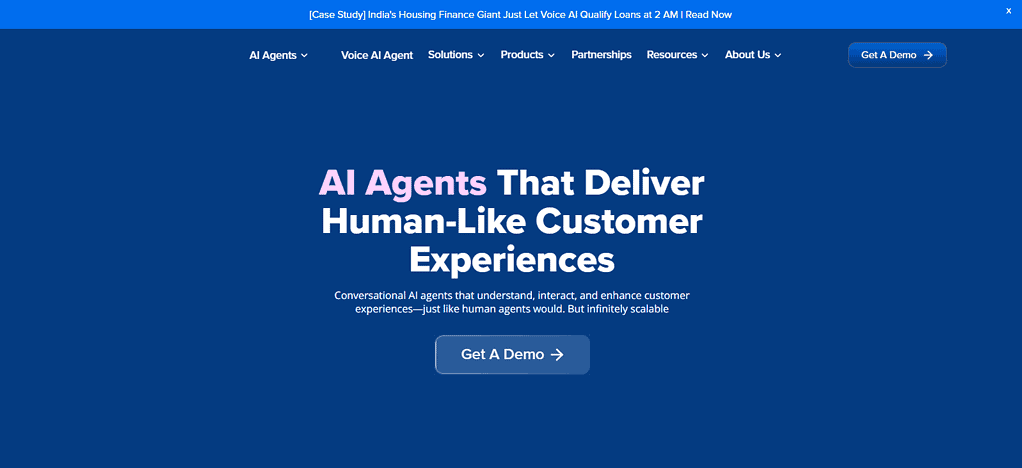
Features include: natural language processing, intent recognition, multilingual bot development and language-specific conversation workflows. Its Linguist Pro capabilities help businesses manage multilingual communication. Knowledge integration enables agents to pull information from existing customer support resources.
There is no common public benchmark for how well the translation works . It is thus important to test for specific languages . Pricing is typically customized based on business needs, conversation volumes, integrations and deployment requirements.
Key Features
| Feature | Description |
|---|---|
| Multilingual AI Agents | Supports more than 100 languages for customer interactions. |
| Voice Conversations | Handles customer requests through natural voice interactions. |
| Intent Recognition | Understands customer requirements beyond individual keywords. |
| Customer Service Automation | Automates common questions and repetitive service requests. |
| Performance Analytics | Tracks resolution rates, response times, CSAT, and NPS. |
| Business Integrations | Connects conversational agents with business systems and support workflows. |
Pros
| Advantages | Explanation |
|---|---|
| Broad Language Coverage | Helps businesses communicate with customers across international markets. |
| Voice-Based Support | Supports natural conversational experiences without rigid menu options. |
| Customer Analytics | Provides performance insights for improving support operations. |
| Automated Query Handling | Reduces manual work for frequently repeated customer requests. |
Cons
| Limitations | Explanation |
|---|---|
| Enterprise-Oriented Setup | Advanced implementations may require integration and configuration resources. |
| Pricing Transparency | Businesses generally need customized pricing information. |
| Language Performance Testing | Regional accents and specialized vocabulary should be tested before deployment. |
10. Crescendo.ai
Crescendo.ai is an AI native customer experience platform that delivers automated customer service and human support expertise. It is focused on managing customer conversations, automating repetitive requests and improving service operations with AI-powered workflows. Multilingual support can help international businesses serve customers across different language markets.

But, a complete verified language-by-language coverage list and standardized translation accuracy score are not publicly established here. It’s customer experience platform combines AI automation, knowledge resources and human-assisted support to maintain service quality. Pricing is based on your support volume, operational needs and service agreements.
Key Features
| Feature | Description |
|---|---|
| Concierge Agent | Handles customer conversations across voice, chat, email, and text. |
| Autonomous AI Agents | Automates customer service tasks and repetitive interactions. |
| Quality Agent | Evaluates customer conversations against performance and policy requirements. |
| Agent Assist | Provides real-time assistance to human customer support specialists. |
| Applied Insights | Identifies recurring customer problems and operational improvement opportunities. |
| Human Escalation | Transfers unresolved conversations to human representatives with conversation context. |
Pros
| Advantages | Explanation |
|---|---|
| Combined AI and Human Support | Connects automated customer service with human assistance. |
| Multiple Communication Channels | Supports voice, chat, email, and text interactions. |
| Conversation Quality Monitoring | Evaluates interactions to identify service and policy issues. |
| Continuous Optimization | Uses conversation insights to identify improvements in customer support operations. |
Cons
| Limitations | Explanation |
|---|---|
| Language Coverage Verification | A complete language-by-language support list should be confirmed before deployment. |
| Custom Pricing | Public pricing may not provide enough information for direct cost comparisons. |
| Enterprise Evaluation | Businesses should evaluate implementation requirements and integration compatibility. |
| Performance Validation | Automated responses should be tested against real customer scenarios before full deployment. |
Conclusion
AI agents for multilingual customer support are helping businesses communicate with customers in different languages, regions and channels of communication.
Intercom Fin AI, Ada AI, Zendesk AI Agents, Salesforce Agentforce, Yellow.ai, Freshworks Freddy AI, Cognigy.AI, Google Contact Center AI, Haptik AI, Crescendo.ai are some of these platforms that offer a plethora of features for automating conversations, understanding customer inquiries, translating responses, and maintaining knowledge bases. But when selecting a platform, companies should look at language coverage, translation quality, pricing, integration capabilities and human escalation capabilities. The right solution can reduce support workloads, improve response times and deliver more consistent customer experiences across international markets.
FAQ
Can AI agents automatically detect a customer’s language?
Yes. Many multilingual AI agents use natural language processing to identify the language of incoming messages and generate responses in the customer’s preferred language.
Do multilingual AI agents support regional languages?
Some platforms support regional languages and dialects, but availability varies. Businesses should verify specific language support and test regional vocabulary, accents, and local expressions before deployment.
Can multilingual AI agents integrate with CRM and helpdesk software?
Yes. Many platforms integrate with CRM and helpdesk systems to access customer information, manage support tickets, retrieve knowledge articles, and maintain conversation histories.
Can multilingual AI agents transfer conversations to human support agents?
Yes. Most enterprise-focused solutions offer human escalation capabilities. They can transfer complex queries to human representatives while preserving conversation context and relevant customer information.