


In this article, I will describe the Best NotebookLM Competitors for AI Research in 2026. While AI software continues to improve, research platforms such as Atlas and Elicit, and projects such as the Claude Project, Perplexity, Consensus and Recall, as well as Obsidian, SurfSense, Elephas, and Saner.AI, will provide researchers options that address citation and software integration.
How To Choose NotebookLM Rivals for AI Research
Research Focus
Look to see if the competitor product focuses on academic literature review (Eg. Elicit, Consensus), long context reasoning (the Claude Projects), or other areas (Eg. Atlas for visual reasoning). Pick the competitor product that best aligns with your area of research.
Pricing & Others
Look to see if there are alternative, or freemium, products, and evaluate cost benefit.
Privacy & Other
If your research is of a sensitive nature, then pick a local first, or offline, product (Eg. Obsidian, Elephas).
Collaboration Features
For team projects, choose rivals like SurfSense or Recall that support shared workspaces, version control, and long-term knowledge bases.
Citation & Evidence Support
Tools like Elicit and Consensus excel in structured citations and peer-reviewed evidence, making them ideal for academic rigor compared to NotebookLM’s limited export options.
Key Points
| Rival | Core Strengths | Key Differentiator in 2026 |
|---|---|---|
| Atlas | Private research synthesis, mind maps | Source‑linked answers, visual knowledge maps |
| Elicit | Academic literature review | Extraction tables, citation management |
| Claude Projects | Long‑context reasoning | Handles 1000+ page docs, strong logic |
| Perplexity | Web‑grounded research | Real‑time search + source chat |
| Consensus | Evidence‑based answers | Peer‑reviewed citation grounding |
| Recall | Lifelong knowledge base | Self‑organizing memory across media |
| Obsidian | Privacy & offline use | Local‑first, plugin ecosystem |
| SurfSense | Open‑source team research | NotebookLM‑style clone, collaborative |
| Elephas | Apple‑native workflows | Private document AI on macOS/iOS |
| Saner.AI | Task‑linked research | Connects notes to meetings & projects |
1. Atlas
Atlas was founded in 2022 as a private company that provides a research synthesis platform for academic and business customers. Atlas charges a subscription rate of $20/month for individual customers and charges business customers rates on a case-by-case basis.
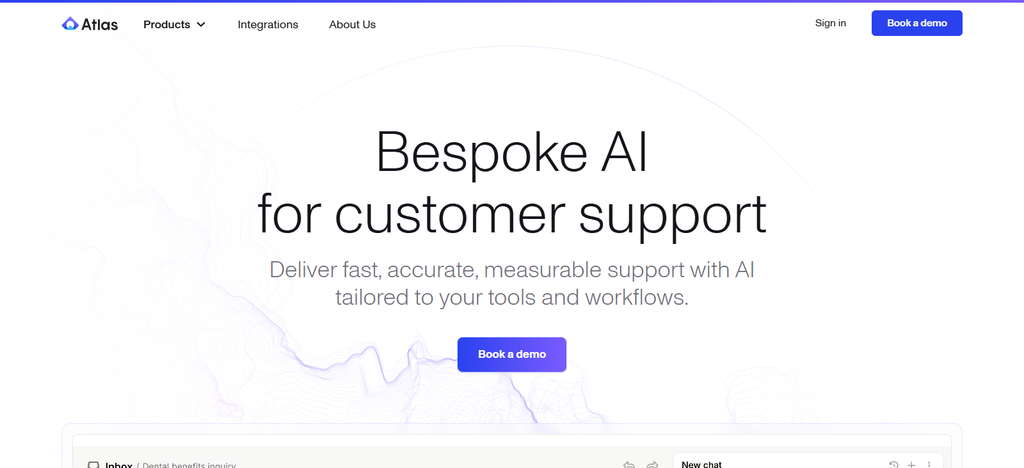
Atlas’ main research category is business and academic customer and employee research and knowledge synthesis. Atlas differentiates itself from the competition by providing research synthesis in the form of visualizations and other techniques. Atlas is focused on research knowledge synthesis, academic and business publishing and employee and customer research.
Atlas utilizes various academic and business research databases for web research and synthesis. In knowledge management, Atlas is focused on visual representation of research and knowledge and synthesis of research and knowledge to a great extent. In comparison to NotebookLM, Atlas is focused on research and knowledge synthesis and management in an effort to protect user data and privacy.
Atlas Traits
- Launched in 2022, Atlas prices their subscription at around $20 USD a month.
- Specializes in, and patents, technologies involving knowledge graphs and synthesis.
- Suitable for academic and industrial research and accelerates workflows.
- Allows users to export research and scholarship data and knowledge graphs.
- Users can visually construct and edit knowledge graphs.
| Advantages | Disadvantages |
|---|---|
| Strong visual knowledge maps for complex synthesis | Subscription cost (~$20/month) may deter casual users |
| Source-linked answers ensure citation accuracy | Limited offline functionality compared to Obsidian |
| Ideal for academic and enterprise workflows | Learning curve for visual mapping features |
| Integrates with scholarly databases for structured exports | Collaboration features less advanced than SurfSense |
| Privacy-conscious alternative to cloud-only tools | Smaller ecosystem of plugins compared to Obsidian |
2. Elicit
Launched in 2021, Elicit is a research and literature synthesis tool focused on academic customers. The tool offers a free and paid subscription model at $15/month. Elicit’s primary research synthesis category is academic research and literature synthesis.
The tool is useful in synthesizing structured research and literature by extracting and presenting research methodology, results and findings in a tabular form. Web research is done through the tool’s integration with Semantic Scholar and other academic journals.
Elicit is useful in systematic reviews of research and literature by extracting and synthesizing research and literature to projects and organizational units. In knowledge management, Elicit is comparable to NotebookLM in citation synthesis and other research and literature management functions.
Elicit Traits
- Founded in 2021, Elicit’s main functions are provided for free, while their synthesis function costs around $15 USD a month.
- Focuses on systematic review of scholarly literature.
- Automatically extracts data from scholarly articles and synthesizes it in tables.
- Cites and links articles using Semantic Scholar.
- Well known for synthesizing and representing citations.
| Advantages | Disadvantages |
|---|---|
| Excellent for systematic literature reviews | Focused mainly on academic research, less versatile |
| Extracts structured data into tables | Limited customization of outputs |
| Integrates with Semantic Scholar for reliable citations | Web research scope narrower than Perplexity |
| Affordable pricing ($15/month advanced) | Collaboration features are minimal |
| High citation accuracy | Dependent on external databases for coverage |
3. Claude Projects
Claude Projects was launched by Anthropic in 2025 as an extension of its Claude model. Claude Projects employs the same pricing strategy as Anthropic, offering a professional plan for $30/month and higher plans for organizations. Its strongest suit, long-context reasoning, allows Claude to digest large body of texts, for example, thousands of pages of a novel.
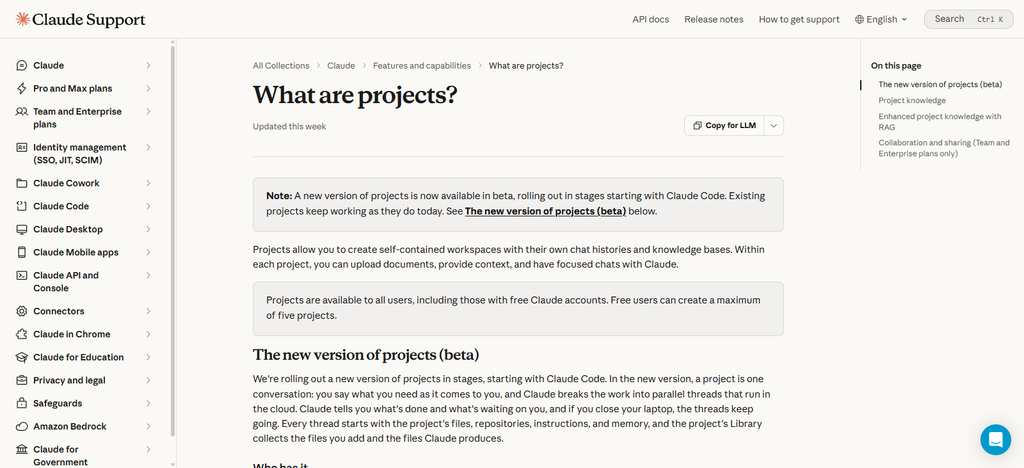
Claude can organize projects, draw connections between pieces of evidence and other researches, and assist with web researches. Claude integrates APIs for real-time web searches and is, therefore, limited by the reasoning capacity of the real world. Its reasoning is nonetheless consistent and sound.
Retention of equipped knowledge across multiple sessions is another positive attribute of Claude. For large sets of text, like a novel or long research papers, Claude excels and is faster and more consistent than NotebookLM.
Claude Projects Traits
- Anthropic’s competitor product, launched in 2025, costs around $30 USD a month.
- Allows users to reason over long (1000+ page) documents.
- Creates project documents, and allows users to annotate and synthesize documents.
- Integrates with web search APIs.
- Synthesizes and represents citations in a logical and consistent manner.
| Advantages | Disadvantages |
|---|---|
| Handles 1,000+ page documents with ease | Higher pricing ($30/month) |
| Strong logical consistency in synthesis | Requires powerful hardware for optimal use |
| Project-based organization and annotation | Less visual than Atlas |
| Integrates with real-time search APIs | Collaboration limited compared to SurfSense |
| Ideal for deep academic and legal research | May overwhelm casual users with complexity |
4. Perplexity
Perplexity is a web-research assistant. It charges $20/month for its Pro plan. Perplexity employs real-time web researches and is, therefore, ideal for professionals who rely on the web for their jobs, like analysts and journalists. Perplexity, like many other AI assistants, is limited to researches it can conduct on the web. It doesn’t integrated large sets of text like NovelAI or other story writing AIs.
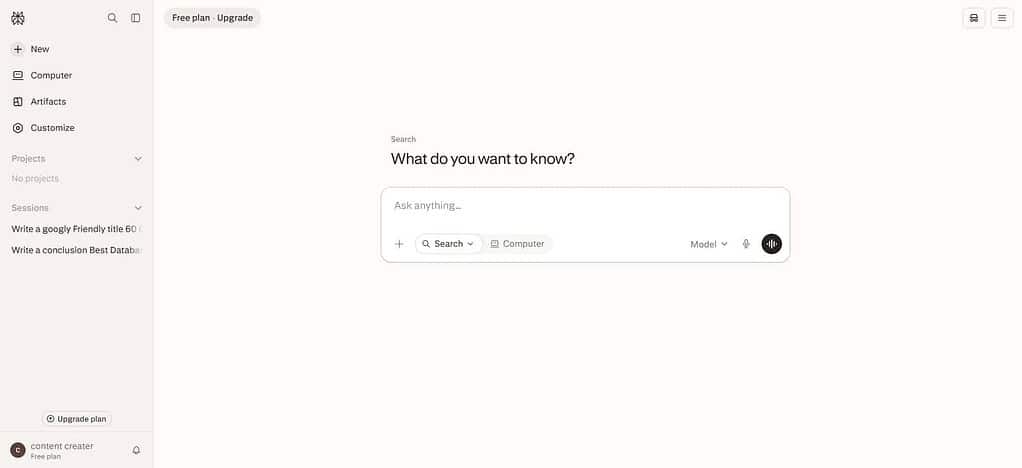
Perplexity, however, is capable of grounding its answers and researches with other texts on the web and providing references. It supports saving and organizing researches. Perplexity is faster and more accurate than NotebookLM in grounding its answers and researches.
Perplexity Traits
- Launched in 2022. Their core function is a search-based, synthesis assistant that provides source-linked, explanatory answers to user questions, and costs around $20 USD a month.
- Focuses on researching and synthesizing information available on the web in an explanation-based manner.
- Supports citation and project management.
- Distinguishes competitors by providing source citations in real time.
| Advantages | Disadvantages |
|---|---|
| Real-time web-grounded research | Subscription cost ($20/month Pro) |
| Transparent, source-linked answers | Dependent on internet connectivity |
| Conversational search interface | Knowledge management weaker than Recall |
| Supports citation exports | Limited offline use |
| Saves threads for project organization | Less suited for academic systematic reviews |
5. Consensus
Consensus was released in 2021 as an AI tool to assist with answering questions based on evidence. It costs $15 a month, with available business licenses. The category of research it falls under is scientific consensus extraction. Therefore, it is primarily used by researchers in the medical and academic fields.
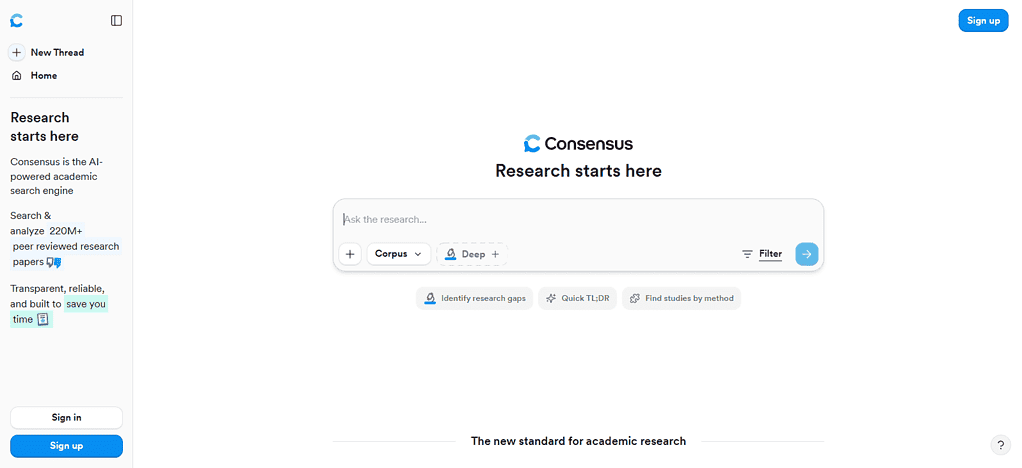
It is said to help researchers by analyzing peer-reviewed studies and showing areas of scientific accord and discord. In regards to web research, Consensus partners with various academic and scholarly journals. It provides services in knowledge management by providing evidence informs tables. It differs from NotebookLM in that it provides peer-reviewed citations.
Consensus Traits
- Launched in 2021. Price is around $15 USD a month.
- Automatically generates research and scholarly evidence-based consensus and argument summaries.
- Distills peer-reviewed journals and articles and creates research evidence tables.
- Integrates with PubMed.
- Distinguishes competitors by providing peer-reviewed citations.
| Advantages | Disadvantages |
|---|---|
| Evidence-based answers from peer-reviewed studies | Narrow focus on scientific/medical research |
| Affordable pricing ($15/month) | Limited general-purpose use |
| Integrates with PubMed and scholarly databases | Less flexible for non-academic projects |
| Structured evidence tables for clarity | Collaboration features minimal |
| Trusted for verified sources | Dependent on database coverage |
6. Recall
Recall was released in 2024 and focuses on personal and team cognitive/knowledge management. It costs $25 a month, with available team and business licenses. It helps users save and recover information stored in various formats, including text, pictures and audio.
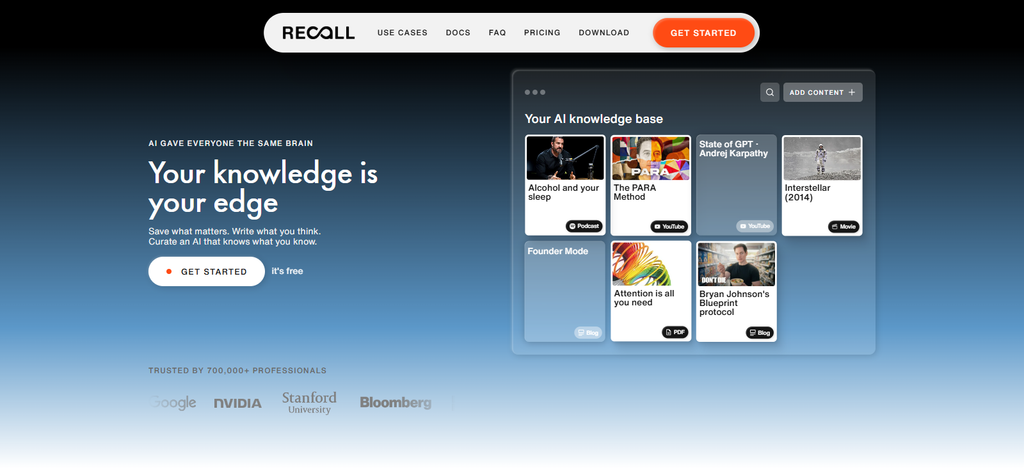
It employs artificial intelligence and machine learning to provide recommended IPs based on a user’s search. It helps store web researched information. It is said to provide services in knowledge management and helps users retain information. It is said to be better than NotebookLM as it doesn’t have a time restriction.
Recall Traits
- Launched in 2024. Their main differentiating feature is a team-based, or individual, “knowledge bank” that costs around $25 USD a month.
- Automated Tagging and Search
- Integrates with APIs to import data from other services
- Most innovative feature: “Self-organizing” memory
| Advantages | Disadvantages |
|---|---|
| Lifelong knowledge base with memory retention | Higher pricing ($25/month) |
| Automated tagging and semantic search | Setup complexity for new users |
| Captures external sources via APIs | Less visual than Atlas |
| Self-organizing memory ensures continuity | Collaboration weaker than SurfSense |
| Ideal for individuals and teams | Still evolving ecosystem |
7. Obsidian
Obsidian is a relatively new (2020), local-first knowledge management tool and plugin engine. Its paid license costs $25 per year, and it offers a free tier. Due to its focus on privacy, it is located in the note taking privacy category, and is consequently used by doctors, lawyers, academics, and others. Its premium features include integrations with various AI plugins.
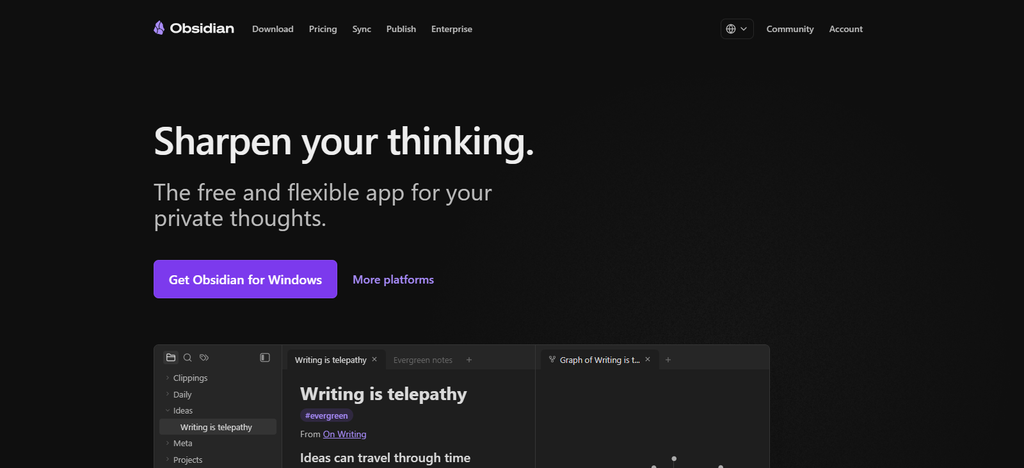
For research, Obsidian leverages plugins to access web services. Obsidian is focused on offline research and knowledge management. Its strongest suite is graph and relationship linking and representing data. Mid-paragraph, Obsidian competes with NotebookLM, as it is local-first storage, versus NotebookLM’s cloud storage.
Obsidian Traits
- Founded in 2020, freemium with $25/year commercial license
- • Local-first, privacy-focused note-taking and graph views
- • Markdown-based notes with plugin ecosystem for AI integration
- • Offline-first design ensures secure knowledge storage
- • Differentiator: privacy and local-first knowledge management
| Advantages | Disadvantages |
|---|---|
| Local-first, privacy-focused storage | Requires manual plugin setup |
| Affordable ($25/year commercial license) | Limited built-in AI features |
| Markdown-based notes with graph views | Collaboration weaker than cloud tools |
| Strong plugin ecosystem | Web research depends on third-party plugins |
| Offline-first design ensures security | Learning curve for graph visualization |
8. SurfSense
SurfSense is a knowledge management and research tool focused on privacy. It has a free individual user tier, and charges for its higher tiers, which support group research. SurfSense supports a variety of real-time collaborative note taking and editing services.
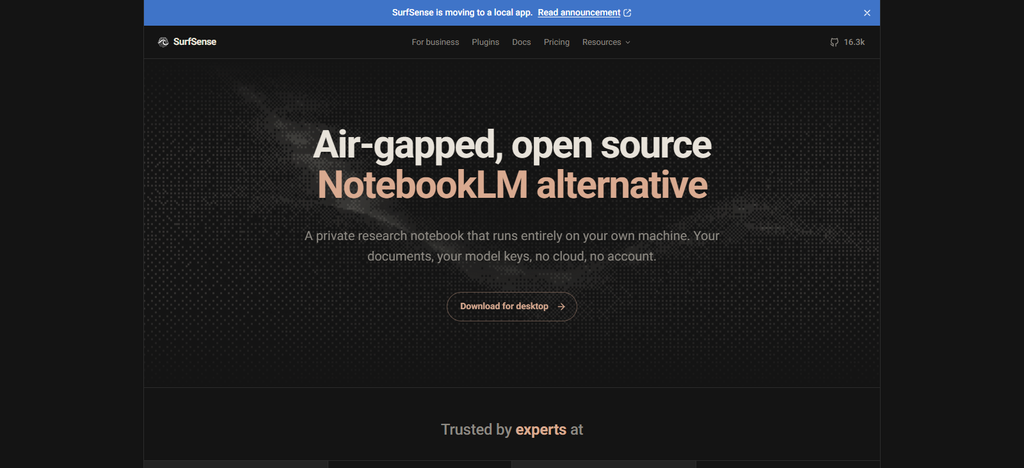
For research, it provides integrations with citing APIs. It supports and manages group research and related documentation. SurfSense is based on the principles of collaboration and . mid paragraph, it is SurfSense’s focus on community that differentiates it from NotebookLM.
SurfSense Traits
- Launched in 2025, freemium
- Focused on Collaborative Research
- Supports citation and real-time collaboration
- Most Innovative Feature: Community
| Advantages | Disadvantages |
|---|---|
| Open-source and free for individuals | Less polished UI compared to commercial rivals |
| Paid tiers for team collaboration | Requires technical setup for advanced use |
| Collaborative notebooks with real-time editing | Smaller ecosystem than Obsidian |
| Supports citation tracking | Limited offline functionality |
| Community-driven development | Dependent on open-source contributions |
9. Elephas
Launched in 2021, Elephas is an AI research and writing assistant, native to the Mac and iPad. It charges $10 a month, and offers a one time purchasing option for a lifetime subscription. It focuses on the category, “Personal Productivity and Research.” It summarizes documents and writes e-mails. It also provides a workflow to complete tasks using AI.
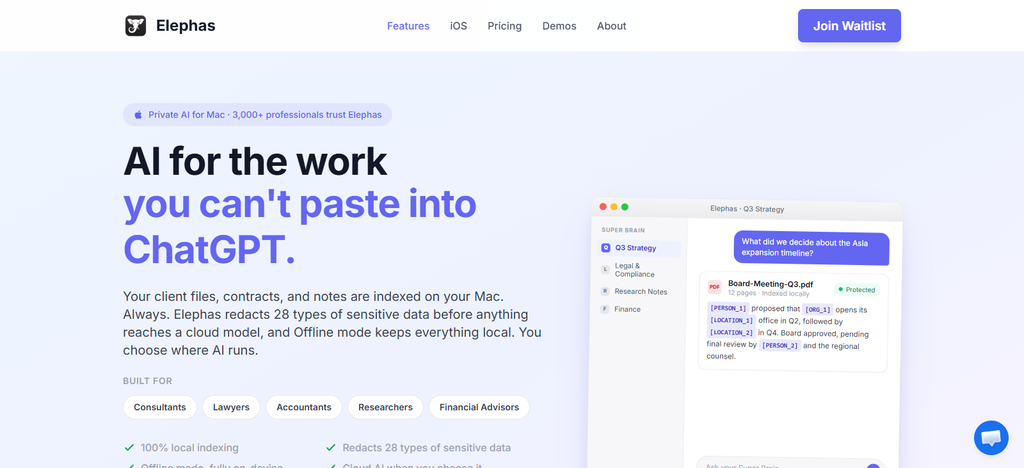
For web research it utilizes Safari and other Mac applications. It focuses on private document AI to provide privacy and security for the user’s data. Mid-briefing, the main competition for Elephas and NotebookLM is Apple’s native privacy.
Elephas Traits
- Launched in 2021, Apple-exclusive, $10/month or $100/year
- Focused on productivity and research
- Integrates with Apple’s apps to enhance private work
- Summarizes documents and suggests email taxts
- Most Innovative Feature: Privacy and Ecosystem
| Advantages | Disadvantages |
|---|---|
| Apple-native integration with macOS/iOS | Limited to Apple ecosystem |
| Affordable pricing ($10/month or lifetime license) | Less suited for cross-platform teams |
| Private document AI ensures security | Collaboration features minimal |
| Offers summarization and productivity tools | Web research scope narrower than Perplexity |
| Seamless integration with Apple apps | Focused more on personal workflows |
10. Saner.AI
Launched in 2023, Saner.AI assists with research related to work and project management. It charges $12 a month, and offers an enterprise plan for project management. It focuses on the research category of, “Task and Project Research.” It provides services for project management, note taking, and integrates with video meeting applications.
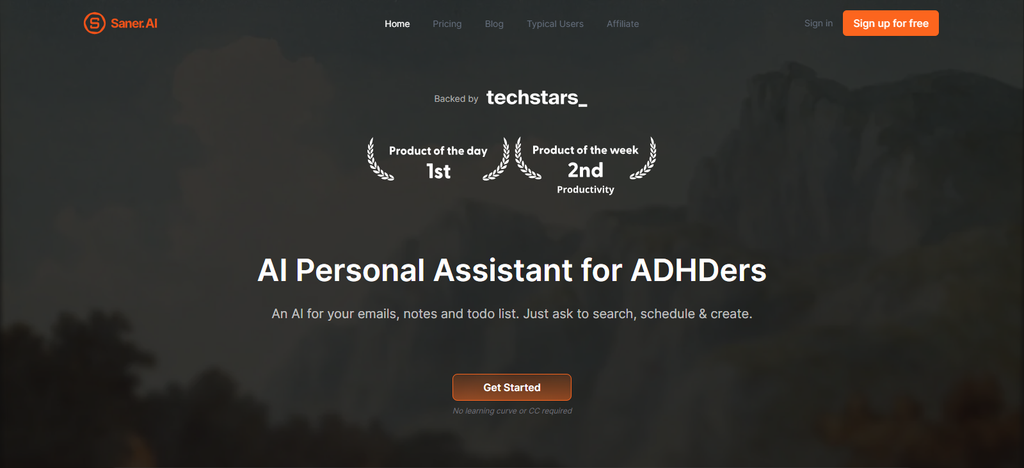
It provides web research through an API. It focuses on management and integration of research related to work and project activities. Mid-briefing, Saner.AI and NotebookLM are directly competing products, focusing on task and project research and management.
Saner.AI Traits
- Launched in 2023, $12/year
- Focused on research, project and task management
- Integrates with project management, video conference and other services
- Most Innovative Feature: Integrated Research and Action Items
| Advantages | Disadvantages |
|---|---|
| Connects research directly to tasks/projects | Narrow focus on project-linked research |
| Affordable pricing ($12/month) | Less robust for academic literature reviews |
| Integrates notes with meetings and project tools | Smaller ecosystem compared to Obsidian |
| Supports API connections for external sources | Collaboration weaker than SurfSense |
| Ensures actionable outcomes from research | Still developing advanced features |
Comparison Table
| Tool | Founded | Pricing | Primary Research Category | Web Research | Knowledge Management |
|---|---|---|---|---|---|
| Atlas | 2022 | $20/month | Visual knowledge synthesis | Scholarly database integration | Knowledge graphs & mapping |
| Elicit | 2021 | Freemium, $15/month advanced | Academic literature review | Semantic Scholar integration | Structured extraction tables |
| Claude Projects | 2025 | $30/month | Long-context reasoning | Real-time search APIs | Project folders & annotation |
| Perplexity | 2022 | Freemium, $20/month Pro | Real-time web research | Live source-linked answers | Saved threads & project org. |
| Consensus | 2021 | $15/month | Scientific consensus extraction | PubMed & scholarly databases | Evidence tables & verified citations |
| Recall | 2024 | $25/month | Lifelong knowledge base | API capture of external sources | Self-organizing memory |
| Obsidian | 2020 | Freemium, $25/year license | Privacy-focused note-taking | Plugin-based API connections | Local-first graph visualization |
| SurfSense | 2025 | Free, paid team tiers | Collaborative research notebooks | Open API integration | Shared workspaces & version control |
| Elephas | 2021 | $10/month or lifetime | Apple-native productivity research | Safari & Apple ecosystem apps | Private document AI workflows |
| Saner.AI | 2023 | $12/month | Task-linked research | API connections | Notes tied to projects & meetings |
Conclusion
In 2026, users of AI research tools will no longer have to rely on NotebookLM for structured knowledge. The presence of Atlas, Elicit, Claude Projects, Perplexity, Consensus, Recall, Obsidian, SurfSense, Elephas, Saner.ai and others, means that users will have a number of options for structured knowledge.
These options differ from one another in a number of ways, including the precision with which they generate citations, their models of privacy and security, the nature of their integration with other services, their pricing, their approach to the lifelong retention of knowledge, and when they were founded.
Users will have the opportunity to select the services that best meet their needs for web-based research, management of knowledge, and the day-to-day management of their work and research.
FAQ
What is Atlas?
Atlas is a research synthesis tool founded in 2022. It focuses on visual knowledge maps and costs around $20/month. It’s best for academic and enterprise users who need structured visualization and citation tracking.
How does Elicit work?
Elicit, launched in 2021, is a literature review assistant. It’s freemium with advanced features at $15/month. It extracts structured data from papers and integrates with Semantic Scholar for reliable citations.
What makes Claude Projects unique?
Claude Projects, introduced in 2025 by Anthropic, specializes in long-context reasoning. Pricing starts at $30/month. It can handle 1,000+ page documents, making it ideal for deep academic or legal research.
Is Perplexity good for web research?
Yes. Perplexity, founded in 2022, excels in real-time web-grounded research. It’s freemium with Pro at $20/month. It provides source-linked answers and citation exports, perfect for journalists and analysts.
Why use Consensus?
Consensus, founded in 2021, focuses on evidence-based answers. At $15/month, it integrates with PubMed and other scholarly databases, summarizing peer-reviewed studies for medical and scientific research.