




I will discuss the top Enterprise Search Software in the upcoming year that provides scalability, AI-based relevant search, and integrations. Large enterprises have a large structured and unstructured data repository. Search solutions, like the ones mentioned above, help enterprises to gain control over their data, increase employee productivity, and adhere to data compliance standards. With such search solutions, enterprise data is easily accessible to employees wherever they are.
What Is Enterprise Search Software?
Enterprise Search Software provides large companies the ability for employees to search, retrieve, and analyze information throughout the company and beyond. Traditional search engines are not adequate to meet these needs. Enterprise Search Software is able to pull and index all types of information including emails and documents.
This type of software utilizes Artificial Intelligence to provide search results, and provides the ability for users to conduct searches in the manner in which they naturally conduct searches. Enterprise Search Software provides the ability for users to conduct searches within the confines of their permissions.
This software, when integrated with other applications, enhances compliance and provides users the ability to take full advantage of the features and functionality provided by other software applications used by the company.
Why Large Businesses Need Enterprise Search
Ability to search large datasets: Large enterprises have thousands (or even millions) of records and documents. Enterprise search offers a way to quickly access these documents and information.
Employee productivity: Enterprise search helps employees locate information quickly. As a result, employees can spend more time on other productive activities.
Compliance: Several enterprise search platforms have features that help regulated enterprises manage access controls and provide audit logs.
Artificial Intelligence: Contextual information and search results based on a user’s profile are offered by some enterprise search platforms.
Integration: Enterprise search applications integrate with other platforms, and as a result, provide access to information across an organization’s ecosystem.
Key Points
| Software | Best For | Key Features |
|---|---|---|
| Glean | Permission-scoped workplace search | Analytics linking query behavior to coverage gaps; strong reporting on relevance outcomes. |
| Google Cloud Vertex AI Search | Cloud-native enterprises | Built-in access control enforcement; hybrid retrieval for RAG workflows. |
| IBM Watson Discovery | Semantic search & Q&A | Document ingestion pipelines, metadata extraction, governed semantic search. |
| Elastic Enterprise Search | Hybrid retrieval tuning | Explainable diagnostics, customizable relevance scoring, open-source flexibility. |
| Amazon Kendra | Natural language enterprise queries | ML-powered search, permission-aware indexing, fast deployment. |
| Microsoft Search | Microsoft ecosystem users | Deep integration with Office 365, Teams, and SharePoint. |
| Lupl | Legal & compliance teams | Permission-aware search for legal docs, improving relevance over time. |
| Coveo | Personalization-heavy enterprises | AI-driven recommendations, contextual search, strong analytics. |
| Mindbreeze InSpire | Enterprise knowledge management | Semantic AI search, connectors for diverse repositories, compliance-ready. |
| Yext Search | Customer-facing enterprises | Structured Q&A search, website integration, NLP-powered answers. |
1. Glean
Launched in 2019, Glean offers enterprise search with a specialization in horizontal workplace search. With access control in mind, Glean is able to index enormous numbers of workplace documents and make them searchable.
Pricing is done through subscription, and larger enterprise searches are expected to increase in the coming years. currently, Glean uses AI to enhance search with semantics and other contextual dimensions, and to analyze search trends to suggest where coverage is lacking.
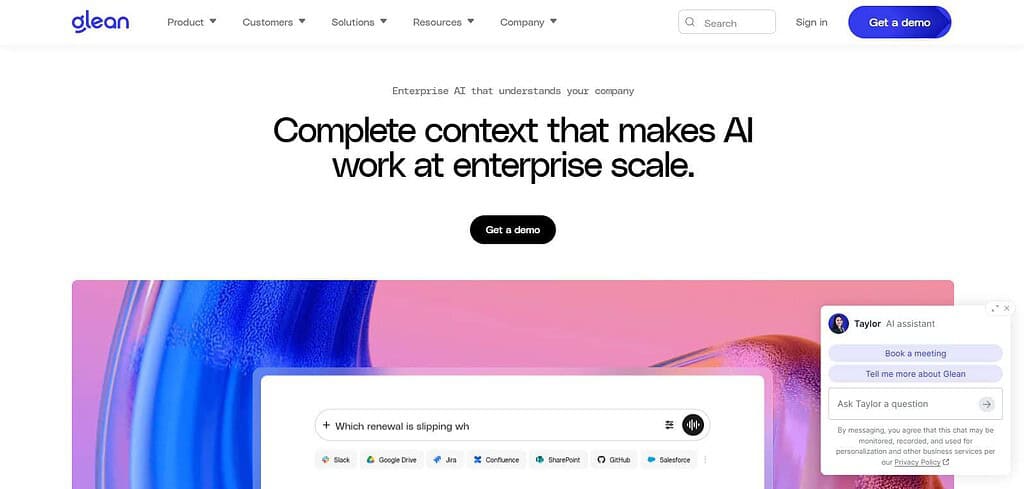
The app integrates with numerous productivity and collaboration tools. Glean is well-positioned to offer secure, organization-wide search and integration across multiple workplace applications.
What makes it unique: Different types of search are allowed based on a person’s permission level. Search is logged and analyzed to determine what is being searched for and what is not accessible.
Limitations: Works best with SaaS applications and other integrations beyond its core features.
Best for: Medium to large companies
Usage: Search across various business applications and tools
| Feature | Details |
|---|---|
| Founded | 2019 |
| Scalability | Handles millions of documents with permission-aware indexing |
| Pricing | Subscription-based, tailored to enterprise size |
| AI Capabilities | Semantic search, contextual ranking, analytics-driven insights |
| Search Type | Keyword + semantic hybrid |
| Supported Data Sources | Google Workspace, Slack, Jira, Salesforce, Confluence |
| Integrations | Productivity suites, collaboration tools, APIs |
| Security | Permission-scoped search with strict access controls |
| Analytics | Tracks query behavior and coverage gaps |
| Deployment | Cloud-native SaaS |
| Customization | Configurable relevance tuning |
| Ideal Use Case | Large enterprises needing unified workplace search |
2. Google Cloud Vertex AI Search
Google Cloud’s Vertex AI Search is a cloud-based solution for enterprise customers. It is part of Google’s larger AI infrastructure initiative. Like other Google Cloud products, it uses a pay-as-you-go model for pricing. Expect higher fees for larger, more powerful computing units.
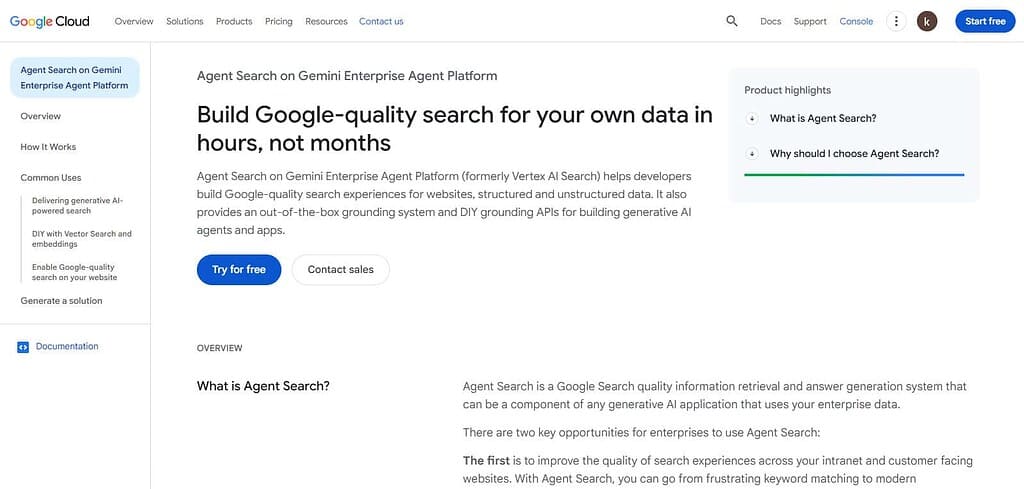
Vertex AI Search has features for semantic ranking and hybrid AI retrieval. It supports access controls and auditing. By default, it can connect to other Google Cloud services. However, it can integrate with APIs and other services. While the connector is Google Cloud centric, it can integrate with other applications.
It can perform advanced text searings across multiple services. Vertex AI Search favors customers using Google Cloud, as it provides features for administrative and operational controls, as well as end-user search.
What makes it unique: Along with searching, other business processes can be automated based on artificial intelligence and machine learning models.
Limitations: Search is bound to Google products and other services integrated within Google Cloud.
Best for: Large companies that use Google Cloud products.
Usage: Automate business processes and workflows.
| Feature | Details |
|---|---|
| Founded | Part of Google Cloud AI suite |
| Scalability | Global cloud-native infrastructure |
| Pricing | Pay-as-you-go with enterprise tiers |
| AI Capabilities | Hybrid retrieval, semantic ranking, RAG workflows |
| Search Type | Keyword, vector, hybrid |
| Supported Data Sources | Google Cloud Storage, BigQuery, Drive, APIs |
| Integrations | Google Cloud ecosystem + external apps |
| Security | Built-in access control enforcement |
| Analytics | Query performance dashboards |
| Deployment | Cloud-native |
| Customization | Flexible API-driven tuning |
| Ideal Use Case | Cloud-first enterprises on Google Cloud |
3. IBM Watson Discovery
From IBM’s AI unit, Watson Discovery offers an enterprise search and Q&A platform powered by semantic AI. It is used by various departments and agencies in financial, healthcare and government sectors to analyze large volumes of data and documentation.
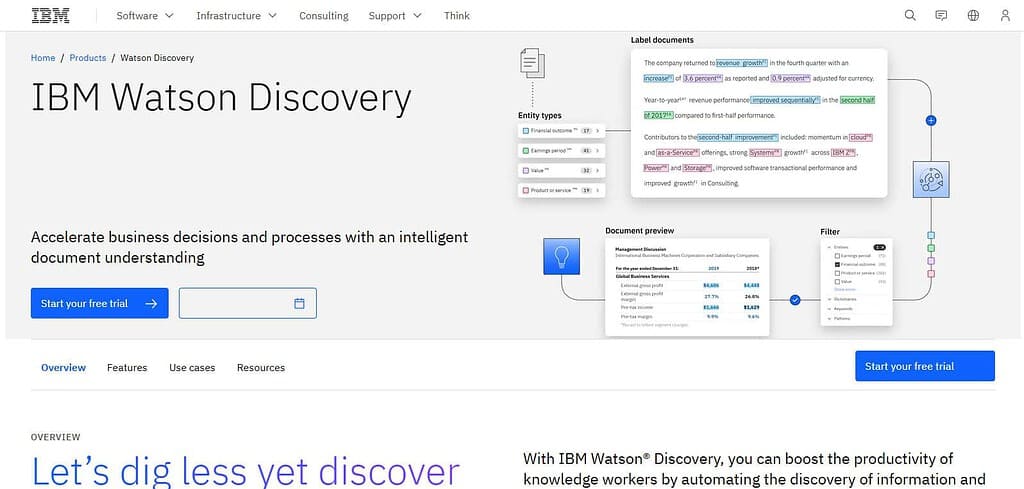
Pricing is based on the volume of data processed and the level of AI integration. The AI integrations include semantic search and metadata extraction. The solution extracts metadata from various data sources including structured data and documents.
It also integrates with various data management and enterprise collaboration platforms. The solution is useful for large enterprises in the financial and healthcare sectors that are regulated and require a high level of security and AI governance for compliance.
What makes it unique: Advanced natural language processing and search.
Limitations: More expensive and more complicated to implement when compared to alternatives.
Best for: Large companies in strict regulatory industries
Usage: Search and discovery of sensitive legal and healthcare information
| Feature | Details |
|---|---|
| Founded | IBM AI division |
| Scalability | Billions of documents across hybrid/multicloud |
| Pricing | Enterprise-grade, flexible tiers |
| AI Capabilities | NLP, OpenRAG, Smart Document Understanding |
| Search Type | Keyword, vector, hybrid |
| Supported Data Sources | Databases, PDFs, emails, repositories |
| Integrations | IBM Cloud, Salesforce, APIs |
| Security | Governance, lineage, compliance-ready |
| Analytics | Explainable AI diagnostics |
| Deployment | Hybrid + multicloud |
| Customization | Metadata extraction pipelines |
| Ideal Use Case | Compliance-heavy industries |
4. Elastic Enterprise Search
Elastic was started in 2012 and offers search products based on Elasticsearch. Elasticsearch can work with large datasets and can scale to large installations. It can perform distributed indexing. Elastic offers both a free, open-source version and an enterprise version of its products.

Elastic offers services that use AI to provide diagnostic information and help customize relevance scoring and other retrieval tasks. Elastic allows users to query a variety of data sources. It provides integration services with a variety of products and APIs. Elastic provides services to organizations that want to be in control of the products and services they use.
What makes it unique: Offers more control over search results.
Limitations: More appropriate for companies that have the ability to deploy and manage enterprise products.
Best for: Companies of any size
Usage: Search applications and products within a company.
| Feature | Details |
|---|---|
| Founded | 2012 |
| Scalability | Distributed indexing for massive datasets |
| Pricing | Open-source + enterprise subscriptions |
| AI Capabilities | Explainable diagnostics, customizable scoring |
| Search Type | Keyword, vector, hybrid |
| Supported Data Sources | Websites, apps, logs, repositories |
| Integrations | Microsoft, Google, APIs |
| Security | Role-based access |
| Analytics | Relevance tuning dashboards |
| Deployment | On-prem + cloud |
| Customization | Full open-source flexibility |
| Ideal Use Case | Enterprises needing control & transparency |
5. Amazon Kendra
Launched in 2019 by AWS, Amazon Kendra is an enterprise search solution. Kendra’s search index is built using natural language. It is designed to scale to large fleets of documents and is deployed to support many types of search.
Like other AWS offerings, it charges based on usage. Enterprise search solutions provide access to many different data sources, and Kendra supports Amazon RDS, Amazon S3, Salesforce, and Microsoft SharePoint. Kendra uses ML to provide context awareness for access control when determining what data to include in a search index. It is a good option for customers who wish to have an enterprise-wide natural language search, and who have already committed to the AWS ecosystem.
What makes it unique: Search is performed using natural language.
Limitations: Search is available only within Amazon Web Services.
Best for: Companies with a significant presence in Amazon Web Services.
Usage: Search company’s internal data.
| Feature | Details |
|---|---|
| Founded | AWS, 2019 |
| Scalability | AWS-native, millions of documents |
| Pricing | Usage-based (queries + indexing) |
| AI Capabilities | ML-powered semantic search |
| Search Type | Natural language queries |
| Supported Data Sources | SharePoint, Salesforce, S3, RDS |
| Integrations | AWS ecosystem + APIs |
| Security | Permission-aware indexing |
| Analytics | Query relevance monitoring |
| Deployment | Cloud-native |
| Customization | API-driven |
| Ideal Use Case | AWS enterprises needing fast deployment |
6. Microsoft Search
Integral to the Microsoft 365 suite, Microsoft Search empowers contextual and semantic search throughout Microsoft’s applications and services including Office, Teams and SharePoint. Microsoft Search is designed for large enterprises and multinational organizations with its capability to scale to millions of users.
AI enhances the search capabilities and integrates user behavior to customize search results. Microsoft Search restricts its data sources to Microsoft applications and services. Search results are integrated with Microsoft’s Graph API, allowing for search integration outside of Microsoft’s services. Microsoft Search offers the best enterprise search solution for organizations completely or partially leveraging Microsoft’s productivity suite.
What Makes It Different: Deep integration with Microsoft 365 apps and Teams.
Potential Limitations: Limited customization outside Microsoft ecosystem.
Ideal Business Size: Large enterprises standardized on Microsoft tools.
Use Cases: Contextual search across Office apps, OneDrive, Outlook, and SharePoint.
| Feature | Details |
|---|---|
| Founded | Microsoft 365 ecosystem |
| Scalability | Global enterprise-ready |
| Pricing | Bundled in Microsoft 365 |
| AI Capabilities | Semantic ranking, personalization |
| Search Type | Contextual + semantic |
| Supported Data Sources | Office apps, OneDrive, Outlook, SharePoint |
| Integrations | Microsoft Graph API |
| Security | Microsoft compliance standards |
| Analytics | Usage insights |
| Deployment | Cloud-native SaaS |
| Customization | Limited, ecosystem-driven |
| Ideal Use Case | Microsoft-centric enterprises |
7. Lupl
Launched in 2020, Lupl is an enterprise search platform for the legal industry. Its technology is designed to provide law firms and organizations with a means to structure and store case files, contracts, and other regulatory documents.
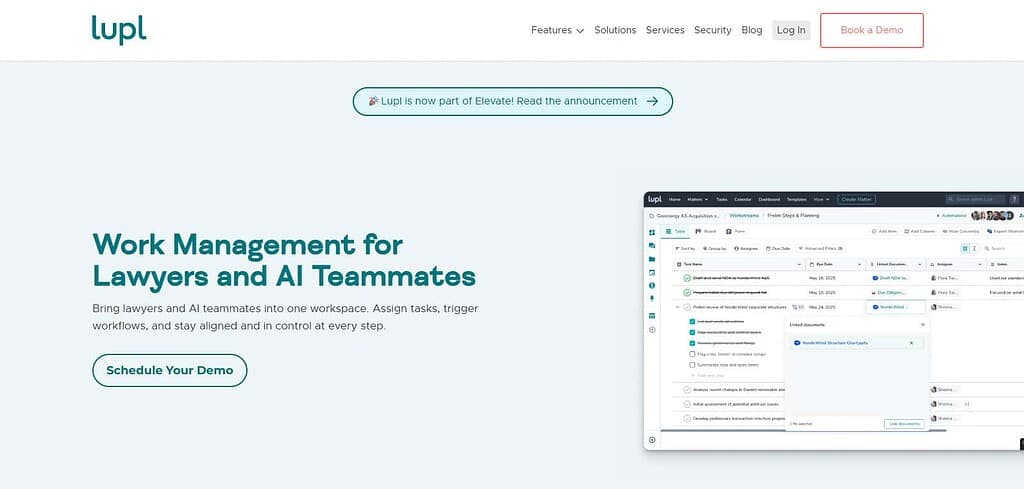
Lupl offers different subscription plans, depending on the needs of the firm or organization. Its artificial intelligence (AI) technology focuses on legal document search and retrieval. Lupl offers its APIs to legal, case management, and compliance document and record keeping systems. It has integrations for Slack, Microsoft 365, and several legal technology systems and services. Lupl’s main customer base is legal services organizations and firms.
What Makes It Different: Legal-focused search with permission-aware indexing.
Potential Limitations: Narrow focus; less useful outside legal/compliance industries.
Ideal Business Size: Law firms and compliance-heavy organizations.
Use Cases: Secure search across case files, contracts, and regulatory documents.
| Feature | Details |
|---|---|
| Founded | 2020 |
| Scalability | Tailored for law firms |
| Pricing | Subscription-based |
| AI Capabilities | Legal document contextual search |
| Search Type | Permission-aware |
| Supported Data Sources | Legal repositories, case systems |
| Integrations | Microsoft 365, Slack, legal tech |
| Security | Strict compliance controls |
| Analytics | Legal workflow insights |
| Deployment | SaaS |
| Customization | Legal-specific tuning |
| Ideal Use Case | Legal & compliance teams |
8. Coveo
Established in 2004, Coveo provides AI-based enterprise search and personalization solutions. The service can handle a large number of queries and is designed to be used by large companies. The costs associated with the service are designed specifically for large companies and include tiers based on the number of queries as well as advanced AIs.
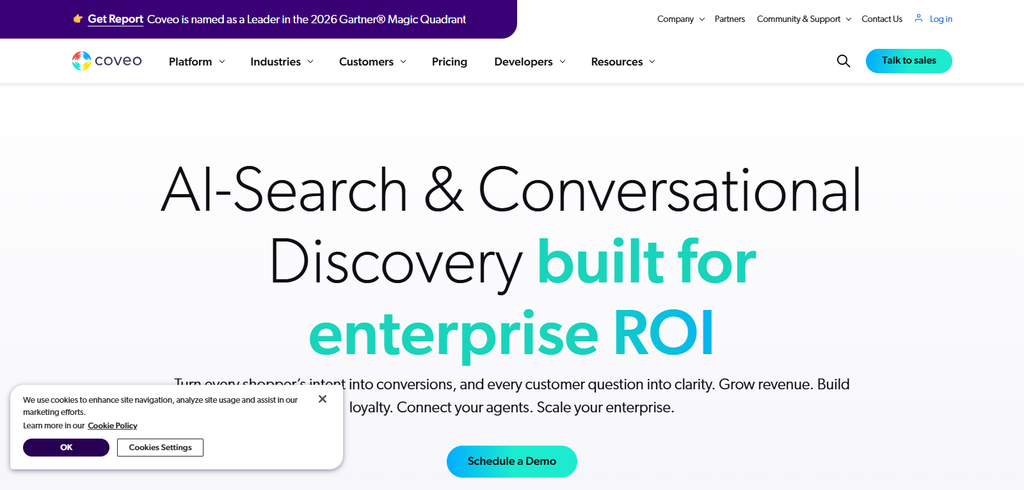
Beyond query-based search, Coveo’s AIs provide recommendations and other search personalization. Coveo’s solutions extend search beyond enterprise systems and applications and cover other customer service and support systems. Through AIs and custom recommendations, Coveo aims to improve customer service and engagement, and ultimately, an organization’s bottom line.
What Makes It Different: AI-driven personalization and contextual recommendations.
Potential Limitations: Higher cost for advanced personalization features.
Ideal Business Size: Large customer-facing enterprises.
Use Cases: Personalized search for CRM, ERP, and customer support systems.
| Feature | Details |
|---|---|
| Founded | 2004 |
| Scalability | Millions of queries daily |
| Pricing | Enterprise subscription tiers |
| AI Capabilities | Personalization, contextual recommendations |
| Search Type | Semantic + behavioral |
| Supported Data Sources | CRM, ERP, support repositories |
| Integrations | Salesforce, ServiceNow, e-commerce |
| Security | Role-based |
| Analytics | Customer engagement dashboards |
| Deployment | Cloud-native |
| Customization | Personalization tuning |
| Ideal Use Case | Customer-facing enterprises |
9. Mindbreeze InSpire
Based in Austria, Mindbreeze InSpire launched in 2005 as a knowledge management solution. They work with global companies with millions of documents. Pricing is available with an enterprise subscription. Mindbreeze offers semantic AI search and NLP to predict search intent and enhance search results.
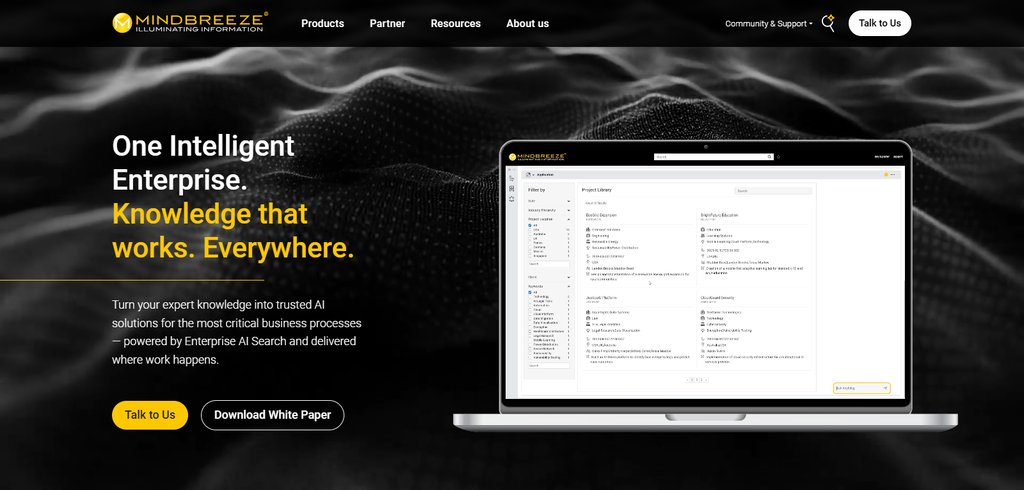
Additional features to help with search results are rules and auto-classification. Data sources can be Emails, PDF, and other enterprise resources. Mindbreeze is compatible with Microsoft and Google and helps with custom integrations. The solution helps companies with knowledge and document discovery and works well with company governance and compliance.
What Makes It Different: Semantic AI search with compliance-ready indexing.
Potential Limitations: Enterprise licensing can be expensive; requires governance expertise.
Ideal Business Size: Global enterprises with knowledge management needs.
Use Cases: Knowledge discovery across databases, emails, and enterprise repositories.
| Feature | Details |
|---|---|
| Founded | Austria, 2005 |
| Scalability | Billions of documents |
| Pricing | Enterprise licensing |
| AI Capabilities | Semantic AI, NLP relevance |
| Search Type | Hybrid |
| Supported Data Sources | Databases, emails, PDFs |
| Integrations | Microsoft, Google, APIs |
| Security | Compliance-ready |
| Analytics | Knowledge discovery dashboards |
| Deployment | Hybrid |
| Customization | Configurable pipelines |
| Ideal Use Case | Knowledge management & compliance |
10. Yext Search
In 2006, Yext launched its first products for structured Q&A. Since then, it has focused on similar customer-facing offerings. Although it can handle tens of thousands of queries per second, its prices are mostly geared for the enterprise level. Its products utilize NLP and other AI to generate answers to user queries and to facilitate search.
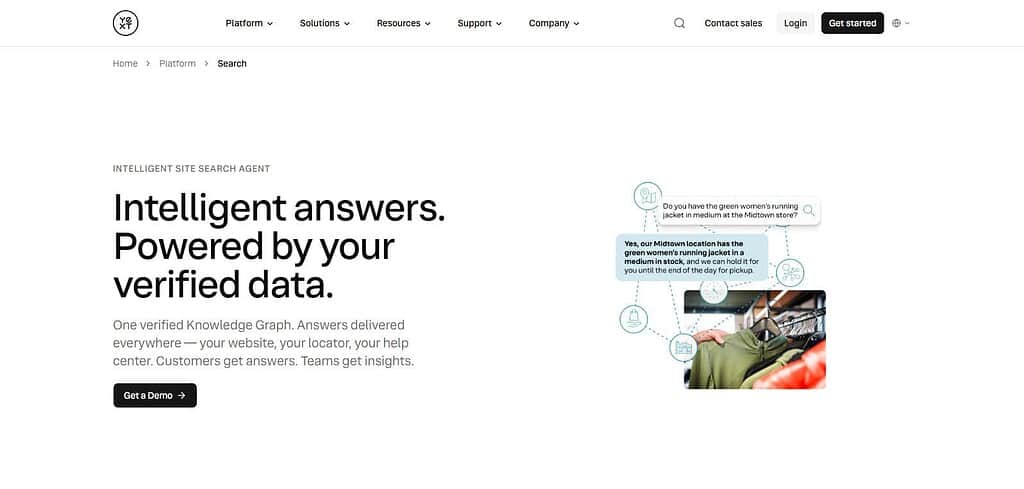
Its products can be integrated with customer support and sales platforms, and customer resource management (CRM) systems. It facilitates customer and user search on enterprise platforms. It primarily assists enterprises that want to provide customer search and support.
What Makes It Different: Structured Q&A search for customer-facing environments.
Potential Limitations: Focused on external-facing search; less suited for internal knowledge.
Ideal Business Size: Large enterprises with high customer query volumes.
Use Cases: NLP-powered Q&A for websites, CRM, and customer support portals.
| Feature | Details |
|---|---|
| Founded | 2006 |
| Scalability | High-volume customer queries |
| Pricing | Subscription tiers |
| AI Capabilities | NLP-powered Q&A |
| Search Type | Structured Q&A |
| Supported Data Sources | Websites, CRM, support repositories |
| Integrations | Salesforce, Zendesk, e-commerce |
| Security | Customer data compliance |
| Analytics | Query performance dashboards |
| Deployment | SaaS |
| Customization | Structured Q&A tuning |
| Ideal Use Case | Customer-facing enterprises |
Conclusion
In summary, the enterprise search software of 2026 shows how large organizations expect and install search solutions that have the potential to scale to the entire organization, and incorporate AI to gain search relevance. Cloud-first organizations can opt for Amazon Kendra and Microsoft Search. Other options that incorporate AI, but have a different focus are IBM Watson Discovery and Elastic Enterprise Search.
Lupl is a dedicated search solution for legal documents, and other industry solutions also exist. Personalizing search for customers is possible with Coveo and Yext Search. Mindbreeze InSpire provides a compliance solution for search. Other organizations that deploy solutions from this vendor can gain similar benefits.
FAQ
What is enterprise search software?
Enterprise search software enables organizations to index, retrieve, and analyze information across multiple internal and external data sources, ensuring employees and customers can access relevant knowledge quickly.
Which enterprise search tools are best for large businesses in 2026?
Top platforms include Glean, Google Vertex AI Search, IBM Watson Discovery, Elastic, Amazon Kendra, Microsoft Search, Lupl, Coveo, Mindbreeze InSpire, and Yext Search — each excelling in scalability, AI-driven relevance, and integrations.
How does pricing work for enterprise search platforms?
Pricing varies: cloud-native tools like Google Vertex AI Search and Amazon Kendra use consumption-based models, while Glean, Coveo, and Yext offer subscription tiers. Elastic provides open-source plus enterprise licensing.
What AI capabilities do these platforms offer?
AI features include semantic search, hybrid retrieval, contextual ranking, personalization, and NLP enrichments. IBM Watson Discovery and Coveo lead in advanced NLP, while Glean and Kendra excel in natural language queries.