



In this article, I discuss the best Enterprise AI Agent Platforms for Businesses. These platforms empower organizations to automate workflows, optimize productivity, and augment intelligent decision-making.
AI platforms provide the capability of building intelligent agents dedicated to customer support, business operations, and the analysis and automation of business-related tasks. I evaluate the platforms’ characteristics, pricing, advantages, and limitations. Businesses can then select the most appropriate AI for their needs.
Why Choose Enterprise AI Agent Platforms for Businesses
Business Process Automation: Enterprise AI agent platforms help automate tedious business processes and reduce the manual workload on functions across the business.
Boost Employee Productivity: AI agents support employees by taking care of more mundane tasks and the need for instant Q&A, thereby enabling employees and teams to concentrate on tasks that carry more significance.
Improved Customer Service: AI agents allow companies to respond more quickly to customers, provide more personalized support, and offer round-the-clock customer care over multiple channels.
Enhanced Data-Driven Insights for Better Decisions: Enterprise AI agent platforms offer their clients the capability to quickly and easily analyze millions of business transactions and data to generate reports that help executives make better and wiser business decisions.
Improved Enterprise Performance: Intelligent automation provided by the AI agent platforms helps businesses greatly improve the bottom line by eliminating process inefficiencies and errors.
Enterprise-Wide Scalable Solutions: Cumulatively, the various AI agent platforms provide solutions that can be scaled across the business to support the needs of more users, more business functions, more workflows, and more complex business functions to be automated as the business grows.
Seamless Integration with Other Business Applications: AI agent platforms can be easily integrated with business applications like CRM, ERP, various cloud services, databases, and more.
Organized Data: Enterprise AI agents support the automation of the capturing and organizing and analyzing of business data, which improves the speed at which data can be accessed and the insights derived.
Reduced Cost of Operations: AI-based automation reduces the burden of manual tasks, which saves business resources and time.
Future-Readiness to Support Growth and Innovation: Enterprise AI agents allow businesses to quickly adopt new advanced AI technologies.
Benefits Of Enterprise AI Agent Platforms for Businesses
Automation of Business Processes: Platforms make automation of business processes including automation of repetitive tasks and management of workflow via reduction of manual requests and involvement.
Increased Employee Productivity: Automation of repetitive employee tasks such as answering questions, report generation, and data analysis is done to assist agents in their business day-to-day.
Non-stop Customer Service: AI Agents serve and respond to customer queries and requests for assistance at any time and provide faster and more tailored solutions without the need of people.
Informed Business Decisions: Real-time analysis of business data and provision of insights with suggested actions facilitate the decisions of business leaders.
Improved Business Productivity: Agents minimize and even eliminate business process bottlenecks and errors and enhance productivity.
Cost Efficiency: The automation of business processes promotes savings in labor costs, general resource expenditure, and improved financial performance.
Fast Business Data Processing: Large volumes of data and their processing are done at faster rates to be able to recognize business gaps, opportunities, and threats.
Data System Harmonization: Platforms produce a seamless workflow by integrating with existing business systems and cloud applications.
Improved Customer Engagement: AI Agents enhance customer engagement with faster and more tailored assistance.
Business Operations Flexibility: Enterprise AI Agent Platforms possess the capabilities to adapt to changes in volume, user, and business operations.
Teamwork Enhancement: Automation of tasks, information sharing, and communication is achieved by the Agents.
Improved Security and Compliance: Many enterprise AI platforms include features for data protection and access control, as well as governance tools that facilitate secure business operations.
Best Enterprise AI Agent Platforms for Businesses List
- Microsoft Copilot Studio
- Google Vertex AI Agents
- Salesforce Agentforce
- UiPath AI Center
- IBM Watsonx Orchestrate
- Oracle Digital Assistant
- SAP Joule AI
- n8n AI Agents
- Relevance AI
- MindStudio
10 Best Enterprise AI Agent Platforms for Businesses 2026
1. Microsoft Copilot Studio
Microsoft Copilot Studio, one of the best enterprise AI agent platforms, allows businesses to create AI agents with coding knowledge. These AI agents can be used to support employees and manage customer support and business workflows and processes outside of Microsoft tools.
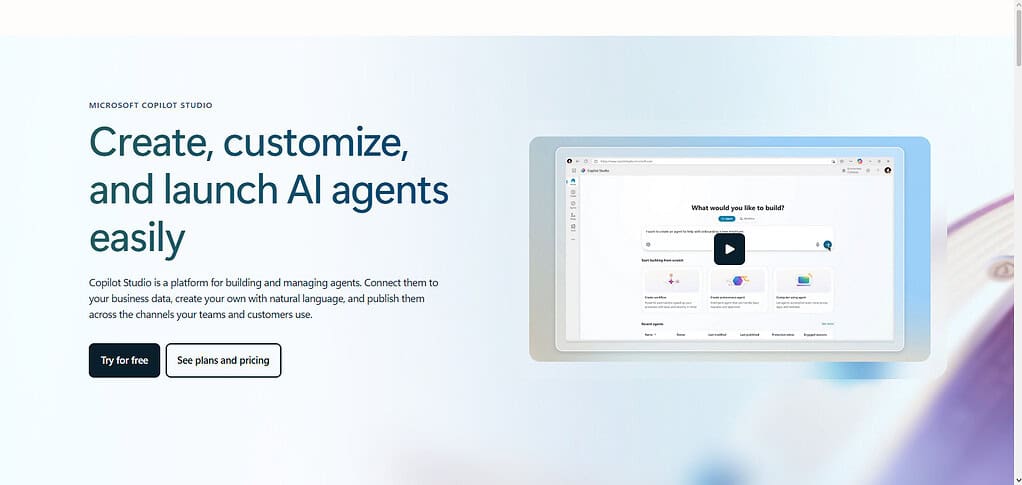
Microsoft Copilot Studio allows businesses to build conversational agents that can handle tasks in various applications and understand the company’s data.
Pricing: Microsoft Copilot Studio adopts a pay-per-use pricing model with several paid message packs and enterprise licenses. Limitations: Adopting the Microsoft ecosystem and advanced customization can increase the technical skills and cost.
Microsoft Copilot Studio
Strengths
- Smooth Microsoft Integration: Integrates effortlessly with Microsoft 365.
- Low-Code Agents: Requires little coding for AI agent creation.
- Strong Enterprise Security: Provides security and compliance at the Microsoft level.
- Automated Workflows: Automates support, employee tasks, and business workflows.
- Generative AI: Implements advanced conversation capabilities.
Pricing
- Usage-Based Pricing: AI messages and agent interactions determine costs along with enterprise needs.
- Microsoft Licensing Options: Pricing may be provided or bundled with Microsoft business subscriptions.
- Enterprise Plans: Custom licensing packages may be available for larger enterprises.
- Additional Costs: Connectors, integrations, and features may incur extra costs.
- Flexible Pricing Model: Designed for small teams and large enterprises.
Limitations
- Microsoft Product Dependency: Best for enterprises using Microsoft products.
- More Costly for Enterprises: Advanced costs increase with large-scale use.
- Less Customization: More complex AI workflows may incur additional costs.
- Training: New users require advanced capability training.
- Integration with Other Products: May require additional work for non-Microsoft products.
2. Google Vertex AI Agents
Google Vertex AI Agents is an advanced enterprise AI solution. Using Vertex AI Agents, organizations design custom AI agents on the Google Cloud Infrastructure, leveraging Generative AI and ML Models. The platform offers advanced reasoning, data fetching, automation, and enterprise application integration.
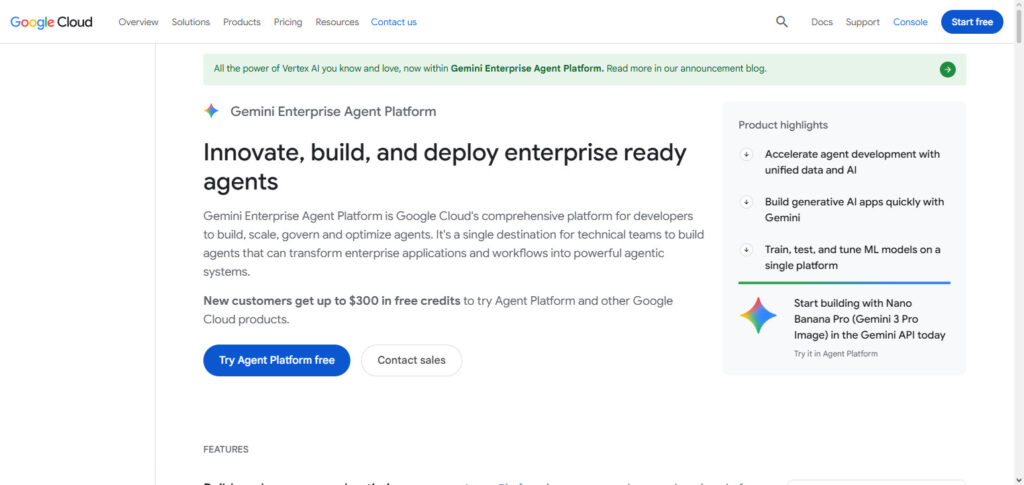
The platform enables firms to design AI agents for different purposes such as customer service and sales. Firms can also use Google AI models and security features.
Pricing: Google Vertex AI Agents employs a pay-as-you-go model consisting of the costs of computing, model usage, this storage, and API calls. Limitations: The platform may require advanced skills in cloud computing, and the costs of deploying at scale in an enterprise setting can be prohibitive.
Google Vertex AI Agents
Strengths
- Powerful AI Infrastructure: Advanced Machine Learning is rooted in Google Cloud.
- Scalable for the Enterprise: AI is capable of covering large business operations.
- Intelligent Data Insights: Has advanced data processing and connections with enterprise data sources.
- Hybrid AI Model Support: Companies can engage several AI models.
- Enterprise-Grade Cloud Security: Offers enterprise infrastructure security and compliance tools.
Pricing
- Pay-What-You-Use: Prices for models, allocated API requests, and on-demand compute resources.
- Custom Pricing for Enterprise Clients: Larger customers get unique offer design.
- AI Models and Workload Pricing: Costs associated with selected AI models.
- Compute Resource Costs: May incur additional costs for processing, storage, and networking.
- Usage Based Pricing: Companies are charged based on how much they actually use.
Limitations
- AI and Google Cloud Knowledge: Users must have this knowledge.
- Challenging Initial Configuration: Many find the initial setup challenging.
- Potential for Uncontrolled Costs: May be high costs in relation to the large AI workloads.
- Developer Focused Tool: Non-technical users will likely struggle to use the platform.
- Exclusive Google Cloud Dependency: Optimal performance can only be achieved using Google Cloud.
3. Salesforce Agentforce
Salesforce Agentforce is designed for companies that wish to automate employee and customer interaction through the business sales and services workflow automation. Agentforce uses Salesforce CRM Direct Connect. Personalization is the game changer for AI, and Agentforce is no different.
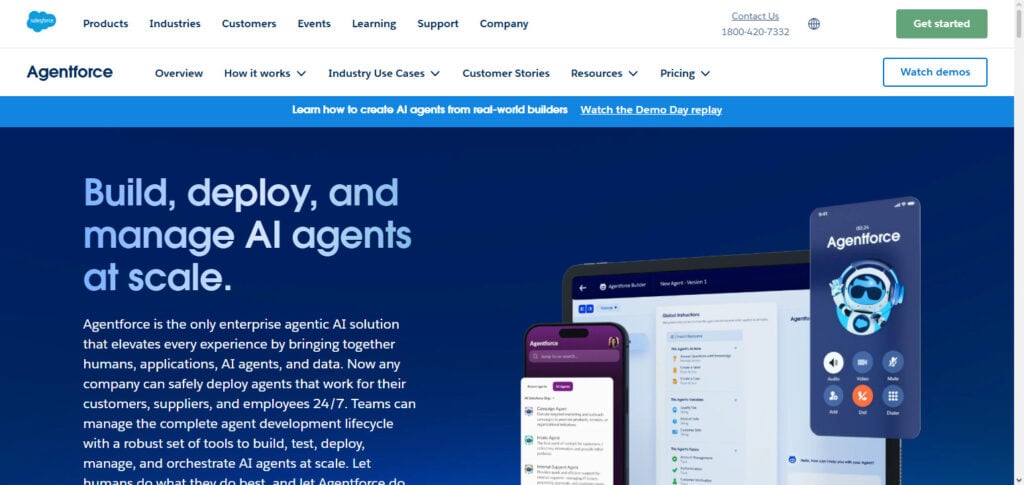
It can now dynamically respond to customer requests, and even support your employees by providing real-time insights. Agentforce combines automation with customer relationship intelligence to generate productivity.
Pricing: Agentforce pricing hinges of Salesforce editions, AI “consumption” and features selected. Enterprise plans draw custom quotes. Constraints: As designed, Agentforce was built to work best “In the Box” with Salesforce. Companies using other CRM systems/solutions or those looking to integrate other systems may incur a high costo.
Salesforce Agentforce
Strengths
- Seamless CRM Integration: Integrates directly with Salesforce customer data and existing business workflows.
- Automation of Customer Service Tasks: Supports the automation of many customer service and sales tasks.
- AI Experiences Based on Customer Data: Uses customer data to build experiences.
- Designed for Enterprises: Has the structure and security of an enterprise platform.
- Designed for Rapid Business Adoption: Built for Salesforce customers with little to no additional work needed.
Pricing
- Salesforce Model: Pricing is based on which Salesforce products are purchased and which AI capabilities are purchased.
- Pay for Usage Model: Costs are related to the number of conversations that agents take and the number of actions they perform.
- Enterprise Focused Pricing: Large customers get unique offers.
- Licencing Costs: Advanced capabilities may require additional licensing of higher Salesforce tiers.
- Usage Based Pricing: Pricing is based on which scale customers need.
Limitations
- Salesforce Dependency: Works best with businesses that already utilize Salesforce.
- Small Business Pricing: Pricing is high.
- External Integration Flexibility: Integrating with external platforms is difficult.
- Complicated Customization: More complex workflows require greater customization.
- Salesforce Familiarity: End users are expected to know the platform.
4. UiPath AI Center
UiPath AI Center is a business oriented AI Agent platform that helps combine AI technologies with RPA. Ai Center features a comprehensive suite of tools, giving organizations the ability to deploy and manage machine learning models that automate the execution of repetitive and complicated workflows.
UiPath AI Center is often used to automate tasks such as document processing, customer and finance operations, and other intelligent business operations. Pricing: As a daily rate, UiPath AI Center pricing comes from the number of automation platform licenses and AI workloads.
Tailored pricing is available for giant enterprises. Considerations: Some familiarity with RPA concepts may be needed, and for smaller enterprises, the cost in relation to lighter AI solutions on the market may be prohibitive.
UiPath AI Center
Strengths
- AI + Automation Synergy: Offers the combination of AI with automation.
- Workflow Automation: Capable of automating complex business workflows.
- AI Management System: Assists with the deployment and management of AI.
- Business Process Workflows: Great for finance, HR, and operations.
- Automation at Scale: Focuses on large enterprises.
Pricing
- Enterprise License: Costs are based on automation and users.
- Customized Pricing: Custom packages for large clients.
- AI Pricing: May incur additional costs for AI.
- Subscription to the Platform: Covers automation and AI management.
- Diverse Deployment Options: Various enterprise needs addressed.
Limitations
- Cost: High compared to automation tools with embedded AI.
- Technical Automation Knowledge: Requires knowledge of automation.
- Complex Automation: Planning is required for large scale automation.
- Teams for Automation: Typically requires a dedicated team.
- Small Business Fit: Focused on large enterprises.
5. IBM Watsonx Orchestrate
IBM IBM Watsonx Orchestrate works by coupling AI assistants with company applications, workflows, and data resources, and targets the automation of business tasks. IBM Watsonx Orchestrate can assist enterprises in building digital workers that can manage the HR processes, customer support, and operational and productivity tasks.
Watsonx Orchestrate aims at enterprise automation featuring security, governance, and management of AI. Pricing: The costs associated with IBM Watsonx Orchestrate depends on the usage, the way it is deployed, requests of the enterprise, and the selected IBM Cloud services.
Limitations: Potential users should note that this tool can have a steep learning curve and may be too complex or advanced for smaller organizations and require technical resources to implement and customize.
IBM Watsonx Orchestrate
Strengths
- Enterprise Automation: AI for automation of complex business tasks.
- Strong Governance Features: AI management and compliance controls.
- Business Application Integrations: Integrations with enterprise applications.
- AI for the Enterprise: AI ready for enterprise customers.
- Intelligent Digital Workers: Develops AI assistants to streamline tasks.
Pricing
- Enterprise Subscription Pricing: Tailored to business needs and usage.
- Custom IBM Packages: Pricing is case by case for very large clients.
- Cloud-Based Pricing: Based on IBM Cloud resource consumption.
- AI Service Usage Fees: Fees may be workload-dependent.
- Flexible Enterprise Agreements: Supports tailored contracts.
Limitations
- Complex Platform: Requires considerable technical know-how.
- Higher Implementation Costs: Designing the enterprise solution may be costly.
- Steep Learning Curve: Users may have to undergo IBM training.
- Limited Small Business Adoption: Primarily for large enterprises.
- Integration Difficulty: Connecting various systems may require additional know-how.
6. Oracle Digital Assistant
Oracle Oracle Digital Assistant is a platform that builds AI assistants for enterprise use cases from customer service to business automation. It offers organizations the ability to create conversational assistants to aid support for employees and customers alike. It offers integrations for many of Oracle’s cloud offerings as well as their ERP, HR, and database solutions.
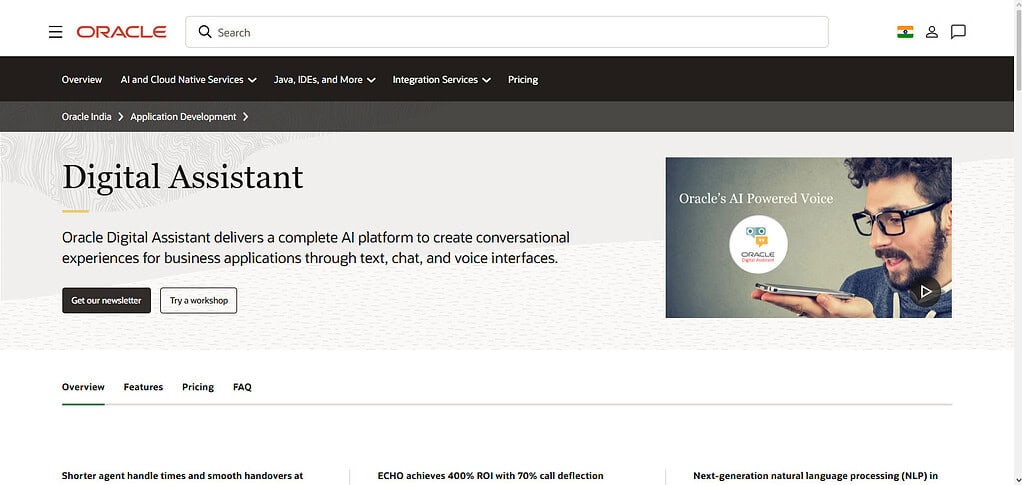
Commercial entities build AI agents for use cases in productivity and user experience. Pricing: Pricing for Oracle Digital Assistant is dependent on usage, licensing models, and enterprise deployments from Oracle Cloud. Limitations: The platform is going to be the most useful for organizations that are Oracle clients. If there are other technologies in use, other integrations will likely be necessary.
Oracle Digital Assistant
Strengths
- Oracle Application Integration: Great for Oracle ERP and HR and cloud solutions.
- Conversational AI Capabilities: Develops intelligent business assistants.
- Enterprise Security: Secured AI interaction.
- Multi-Channel Support: Web, mobile, and business application support.
- Business Process Automation: Creates efficiency in business operations.
Pricing
- Oracle Cloud Pricing: Based on usage and Oracle Cloud services.
- Enterprise Licensing: Tailored pricing for large enterprises.
- Subscription Models: Based on organizational needs.
- Features Availability: Advanced business assistant capabilities may incur additional costs.
- Enterprise Need Support: Designed for large enterprises.
Limitations
- Best for Oracle Users: Outside of Oracle environments, less beneficial.
- Complex Solutions: High level of technical know how.
- High Costs: Enterprise licensing may be costly.
- Limited Customization: May need development for custom solutions.
- Learning Requirements: Users need to learn the Oracle platforms.
7. SAP Joule AI
SAP SAP Joule AI is a platform designed to integrate enterprise AI assistants built to improve business functionality across all SAP applications. SAP Joule allows employees to gain more insights, complete analyses and tasks, as well as, automate workflows via natural language processing. SAP Joule .
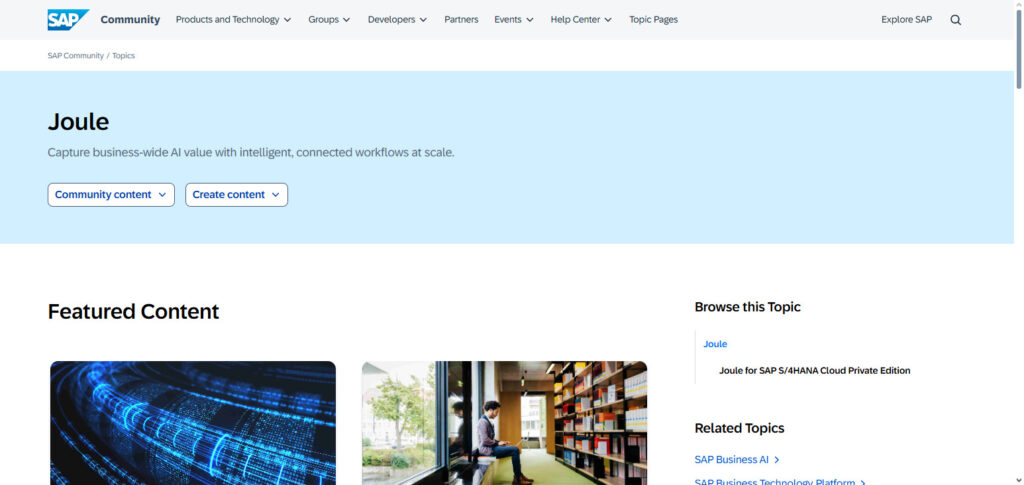
encompasses functions in finance, supply chains, HR, and enterprise resource planning. Pricing: SAP Joule AI is generally baked into SAP cloud subscriptions, relies on enterprise agreements and is dependent upon user and AI capabilities requirements.
Limitations: Companies that do not utilize SAP may not receive the complete offerings, as advanced functionalities demand the purchase of more SAP licenses, as well as, more configurations.
SAP Joule AI
Strengths
- SAP Ecosystem Integration: Works with SAP ERP and business applications.
- Enterprise Data Insights: Provides AI-powered business recommendations.
- Workflow Automation: Helps automate enterprise processes.
- Industry-Specific Intelligence: Supports finance, HR, and supply chain.
- Secure Enterprise AI: Built for business data protection.
Pricing
- SAP Subscription Pricing: Available through SAP cloud agreements.
- Enterprise Licensing: Pricing depends on company size and usage.
- Additional SAP Costs: Some features require extra licenses.
- Custom Enterprise Packages: Available for large organizations.
- Usage-Based Charges: May apply depending on AI consumption.
Limitations
- SAP Dependency: Works best for SAP customers.
- High Cost: Enterprise SAP solutions can be expensive.
- Complex Implementation: Requires SAP expertise.
- Limited Non-SAP Integration: External systems may need customization.
- Training Requirements: Employees may need SAP knowledge.
8. n8n AI Agents
n8n n8n AI Agents allows companies to custom make automated systems that utilize artificial intelligence. It integrates large language model systems within an automation framework for simpler interconnection of application programming interfaces (APIs), databases, business utilities, and AI systems.
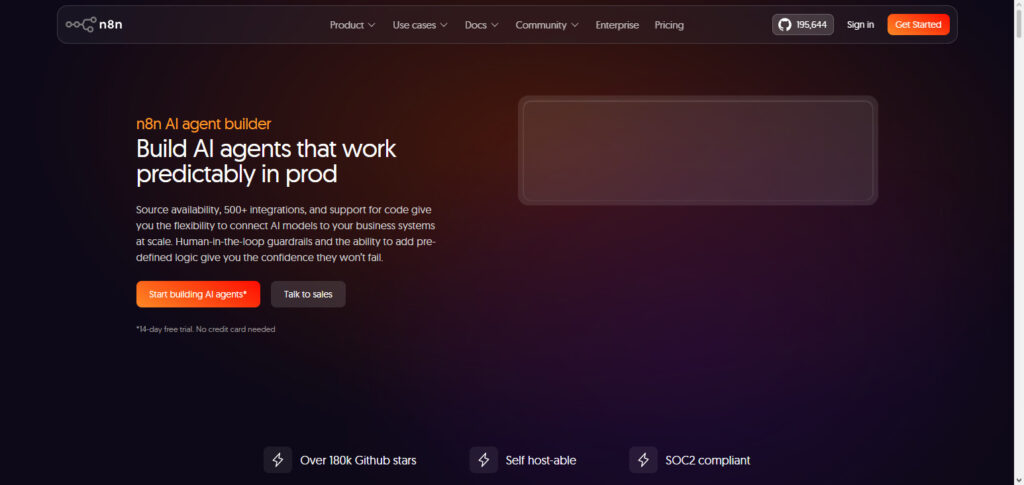
Automated marketing, AI customer support, AI based data processing, and optimizing internal systems for an organization are common use cases for n8n AI Agents. Pricing: n8n has offerings for cloud-based subscriptions and self-hosted systems, which means it can be flexible to fit varying scales for businesses.
Limitations: A barrier to entry with n8n is that advanced AI agents require a substantial level of building complexity that may be an unmanageable burden on a company’s existing development staff.
n8n AI Agents
Strengths
- Flexible Workflow Automation: Connects multiple apps, APIs, and AI models.
- Open-Source Availability: Offers self-hosting options for businesses.
- Custom AI Workflows: Allows advanced automation creation.
- Wide Integration Support: Connects with hundreds of services.
- Cost-Friendly Option: Suitable for startups and growing businesses.
Pricing
- Cloud Subscription Plans: Pricing depends on workflow executions and usage.
- Self-Hosted Option: Businesses can run n8n on their own servers.
- Free Community Edition: Available for basic usage.
- Enterprise Plans: Include advanced security and support.
- Scalable Costs: Increases based on automation requirements.
Limitations
- Technical Skills Needed: Advanced workflows require development knowledge.
- Maintenance Responsibility: Self-hosting requires management.
- Limited Enterprise Features: Compared with large enterprise platforms.
- Complex Automation Design: Large workflows can become difficult.
- Support Limitations: Premium support requires paid plans.
9. Relevance AI
Relevance AI Relevance AI provides an enterprise AI agent platform. Its main product is an AI agent building tool for use within a variety of business functions like sales, research, and operations, as well as customer support and data analysis, and without requiring extensive code.
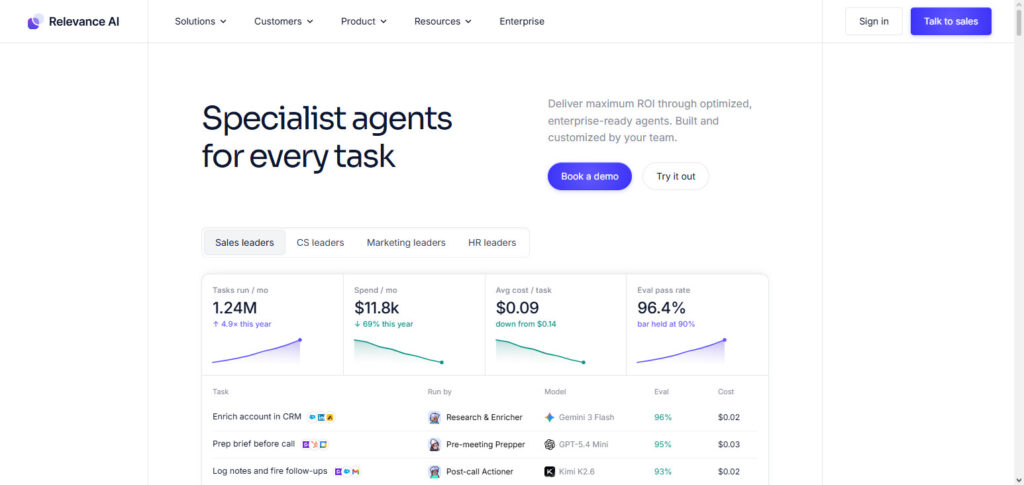
Relevance AI helps customers build autonomous AI business workflows. Pricing: Businesses can choose a Relevance AI subscription plan based on the number of required users, agents, and workflows.
Limitations: Large scale AI agent use across an enterprise will probably require a higher subscription plan, and users will likely have to spend some time tuning AI agents for the business’s complex workflows.
Relevance AI
Strengths
- Workforce AI Buildout: Builds AI for different departments.
- No-Code: Simple agent creation.
- Business Automation: Handles tasks for sales, research, operations.
- Personalized AI: Build custom workflows.
- Agent Flexibility: Multiple AI Workers.
Pricing
- Tiered Subscriptions: Based on users and AI.
- Free Trials: For feature testing.
- Team Plans: For scaling businesses.
- Enterprise Plans: For larger companies.
- High Activity Fee: Based on how often companies use AI.
Limitations
- Enterprise Features Gap: Smaller platforms have more.
- High Usage Fees: AI can quickly become costly.
- Time Investment: Learning how to optimize agents can take time.
- Higher Plans for Advanced Features: Premium features require step-ups.
- Complex Tasks Automated: Advanced workflows require a lot of customizing.
10. MindStudio
MindStudio is an AI agent development platform that helps companies create AI apps and virtual assistants without heavy lifting on the coding side. Businesses can design workflows for AI and connect models to deploy AI solutions targeted at business needs.
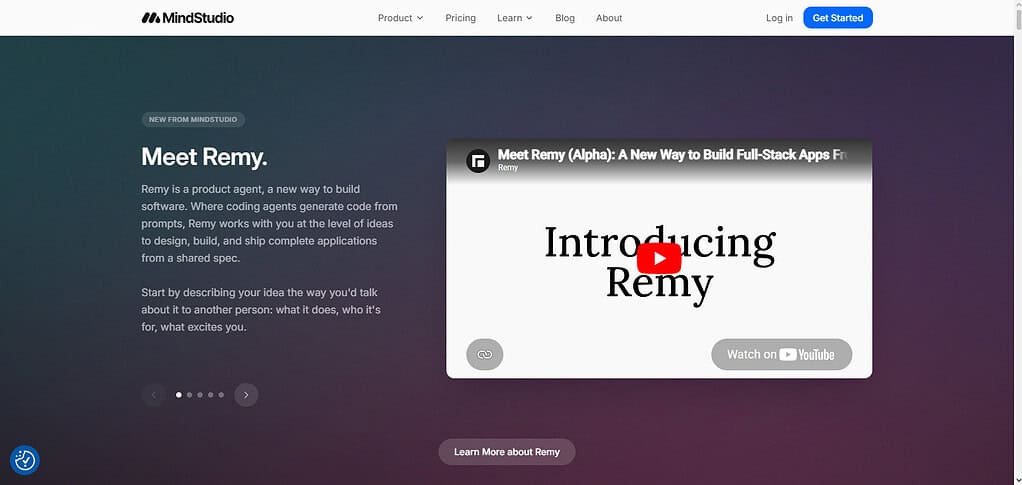
MindStudio can be used to create applications that automate processes, aid internal functions, enhance customer experience, and improve productivity. Pricing: Pricing for MindStudio is usually based on usage, number of connections to AI models, as well as features and requirements for the workspace and enterprise. Limitations:
It does cut down the effort on the coding for AI, but most of the advanced enterprise features will still need added investments, and companies might find the platform to have limitations when managing complex workflows and large-scale deployments.
MindStudio
Strengths
- Fast AI App Development: Quick and easy build for simple AI apps.
- No Development Required: No-code.
- Personalized Flexible AI: Easy app development.
- Fast AI Roll out: Flexible for different AI use cases.
Pricing
- Subscription Plans: Costs depend on required features and limits.
- AI Usage Costs: Usage costs depend on consumption of various models.
- Team Packages: Designed for business collaboration.
- Enterprise Pricing: Custom designed for bigger businesses.
- Flexible Scaling: Varied business sizes supported.
Limitations
- Less Enterprise Mature: Compared with Microsoft, IBM, or Google platforms these have less maturity.
- Less Advanced Governance: More tools may be required to help achieve full compliance.
- AI Models: The connected models affect the overall performance.
- Complex Enterprise Workflows: Additional customization may still be required.
- Scaling Difficulties: Large deployments are likely to require plans at a higher level.
Conclusion
Enterprise AI agent platforms are altering task automation, productivity, and decision-making for businesses. Microsoft Copilot Studio, Google Vertex AI Agents, Salesforce Agentforce, and IBM Watsonx Orchestrate offer effective automation solutions for workflows, customer service, and operations across the enterprise.
The proper AI agent platform selection for a business will depend on its goals, finances, flexibility, and security, as well as systems in use. By 2026, as the use of AI expands, these platforms will be vital to constructing organizations that are ready for the future with great efficiency and intelligence.
FAQ
What are Enterprise AI Agent Platforms?
Enterprise AI Agent Platforms are software solutions that help businesses create intelligent AI agents to automate workflows, analyze data, support customers, and improve operational efficiency.
Why should businesses use AI agent platforms?
Businesses use AI agent platforms to reduce manual work, automate repetitive tasks, improve decision-making, enhance customer experiences, and increase employee productivity.
Which is the best Enterprise AI Agent Platform in 2026?
The best platform depends on business requirements. Microsoft Copilot Studio, Google Vertex AI Agents, Salesforce Agentforce, and IBM Watsonx Orchestrate are among the top choices for enterprises.
Are Enterprise AI Agent Platforms suitable for small businesses?
Yes, many AI agent platforms offer scalable pricing plans and no-code or low-code tools, allowing small and medium businesses to automate processes without large technical teams.
How much do Enterprise AI Agent Platforms cost?
Pricing varies by platform, usage, features, integrations, and enterprise requirements. Some platforms offer subscription plans, while others use pay-as-you-go pricing models.