




I will evaluate the Best AI Agents for Software Testing that will help automate testing, increase testing precision, decrease manual testing, and provide faster quality software to your business.
These AI-enabled Testing Solutions use Machine Learning and Intelligent Automation to identify faults, streamline testing, and improve software consistency. I will examine the Features, Benefits and Drawbacks for each solution and discuss the software within the context of the modern development team.
What is AI Agents for Software Testing ?
AI Agents for Software Testing are advanced tools that leverage AI to facilitate the software testing process. A majority of the testing process (like creating a test case, executing the test, analyzing results, identifying bugs, and making suggestions) can be done by AI Agents Software Testing with little human help. These software testing agents use their learning capabilities to improve testing and adapt to changes in the application.
AI Agents for Software Testing accommodate different testing methods. These methods range from functional testing to regression, API, performance, and visual testing. Since AI Agents for Software Testing take over the mundane manual tasks, organizations are able to see a positive impact on their software testing by allowing them to release software more frequently and reliably. The testing done with the help of AI Agents for Software Testing is done more efficiently and effectively.
Benefits Of AI Agents for Software Testing
Accelerated Testing: Since AI agents can take on repetitive tasks, teams can run test cases, validate, and expedite quality checks.
Test Accuracy Enhancement: AI testing agents analyze application activities and detect issues with precision, minimizing errors, and enhancing application reliability.
Automated Test Generation: Time is saved as the agents analyze application needs and user behaviors and past testing activities to create test cases.
Automation of Testing: AI Agents are capable of performing regression testing, bug detection, and performance testing, which allows a tester to concentrate on other aspects of quality testing.
Automated Test Script Updating: AI testing agents save time by updating test scripts whenever there are changes in the application, thereby reducing the likelihood of a failed test due to changes.
Predictive Bug Detection: AI tools are capable of learning of past bug detection issues, thus predicting the same issue before the release.
Increased Testing Automation: In a comparative analysis, the range of testing performed by AI Agents is extensive.
Rapid Deployment: Automated testing and the rapid feedback of AI Agents quickly execute quality checks and expedite the deployment of the application.
Reduced Testing Costs: The integration of AI technology in testing reduces the dependence on manual testing and the costs associated with quality assurance after the software is released.
Always-on Testing: Further integrated DevOps and CI/CD pipelines for constant testing even more throughout the development stages.
Smart Testing and Reporting: Automatically generated reports that includes detailed failure analysis and performance metrics empower teams to choose smarter testing options.
Quality Assurance: Early identification of both functional and visual errors further ensure that applications remain stable and reliable while enhancing customer experience.
Risks & Considerations of AI Agents for Software Testing
| Risk / Consideration | Details |
|---|---|
| High Implementation Cost | Some advanced AI testing platforms require expensive subscriptions, infrastructure investments, and training costs, which may be challenging for small businesses. |
| Learning Curve | Teams may need time to understand AI-based testing workflows, configure tools, and develop skills to use advanced automation features effectively. |
| Data Privacy Concerns | AI testing agents may require access to application data, test environments, and user information, creating potential security and privacy risks. |
| Limited Human Decision-Making | AI agents can automate many tasks, but human testers are still required for exploratory testing, business logic validation, and complex decisions. |
| False Test Results | AI systems may sometimes generate false positives or false negatives, requiring human review to verify testing outcomes. |
| Integration Challenges | Connecting AI testing tools with existing development environments, CI/CD pipelines, and testing frameworks can require technical expertise. |
| Dependency on Quality Data | AI models need accurate testing data and application insights to provide reliable results and improve performance. |
| Maintenance Requirements | AI testing systems still require regular monitoring, updates, and adjustments to maintain accuracy as applications evolve. |
| Over-Automation Risk | Excessive reliance on AI agents may reduce human involvement and overlook usability issues that require manual evaluation. |
| Tool Compatibility Issues | Some AI testing platforms may have limited support for specific technologies, legacy systems, or complex application architectures. |
| Security Risks | Poorly configured AI testing tools may expose sensitive application details or create vulnerabilities during automated testing processes. |
| Vendor Lock-In | Organizations may become dependent on a specific AI testing provider, making migration to another platform difficult and costly. |
Best AI Agents for Software Testing List
- Testim AI
- Mabl AI
- Applitools Eyes AI
- Functionize AI
- Test.ai
- LambdaTest AI
- Sauce Labs AI
- BrowserStack AI
- Katalon AI
- Tricentis Tosca AI
10 Best AI Agents for Software Testing in 2026
1. Testim AI
Testim AI is a test automation solution that focuses on the acceleration and simplification of the automation testing process for development teams. As one of the Best AI Agents for Software Testing, Testim AI is a machine learning-based tool that cuts down the time and effort spent on test maintenance by automatically adapting to the changes made in the UI of the application.
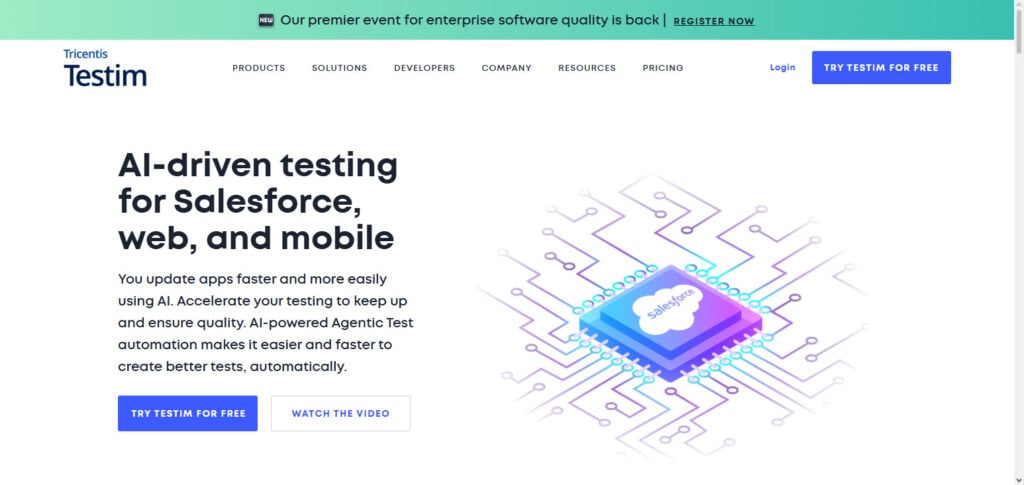
Testim AI is capable of end-to-end testing of web applications and integrates with most of the popular CI/CD tools. With the early detection of bugs and by increasing the coverage of tests and automating the tedious manual tests, Testim AI fosters the acceleration of the release process of software. Its smart locators, analytics, and components that can be reused are a suitable fit for an Agile methodology.
Testim AI Features, Pros & Cons
Features:
- AI Test Automation: Uses AI to improve test design and reduce manual testing.
- Smart Locators: Identifies UI elements and modifies tests as UIs evolve.
- Low-Code Testing: Non-developers can create automated tests.
- CI/CD Integration: Works with DevOps for rapid testing.
- Test Analytics & Reporting: Detailed analytics and reporting for tests.
Pros:
- Updates tests automatically, reducing test maintenance time.
- Easy to adopt for both technical and non-technical users.
- Automated tests are stable and created quickly.
- Automated tests reduce time needed for web app testing.
Cons:
- Only web apps can be tested.
- High pricing plans may be needed for advanced features.
- Time is needed to learn the AI-based workflows.
- Custom test design is highly limited.
- Large projects need a lot of prep work.
2. Mabl AI
Mabl AI is an intelligent testing solution that uses ML to help teams automate testing for web, mobile, and API services with little to no coding. As one of the Best AI Agents for Software Testing, Mabl AI analyzes the behavior of an application and the changes made to it, maintaining the tests it runs automatically.
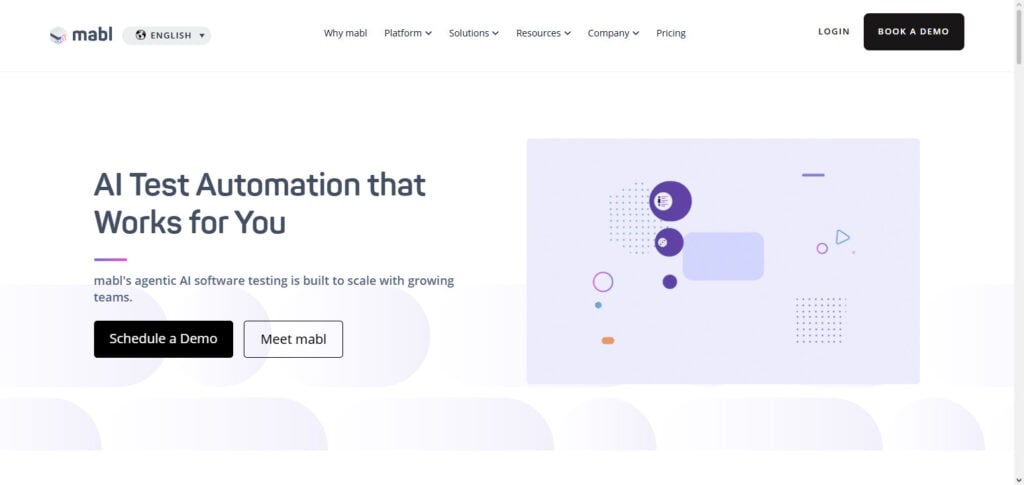
With its seamless integration into DevOps pipelines, Mabl AI enhances continuous testing by surfacing tasks to be completed prior to deployment. Mabl AI is capable of both visual tests and API tests, and it can also provide assessment of browser performance. Its repetitive task reduction and smart automation of tests lets development and testing teams maintain and develop higher quality software.
Mabl AI Features, Pros & Cons
Features:
- AI Test Automation: Uses AI for test automation and maintenance.
- Cross Browser Testing: Test automation is done across multiple browsers.
- API Testing: Automation of API tests is possible.
- Visual Testing: Defects and changes in UI are captured.
- DevOps Ready: Compatible with automation in CI/CD.
Pros:
- Low-code test automation is easy to use.
- Automated tests are updated as the app is modified.
- Decreases the need for manual testing.
- Automated tests are detailed and easy to understand.
- Great for testing in an agile framework.
Cons:
- Small teams may find the software costly.
- Not much support for specialized testing.
- Might need additional training for some features.
- Not the best option for very large complex systems.
- Some AI recommendations may still require manual checks.
3. Applitools Eyes AI
Applitools Eyes is an AI-advanced visual testing solution that discovers visual bugs in web, mobile, and digital applications. It is among the Best AI Agents for Software Testing. Applitools Eyes AI is a powerful software that utilizes advanced computer vision technology to detect gaps in the application by taking and comparing screenshots.
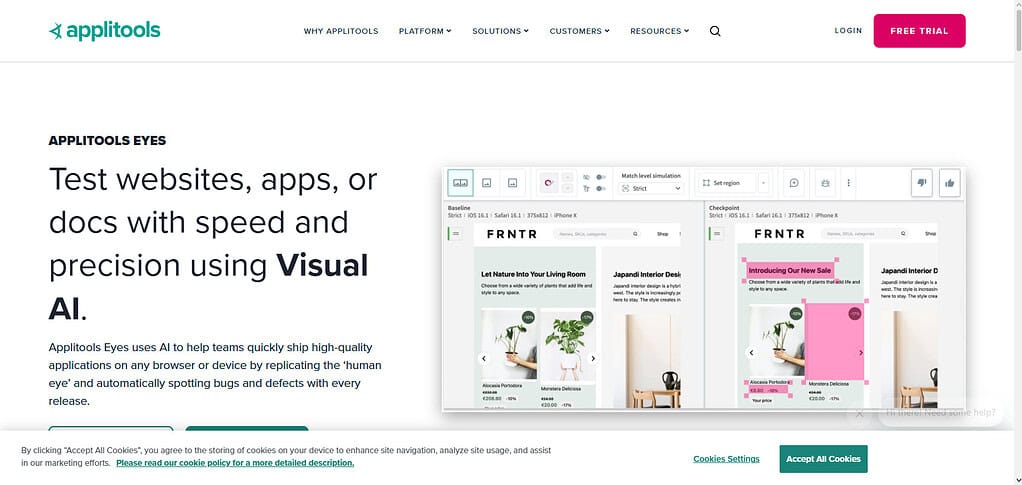
Unlike traditional testing tools, which compares pixels, Applitools Eyes AI configures the difference in UI, thus reduces false positive results. It is a powerful solution for the cross-browser and cross-device testing. By employing automated visual validation, Applitools Eyes AI enables organizations to deliver consistent user experiences, increase testing speed, and deliver the application on time.
Applitools Eyes AI Features, Pros & Cons
Features:
- AI Visual Testing: Recognizes changes using an AI approach.
- Cross-Platform Testing: Validates across webpages, mobile apps, and other digital assets.
- Smart Comparison Technology: Evaluates significant changes in UI.
- Automated Visual Validation: Simplifies UI testing.
- Integration Support: Compatible with many testing frameworks.
Pros:
- Simplifies detection of visual UI errors.
- Significantly less false alerts when compared to similar tools.
- Supports testing across multiple devices and browsers.
- Extremely beneficial for visual regression testing.
- Consistency and quality of UI and User Experience is enhanced.
Cons:
- Testing is almost exclusively visual.
- Can be a large investment for small businesses.
- Requires a good amount of setup.
- Extremely limited when compared to other functional testing tools.
- May need optimization for large test cases.
4. Functionize AI
Functionize is an AI software testing solution that integrates machine learning, natural language processing, and automation to provide an innovative solution in software testing. Functionize AI is the example of the Best AI Agents for Software Testing.
Functionize AI enables users to write automated tests by using sentences in plain English without the need to write complex code. It fits in the automation gap by understanding the behavior of the application, and makes test case updates and identifies probable failures. Functionize performs functional, regression, and performance testing on web applications.
The intelligent test maintenance feature of Functionize significantly reduces the time spent on fixing broken test automation scripts which helps organizations achieve their goal of faster release cycles. Functionize is a powerful tool for enterprises to implement automated testing at scale and with innovations.
Functionize AI Features, Pros & Cons
Features:
- Natural Language Test Creation: Instructions to create tests can be as simple as writing a sentence.
- Self-Healing Tests: Tests automatically update themselves when the application changes.
- AI-Based Analysis: Analyze test failures and issues in testing.
- Cloud-Based Automation: Provides Automation and Testing as a Service.
- End-to-End Testing: Both functional and regression testing is supported.
Pros:
- Greatly reduces the need for coding.
- Lowers the barrier for Test Automation and AI adoption.
- Enhances productivity and further accelerates the confidence to test.
- Supports large scale enterprise solutions.
- Provides comprehensive coverage of all possible scenarios.
Cons:
- More expensive compared to basic tools.
- Time consuming to train AI Models.
- May require support for complicated setups.
- Less customization in certain cases.
- Some organizations may be cautious of Cloud dependency.
5. Test.ai
Test.ai aims to enhance the testing of mobile applications with automated testing. Test.ai is recognized as one of the Best AI Agents for Software Testing. Using machine learning, Test.ai explores applications, analyzes user interactions, and detects bugs and other issues. Test.ai performs automated functional tests on various mobile environments and helps testers reduce tedious manual labor.
Test.ai is capable of analyzing the strange and unexpected behaviors of applications and suggests corrective measures. The mobile development community is full of professionals who want to take part in mobile application testing to ensure that mobile applications are as reliable as possible as quickly as possible.
The AI-powered solution offered by Test.ai enables mobile application development teams to maximize application testing coverage, while the solution itself automates testing. Test.ai increases the standard of mobile application development and testing.
Test.ai Features, Pros & Cons
Features:
- AI Mobile Testing: Creates a way to automate mobile testing.
- Machine Learning Analysis: Learns App behavior automatically.
- Automated App Exploration: Interacts like a user to find bugs.
- Functional Testing
- Bug Detection.
Pros:
- Good focus on mobile testing.
- Less manual testing.
- Finds issues that are difficult to see.
- Better mobile apps.
- Simple automation of repetitive tasks.
Cons:
- Limited compared to enterprise level testing.
- A focus on mobile apps.
- May need a user to verify results.
- Testing complex backends is less feasible.
- Application complexity has an effect on AI.
6. LambdaTest AI
LambdaTest is a cloud-based testing platform that uses AI to automate the testing of applications on the web and mobile interfaces.
LambdaTest is considered one of the Best AI Agents for Software Testing. LambdaTest AI offers teams the ability to conduct cross-browser testing, run automated tests, and perform real-time defect isolation and resolution on a wide array of browser and operating system combinations.
LambdaTest AI further augments the testing experience by assisting the framework and enhancing the resolution process by decreasing the time it takes to detect and resolve issues. LambdaTest combines a number of testing automation frameworks, including Selenium, Cypress, and Playwright.
By discovering and correcting browser compatibility issues, LambdaTest helps both development and quality assurance teams build reliable applications while minimizing testing and infrastructure costs.
LambdaTest AI Features, Pros & Cons
Features:
- AI Cross Browser Testing: Cross-browser App testing.
- Real Device Testing: Testing on real devices.
- Built for Selenium, Playwright, and Cypress Automations: Supports automation frameworks.
- Bug Analysis
- Cloud Testing: No setup/installation required.
Pros:
- Over a thousand Browsers and OS.
- Cost saving infrastructure.
- Fast debugging.
- Great DevOps integration.
- Testing for Web and Mobile.
Cons:
- Premium plans are required for advanced features.
- Over-reliance on the internet may hinder productivity.
- Budget constraints may limit opportunities for large-scale testing.
- Basic knowledge of tools may take time for beginners.
- A solid understanding of programming may be required to develop and run certain tests.
7. Sauce Labs AI
Sauce Labs’ AI tools for automated continuous testing help companies enhance the quality of their apps during the development cycle. Sauce Labs AI is one of the Best AI Agents for Software Testing. It employs intelligent testing to interpret the results, discover testing failures, and streamline testing workflows.
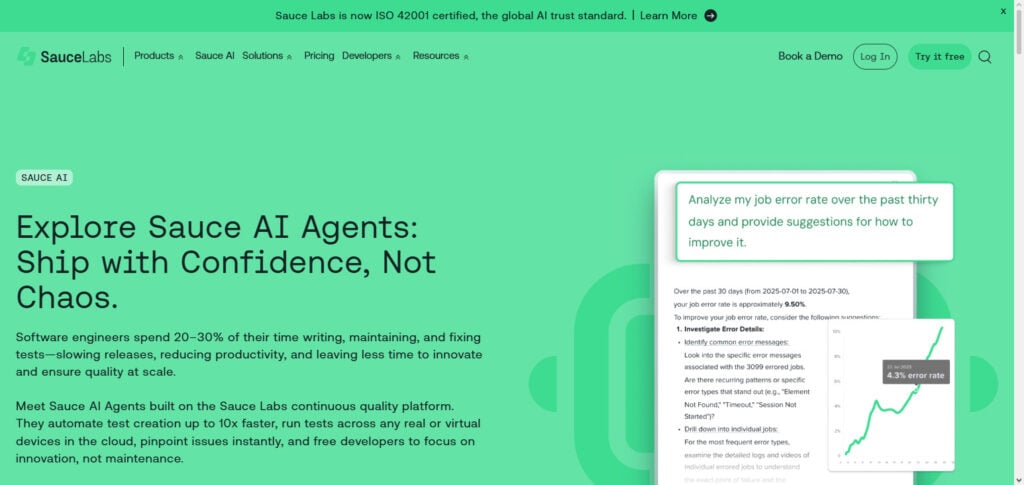
The Sauce Labs AI platform is capable of testing web, mobile, and API services directly on real devices and within the cloud. It further assists quality assurance teams in reaching accelerated development release cycles by providing extensive testing metrics, debugger information, and automation.
Sauce Labs AI works with most of the DevOps tools, enabling companies to construct dependable testing and automation workflows and enhance collaboration between development, quality assurance, and business teams.
Sauce Labs AI Features, Pros & Cons
Features:
- Continuous Testing Platform: Automates testing for all development stages.
- Real Device Cloud: Real devices and browsers available for testing.
- AI Test Analysis: Analyzes test cases to determine the cause of failure.
- API and Mobile Testing: Covers different testing domains.
- CI/CD Integration: Easily integrated within DevOps pipelines.
Pros:
- Provides a robust testing platform for enterprises.
- Can be used to scale testing efforts.
- Comprehensive testing provides insights into the quality of the product.
- Supports testing automation tools.
Cons:
- Costs may be prohibitive for small organizations.
- High level of testing and product knowledge is required.
- High volume of testing may result in higher costs.
- Can be complex to set up.
- Additional work may be needed for some capabilities.
8. BrowserStack AI
BrowserStack is one of the more common testing platforms and incorporates AI with testing both browsers and mobile devices. BrowserStack AI is one of the Best AI Agents for Software Testing. It aids teams in the automation of testing, the discovery of UI concerns, and the verification of apps across numerous devices and browsers.
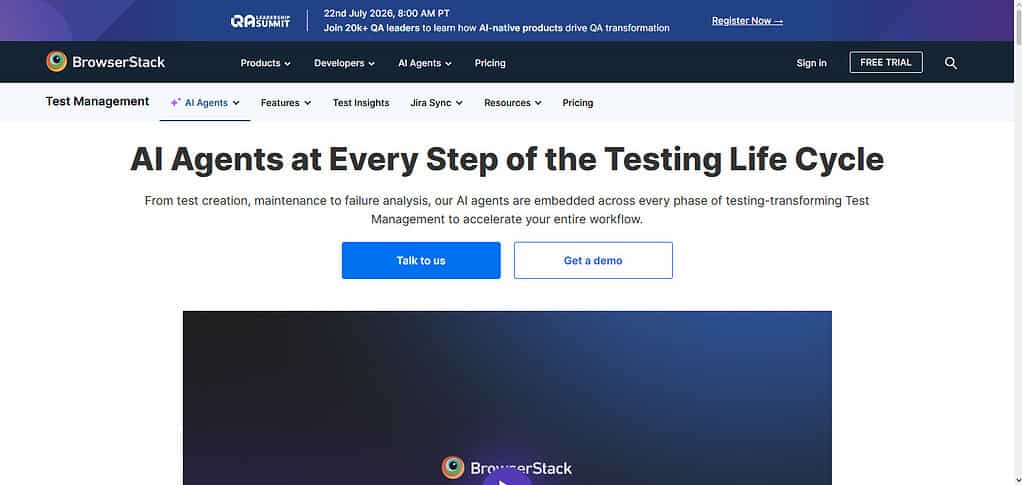
The AI tools aid in the simplification of the debugging process by interpreting failed tests and presenting next steps. BrowserStack helps organizations create reliable multi-platform testing that helps them deliver continuous digital improvement and reduce software bugs before deployment.
BrowserStack AI Features, Pros & Cons
Features:
- AI-Based Testing Assistance: Analyzes test cases and offers suggestions for improvements.
- Cross-Browser Testing: Tests the compatibility of web applications across different browsers.
- Real Device Testing: Tests the functionality of mobile applications.
- Automation Framework Integration: Integrates with Selenium, Appium, Playwright, and others.
- Debugging Tools: Supports quick identification of application issues.
Pros:
- Tests a large number of browsers and devices.
- Easy to set up tests in the cloud.
- Reduces the need for testing infrastructure.
- Can be used for web and mobile applications.
- Provides reliable testing for compatibility.
Cons:
- Subscription for the premium plan may be expensive.
- Dependent on the speed of the internet.
- Some advanced automation may require programming.
- Large teams may be required to purchase higher tiers.
- Very few options for testing offline.
9. Katalon AI
Katalon AI is an augmented testing solution that incorporates the power of AI into automated testing for Katalon Studio. Katalon AI is recognized as the Best AI Agents for Software Testing, as it allows users to create automated tests at a much quicker rate using the features of suggestion, automated script generation, and analysis.
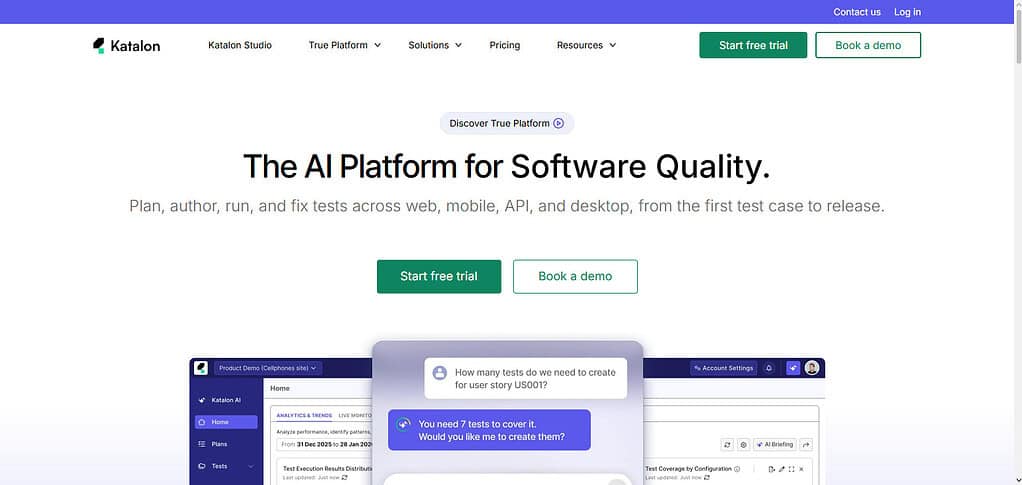
Katalon AI encourages the use of test automation for both technical and non-technical users via its low-code testing features. Katalon Studio provides test management and reporting features, as well as an extensive range of integration options for Continuous Integration/Continuous Deployment (CI/CD), making Continuous Testing easy to implement and use.
The AI features of Katalon enable a streamlined testing process that is simple and faster, as well as increases test coverage. Katalon AI is used by many organizations to fine-tune their Quality Assurance (QA) processes, resulting in the timelier release of higher quality software.
Katalon AI Features, Pros & Cons
Features:
- Low-Code Automation: Automation with minimal code.
- AI Test Assistant: Suggestions with reasoning.
- Testing of Web, API, Mobile, & Desktop Apps.
- CI/CD Compliant.
- Good Reporting/Management Features.
Pros:
- Great UI for beginner testers.
- Testing of different domains.
- Automation development time is less.
- Good integrations.
- Useful for testers of all levels.
Cons:
- Paid versions for advanced features.
- Optimization of large projects may be needed.
- Some features require coding for customization.
- High resource consumption.
- Advanced testing features need time to learn.
10. Tricentis Tosca AI
Tricentis Tosca AI is a testing automation solution for complex software environments that operates using AI and is aimed at large clients. Tricentis Tosca AI incorporates features of intelligent automation, model-based testing, and risk-based analysis to assist organizations improve the quality of their software.
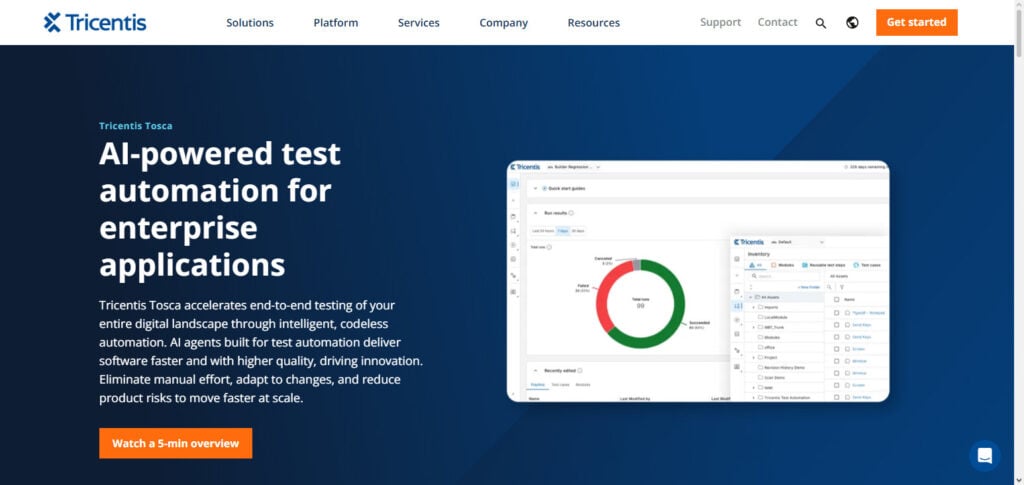
Tricentis Tosca AI is recognized as one of the Best AI Agents for Software Testing as it offers a great amount of automation for different types of software (web, mobile, etc.) and for various types of software environments (enterprise, cloud, etc.) due to its low dependency on coding.
Tricentis Tosca AI is a highly sought testing solution for large corporations due to its active and advanced testing capabilities that are required for large corporate environments and due to its ability to address a broad range of complex testing scenarios.
Tricentis Tosca AI Features, Pros & Cons
Features:
- AI Simplifying Test Automation: Engages with enterprise automation of complex testing.
- Model-Based Testing: Creating tests with limited coding.
- Risk-Based Testing: Testing the areas of the application of most concern.
- Enterprise Application Testing Support.
- Modern Continuous Testing: DevOps compliant.
Pros:
- Appropriate for large enterprise environments.
- Greatly eliminates manual testing.
- Covers complex application environments.
- Great Test Management.
- Greatly enhances the Quality of Software and Speed.
Cons:
- Testing of smaller applications not cost-effective.
- High investment for enterprise deployment.
- Training required to leverage the power of the tool.
- Not required for smaller testing projects.
- Complex testing projects require skilled personnel for further customization.
Comparison Table: Best AI Agents for Software Testing
| AI Agent | Best For | Key Features | Testing Support | Pros | Limitations |
|---|---|---|---|---|---|
| Testim AI | Web Application Testing | AI-powered automation, smart locators, self-healing tests, CI/CD integration, test analytics | Web, Functional, Regression Testing | Easy test creation, reduces maintenance, improves testing speed | Limited advanced customization, mainly focused on web apps |
| Mabl AI | Agile Development Teams | Low-code automation, AI test maintenance, API testing, visual testing, DevOps integration | Web, API, Regression, UI Testing | User-friendly interface, quick automation, strong reporting | Expensive for small teams, limited complex customization |
| Applitools Eyes AI | Visual Testing | AI visual validation, computer vision, cross-browser testing, UI comparison, automated analysis | Visual, UI, Cross-Browser Testing | Excellent visual accuracy, reduces false errors, improves UI quality | Mainly focused on visual testing, higher pricing |
| Functionize AI | Enterprise Test Automation | Natural language testing, self-healing scripts, AI analysis, cloud testing, automated maintenance | Functional, Regression, Performance Testing | Less coding required, scalable automation, intelligent maintenance | Costly plans, requires setup and training |
| Test.ai | Mobile Application Testing | AI app exploration, machine learning analysis, automated bug detection, mobile testing automation | Mobile, Functional Testing | Strong mobile testing capabilities, reduces manual work | Limited enterprise features, focused mainly on mobile apps |
| LambdaTest AI | Cross-Browser Testing | AI test analysis, real device testing, browser automation, debugging tools, cloud infrastructure | Web, Mobile, Browser Testing | Wide browser coverage, easy integration, scalable testing | Requires internet connection, premium features cost more |
| Sauce Labs AI | Enterprise Continuous Testing | Real device cloud, AI failure analysis, automated testing, DevOps integration, test reporting | Web, Mobile, API Testing | Reliable enterprise solution, strong analytics, large-scale support | Expensive, complex setup for beginners |
| BrowserStack AI | Browser & Device Testing | AI-assisted testing, real device testing, browser automation, debugging, framework support | Web, Mobile, Compatibility Testing | Large device coverage, simple setup, reliable results | Advanced features require paid plans, limited offline use |
| Katalon AI | Low-Code Automation | AI test suggestions, script generation, API testing, mobile testing, test management | Web, API, Mobile, Desktop Testing | Beginner-friendly, multiple testing options, good integrations | Some advanced features need coding knowledge |
| Tricentis Tosca AI | Large Enterprise Testing | Model-based testing, AI automation, risk-based testing, enterprise support, continuous testing | Enterprise, Functional, Regression Testing | Powerful automation, supports complex systems, scalable | High cost, requires skilled professionals |
Quick Recommendation Table
| User Requirement | Recommended AI Agent |
|---|---|
| Best Overall AI Testing Automation | Testim AI |
| Best for Visual Testing | Applitools Eyes AI |
| Best for Low-Code Testing | Mabl AI / Katalon AI |
| Best for Enterprise Testing | Tricentis Tosca AI |
| Best for Mobile App Testing | Test.ai |
| Best Cross-Browser Testing | LambdaTest AI / BrowserStack AI |
| Best Continuous Testing Platform | Sauce Labs AI |
| Best AI-Based Self-Healing Tests | Functionize AI |
Conclusion
Software testing is being revolutionized by AI agents that bring speed, intelligence, and efficiency to quality assurance. The Best AI Agents for Software Testing help teams automate mundane activities, improve testing precision, identify problems sooner, and lower development costs. Advanced automation, intelligent analysis, and continuous testing from tools like Testim AI, Mabl AI, Applitools Eyes AI, Functionize AI, and Tricentis Tosca AI are central to this new generation.
The more intricate software solutions become, the more impactful these AI-enabled testing solutions will be for accelerating DevOps and bringing higher reliability to software releases. For organizations adopting these AI Agents, the competitive advantage will be in higher quality software delivered at a faster pace.
FAQ
What are AI Agents for Software Testing?
AI Agents for Software Testing are intelligent tools that use artificial intelligence and machine learning to automate software testing processes. They help identify bugs, create test cases, analyze results, and improve testing accuracy with less manual effort.
Why should businesses use AI Agents for Software Testing?
Businesses use AI testing agents to reduce testing time, improve software quality, increase test coverage, and detect errors earlier in the development cycle. They also help teams release applications faster with fewer defects.
Which are the Best AI Agents for Software Testing in 2026?
Some of the Best AI Agents for Software Testing include Testim AI, Mabl AI, Applitools Eyes AI, Functionize AI, Test.ai, LambdaTest AI, Sauce Labs AI, BrowserStack AI, Katalon AI, and Tricentis Tosca AI.
Can AI Agents replace manual software testing?
AI Agents cannot completely replace manual testing but can reduce repetitive testing tasks. Human testers are still important for exploratory testing, user experience evaluation, and complex decision-making.