

This article, which discusses the Best Edge AI Orchestrators for Industrial IoT that enable industries to deploy, orchestrate and scale any ML/AI workloads at the edge.
These platforms provide greater IT efficiency, improved security and device orchestration across factories, energy systems and smart infrastructure operations as Industrial IoT environments increasingly require real-time intelligence/analytics for better decision making and automation capabilities faster
What Are Edge AI Orchestrators?
Edge AI orchestrators are the software platforms that serve to manage artificial intelligence applications deployed across a distributed set of edge devices, which may include sensors, gateways, industrial machines and local servers. These orchestrators allow AI models to operate closer to the point of data generation, supporting real-time processing by avoiding having all operational data sent back into centralized cloud systems for decision-making.
They take care of device lifecycle management, workload automation and more including the security policy enforcement & remote updates across large Industrial IoT setup. Edge AI orchestrators enable dynamic and efficient coordination of edge computing resources to help organizations reduce latency, improve reliability, enhance data privacyand streamline industrial operations.
Why Industrial IoT Needs Edge AI Orchestration
Real-Time Decision Making
This is called Edge AI, where data on machines and sensors are processed directly to provide immediate responses for automation, safety systems and production control.
Low Latency Operations
For robotics, manufacturing lines and industrial monitoring systems that need real-time responses from AI solutions at the edge (though of course cloud latencies vanish if you just run stuff at home!).
Reduced Bandwidth Usage
By sending only the insights that matter to the cloud, it reduces data transmission costs and network congestion.
Operational Reliability
Such Edge orchestration systems can continue to function through internet blackouts, or even intermittent connectivity.
Predictive Maintenance
Early detection of equipment anomalies by AI models can mitigate exorbitant downtime & increase asset life cycle.
Improved privacy & security of data
Native data stays put, minimizing exposure and lending the most help to compliance requirements.
Scalable Device Management
Orchestrators manage the thousands of industrial devices from a central location while simplifying updates, monitoring and lifecycle management.
Key Features of the Best Edge AI Orchestrators for Industrial IoT
Centralized Edge Device Management
Provide centralized dashboards to monitor, configure and control thousands of edge nodes, gateways & Industrial machines.
Deployment and Lifecycle Management of AI Models
Allows automated deployment, updating, versioning and rollback of AI/ML models at scale across a distributed factory or field environments.
Low Latency Execution and Real Time Data Processing
Locally processes sensor and machine data on the edge for real-time decision making, predictive maintenance and autonomous operations.
Multi-Edge & Hybrid Cloud Orchestration
Orchestration of workloads on the edge devices, infrastructure on-prem and cloud platforms for smooth industrial work process.
Container & Kubernetes Support
Standardizes and deploys applications in heterogeneous industrial hardware with the use of container technologies (Docker/Kubernetes/K3s).
Automated Workload Scheduling
Smartly routes workloads intelligently to the right edge device based on run-time compute power, network conditions and operational priority.
Offline & Intermittent Connectivity Operation
Keeps the industrial systems up and running even in situations where there could be an unstable or absent connection to cloud-based systems.
Key Point & Best Edge AI Orchestrators for Industrial IoT
| Edge AI Orchestrator | Key Point |
|---|---|
| Microsoft Azure IoT Edge + Entra | Securely deploys and manages AI workloads at the edge with identity-based access and centralized cloud governance. |
| IBM Edge Application Manager | Uses autonomous management to scale and operate thousands of edge devices with minimal manual intervention. |
| Siemens Industrial Edge AI | Enables real-time industrial analytics and AI processing directly on factory equipment and automation systems. |
| Bosch IoT Edge Suite | Provides device connectivity, data processing, and local AI execution for smart manufacturing environments. |
| Schneider Electric EcoStruxure Edge AI | Optimizes energy and industrial operations using edge analytics combined with operational technology integration. |
| FogHorn Lightning Edge AI | Delivers ultra-low latency AI analytics designed for industrial sensors, predictive maintenance, and streaming data. |
| EdgeIQ Orchestration Platform | Simplifies device lifecycle management, monitoring, and orchestration across distributed edge environments. |
| KubeEdge (Open Source) | Extends Kubernetes capabilities to edge computing, enabling containerized AI deployment and remote management. |
| HPE Ezmeral Edge AI | Offers enterprise-grade edge AI orchestration with data pipeline management and hybrid cloud integration. |
| NVIDIA Fleet Command | Provides secure remote deployment and lifecycle management of GPU-accelerated AI applications at scale. |
1. Microsoft Azure IoT Edge + Entra
MS Azure IoT Edge with Entra identity services together makes an enterprise-scale edge AI orchestration platform for secure Industrial IOT. This makes it possible for organizations to deploy containerized AI models directly on edge devices, yet still govern them through Azure cloud services.
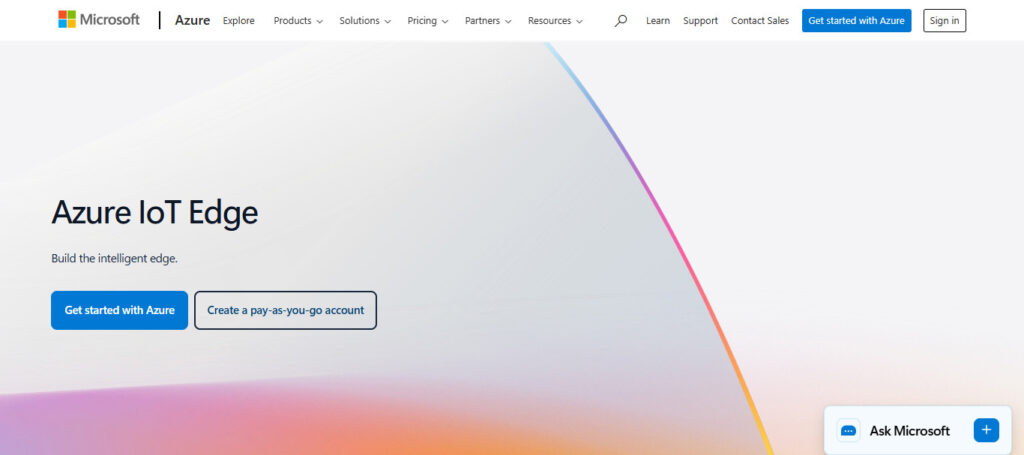
It has features like zero-trust identity management, device authentication and remote monitoring as well as automated updates. What makes it one of the Best Edge AI Orchestrators for Industrial IoT in advanced manufacturing environments is its ability to unify AI analytics with cybersecurity and hybrid cloud operations.
It offers scalable device management, real-time decision-making, and seamless integration with existing enterprise workflows and analytics ecosystems to the business.
Microsoft Azure IoT Edge + Entra — Pros & Cons
| Pros | Cons |
|---|---|
| Deep integration with Azure cloud ecosystem | Strong dependency on Microsoft services |
| Secure identity management via Entra ID | Complex initial configuration |
| Supports containerized AI workloads | Licensing costs increase at scale |
| Enterprise-grade security & compliance | Requires Azure expertise |
| Easy OTA updates and device lifecycle management | Limited flexibility outside Azure stack |
2. IBM Edge Application Manager
IBM Edge Application Manager uses policy-driven automation and AI-based orchestration to provide autonomous management of large edge fleets. This means it allows an enterprise to manage tens of thousands of distributed devices automatically, without manual effort in deploying workloads applications or monitoring and updating them.
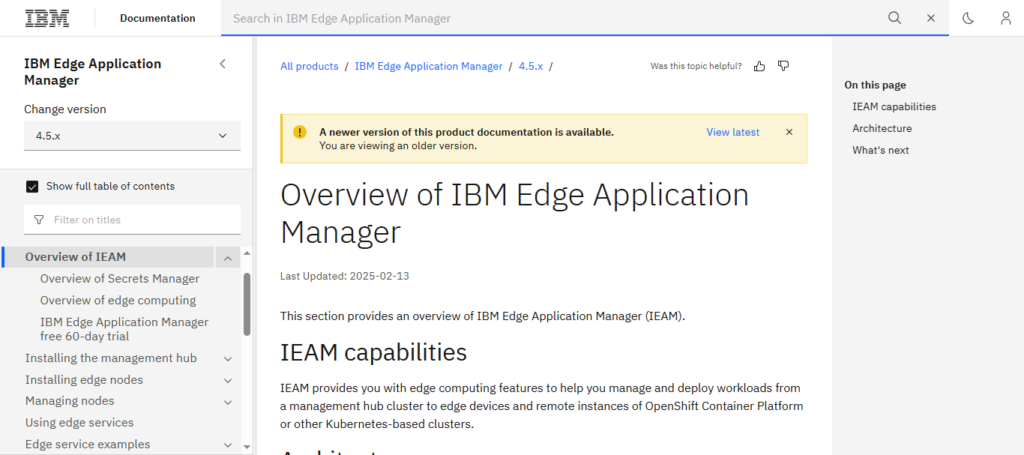
The portal provides support for containerized applications, predictive maintenance models and industrial analytics pipelines. Named one of the Best Edge AI Orchestrators for Industrial IoT, it eliminates operational complexity by intelligently determining ideal workload placement based on each device’s capability, location and network conditions.
The open architecture helps hybrid and multicloud environments achieve a high degree of operational resilience at scale while reducing performance, security, and lifecycle management risk across IoT infrastructures.
IBM Edge Application Manager — Pros & Cons
| Pros | Cons |
|---|---|
| Autonomous workload management at massive scale | Higher enterprise pricing |
| Hybrid and multicloud support | Setup complexity for beginners |
| Policy-based automation across devices | Requires skilled DevOps teams |
| Excellent for distributed industrial sites | Heavy infrastructure requirements |
| Strong AI governance and orchestration | UI less intuitive than competitors |
3. Siemens Industrial Edge AI
Siemens Industrial Edge AI enables analytics & machine learning directly on the factory machines, bringing together operational technology and information technology. So it allows manufacturers to execute AI apps locally for quality inspection, predictive maintenance and production optimization without waiting on a cloud latently.
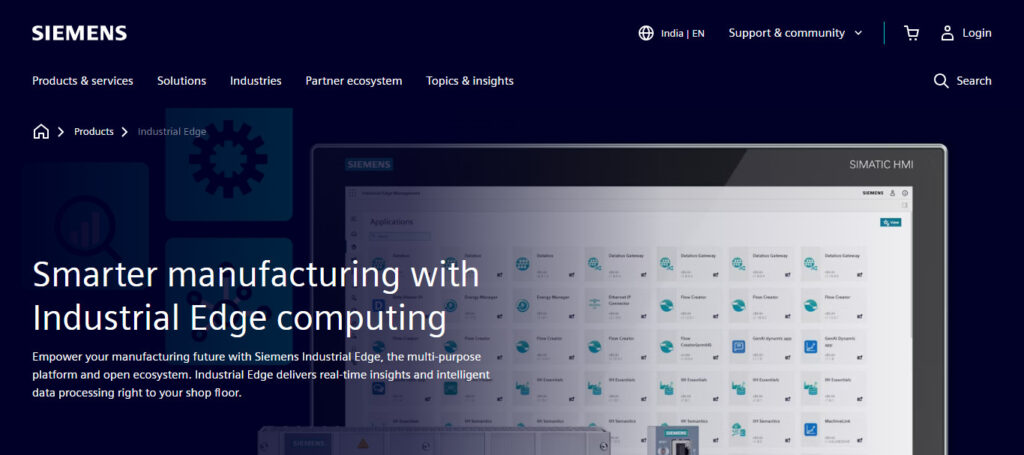
The platform integrates with automation systems, PLCs and industrial control networks. Siemens, one of the Best Edge AI Orchestrators for Industrial IoT, delivers centralized application management but enables local processing on shop floors.
This architecture minimizes downtime, increases data sovereignty and makes it easier for engineers to deploy AI-driven automation that boosts efficiency and safety while supporting real-time industrial decision-making.
Siemens Industrial Edge AI — Pros & Cons
| Pros | Cons |
|---|---|
| Designed specifically for manufacturing environments | Best suited mainly for Siemens ecosystems |
| Seamless OT + IT integration | Hardware dependency in some deployments |
| Real-time industrial analytics | Higher implementation cost |
| Strong PLC and factory automation support | Limited open-source flexibility |
| Reliable industrial-grade performance | Requires industrial engineering knowledge |
4. Bosch IoT Edge Suite
Bosch IoT Edge Suite provides an all-in-one framework for controlling connected devices, post-processing data and running AI workloads nearby industrial resources. It breaks down walls and builds bridges providing interoperability with varying industrial protocols, but also hardware environment.
It allows local analytics, anomaly detection and intelligent automation without needing to be online all the time. Bosch’s offering ranks among the Top Edge AI Orchestrators for Industrial IoT to ensure data privacy and lower bandwidth cost.
The modular architecture enables developers to rapidly deploy applications and integrate with enterprise systems whilst scaling deployments across smart factories, logistics networks and energy infrastructure; all while ensuring consistent device lifecycle management of the ground truth from end-to-end for assured operational visibility.
Bosch IoT Edge Suite — Pros & Cons
| Pros | Cons |
|---|---|
| Built for Industrial IoT scalability | Smaller developer community |
| Strong device lifecycle management | Documentation complexity |
| Advanced security and data governance | Less flexible outside Bosch ecosystem |
| Efficient edge data processing | Integration effort with non-Bosch tools |
| Good digital twin capabilities | Enterprise licensing model |
5. Schneider Electric EcoStruxure Edge AI
The Schneider Electric EcoStruxure Edge AI is an integrated edge orchestration platform for industry automation, energy management and advanced analytics. It is intended for utilities, manufacturing plants and smart buildings to optimize local operational data in order to reduce the energy consumption of equipment.

Built on underlying capabilities of predictive analytics, digital twins and intelligent automation workflows. Its latest award positions EcoStruxure as one of the top edge AI orchestrators for Industrial IoT (IIoT), delivering real-time insights while preserving cyber security and business continuity.
By connecting to operational technology systems, it enables companies to achieve sustainability targets with less downtime and greater efficiency via AI-driven decision-making that can be performed on the industrial edge.
Schneider Electric EcoStruxure Edge AI — Pros & Cons
| Pros | Cons |
|---|---|
| Excellent for energy and smart facility management | Focused mainly on industrial sectors |
| Predictive maintenance capabilities | Requires Schneider infrastructure familiarity |
| Strong sustainability analytics | High deployment cost |
| OT cybersecurity integration | Limited customization flexibility |
| Optimized for energy efficiency | Vendor ecosystem dependency |
6. FogHorn Lightning Edge AI
FogHorn Lightning Edge AI is specifically designed for ultra-low-latency industrial analytics, where immediate decisions matters. It runs on edge gateways to process sensor data in real-time enabling operations like predictive maintenance, condition monitoring and operational intelligence without www.cloud 45 latency.
It enables scalable deployment at distributed facilities of machine learning inference and rules-based automation. FogHorn has been identified as one of the Best Edge AI Orchestrators for Industrial IoT, and is embedded in environments that include oil and gas, manufacturing, transportation.
Work with a lightweight architecture that is optimized for minimal resource utilization while providing real time intelligence enabling industries to prevent equipment failures, improve the safety outcomes of people and increase production efficiency via continuous edge analytics.
FogHorn Lightning Edge AI — Pros & Cons
| Pros | Cons |
|---|---|
| Ultra-low latency analytics | Smaller ecosystem compared to hyperscalers |
| Works offline without cloud reliance | Limited enterprise integrations |
| Lightweight edge deployment | Scaling large environments can be complex |
| Real-time streaming analytics | Fewer community resources |
| Ideal for predictive maintenance | Advanced tuning required |
7. EdgeIQ Orchestration Platform
EdgeIQ Orchestration Platform specializes in unified device lifecycle management with visibility and control for heterogeneous Industrial IoT environments. It allows for easier onboarding, monitoring, firmware updates and analytics deployment from a unified dashboard. EdgeIQ enables scalable orchestration of AI workloads and integrates with cloud providers as well as enterprise applications.
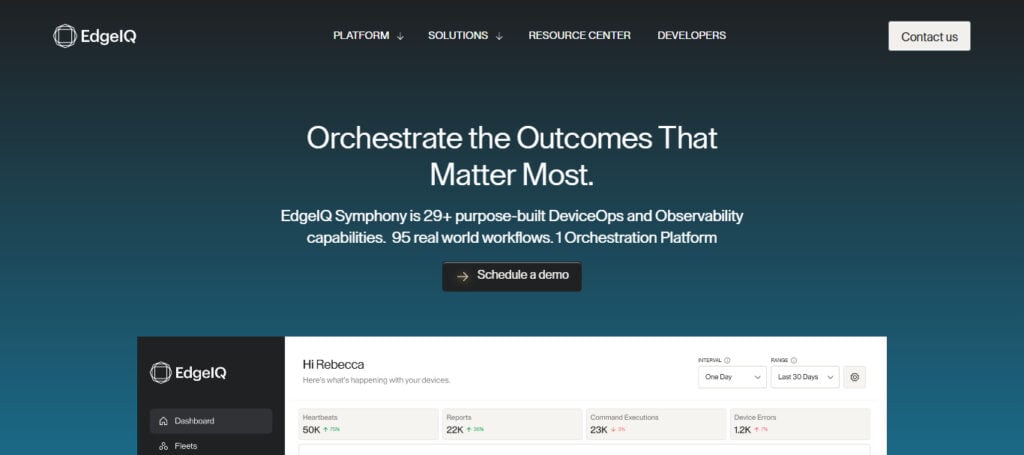
The App Controller IoT platform was also selected as one of the Best Edge AI Orchestrators for Industrial IoT because it emphasizes operational intelligence that comes from linking device management features with orchestration capabilities over data.
This Allows organizations to achieve better asset visibility, faster deployment cycles and greater reliability ensuring operations teams can manage distributed industrial infrastructure efficiently with performance optimization for local operation without losing secure connectivity across global edge networks.
EdgeIQ Orchestration Platform — Pros & Cons
| Pros | Cons |
|---|---|
| Unified device orchestration dashboard | Less brand recognition |
| Multi-vendor IoT support | Smaller partner ecosystem |
| Strong monitoring and automation tools | Enterprise onboarding required |
| Real-time operational visibility | Advanced features need customization |
| Flexible deployment models | Limited AI marketplace integrations |
8. KubeEdge (Open Source)
KubeEdge adds further capabilities to Kubernetes in the cloud by enabling reliable and rapid deployment of containerised applications and AI models on edge nodes, even when transient connectivity exists.
The cost-effective, open-source framework allows for edge autonomy while enabling communication between devices and workload synchronization in the cloud from both a cloud-native perspective and an edge point of view.
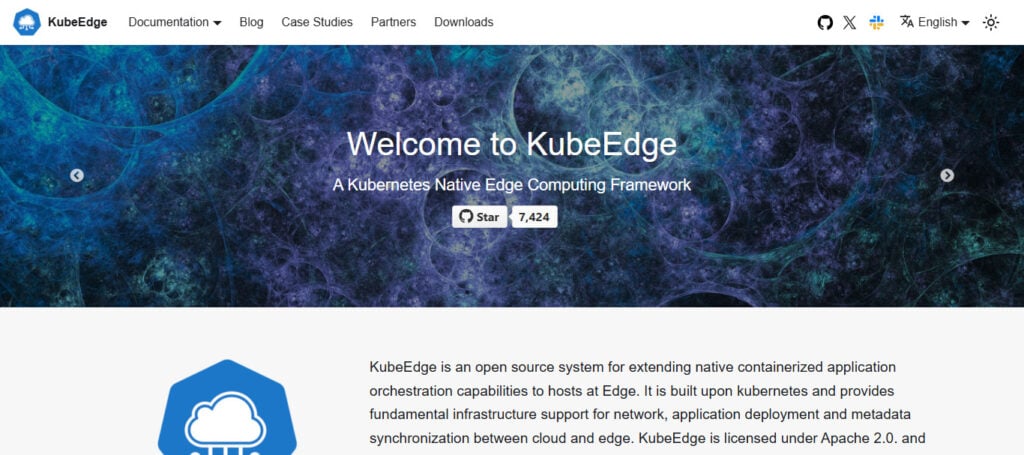
This enables the reuse of cloud-native tools and allows developers to deploy intelligence services closer in proximity (toward industrial operations). Respected as one of the Best Edge AI Orchestrators in Industrial IoT, KubeEdge enables organizations looking for vendor flexibility and neutrality along with cost savings.
This can be seen in its popularity for smart manufacturing, robotics, and logistics as it enables scalable orchestration with lightweight infrastructure needs while also supporting resilient edge computing operations that align well to modern cloud-native development practices.
KubeEdge (Open Source) — Pros & Cons
| Pros | Cons |
|---|---|
| Fully open-source and cost-effective | Requires Kubernetes expertise |
| Native Kubernetes edge extension | Complex setup for beginners |
| Highly customizable deployments | Limited enterprise support |
| Vendor-neutral architecture | Manual security configuration |
| Excellent for cloud-native edge AI | Maintenance responsibility on users |
9. HPE Ezmeral Edge AI
With Hewlett Packard Enterprise Ezmeral Edge AI, enterprises have an enterprise-ready platform for deploying AI pipelines and managing data workflows as well as orchestrating applications across hybrid environments.
It provides a single solution that integrates container orchestration, data fabric management and AI lifecycle tools designed for industrial deployment. Users can implement machine learning models directly onto remote sites, while keeping control over the process centrally.
Ezmeral has earned industry recognition in the “Top Edge-Enabled Application Development Platforms,” as well as among Best Edge AI Orchestrators for Industrial IoT, because it enables organizations to gain business value from their data by operationalizing AI faster and maintaining governance at scale.
As a result, it provides the flexible architecture which could be well-supported for manufacturing automation and telecom edge computing with high-performance distributed intelligence needed in smart infrastructure initiatives.
HPE Ezmeral Edge AI — Pros & Cons
| Pros | Cons |
|---|---|
| Enterprise-grade AI lifecycle management | Expensive enterprise solution |
| Hybrid cloud and edge integration | Requires HPE ecosystem familiarity |
| High-performance data pipelines | Deployment complexity |
| Strong analytics and MLOps features | Smaller developer community |
| Designed for large-scale enterprises | Training required for teams |
10. NVIDIA Fleet Command
NVIDIA Fleet Command provides a secure solution to remotely deploy and manage the lifecycle of GPU-accelerated AI applications at the edge. Allows enterprises centrally to provision systems, deploy containers and monitor AI workloads between 40+ different industrial sites.
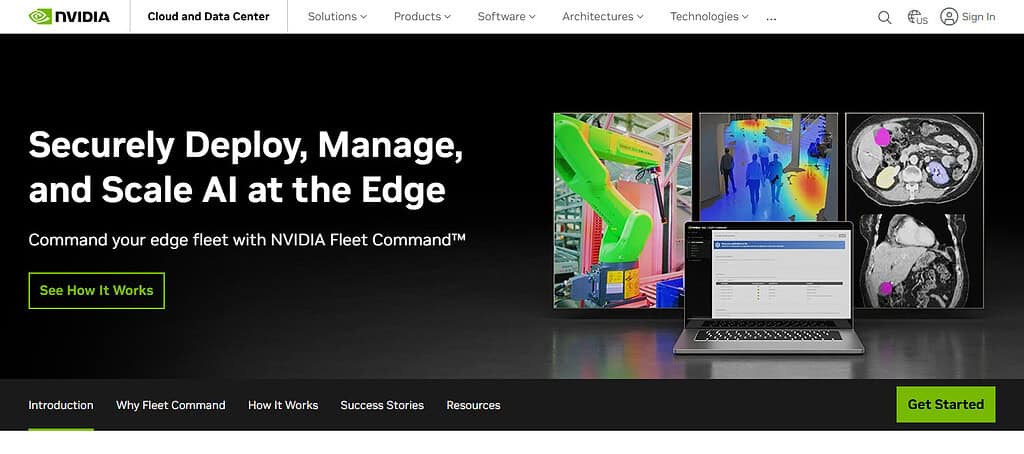
Designed for demanding workloads in computer vision, robotics and autonomous inspection applications with high GPU acceleration. Fleet Command is an Edge AI Orchestrator for Industrial IoT that performs exceptionally well in enabling enterprises to manage high-performance AI operations, while supporting the highest levels of security and reliability.
Simplified deployment workflows, high speed AI inference as well as a worldwide scalable management of the intelligent edge infrastructure are benefits for organizations.
NVIDIA Fleet Command — Pros & Cons
| Pros | Cons |
|---|---|
| Optimized for GPU-accelerated AI workloads | Requires NVIDIA hardware |
| Simplified remote AI deployment | Hardware costs can be high |
| Excellent for computer vision and robotics | Less suited for lightweight devices |
| Centralized fleet management | Vendor lock-in risk |
| High-performance inference capabilities | Needs GPU infrastructure expertise |
Comparison of Leading Edge AI Orchestration Platforms
| Platform | Vendor Focus | Deployment Model | AI/ML Capability | Device Management | Industry Strength | Open Source Support | Best For |
|---|---|---|---|---|---|---|---|
| Microsoft Azure IoT Edge + Entra | Cloud + Identity | Hybrid Cloud-Edge | Strong AI integration with Azure ML | Advanced centralized control | Smart factories, utilities | Partial | Enterprises using Microsoft ecosystem |
| IBM Edge Application Manager | Autonomous Operations | Multi-cloud Edge | Policy-driven AI deployment | Massive fleet automation | Telecom, manufacturing | Limited | Large-scale edge fleets |
| Siemens Industrial Edge AI | Industrial Automation | On-prem Industrial Edge | Industrial analytics & predictive AI | Factory device lifecycle tools | Manufacturing & OT | No | Industrial automation environments |
| Bosch IoT Edge Suite | Connected Devices | Hybrid Edge Platform | IoT analytics & automation AI | Secure device lifecycle mgmt | Automotive, logistics | Limited | Industrial IoT ecosystems |
| Schneider Electric EcoStruxure Edge AI | Energy & Automation | Distributed Edge | Energy optimization AI models | Industrial monitoring & control | Energy, smart buildings | No | Energy-intensive industries |
| FogHorn Lightning Edge AI | Edge-native AI | Fully Edge-first | Real-time streaming AI | Lightweight orchestration | Oil & gas, industrial sites | No | Low-latency operations |
| EdgeIQ Orchestration Platform | Device Intelligence | Hybrid Edge | Data orchestration + analytics | Strong device visibility | Logistics & asset tracking | Limited | Operational intelligence |
| KubeEdge (Open Source) | Kubernetes Extension | Cloud-native Edge | Containerized AI workloads | Kubernetes-based management | Multi-industry | Yes | DevOps & cloud-native teams |
| HPE Ezmeral Edge AI | Enterprise Edge Infrastructure | Hybrid AI Platform | MLOps + edge analytics | Enterprise-scale governance | Telecom, retail, industrial | Partial | AI at enterprise scale |
| NVIDIA Fleet Command | GPU Edge AI | GPU-accelerated Edge | Advanced AI inference & vision AI | Remote GPU fleet deployment | Robotics, vision AI | Limited | AI-heavy industrial workloads |
Conclusion
In the context of any edge artificial intelligence orchestration model, modern industrial IoT is inching towards decentralized computing and other forms themselves become a formidable core foundation for industries when it comes to real-time automation or predictive intelligence.
Intelligent Economic Edge AI Orchestrators For Industrial IoT empower organizations to deploy their AI models closer (to the machines), reduce cloud dependency, and instantly act on operational decisions. Enterprise leader and open-source ecosystem provide secure device management, easily scalable deployments of devices managed, and intelligent automation of workloads across distributed environments.
As factories, energy systems, logistics networks and smart infrastructure continues to evolve with edge orchestration solutions the efficiency will be improved while maintaining latency that is lower than ever before enhancing cyber security and digital transformation at global levels. Picking the right orchestrator boils down to infrastructure scale, complexity of AI workloads and long term industrial innovation objectives.
FAQ
What is an Edge AI Orchestrator in Industrial IoT?
An Edge AI orchestrator is a platform that deploys, manages, monitors, and updates AI applications directly on edge devices such as sensors, gateways, and industrial machines. Instead of sending all data to the cloud, AI models run locally, enabling faster decision-making, reduced latency, and improved operational efficiency in Industrial IoT environments.
Why are Edge AI Orchestrators important for Industrial IoT?
Industrial environments require real-time analytics and uninterrupted operations. Edge AI orchestration enables predictive maintenance, automated quality control, and instant anomaly detection. It minimizes bandwidth usage, enhances system reliability, and ensures operations continue even during network disruptions.
Which companies provide leading Edge AI orchestration platforms?
Several technology leaders offer advanced solutions, including Microsoft, IBM, Siemens, Schneider Electric, NVIDIA, and Hewlett Packard Enterprise. These vendors provide scalable orchestration tools designed for manufacturing, energy, transportation, and smart infrastructure deployments.
How is Edge AI different from Cloud AI?
Cloud AI processes data in centralized data centers, which can introduce latency and higher bandwidth costs. Edge AI processes data locally near devices, enabling real-time responses, enhanced privacy, and faster automation—critical for industrial operations where milliseconds matter.