





This article covers The Best Systems Institutional Asset Allocation Models that help institutional investors optimize portfolios and aid in investment risk management as well as long term performance.
These advanced platforms offer powerful analytics, scenario modeling and real-time insights that allow asset managers, pension funds and financial institutions to make smarter allocation decisions — using data from within a complex global investment universe.
What is Institutional Asset Allocation Models?
These are structured investment frameworks used by large financial institutions, including pension funds, insurance companies, endowments, sovereign wealth funds and asset management firms, to allocate investments among various categories of assets.
These models guide institutions in balancing risk and return with allocations to equities, fixed income, real estate, private equity, infrastructure and alternative investments. The time and frequency investment that institutions want to make is more consistent with long term financial goals, liquidity needs, compliance requirements and diversification benefits.
Institutions could achieve portfolio performance optimization along with stability during shifting market scenarios through quantitative analysis, economic forecasting and risk modelling.
Key Point & Best Systems for Institutional Asset Allocation Models
| Platform | Key Points |
|---|---|
| BlackRock Aladdin | Integrated risk analytics, portfolio construction, real-time market data, enterprise investment management, advanced scenario analysis |
| Bloomberg PORT | Powerful portfolio analytics, benchmark comparison, risk attribution, ESG analytics integration, real-time Bloomberg data access |
| SimCorp Dimension | Front-to-back investment platform, multi-asset support, automated workflows, regulatory reporting tools, scalable institutional solution |
| MSCI BarraOne | Multi-asset risk modeling, factor risk analytics, performance attribution, stress testing capabilities, global market coverage |
| Morningstar Direct | Investment research database, portfolio analysis tools, asset allocation modeling, performance tracking, customizable reporting |
| Wilshire Compass | Institutional portfolio monitoring, asset allocation oversight, performance analytics, risk measurement tools, governance reporting |
| Moody’s Analytics RiskConfidence | Liquidity and risk monitoring, stress testing models, scenario analysis, portfolio transparency, regulatory compliance support |
| Kyriba Investment Management | Treasury and investment visibility, liquidity optimization, cash forecasting tools, centralized portfolio monitoring, cloud-based platform |
| Cambridge Associates Portfolio Tools | Endowment-style allocation insights, portfolio benchmarking, performance analytics, private market exposure tracking, institutional reporting |
| Axioma Risk | Quantitative risk models, factor-based analytics, portfolio optimization tools, market risk forecasting, institutional-grade analytics |
1. BlackRock Aladdin
BlackRock Aladdin One of the most advanced platforms, used by global institutional investors for portfolio construction, risk analytics, and investment operations. It fuses front-, middle- and back-office workflows into a single ecosystem that gives asset managers real-time view of exposures, liquidity and performance. Institutions leverage advanced scenario modeling, stress tests and embedded market data to enable strategic decisions.

When it comes to Best systems for institutional assets allocation models, Aladdin is unmatched in its scale by any competitor and also has more AI-driven analytics than others enabling effective management across multi-asset portfolios ranging from equities, fixed income, alternatives through derivatives.
BlackRock Aladdin Features
- Comprehensive investment management across portfolio construction, risk, trading and operations.
- Allocation decisions across public and private assets with a whole-portfolio view.
- Real-time advanced risk analytics, stress testing and scenario modeling tools.
- Data providers, brokers, and trading platforms linked in an integrated ecosystem.
- The ability to monitor performance in real time at these levels and optimise the portfolio accordingly.
BlackRock Aladdin Pros & Cons
| Pros | Cons |
|---|---|
| Industry-leading multi-asset risk analytics | Very expensive enterprise pricing |
| End-to-end portfolio management ecosystem | Requires specialized implementation team |
| Advanced stress testing & scenario modeling | Complex onboarding process |
| Integrated trading, compliance, and operations | Not suitable for small firms |
| Unified data architecture across portfolios | Heavy system customization needed |
2. Bloomberg PORT
Bloomberg L.P. PORT A widely trusted portfolio analytics and risk management solution built on Bloomberg’s extensive financial data infrastructure. Institutional portfolios receive comprehensive analysis through the system with deep performance attribution, benchmark and factor risk comparison.

Investors can gain an overview of exposures across global markets, and access real time analytics from right inside the Bloomberg Terminal environment. For the **Best Systems for Institutional Asset Allocation Models category, Bloomberg PORT is recognized as an excellent source across investment research, portfolio optimization and strategic asset allocation planning with its seamless integration of market intelligence, ESG metrics, scenario analysis tools and customizable dashboards.
Bloomberg PORT Features
- Bloomberg industry and government data, news analysis, and insights.
- Performance attribution and benchmark comparison analysis
- Multi-asset risk exposure detection and monitoring.
- Analytics for ESG, factor, and thematic investment strategies
- Institutional investor reporting dashboards that can be customized
Bloomberg PORT Pros & Cons
| Pros | Cons |
|---|---|
| Deep integration with Bloomberg data terminal | High subscription cost |
| Powerful risk and performance analytics | Limited customization flexibility |
| Real-time portfolio monitoring | Depends heavily on Bloomberg ecosystem |
| Strong fixed-income analytics | Steep learning curve |
| Widely trusted by institutional investors | Requires Bloomberg infrastructure |
3. SimCorp Dimension
SimCorp Dimension is an investment management platform offered as a front-to-back solution and designed for institutional asset managers, pension funds, and insurance companies. It facilitates portfolio modeling, compliance monitoring, trade execution, and performance reporting all in one system. Its automation enhances transparency across asset classes while also lowering operational complexity.
In the Best Systems for Institutional Asset Allocation Models category, SimCorp Dimension is noted for its robust data governance framework paired with its multi-asset flexibility and capability to bridge investment strategy with operational execution, enabling institutions to manage high portfoliobulk of assets at a cost-effective basis while continuing to address changing regulatory demands.
SimCorp Dimension Features
- Front-to-back investment lifecycle management platform.
- Accounting and valuation system for multi-asset portfolio
- Orchestration of workflow and trade processing operations.
- Cross-functional compliance monitoring and regulatory reporting.
- Analytics for advanced performance measurement and asset allocation
SimCorp Dimension Pros & Cons
| Pros | Cons |
|---|---|
| Front-to-back investment management solution | Long implementation timeline |
| Strong asset allocation modeling tools | Complex system configuration |
| Automated workflows and accounting integration | High operational cost |
| Multi-asset class support | Requires trained internal staff |
| Global regulatory compliance capabilities | Custom upgrades can be costly |
4. MSCI BarraOne
MSCI Inc. BarraOne is a risk and performance analytics platform that covers multiple assets ensuring that institutions can identify the exposure of their portfolios at security — as well as factor level. It merges market data, risk models and performance attribution to provide investors with insight into sources of return and potential vulnerabilities.
The system is used by asset allocators to conduct stress testing and scenario simulation across global markets. Among forums discussing the Best Systems for Institutional Asset Allocation Models, some of the most valuable traits mentioned about MSCI BarraOne are factors-based analytics, comprehensive global coverage, and a means to deliver consistent risk insights across both public and private investments.
MSCI BarraOne Features
- Risk discipline and portfolio analytics as applied to multi-asset classes.
- Risk decomposition and performance attribution (using factors).
- Scenario analysis and macroeconomic stress-testing tools
- NPV Ideal – Integration of exposure transparency into global portfolios
- An enterprise risk management framework to institutional portfolios
MSCI BarraOne Pros & Cons
| Pros | Cons |
|---|---|
| Advanced risk factor modeling | Less portfolio trading functionality |
| Strong ESG and climate risk analysis | Focused mainly on analytics |
| Scenario analysis and stress testing | Requires external systems for execution |
| Global exposure monitoring | Expensive institutional license |
| Accurate multi-asset risk aggregation | Limited operational workflow tools |
5. Morningstar Direct
Morningstar, Inc. Direct is widely used by institutional consultants, wealth managers and research teams as it integrates investment research capabilities with portfolio analytics tools. It offers in-depth fund databases, asset allocation tools and performance measurement capabilities that help make evidence-based investment decisions.
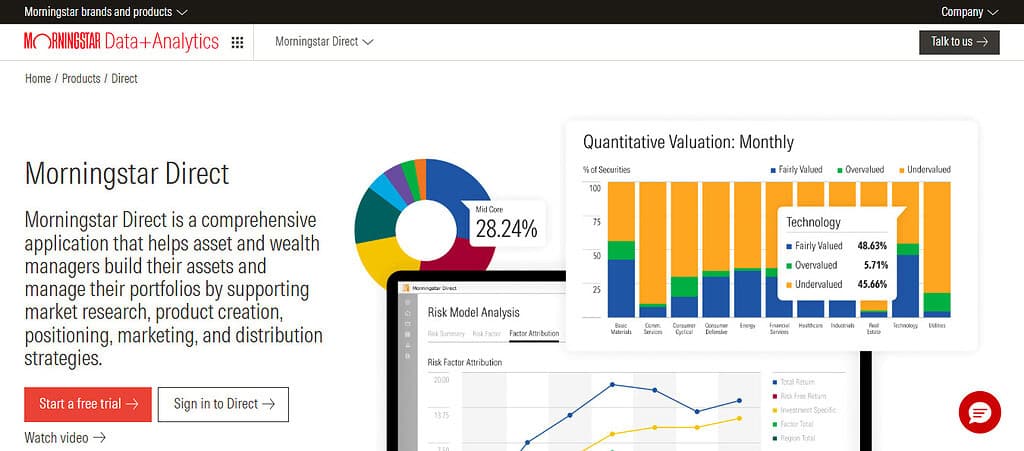
Users have the ability to build models, analyze strategies and create tailored institutional reports. Best Systems for Institutional Asset Allocation Models: Morningstar Direct Integrating its deep investment research and advanced financial analytics, together with portfolio modeling tools that simplify comparing strategies while analyzing risk exposures to optimize long-term allocation decisions.
Morningstar Direct Features
- In-depth global investment and fund research database
- Tools for asset allocation modeling and portfolio construction.
- Investment comparison analytics and manager screening.
- Institutional reporting and presentation customization.
- Both historical and forward-looking analytics for performance tracking.
Morningstar Direct Pros & Cons
| Pros | Cons |
|---|---|
| Extensive investment research database | Less powerful for large institutions |
| Strong asset allocation research tools | Limited advanced risk modeling |
| Easy performance benchmarking | Data dependency on Morningstar universe |
| User-friendly interface | Not full front-office platform |
| Excellent fund analytics capabilities | Limited trading functionality |
6. Wilshire Compass
Wilshire Advisors Compass tooling is aimed at institutional portfolio monitoring and governance oversight. The platform provides performance analytics, asset allocation tracking and risk measurement tools specifically for pension funds, endowments and foundations. It enables investment committees to track relative portfolio outcomes against strategic targets and benchmarks.

Wilshire Compass —highlighted in Best Systems for Institutional Asset Allocation Models—delivers advanced reporting transparency, customizable dashboards and decision-support analytics to help institutions ensure strategic investment alignment with governance policies and accountability to complex multi-manager investment structures.
Wilshire Associates Compass Features
- Monitor institutional portfolios and provide governance oversight.
- Track and analyze strategic asset allocation.
- Asset owner risk monitoring dashboards.
- Measuring the performance of multi-asset class portfolios
- Pension funds and endowments decision-support tools.
Wilshire Compass Pros & Cons
| Pros | Cons |
|---|---|
| Strong institutional performance reporting | Smaller ecosystem than competitors |
| Asset allocation monitoring tools | Less automation compared to enterprise systems |
| Multi-asset performance attribution | Limited trading integration |
| Customizable dashboards | Requires external data feeds |
| Good pension fund analytics | Moderate scalability limits |
7. Moody’s Analytics RiskConfidence
Moody’s analytics RiskConfidence is a liquidity risk monitoring and portfolio stress analysis solution for institutional investors. It consolidates holdings data to assess exposure across liquidity through normal and stressed market conditions. It is used by institutions to simulate redemption pressure, market shifts and regulatory scenarios.
RiskConfidence has proved to be a significant player in the models for institutional asset allocation systems due to its ability to give asset managers insight into liquidity constraints beyond just their factor-based models, so they are prepared when markets turn and investors start removing capital during crises while still meeting regulatory requirements.
Moody’s Analytics RiskConfidence Features
- Analytics for liquidity and portfolio risk assessment
- Models for stress testing and market shock simulation.
- Tools for transparency about portfolio holdings and exposures
- Regulatory and compliance reporting support.
- Scenario oriented allocation analysis for enstitional investors
Moody’s Analytics RiskConfidence Pros & Cons
| Pros | Cons |
|---|---|
| Advanced liquidity and risk forecasting | Complex analytics setup |
| Scenario and stress-testing models | Requires quantitative expertise |
| Credit and market risk integration | Implementation can be lengthy |
| Regulatory reporting support | Higher licensing cost |
| Enterprise-grade analytics engine | Steep learning curve |
8. Kyriba Investment Management
Kyriba Investment Management — offers cloud-based visibility across investments, liquidity positions and cash management activities. The system connects treasury operations with investment oversight to allow institutions to optimize allocations and liquidity planning for the short term. These advanced forecasting tools enable finance teams to manage capital efficiently while minimizing operational risk.

In the realm of Best Systems for Institutional Asset Allocation Models, Kyriba is recognized as a leader in bridging treasury liquidity insights, helping institutions fine-tune their asset allocation strategies to have more control over cash deployment, risk exposure and capital efficiency across global operations.
Kyriba Investment Management Features
- A treasury and investment visibility platform that is cloud-based
- Predictive liquidity capabilities and cash flow analytics.
- Centralized investment portfolio tracking system.
- Investment risk and exposure monitoring.
- Integration with treasury, payments and financial systems
Kyriba Investment Management Pros & Cons
| Pros | Cons |
|---|---|
| Strong liquidity and cash investment visibility | Limited deep asset allocation analytics |
| Treasury-focused investment workflows | Not designed for hedge funds |
| Cloud-based deployment | Fewer advanced risk models |
| Automated cash positioning | Requires integrations for portfolio analytics |
| Real-time financial exposure monitoring | Less suitable for complex derivatives |
9. Cambridge Associates Portfolio Tools
Cambridge Associates Portfolio Tools — Focus on endowment-style investment strategies focused on diversification and long-term asset allocation. It offers benchmarking analytics, tracking of private market exposure for a measured balanced portfolio performance, based upon institutional investment aims. Investors to gain insights into diversification on asset class and manager level across public and private assets.

Within the context of Best Systems for Institutional Asset Allocation Models Cambridge Associates systems provide insight derived from market-leading research, governance reporting and data-driven portfolio construction methodologies that have been widely adopted by both universities and foundations.
Cambridge Associates Portfolio Tools Features
- Endowment-style strategic asset allocation analytics.
- Evaluation and comparison of private market investments.
- Institutional performance evaluation frameworks.
- Portfolio strategy model & long term planning
- Grow OMEGA Insights asset owners and foundations tailored custom analytics
Cambridge Associates Portfolio Tools Pros & Cons
| Pros | Cons |
|---|---|
| Excellent private market benchmarking | Primarily advisory-focused |
| Institutional portfolio research expertise | Limited trading capabilities |
| Strategic asset allocation insights | Less automation than enterprise platforms |
| Strong endowment & pension analytics | Smaller technology ecosystem |
| High-quality investment data | Custom access required |
10. Axioma Risk
Qontigo Axioma Risk provides quantitative risk modeling and portfolio optimization solutions for institutional investors and quantitative asset managers.

The analytics on the platform are factor based and analyze worldwide portfolios for market, credit, and systematic risks. Its forecasting models and optimization engines are used by institutions to design efficient portfolios that meet investment objectives.
Axioma Risk is recognized in the Best Systems for Institutional Asset Allocation Models* section because its mathematical modeling capabilities combined with scalable analytics infrastructure allow risk forecasting to be integrated deep within the asset allocation workflow process, improving decision-making precision.
Axioma Risk Features
- Quantitative factor-based risk modeling engine.
- Tools for portfolio optimization and allocation simulation.
- Market risk prediction and exposure analytics.
- Multi-asset institutional risk management framework.
- Bonded with enterprise investment management systems
Axioma Risk Pros & Cons
| Pros | Cons |
|---|---|
| Quantitative risk modeling expertise | Best suited for quant teams |
| Portfolio optimization capabilities | Requires strong data infrastructure |
| Factor-based investment analysis | Limited accounting functions |
| High-performance risk calculations | Integration effort required |
| Institutional-grade analytics | Less operational workflow coverage |
Conclusion
That is key for institutions that are trying to manage risk, return, liquidity and longer-term investment goals. Modern asset allocation platforms come with advanced analytics, real-time data integration, scenario modeling and performance monitoring that enable better strategic decision-making. Data-driven portfolio construction at scale is achieved by technology (Exhibit 11): solutions such as BlackRock Aladdin, Bloomberg L.P. PORT and MSCI Inc. BarraOne.
Ultimately, the best system is based on institutional needs, investment complexity, governance structure, and operational workflows. Through adoption of these advanced allocation modelling platforms, investors can build resilience in the portfolio, enhance risk management and result in more consistent long-term performance among increasingly complex global financial markets.
FAQ
What are Institutional Asset Allocation Models?
Institutional asset allocation models are structured investment frameworks used by pension funds, endowments, insurance companies, and asset managers to distribute capital across asset classes such as equities, fixed income, real estate, and alternatives to achieve long-term investment objectives while managing risk.
Why do institutions need asset allocation modeling systems?
Institutions manage large and complex portfolios that require advanced analytics, risk monitoring, and performance tracking. The Best Systems for Institutional Asset Allocation Models help investors optimize diversification, manage volatility, improve governance, and make data-driven strategic investment decisions.
How do these systems improve investment decision-making?
They combine market data, quantitative models, and portfolio analytics to provide insights into risk exposures, diversification efficiency, and expected returns, enabling investment committees to make more informed allocation and rebalancing decisions.
Are asset allocation modeling systems suitable for small investment firms?
Some platforms are enterprise-level solutions designed for large institutions, but many providers now offer scalable or cloud-based versions that smaller asset managers and investment advisors can adopt based on their portfolio size and operational needs.