





I’ll go over the Best Embedded Finance Platforms for SaaS Companies in this post, looking at the best options that enable companies to incorporate financial services, banking, payments, and cards straight into their apps.
These systems let SaaS enterprises to grow rapidly while providing their clients with seamless financial functionality by streamlining operations, guaranteeing compliance, and improving user experience.
Why Use Embedded Finance Platforms for SaaS Companies
Integrated Financial Services – Users can make payments, access bills, make transfers, and use cards all from within your app.
Streamlined User Verification & Account Creation – Users can complete the required KYC and AML processes without exiting the app.
Monetized Financial Services – SaaS companies can offer and charge for payments, cards, lending, and even subscription financial services.
Reduced Operational Risks – For SaaS companies, platforms mitigate risks by managing banks, security, and compliance.
Increased Customization – SaaS companies can add (or remove) financial services any time and at any scale, thanks to the modularity of embedded finance.
Pay as You Grow – Keep financial offerings lean initially, and add as your needs scale.
Outsourced Financial Operations – Embedded finance platforms allow SaaS companies to focus on their primary offerings without the need to build, invest, and manage an entire banking operation.
Key Point & Best Embedded Finance Platforms for SaaS Companies List
| Platform | Key Point |
|---|---|
| Stripe Connect | Enables businesses to build marketplaces and manage payments with global payout support and flexible split payments. |
| Marqeta | Provides modern card issuing and payment processing with real-time authorization and advanced program management. |
| Plaid | Connects apps to users’ bank accounts securely for data access, verification, and transaction insights. |
| Synctera | Offers banking-as-a-service (BaaS) platform for fintechs to launch products with partner banks and APIs. |
| Solaris | BaaS provider that delivers banking accounts, cards, and payment services for fintech platforms. |
| Mambu | Cloud-native banking engine for lending, deposits, and digital banking operations with modular APIs. |
| Treasury Prime | API-first banking platform enabling fintechs to integrate bank accounts, payments, and card issuance. |
| Bond | Provides embedded finance APIs for lending, banking, and credit card services with compliance handling. |
| Railsr (formerly Railsbank) | Offers global embedded finance solutions including accounts, cards, and payment services for fintechs. |
| Weavr | Embedded finance platform enabling companies to integrate payments, cards, and banking services into apps. |
1. Stripe Connect
One of the most flexible payment options, Stripe Connect is made for marketplaces, SaaS platforms, and international companies. It enables businesses to easily handle international transactions, divide payouts among several parties, and manage complicated payments.
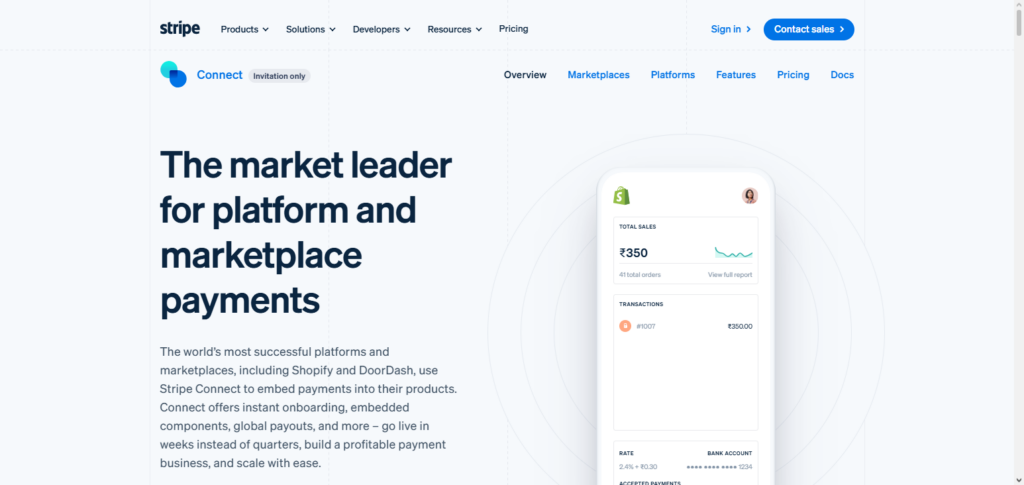
Onboarding, compliance, and verification procedures are made easier by its strong API connection. Because Stripe Connect combines flexibility, scalability, and global reach while upholding strict security standards, many SaaS organizations favor it.
Fast implementation and simple customization are guaranteed by its developer-friendly infrastructure. All things considered, Stripe Connect is among the top embedded finance solutions for SaaS firms looking for scalable, dependable, and effective payment handling.
Stripe Connect Features, Benefits & Drawbacks
Features:
- Payment processing globally.
- Marketplace split payout.
- APIs for developers.
- Compliance and fraud detection.
- Supports multiple currencies.
Benefits:
- Fast integration into SaaS.
- Flexible revenue distribution and payout.
- It’s scalable and reliable.
- Improves security and regulatory compliance.
- Supports international markets.
Drawbacks:
- Costs for smaller transactions are high.
- Service is unavailable in certain regions.
- Development is a must for advanced features.
- Marketplaces is a complex setup.
- Reliability on Stripe’s uptime.
2. Marqeta
Marqeta focuses on card issuing and payment processing with features such as real-time authorizations, customizable card programs, and fraud tools. SaaS companies use Marqeta’s services to build and support virtual, physical, and prepaid cards.
Marqeta’s open API provides a solution for developers to build payment experiences, fund automation, transaction tracking and more. Marqeta provides real time funding and programmable controls to help companies manage their spend control programs.
With a solid global presence and compliance to global regulations, Marqeta is considered one of the top embedded finance platforms for SaaS companies especially for those with customized cards and higher levels of financial automation.
Marqeta Features, Benefits & Drawbacks
Features:
- Issuance of both virtual and physical cards.
- Authorization of transactions in real-time.
- Program cards that are customizable.
- Control and monitoring fraud.
- An approach centered around APIs.
Benefits:
- Cards are tailored for SaaS applications.
- Payments that are instantaneous.
- Helps to lower the risk of fraud.
- Management of programs that is flexible.
- Easy financial workflows.
Drawbacks:
- Primarily aimed at card-heavy SaaS models.
- High costs for small businesses.
- Must have developer integration.
- Limited core banking features.
- Doesn’t cater to basic payment requirements
3. Plaid
Plaid is one of the top providers of financial data connectivity services in the industry, and helps SaaS companies access and verify user bank accounts. By integrating SaaS applications with financial institutions, Plaid provides real time account verification, transaction history access, and payment ability.

SaaS companies leverage Plaid to optimize the user onboarding experience, mitigate fraud, and create a more efficient financial user experience. Due to Plaid’s partnerships with large and various financial institutions, they are favored for embedded finance solutions.
Due to their simple API, and a wide range of data security, they are recognized as one of the top embedded finance platforms for SaaS companies as they create automation in financial processes while remaining compliant.
Plaid Features, Benefits & Drawbacks
Features:
- Links to bank accounts
- Access to transactions
- Identity verification
- Payment initiation
- Secure API
Benefits:
- Streamlined user onboarding
- Financial app insights
- Fraud prevention with verification
- Seamless API integration with SaaS
- Respected reliability and security
Drawbacks:
- Restricted payment privileges
- Incomplete bank coverage
- Scaling limitations due to API calls
- Financial tools for lending features
- Expanding costs with customer growth
4. Synctera
Synctera operates as a Banking as a Service platform that enables SaaS and fintech companies to develop banking products without having banking licenses. The company provides SaaS companies with banking APIs and connects them to partner banks for services like payment processing, card issuance, and account opening.
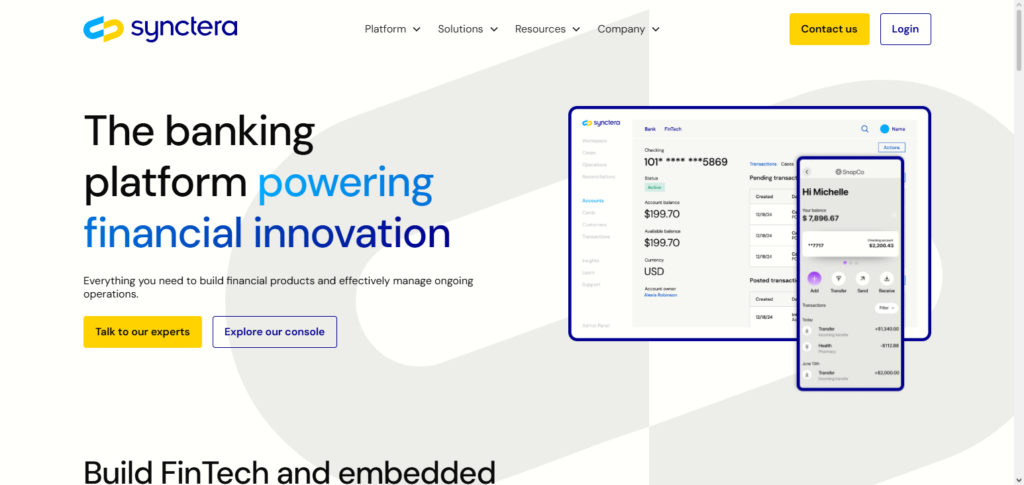
What makes Synctera unique is that it offers a modular solution and paves a smooth pathway for less complicated regulatory processes.
Thus, startups are able to focus more on their customers and user experience. Due to its speed, flexibility, and security, Synctera is regarded as one of the finest embedded finance platforms for SaaS companies in particular for those generating creative financial services with little operational burden.
Synctera Features, Benefits & Drawbacks
Features:
- Banking with Partner Banks
- Banking as a Service
- Account and card services
- Payment APIs
- Compliance as a service
Benefits:
- Quickly introduce new banking services
- Simplifies regulatory oversight
- Modular API for varied integration
- Banks SaaS products without owning a bank
- Less operational complexity
Drawbacks:
- Restricted global expansion
- Dependent on Partner Banks
- Complex integration
- High pricing for new ventures
- Less applicable to SaaS without a financial angle
5. Solaris
Solaris operates in the European Union and offers the full suite of BaaS products, consisting of banking accounts, payments, cards, and loans. After integrating its APIs, the SaaS company can offer its end users embedded finance functionalities, such as deposits, money transfers, and instant payout services.
Solaris builds its products with a focus on security, compliance, scale, and a SaaS company’s ability to offer financial services without the banking infrastructure. Solar’s flexibility enables the SaaS company to customize banking services to offer a tailored experience to their end users.
With its significant European and worldwide presence, Solaris is one of the finest embedded finance platforms for SaaS companies and is particularly suited for those who need quick implementations to integrate financial services to their products.
Solaris Features, Benefits & Drawbacks
Features:
- Digital banking services
- Payment services
- Card services
- Lending
- Compliance and security
Benefits:
- Comprehensive Banking as a Service solution
- Quick deployment for SaaS
- Supports embedded cards and payments
- Scalable for growing platforms
- Ensures regulatory compliance
Drawbacks:
- Primarily European focus
- Can be costly for small SaaS companies
- API learning curve for developers
- Limited US support
- Advanced features require developer resources
6. Mambu
Mambu offers core banking, lending, and deposit services via a cloud-native banking platform. Fintechs and SaaS companies use Mambu to quickly create digital banking services using cloud infrastructure and modular APIs. Mambu’s platform offers regulatory compliance, account management, payments, and financial workflows.
Mambu’s versatility aids SaaS companies in expanding their account services, modifying financial offerings, and operational scaling. Mambu is dependable and reliable, making it one of the finest embedded finance platforms for SaaS companies. It’s especially true for SaaS companies seeking to embed banking and lending capabilities into their services.
Mambu Features, Benefits & Drawbacks
Features:
- Cloud-native banking engine
- Lending & deposit management
- API-based modular design
- Core banking functions
- Regulatory support
Benefits:
- Enables SaaS to offer full digital banking
- Highly scalable for enterprise platforms
- Flexible for customized financial products
- Reduces operational overhead
- Cloud-native reliability
Drawbacks:
- Not a payment processor
- Complex setup and onboarding
- Costs increase with scale
- Requires technical expertise
- Limited prebuilt integrations
7. Treasury Prime
SaaS companies can include banking services directly into their products using Treasury Prime, an API-first banking platform. Account creation, card issuing, payment processing, and compliance management are among its services. Treasury Prime’s strong APIs help SaaS systems by facilitating smooth integration and real-time financial operations.
Additionally, it reduces operational complexity for firms by offering fraud detection, reporting, and regulatory support. One of the top embedded finance platforms for SaaS firms, Treasury Prime is well-known for its adaptability and developer-friendly tools, enabling enterprises to provide integrated financial services without the hassle of traditional banking infrastructure.
Treasury Prime Features, Benefits & Drawbacks
Features:
- Account creation APIs
- Payment initiation
- Card issuance
- Compliance & reporting
- Banking-as-a-Service
Benefits:
- Quick embedded finance deployment
- Automates compliance and reporting
- Smooth integration with SaaS applications
- Reduces operational burden
- Supports programmatic payments
Drawbacks:
- Dependent on partner banks
- Limited global support
- Integration can be complex for small teams
- API learning curve
- Identifying a banking partnership isn’t a complete banking solution
8. Bond
Bond offers embedded finance APIs for banking, lending, and credit services, enabling SaaS companies to embed financial products in their services.
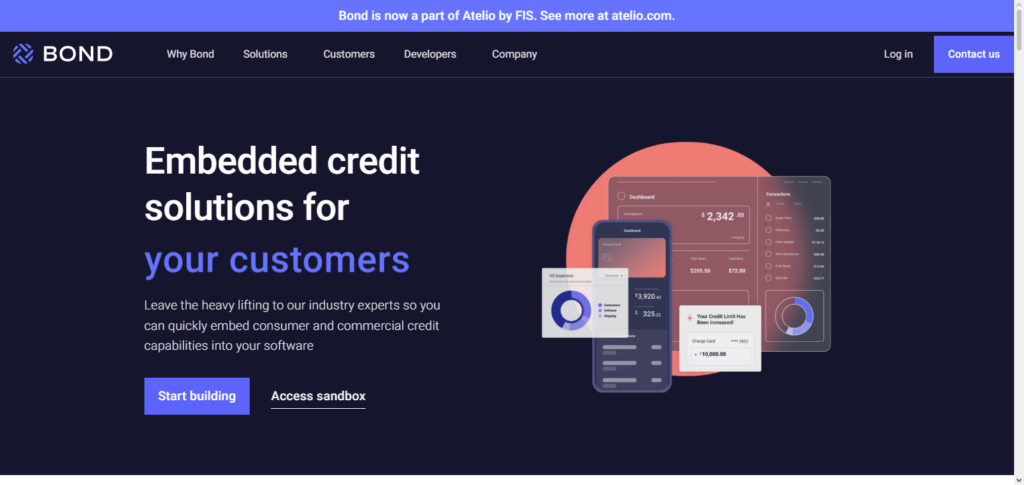
Through one API, SaaS companies can automate compliance, and provide card issuance and account management services. SaaS companies can launch regulatory compliant financial services in a matter of days. Because of its modular design, Bond can easily be scaled to its customers’ needs.
Bond’s customers can customize their services, gain operational efficiencies in user management and transaction tracking, and enhance their offerings. Bond is one of the top embedded finance platforms for SaaS companies because of unmatched speed, security, and developer support, allowing seamless finance integrations for end users.
Bond Features, Benefits & Drawbacks
Features:
- Banking and lending services
- Account management
- Card issuing
- Automated compliance
- Modular API
Benefits:
- Embedded finance can be integrated quickly
- Saas adaptable and flexible
- Less regulatory strain
- Quick to market
- Financial products can be more inventive
Drawbacks:
- Limited payment processing and direct
- Knowledgeable developers are a must
- Startups may find costs prohibitive
- Limited international availability
- Focused on SaaS Fintech
9. Railsr (formerly Railsbank)
A global embedded financial platform, Railsr provides solutions for accounts, cards, payments, and regulatory compliance. Without creating banking infrastructure, SaaS companies may incorporate banking functionality straight into apps by using Railsr.
Financial services including virtual and actual cards, account management, and foreign payments may be quickly implemented thanks to its APIs. Railsr helps companies provide seamless financial experiences by emphasizing security, scalability, and operational effectiveness.
Railsr is regarded as one of the best embedded finance platforms for SaaS firms because of its extensive capabilities and versatility, which enable platforms to smoothly integrate financial services while maintaining compliance.
Railsr (formerly Railsbank) Features, Benefits & Drawbacks
Features:
- Account and card issuing
- Payment processing
- Compliance, and KYC
- Global multi-currency
- Embedded finance, API first
Benefits:
- Global BaaS solution that is complete
- Fintech embedded banking for SaaS
- Less regulations to worry about
- API’s that are more flexible and scalable
- Financial services that are available cross border
Drawbacks:
- Complexity that can be great for newcomers
- Expensive for SaaS
- Advanced developers are needed for additional set up
- Limited Partner banking services
- Geography can limit features
10. Weavr
Weavr enables SaaS companies to provide their end users with embedded banking, payments, and cards. Weavr’s solutions include APIs for transactional processing, compliance, and user account management, which save SaaS companies from building their own banking solutions and provide their users with the financial services they need to drive their business.
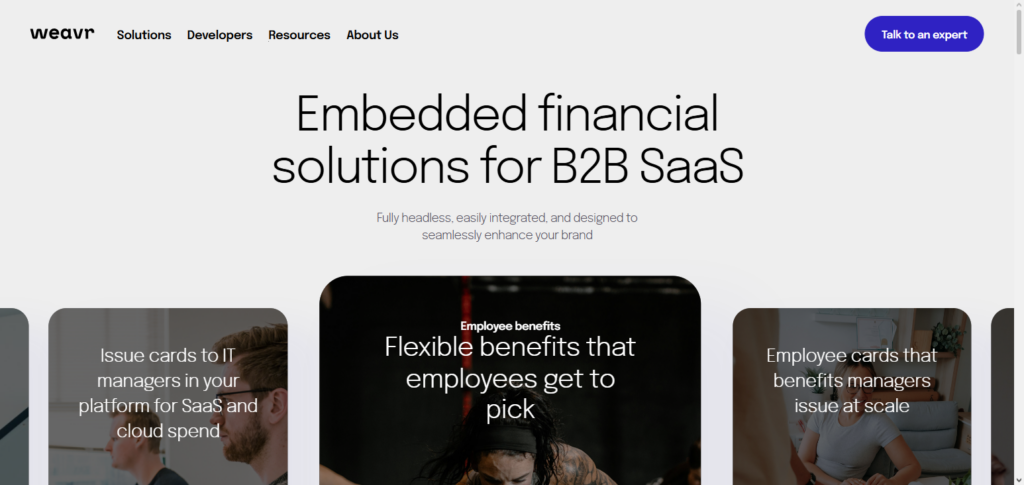
Weavr’s design supports rapid deployment and flexible/custom scaling to meet the needs of each user. Weavr is recognized as one of the best embedded finance platforms for SaaS companies primarily because of its ease of use and the complexity it removes from fintech integrations.
Weavr Features, Benefits & Drawbacks
Features:
- Banking and payments that are embedded
- Issuance of cards
- Transactions in real time
- KYC and compliance
- A platform that is modular and API driven
Benefits:
- Embedded payments and banking are rapidly integrated.
- Compliance and KYC are automated.
- Card issuing and account management are included.
- Modular API based Structure.
- Real-time Transactions.
Drawbacks:
- Global banking support is limited
- Needs developer involvement
- Extra integration may be required for advanced features
- Not an entire core banking solution
- Not ideal pricing for smaller SaaS businesses
Conclusion
In summary, the emergence of embedded finance has revolutionized the way SaaS companies provide value to their customers by enabling the smooth integration of financial services, banking, and payments within applications.
Businesses can build financial products swiftly and safely thanks to platforms like Stripe Connect, Marqeta, Plaid, Synctera, Solaris, Mambu, Treasury Prime, Bond, Railsr, and Weavr that offer strong APIs, scalability, and regulatory compliance.
The needs of your platform—whether they are related to loans, banking accounts, card issuance, or payment processing—will determine which embedded finance partner is best.
In general, SaaS organizations may increase user engagement, increase income, and maintain their competitiveness in the quickly changing financial market by utilizing these solutions.
FAQ
What is embedded finance, and why is it important for SaaS companies?
Embedded finance allows SaaS platforms to integrate banking, payments, lending, or card services directly into their apps without building a bank. It enhances user experience, increases revenue opportunities, and reduces friction in financial transactions.
Which platforms are considered the best embedded finance solutions for SaaS?
Top platforms include Stripe Connect, Marqeta, Plaid, Synctera, Solaris, Mambu, Treasury Prime, Bond, Railsr, and Weavr. They offer APIs for payments, banking, card issuance, compliance, and financial automation.
How do SaaS companies choose the right embedded finance platform?
Selection depends on business needs: payment processing, card issuance, account management, lending services, or global reach. Scalability, security, developer-friendliness, and regulatory support are key factors.
Can these platforms handle regulatory compliance for financial services?
Yes. Most top embedded finance platforms provide regulatory compliance tools, KYC/AML verification, and secure financial operations, reducing the burden on SaaS companies.
Are these platforms suitable for global operations?
Many, such as Stripe Connect, Marqeta, Solaris, and Railsr, support international payments, multi-currency accounts, and cross-border transactions, making them ideal for SaaS businesses with global users.