





The Best Economic Data Websites that offer trustworthy, accurate, and current economic information will be covered in this post. GDP, employment, trade, and financial indicators are among the U.S. and international data covered by these platforms.
These websites provide useful tools and insights for analysis, forecasting, and decision-making, regardless of your role as a researcher, policymaker, investor, or student.
Key Features to Look for in the Best Economic Data Websites
Source Credibility and Data Accuracy
Backed by authorities like governments, global institutions, or reputable financial organizations, data will be dependable and verifiable.
Economic Calendars and Data Updates in Real-Time
Websites with data feeds that are live and calendars of economic events should be preferred so that you can maintain the data of released events.
Access to Historical Time-Series Data
Users should be provided with the data sets for the long term so that trend analysis and cycle comparisons can be done, as well as forecasting and backtesting.
Coverage in Geographies
Platforms should be preferred that provide economic data in many countries and regions as well as in the world for better comparisons.
Range of Comprehensive Indicators
Platforms should be preferred that have macro-financial, labor, trade, demographic, and development indicators in one place.
Interface of Data Visualization and Dashboards
Complex data is easier to understand with interactive tools for data representation as economic dashboards can be built and algorithms can be visualized.
Export and Download Options
Seamless integration with reporting, modeling, or software is enabled by CSV, Excel, and API access which helps in exporting and downloading.
Integration and API Features
Automation of data collection and access in real-time integrated apps are valuable for developers and analysts.
Methodology and Documentation Transparency
Knowing how data has been collected and how it has been either modified or recalculated fosters confidence in the correct understanding and use of data.
Categories of Economic Data Platforms
Data Platforms for Government & Public Institutions: The platforms are run by central banks and national statistical offices. For example, in the US, we have the BEA, the Bureau of Labor Statistics, the Census Bureau, and the Eurostat. They provide data which is official, authoritative, and highly reliable for the economic analysis of policies, academic research, and reporting for the public.
Data Portals of International Organizations: They provide platforms run by the International Monetary Fund, the Organization for Economic Cooperation and Development, and the United Nations. For cross-country analysis, global economic analysis, and monitoring country progress on specific goals of development and sustainability, these platforms are the best due to the availability of standardized international data sets.
Market & Finance Data Platforms: They provide the latest and market-influencing economic indicators, along with forecasts and financial analytics. This includes Trading Economics and other services aimed at traders, investors, and financial analysts.
Alternative Data & Commercial Data Marketplaces: Businesses and institutions looking for particular economic data for analytics and competitive intelligence at an advanced level, use these platforms such as Datarade which links users with proprietary, valuable, high-frequency datasets.
Platforms for Academics & Other Researcher: This includes platforms like ALFRED (Archival FRED) which has data from the past, revisions, and transparency. This is best for economists, students of economics, and analysts researching policies and assessing them over a span of a long time.
Community and Open Data Platforms: These communities and open data platforms collect and organize data from several publicly available databases. They assist developers, nongovernmental organisations, and start-ups who wish to use freely available economic data to create applications or perform research.
Key Point & Best Economic Data Websites List
| Platform | Key Points |
|---|---|
| ALFRED (Archival FRED) | ALFRED is a historical data archive from the Federal Reserve Bank of St. Louis that allows users to track real-time changes in economic data over time. It stores vintage versions of U.S. economic indicators, making it ideal for researchers who need to analyze data revisions, policy impacts, and forecasting accuracy. |
| BEA (Bureau of Economic Analysis) | BEA provides official U.S. macroeconomic statistics, including GDP, national income, trade, and industry accounts. It is widely used by economists and policymakers for reliable, government-backed data that supports economic performance analysis and long-term trend evaluation. |
| BLS (Bureau of Labor Statistics) | BLS offers comprehensive labor market data such as employment, unemployment, wages, inflation (CPI), and productivity. Its datasets are essential for understanding workforce trends, cost-of-living changes, and economic health at both national and regional levels. |
| Census Bureau Economic Data | The U.S. Census Bureau provides detailed demographic and business data, including population trends, housing, manufacturing, and trade statistics. It supports market research, policy planning, and economic development with highly granular regional insights. |
| OECD Data Portal | The OECD Data Portal delivers international economic, social, and development indicators across member and partner countries. It is valuable for global comparisons, policy benchmarking, and analyzing economic performance, education, and sustainability trends. |
| Eurostat | Eurostat is the official statistical office of the European Union, offering harmonized data on EU economies, population, industry, and trade. It ensures cross-country comparability, making it ideal for regional analysis and EU-wide economic research. |
| UN Data Portal | The UN Data Portal aggregates global statistics on development, health, environment, population, and economics. It helps researchers and organizations monitor progress toward international development goals and conduct cross-national studies. |
| Trading Economics | Trading Economics provides real-time economic indicators, forecasts, and historical data for over 200 countries. It is popular among traders and analysts for tracking market-moving statistics, central bank decisions, and global economic trends. |
| Datarade Economic Data Hub | Datarade acts as a marketplace for commercial economic and alternative datasets, connecting users with premium data providers. It is useful for businesses and analysts seeking specialized, high-frequency, or proprietary economic data sources. |
| IMF – International Financial Statistics | The IMF’s IFS database offers comprehensive global financial and economic statistics, including exchange rates, balance of payments, and monetary data. It is widely used for international financial analysis, risk assessment, and macroeconomic research. |
1. ALFRED (Archival FRED)
ALFRED is an effective Archival database from the Federal Reserve Bank of St. Louis, which helps users examine the evolution of U.S. Economic data. Since ALFRED keeps “vintage” snapshots of economic indicators like GDP, inflation, and employment, researchers are able to analyze revisions and assess forecasting.
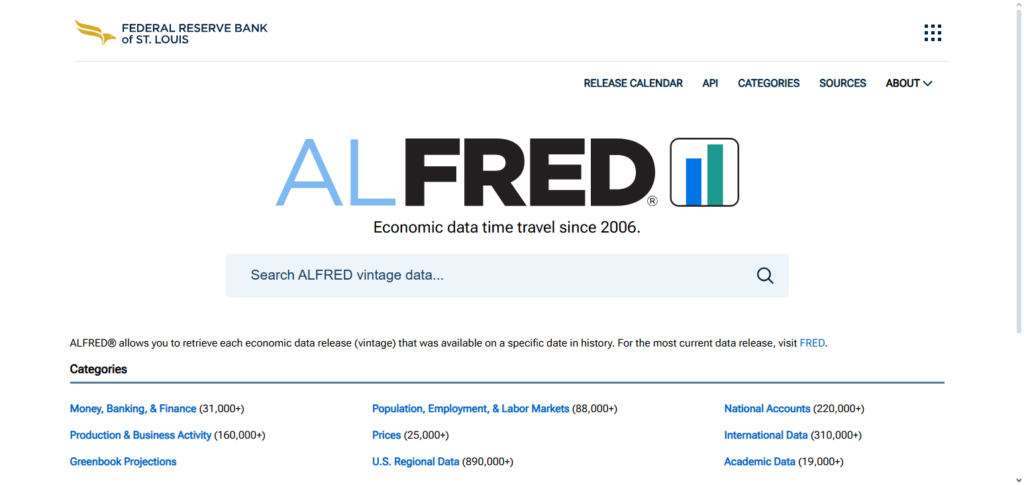
ALFRED is frequently referenced for his transparency and detailed accounts in the middle of academic and policy analyses, Best Economic Data Websites – ALFRED (Archival FRED). Economists, analysts, and students use the platform to see original data releases and updated figures to assess the effects of policies and the accuracy of the data.
ALFRED (Archival FRED) Features, Pros & Cons
Features:
- Available history and vintage data
- Macroeconomic time-series data for the U.S.
- Data revision history tools
- Export and chart features
- API Connectivity
Pros:
- Excellent data for forecasting
- Data revision history available
- Data source – Free for the public
- User-friendly for academics
- Data source – The Federal Reserve
Cons:
- Data mostly relating to the U.S
- centered mainly outside the U.S
- Minimal
- Need to learn to use more advanced features
- market indicators are very few
2. BEA (Bureau of Economic Analysis)
The BEA is the primary federal government source of macroeconomic data including GDP, national income, trade balances, and industry accounts. It publishes data and analyses useful for economic performance assessments and policy and business decision-making.
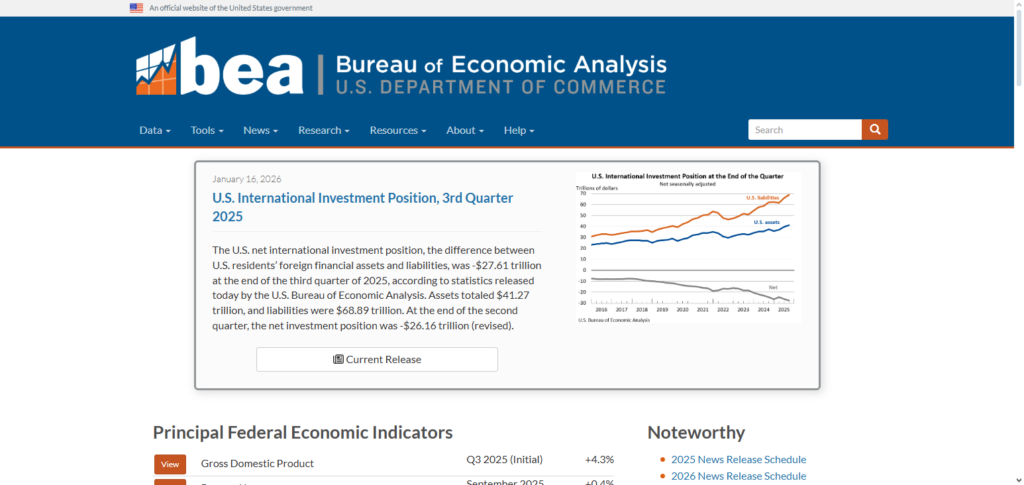
Among the Best Economic Data Websites, the BEA is recognized for its structured, credible, and accurate datasets.
Users can find and analyze interactive tables and data for specific regions and periods, which can aid economic forecasting and modeling. BEA data is commonly used for financial analyses, studies, and policy development concerning economic growth and stability.
BEA (Bureau of Economic Analysis) Features, Pros & Cons
Features:
- Official accounts of U.S. GDP and National
- Tables of data by region and industry
- Historical access of data trends
- Data tools and downloads
- Set of interactive data
Pros:
- National government source
- Extensive coverage of the economy
- Availability to the public free of charge
- Historical data is accurate
- Reporting is of policy-grade quality
Cons:
- Data internationally is minimal
- Real time data is not available
- The site is very complex to use
- The data and toolsets of the API are limited
- Data is very advanced for beginner users
3. BLS (Bureau of Labor Statistics)
The Bureau of Labor Statistics presents multifaceted current data that includes employment, wages, productivity, and prices that comprise the Consumer Price Index. The Bureau’s reports provide data to track inflation, employment, and the health of industries and economies in different regions.
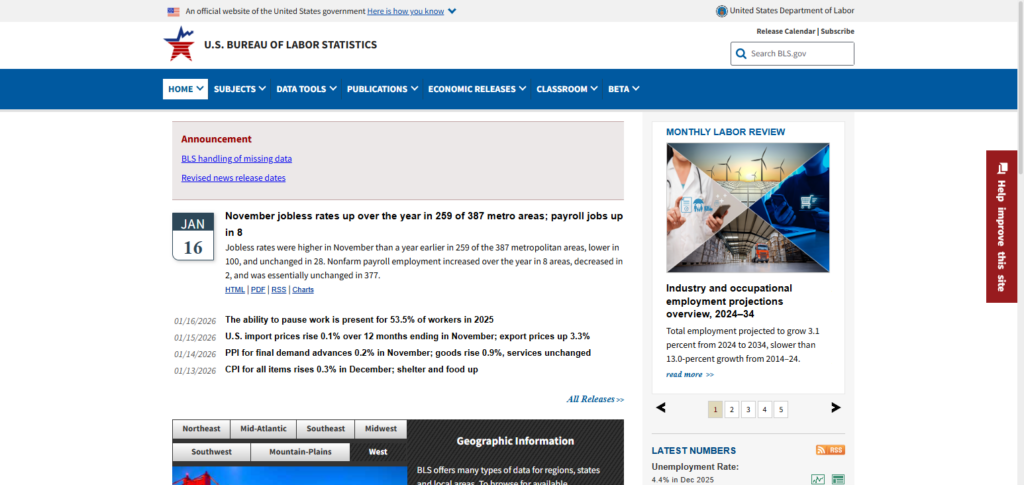
Recognized as one of the Best Economic Data Websites, the Bureau of Labor Statistics provides datasets, graphs, and time-series construction tools without charge.
For economists, journalists, and businesses, the Bureau provides real data on employment, cost of living, and the workforce. People trust the Bureau’s real-world economic data because it describes its methodology and updates it frequently.
BLS (Bureau of Labor Statistics) Features, Pros & Cons
Features:
- Statistics of employment and wages
- Tracking of inflation and CPI
- Data on productivity and on industries
- API for the public
- Interactive charts
Pros:* Reliable sources for labor markets
- Updated frequently
- Access to data is free
- Good understanding of regions
- API that is easy to use
Cons:
- Primarily focused on the U.S.
- Complicated dataset arrangement
- Simple UX design
- Few available financial metrics
- Steep learning curve
4. Census Bureau Economic Data
The U.S. Census Bureau provides data on the economy and demographics of the country, which includes multi-dimensional data on the number of people, housing, manufacturing and trade, and business.
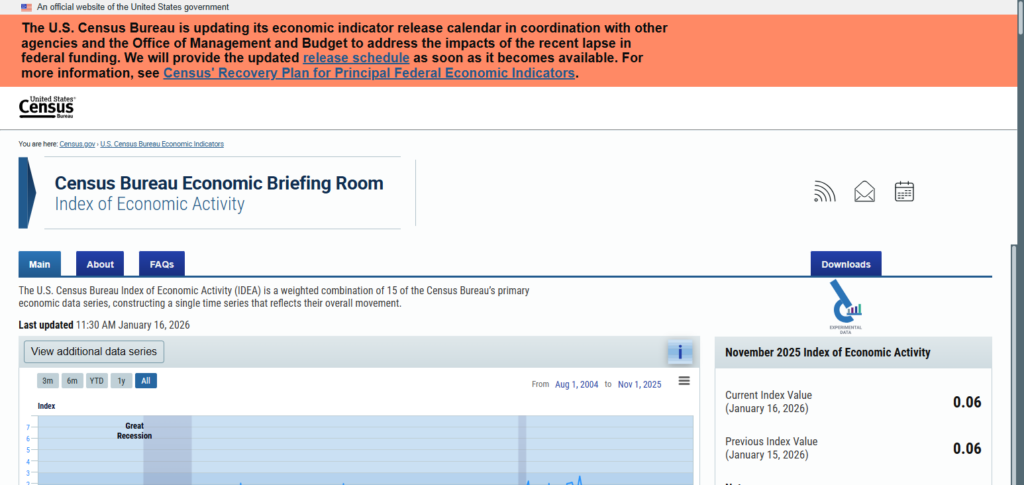
The Census Bureau, with its detailed economic and geographic level data, assists in market research, planning at the regional level, and the formation of policies. , the Best Economic Data Websites recognition highlights the Census Bureau Economic Data because it has the most data from its numerous surveys and economic censuses.
The Census Bureau provides economic data that governments, researchers, and businesses use to determine investment plans and economic strategies.
Census Bureau Economic Data Features, Pros & Cons
Features:
- Surveys for businesses and demographics
- Profiles for each region’s economy
- Data for trade and housing
- Tools for visualization
- Access to API
Pros:
- Data acquired for free from the government
- Coverage for more than one sector
- Accurate information
- Data is useful for research in the market
- Insights on the locality are accurate and detailed
Cons:
- A plethora of data
- Not being cause focused in real-time
- The interface appears to be somewhat slow
- There are no data for global coverage
- Use of technical jargon
5. OECD Data Portal
The OECD Data Portal offers data on the international economy, society, and development across member and partner countries. It includes indicators on GDP growth, education, trade, employment, and sustainability, allowing users to compare countries.
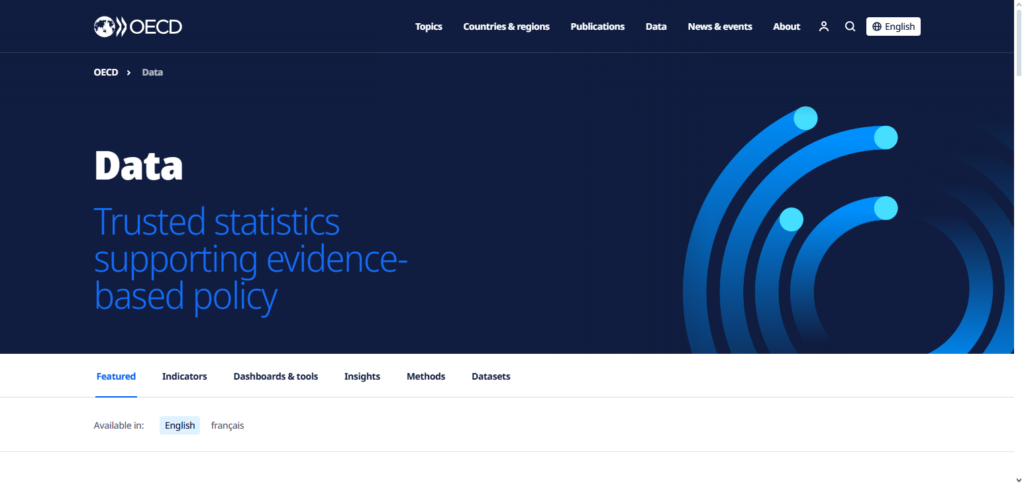
The OECD Data Portal is one of the **Best Economic Data Websites** and is appreciated for its data-sourcing methodologies and international coverage.
Policymakers, researchers, and analysts use the data portal to set benchmarks, analyze public policies, and examine historical trends. Users can visualize data using dashboards and data can be downloaded for use in both academia and in the workplace.
OECD Data Portal Features, Pros & Cons
Features:
- Data on global policy indicators
- Tools for comparing countries
- Dashboards that are interactive
- Data that can be downloaded
- API that is made available to the public
Pros:
- Comprehensive global coverage
- Data available in a standardized format for the globe
- Visuals provided are easy to use
- The service is available free of charge
- Focused data on policies
Cons:
- Data for countries that aren’t part of the OECD is restricted
- Not focused on real-time information
- Notes on methodology can be complicated
- Some data sets are not current
- Very Academic
6. Eurostat
Eurostat is the statistical office of the European Union. Eurostat offers economic and social data for all European Union member states. Data is available on the subjects of inflation, employment, trade, population, and regional development.
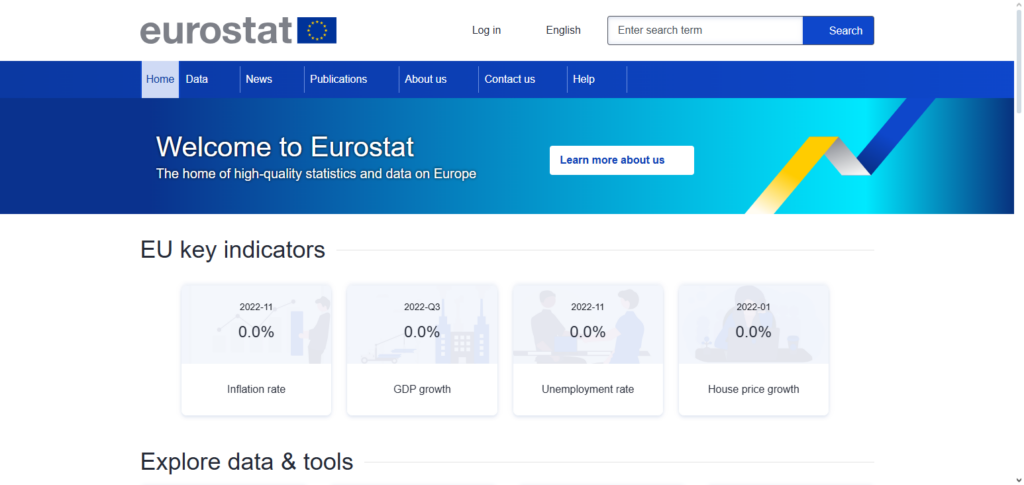
Eurostat is often named among the **Best Economic Data Websites** for ensuring cross-country data comparability and the use of standard unbiased statistical methods.
Researchers and market analysts use Eurostat to assess trends and outcomes of European policies Eurostat offers users the ability to analyze data using interactive dashboards and offers rich European data. Eurostat offers time series data, detailed metadata, and dashboards for users that are studying the regional economy of the European Union.
Eurostat Features, Pros & Cons
Features:
- Statistics that have been harmonized at the EU level
- Explorer for regional data
- Dashboards for visualization
- Tools for time-series analysis
- Services for API
Pros:
- Reliable data for the EU as a whole
- The ability to compare across countries
- Observations that are regional and detailed
- The methodology is reliable and consistent
- Access to the public for free
Cons:
- Only applying to the EU
- Navigation can be complicated
- Limited updates
- Complicated datatables
- Steep learning curve
7. UN Data Portal
The United Nations’ Data Portal compiles global development statistics sourced from multiple UN agencies, covering a range of areas such as health, environment, population, and economics. It enhances global development goal monitoring and international research.
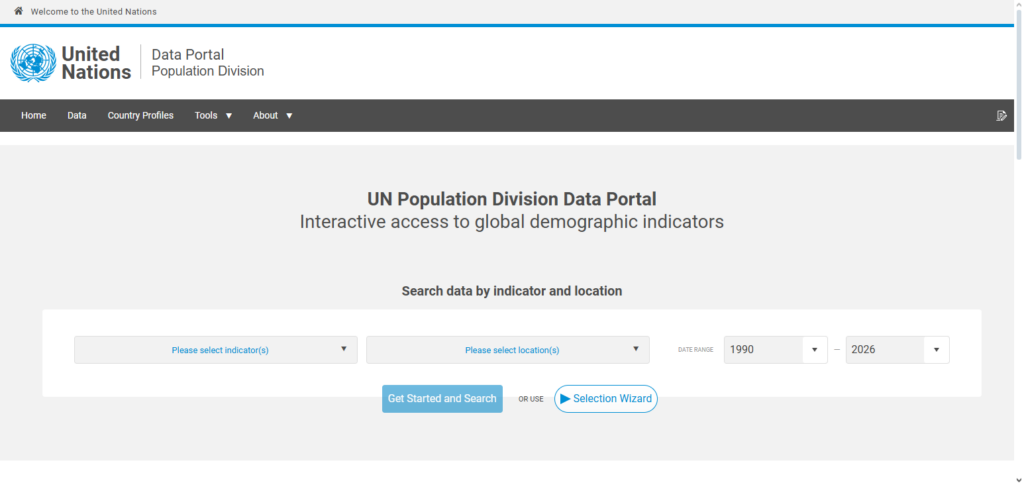
The UN Data Portal has earned accolades in the Best Economic Data Websites category for its popularity and accessible broad coverage. Users have access to one platform where they can monitor trends over time, compare countries, and analyze global metrics.
The portal allows users to access international statistics for their research and humanitarian, policy, and sustainable development plans. It is most beneficial for academics, NGOs, and policymakers.
UN Data Portal Features, Pros & Cons
Features:
- Indicators on global development
- Datasets from multiple agencies
- Tools for comparing countries
- Open access to data
- Several formats available for download
Pros:
- Global coverage
- Data is open access and free
- Metrics on development are available
- The data is from a reliable source: UN
- It is valuable for researchers and NGOS
Cons:
- Insufficient data on financial markets
- The data is not up to date
- Simple interface
- Limited economic modeling features
- The data’s quality and consititency is different from agency to agency
8. Trading Economics
Over 200 countries have real-time and historical economic indicators, forecasts, and market data available for interest rates, inflation, GDP, commodities, and central bank decisions through Trading Economics. This has earned them their popularity among analysts and traders.
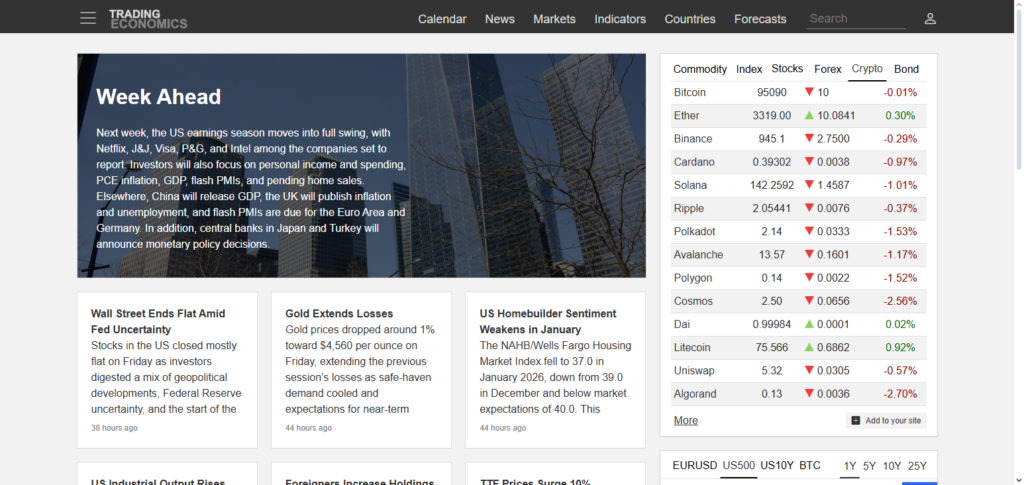
Live updates and predictive analytics make Trading Economics a great addition to the Best Economic Data Websites list.
Users can access economic news along with charts and calendars to monitor important events that impact the market. Financial institutions value their API and customizable dashboards, as do businesses that need data for trading and investing.
Trading Economics Features, Pros & Cons
Features:
- Global Calendar for Economics
- Tools for forecasting
- Interactive graphs
- API services
- Economic Indicators Updated in Real Time
Pros:
- Data is updated in real time
- The emphasis is on the market
- Covers a large number of countries
- User Friendly Dashboards
- It is suitable for commerce
Cons:
- Paid features
- Lack of depth for academic purposes
- Some data is aggregated
- The free version has ads
- Data that is aggregated has a license
9. Datarade Economic Data Hub
Datarade offers a marketplace for users wanting to access premium alternative economic data. It provides high specialization, high frequency, and proprietary datasets that are not available from public data sources. Datarade Economic Data Hub has been listed in the Best Economic Data Websites category for its varying economic data products.
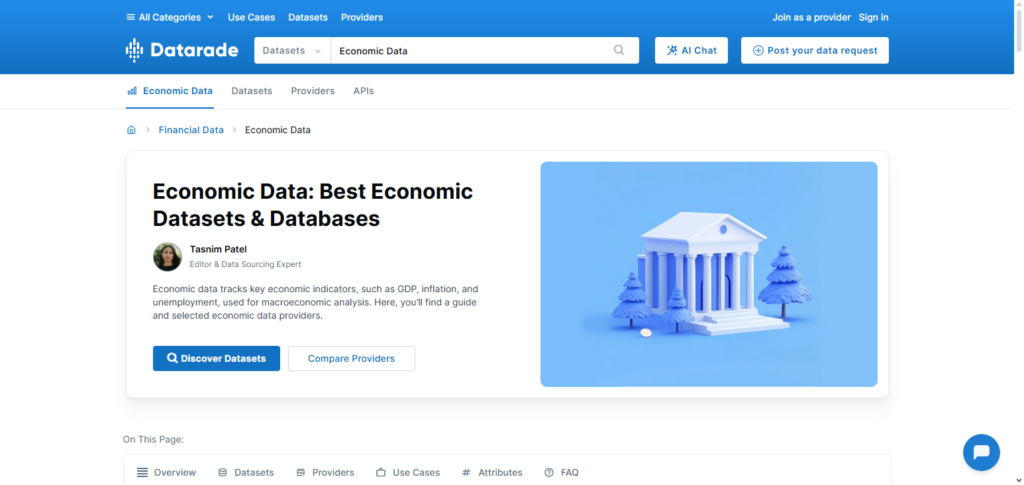
Businesses and analysts access Datarade to procure tailored economic business intelligence, market metrics, and proprietary economic data. Data licensing, discovery, and comparison has been streamlined on this website, making it an optimal choice for firms wanting to embed premium economic data into analytics, forecasting, and strategic economic planning.
Datarade Economic Data Hub Features, Pros & Cons
Features:
- Marketplace for datasets of economic data
- Tools for comparing vendors
- Sourcing of data that is custom
- Support for licenses
- Integrations for API (varies)
Pros:
- Access to data that is tailored to a specific purpose
- The platform is business-oriented
- Data is from premium and high grade sources
- It decreases the time spent searching for vendors
- The datasets are of economic data are of a commercial grade
Cons:
- Access needs to be paid.
- Absence of beginner-friendly service.
- Lack of completely free public data.
- It is reliant on external suppliers.
- The transparency of pricing is inconsistent.
10. IMF – International Financial Statistics
The International Financial Statistics database of the International Monetary Fund offers a collection of data that is global in scope and covers all aspects of economic and financial phenomena, including the statistics of foreign exchange, monetary aggregates, balance of payments, and government finance.
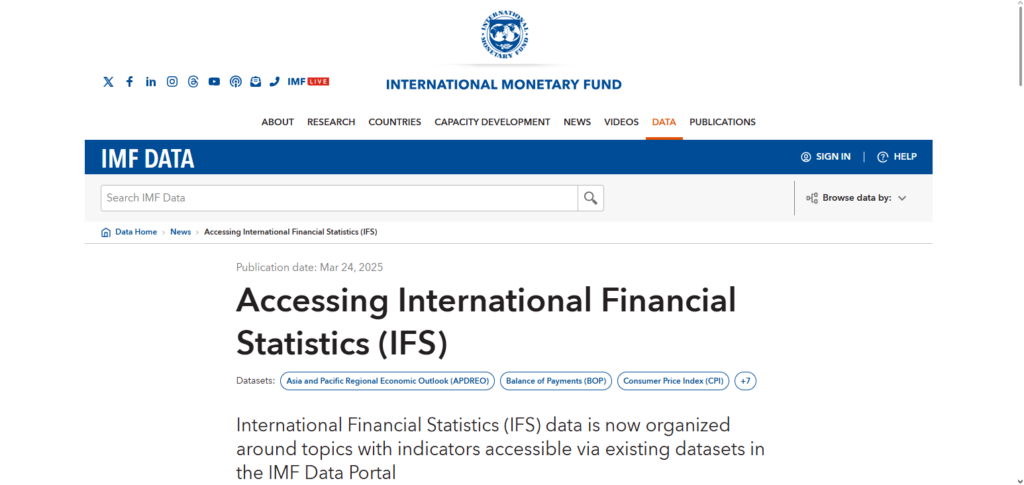
The database is useful for macroeconomic analysis and for cross-country comparisons. Because of the globally standardized data that is provided, the database is often cited in the Best Economic Data Websites – IMF – International Financial Statistics.
Data economists, financial analysts, and policy makers utilize the long and comprehensive time series for risk analysis and policy assessment. The database is often used to understand global financial and economic phenomena.
IMF – International Financial Statistics Features, Pros & Cons
Features:
- Monetary figures worldwide
- Databases of exchange rates.
- Data on balance of payments.
- Statistics on money.
- Downloadable time sequence.
Pros:
- Most reputable global institution.
- Extensive global coverage.
- Unified data collection standards.
- Public data sets available free of charge
- Extensive historical data.
Cons:
- Technical data representations
- Absence of contemporary data
- Difficult to use
- Some of the advanced functions are paid
- Services are not beginner friendly.
Comparison Table: Best Economic Data Websites at a Glance
| Platform | Coverage | Key Data Types | Free Access | API Available | Best For |
|---|---|---|---|---|---|
| ALFRED (Archival FRED) | U.S. historical data | Economic time-series revisions | ✔️ | ✔️ | Tracking data revisions & forecasting |
| BEA (Bureau of Economic Analysis) | United States | GDP, national accounts, trade | ✔️ | ❌/Limited | U.S. economic performance & policy analysis |
| BLS (Bureau of Labor Statistics) | United States | Employment, inflation, wages | ✔️ | ✔️ | Labor market & price indicators |
| Census Bureau Economic Data | United States | Population, business, trade | ✔️ | ✔️ | Demographic & local economic insights |
| OECD Data Portal | Global (OECD members) | GDP, education, labor, trade | ✔️ | ✔️ | International comparisons & policy research |
| Eurostat | European Union | EU economic & social statistics | ✔️ | ✔️ | EU regional & cross-country data |
| UN Data Portal | Global | Development, health, economics | ✔️ | ✔️ | Global development & sustainability analysis |
| Trading Economics | Global | Real-time indicators & forecasts | ❌/Limited | ✔️ | Market-moving data & economic calendars |
| Datarade Economic Data Hub | Global | Premium & alternative datasets | ❌ | Varies | Specialized commercial data sourcing |
| IMF – International Financial Statistics | Global | Financial & macroeconomic stats | ✔️ | ✔️ | International financial indicators & stability |
Conclusion
In the global economy, the top websites for economic data are essential for making well-informed judgments, conducting research, and developing policies.
While international sources like the OECD, Eurostat, the UN Data Portal, Trading Economics, Datarade, and the IMF offer important worldwide viewpoints, platforms like ALFRED, BEA, BLS, and the Census Bureau offer reliable U.S. economic information.
When combined, these systems provide a potent combination of specialized datasets, real-time indicators, and historical depth. Economists, companies, and policymakers can better analyze trends, manage risks, and create plans based on precise, transparent, and trustworthy economic data by utilizing these credible tools.
FAQ
What are economic data websites?
Economic data websites are online platforms that provide access to statistical information about economies, including indicators like GDP, inflation, employment, trade, population, and financial markets. These sites help researchers, businesses, and policymakers analyze trends, forecast performance, and make data-driven decisions.
Which are the best economic data websites for U.S. statistics?
Some of the best sources for U.S. data include ALFRED (Archival FRED), the Bureau of Economic Analysis (BEA), the Bureau of Labor Statistics (BLS), and the U.S. Census Bureau. These government-backed platforms offer highly reliable, regularly updated, and transparent datasets.
What is the best website for global economic data?
For global coverage, popular platforms include the OECD Data Portal, Eurostat, the UN Data Portal, and the IMF’s International Financial Statistics. These sources provide standardized international data that supports cross-country comparisons and global economic analysis.
Are these economic data websites free to use?
Many platforms, such as BEA, BLS, Census Bureau, OECD, Eurostat, and the UN Data Portal, offer free public access. Others, like Datarade and some features of Trading Economics, may require paid subscriptions or licenses for premium and high-frequency datasets.