


I’ll go over the top AI tools for large-scale website personalization in this post. These cutting-edge tools employ AI and machine learning to provide website visitors with customized experiences, product suggestions, and content.
Businesses can boost engagement, boost conversion rates, and provide seamless, relevant experiences for each visitor at scale by evaluating user behavior and preferences in real time.
Criteria for Selecting the Best AI Tools for Website Personalization
Real-time personalization – the capacity to offer more content, products, or offers to visitors in real-time as they browse your website.
Behavioral and contextual targeting – looking at the user behaviours and actions and tailoring the experience based on their interests and preferences as well as suggesting the right experience based on their location and device.
Ease of integration – integration with other platforms like content management systems, e-commerce, customer relationship management systems, and marketing automation solutions.
Scalability – the ability to manage high levels of traffic and customize the experience for multiple audience segments at the same time.
Analytics and reporting – an ability to effectively track performance metrics, such as engagement, conversions, and ROI.
AI & machine learning capabilities – the use of algorithms to predict the purchases and preferences and over time use the information to customize the offerings to the user.
Multi-channel personalization – the ability to provide streaming and meet users on multiple platforms such as the web, mobile, email, and apps.
Ease of use – simple to navigate for marketers with minimal technical expertise.
Cost-effectiveness – reasonable pricing in relation to the features, scalability, and ease of implementation.
Data privacy and compliance – ensures the data protection legislation governing their use of data, such as the General Data Protection Regulation and the California Consumer Privacy Act are followed.
Key Point & Best AI Tools for Website Personalization at Scale
| Platform | Key Point |
|---|---|
| Dynamic Yield | AI-driven personalization and recommendation engine for web, mobile, and email experiences. |
| Monetate | Focuses on A/B testing, multivariate testing, and personalized experiences for e-commerce. |
| Evergage (Salesforce Interaction Studio) | Real-time personalization platform integrated with Salesforce CRM for behavioral targeting. |
| Qubit | Data-driven personalization and experimentation platform for optimizing customer journeys. |
| Segment (Twilio) | Customer data platform (CDP) that unifies user data for targeted messaging and personalization. |
| Personyze | AI-based personalization with behavioral targeting, pop-ups, and email automation. |
| Algolia Recommend | Product recommendation engine enhancing search and discovery experiences. |
| Kibo Personalization | Unified commerce personalization platform integrating content, commerce, and AI recommendations. |
| Insider | Growth management platform offering cross-channel personalization and segmentation. |
| Nosto | E-commerce personalization platform providing product recommendations, pop-ups, and content personalization. |
1. Dynamic Yield
Because Dynamic Yield can provide highly customized experiences in real-time, it stands out as one of the greatest AI solutions for website personalization at scale.
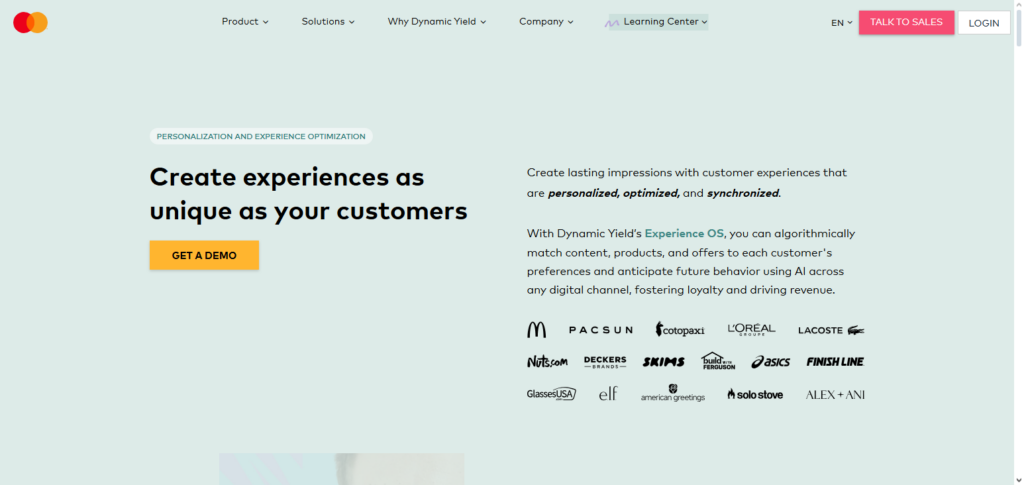
In contrast to traditional tools, it employs sophisticated machine learning algorithms to evaluate user behavior across several touchpoints, including online, mobile, email, and kiosks, enabling businesses to dynamically create promotions, product recommendations, and personalized content.
Its scalability, which allows businesses to handle millions of people while keeping accurate targeting, is its special strength. Its strong analytics and A/B testing capabilities also guarantee ongoing optimization, making each encounter more intelligent, pertinent, and captivating for every visitor.
Dynamic Yield Features, Pros & Cons
Features:
- Content and product personalization driven by AI.
- Behavioral targeting based on user activities.
- Multivariate and A/B testing.
- Targeting and audience segmentation.
- Integrations with CRMs and e-commerce platforms.
Pros:
- Flexibility for personalization options is quite high.
- Offers recommendations based on real-time analytics.
- A variety of reporting, analytics, and metrics tracking tools.
- Numerous faceted personalization (including web, email, apps) engagement.
- Plug-and-play for integration with most e-commerce platforms.
Cons:
- A cost model that some smaller size businesses may struggle with.
- Advanced feature training may take time.
- Campaign configurations may take time.
- Technical support may be needed for some integrations.
- Heavily relies on accurate user data.
2. Monetate
Because it optimizes user experiences by combining data-driven insights with real-time experimentation, Monetate is regarded as one of the best AI solutions for website personalization at scale.
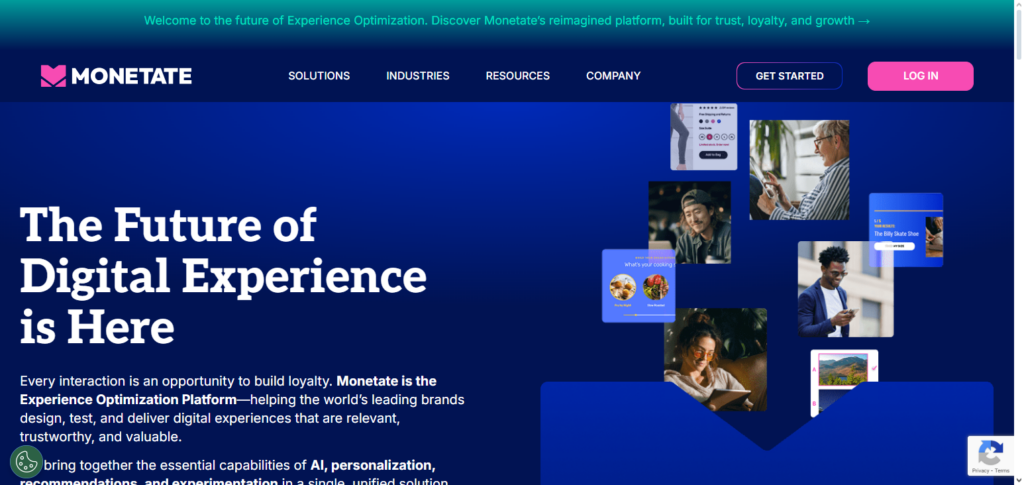
Its distinct advantage is that it allows marketers to perform complex A/B and multivariate testing while providing each visitor with personalized content and product suggestions. Because Monetate’s AI algorithms are always learning from user interactions, personalization is able to dynamically adjust to shifting patterns of behavior.
It enables businesses to effectively expand personalization initiatives, increasing engagement, conversion rates, and customer happiness across digital channels by managing huge traffic levels without sacrificing performance.
Monetate Features, Pros & Cons
Features
- The system provides recommendations of products on an individual basis.
- Behavior and context are targetted at the same time.
- Users take part in A/B tests and use tools to help conversion.
- Users are able to configure their audience and create segments.
- Users have the ability to integrate to e-commerce and marketing systems.
Pros
- The interace is easy to learn and use.
- The system includes support tools to help with conversion optimization.
- The system personalizes content in real time.
- There is an analytics dashboard to help visualize data.
- The system is able to implement campaigns on many channels.
Cons
- More established firms should use this as it can be expensive.
- There is not as much AI support as there is from oher competitors.
- Implementing changes takes time.
- Some advanced customization needs assistance.
- Additional time is needed for the complex targeting options.
3. Evergage (Salesforce Interaction Studio)
Because it provides real-time, behavior-driven experiences across all digital channels, Evergage—now known as Salesforce Interaction Studio—is a top AI solution for website personalization at scale. Its strong connection with Salesforce’s ecosystem, which enables companies to use CRM data in conjunction with real-time behavioral signals to provide highly contextual and pertinent interactions, is what makes it special.
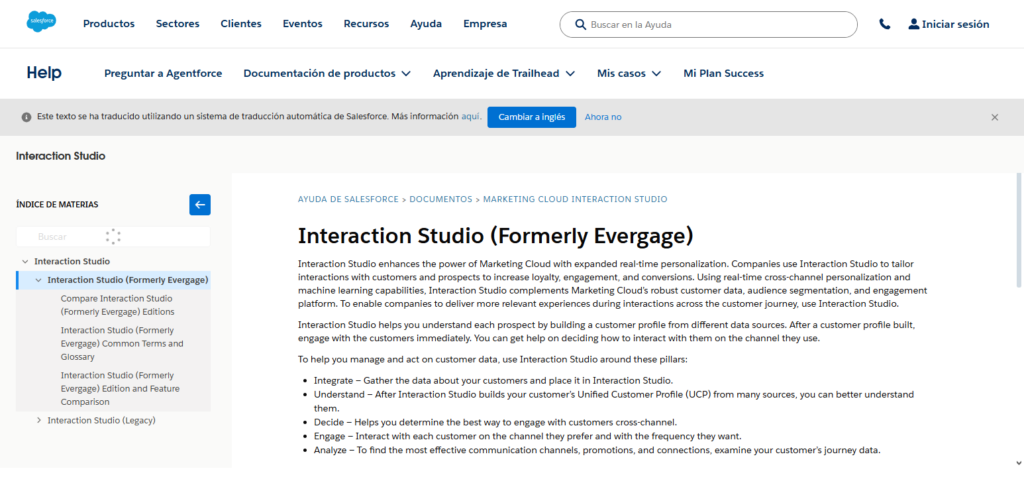
The platform employs sophisticated machine learning to forecast user intent and dynamically customize messaging, recommendations, and content. Evergage guarantees that each visitor receives customized engagement, increasing conversions, loyalty, and overall customer happiness at scale thanks to its capacity to segment audiences in real time and coordinate consistent cross-channel experiences.
Evergage (Salesforce Interaction Studio) Features, Pros & Cons
Features
- Personalized marketing in real time by behavior.
- Recommendations of products and content powered by AI.
- Analytics and tracking of customer journey.
- Customer’s demographics and behavior analytics for segmentation.
- It can work in conjunction with Salesforce CRM and marketing cloud.
Pros
- Excellent real-time personalization.
- Great integration Salesforce products.
- It can manage tailored journeys in all marketing channels.
- AI recommendation systems increase engagement.
- Customer behavior is easy to track and analyze.
Cons
- Expensive for small businesses.
- It can work best only with other Salesforce products.
- Complicated to set up.
- Requires high quality data for the best outcomes.
- Training for advanced analytics may be needed.
4. Qubit
Because it integrates machine learning, predictive analytics, and behavioral data to provide each visitor with highly relevant experiences, Qubit is a leading AI solution for website personalization at scale.
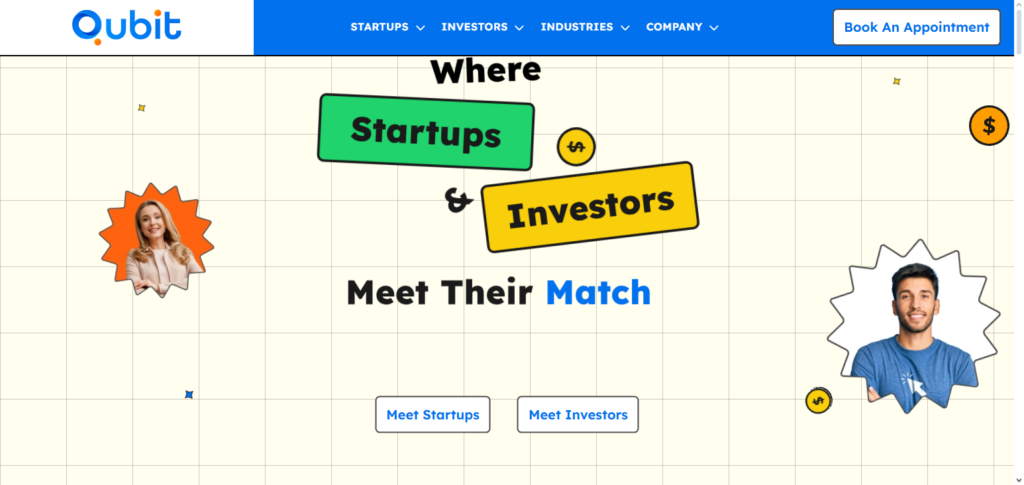
Its capacity to combine consumer data from various sources and produce real-time promotions, product recommendations, and personalized content is its special strength. Additionally, Qubit provides sophisticated testing and segmentation features that let companies experiment and continuously improve.
Qubit is a potent solution for brands looking to build meaningful, data-driven digital experiences because it focuses on both individual-level customisation and large-scale scalability, helping businesses increase engagement, conversions, and revenue.
Qubit Features, Pros & Cons
Features
- Personalization driven by AI.
- Recommendations of content and products.
- Visitors are behaviorally segmented.
- Web experience can be tested and optimized.
- Integrates with popular eCommerce solutions.
Pros
- Personalization and targeting is flexible.
- Allows multiple channels to be used in one campaign.
- Excellent for A/B testing and other optimization tasks.
- Recommendations are given in real time.
- Works well for enterprise level pages.
Cons
- Expensive for small companies.
- Advanced features take time to learn.
- Certain integrations need specialized assistance.
- There is the possibility that setup could take a while.
- Very few templates available right from the start.
5. Segment (Twilio)
Because it functions as a potent Customer Data Platform (CDP) that centralizes and unifies data from every touchpoint, Segment (Twilio) is a top AI solution for website personalization at scale.
Businesses can create highly targeted and consistent experiences across web, mobile, and email channels because to its unique capability of consolidating fragmented user data into a single, actionable perspective. Segment guarantees real-time audience segmentation and predictive customisation at scale through seamless integration with AI-driven personalization engines.
With this data-driven strategy, businesses can effectively improve engagement, conversions, and long-term client loyalty while also gaining a comprehensive understanding of user behavior and optimizing content dynamically.
Segment (Twilio) Features, Pros & Cons
Features:
- Allows for personalized customer data platforms.
- Gathers user data in several different ways.
- Helps build an audience in addition to segmentation in a matter of seconds.
- Can be used with various automated marketing tools.
- Provides support for AI recommendations when used with certain apps.
Pros:
- Outstanding integration for customer data collection.
- Integration with various marketing and personalization tools is a simple task.
- Highly configurable.
- Based on user actions, accurate targeting is available.
- Allows the controlled routing of data to AI personalization.
Cons:
- Integration is needed because it is not a personalization tool in itself.
- Technical knowledge may be needed for a more complicated setup.
- High charges if there is a lot of data.
- Poor built-in personalization capabilities.
- Must implement better data management policies for optimal outcomes.
6. Personyze
Because it provides a full range of real-time behavioral targeting and automation options, Personyze is an outstanding AI tool for website personalization at scale. Its capacity to customize every aspect of a website—including content, pop-ups, advertisements, and recommendations—based on specific user behavior, demographics, and interaction patterns is what makes it special.
Additionally, Personyze incorporates predictive algorithms to deliver the appropriate message at the appropriate moment by anticipating user intent. Businesses can continuously optimize experiences with its user-friendly segmentation, testing, and analytics solutions.
Because of its scalability, predictive intelligence, and detailed personalization, Personyze is a very powerful tool for increasing customer loyalty, engagement, and conversions.
Personyze Features, Pros & Cons
Features:
- Personalizes content for emails and websites in an AI-driven way.
- Targets segmentation and actions of users in a behavioral way.
- Provides recommendations in real-time on what content will be a good fit and even on products.
- Uses messages that are triggered, along with pop-ups and overlays.
- Can be used with various CMS and e-commerce systems.
Pros:
- User friendly.
- Personalization for campaigns is flexible.
- Allows for content optimization in real time.
- Affordable for medium businesses.
- Strong reporting and analytics.
Cons:
- Compared to other industry competitors, AI predictions lag behind.
- Certain integrations might need assistance from tech support.
- There is a steep learning curve when it comes to advanced targeting.
- There is a lack of support for multichannel personalization.
- It can be difficult to scale to an enterprise level Collab.
7. Algolia Recommend
Because it improves search and discovery experiences with highly relevant, real-time product and content recommendations, Algolia Recommend stands out as a leading AI tool for website personalization at scale.
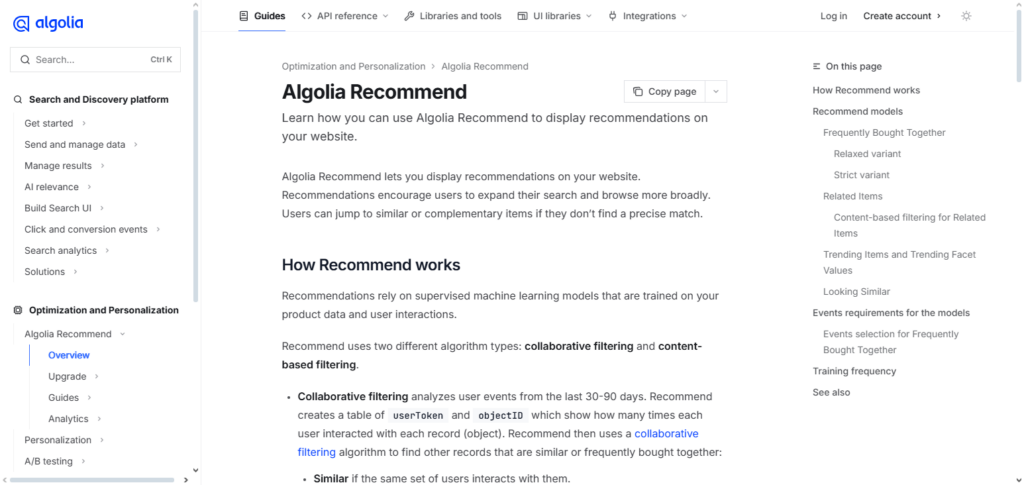
Its distinctive strength is the way it combines AI-driven personalization with robust search engines, enabling companies to instantaneously comprehend user intent and display the best recommendations or results.
Every interaction is customized and timely because to Algolia Recommend’s dynamic adaptation to user behavior, location, and preferences. Scalable and quick, it can manage millions of queries at once, which makes it perfect for businesses looking to increase customer satisfaction, engagement, and conversions through intelligent, tailored discovery.
Algolia Recommend Features, Pros & Cons
Features:
- AI-driven recommendations for products.
- Personalization for search and discovery.
- Targeting based on a user’s engagement behavior and search context.
- Recommendations analytics in real-time.
- Supports e-commerce platforms and CMS.
Pros:
- Great search and recommend functions.
- Engagement increases with recommendations based on real-time data.
- Online stores can integrate the tool seamlessly.
- It is scalable to many items.
- It can be set up quickly and it works efficiently.
Cons:
- There’s not a lot of content personalization.
- The cost might be high with larger inventories.
- There is a lack of email and multichannel personalization.
- It could be required to customize features for Advanced AI.
- There is a steep learning curve when it comes to full utilization.
8. Kibo Personalization
Because it integrates content, commerce, and AI-driven suggestions into a single platform, Kibo Personalization is a top AI tool for website personalization at scale. Personalized product recommendations, dynamic content, and targeted advertising are made possible by its capacity to provide fully contextual experiences through the analysis of both historical and real-time user activity.
Businesses can handle large traffic volumes while preserving accurate personalization across web, mobile, and email channels thanks to Kibo’s scalable design. Kibo guarantees ongoing optimization through sophisticated segmentation, testing, and analytics, assisting companies in boosting customer loyalty, engagement, and conversion rates through intelligent, data-driven customisation at scale.
Kibo Personalization Features, Pros & Cons
Features:
- Both product and content personalization is based on AI.
- It uses user behavior for targeting.
- Tools for A/B tested optimization.
- Audience targeting as well as segmentation.
- It is integrated with e-commerce platforms and CRM.
Pros:
- Personalization for e-commerce is adaptable.
- There are recommendations in real-time.
- Supports enterprise site scalability.
- Strong marketing tools.
- Integration of powerful tools for marketing is available.
Cons:
- It can be expensive for smaller companies.
- May need extra time to implement.
- Requires an established database to achieve desired experiences.
- Specialized engineering would be needed for more advanced personalization.
- Some limitations for custom reporting.
9. Insider
Because it allows for seamless cross-channel personalization—combining web, mobile, email, and push notifications into a single, cohesive experience—Insider is a potent AI tool for website personalization at scale.
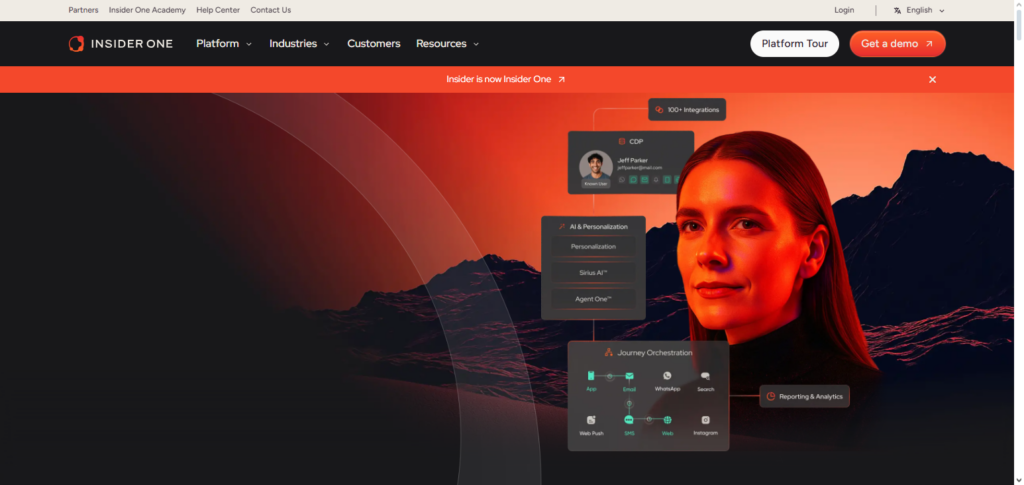
Its AI-driven predictive segmentation, which foresees user behavior and provides highly relevant content, product recommendations, and offers in real time, is its distinctive strength. Additionally, Insider’s platform enables automated optimization and dynamic A/B testing, enabling companies to continuously improve their customization tactics.
Insider helps businesses increase conversions, retention, and long-term loyalty while effectively scaling personalization across millions of users by offering comprehensive insights into customer journeys and enabling bespoke engagement at every touchpoint.
Insider Features, Pros & Cons
Features:
- Personalization of websites and apps through artificial intelligence
- Targeting and segmentation of behaviors.
- Individualization across multiple channels like web, mobile, and email.
- Self-guided A/B tests with automated optimization.
- Instant messaging and recommendations.
Pros:
- Personalization across multiple channels is advanced.
- Engagement levels rise due to recommendations made with AI in real time.
- Marketers can easily navigate the interface.
- Solid tools available for reporting and analytics.
- Aided in personalized journeys across multiple touchpoints.
Cons:
- More expensive when compared to other options for mid-sized companies.
- New users tend to take time to get accustomed to the advanced features of AI.
- Managed data for optimized personalization is needed.
- Specialized engineering would be needed for more advanced personalization.
- Certain features only available in enterprise-tier subscriptions.
10. Nosto
Specifically created for e-commerce companies looking to provide customized purchasing experiences, Nosto is a top AI platform for website personalization at scale. Its distinctive strength is its ability to give personalized product recommendations, content, pop-ups, and prompted emails by fusing real-time behavioral data with sophisticated machine learning.
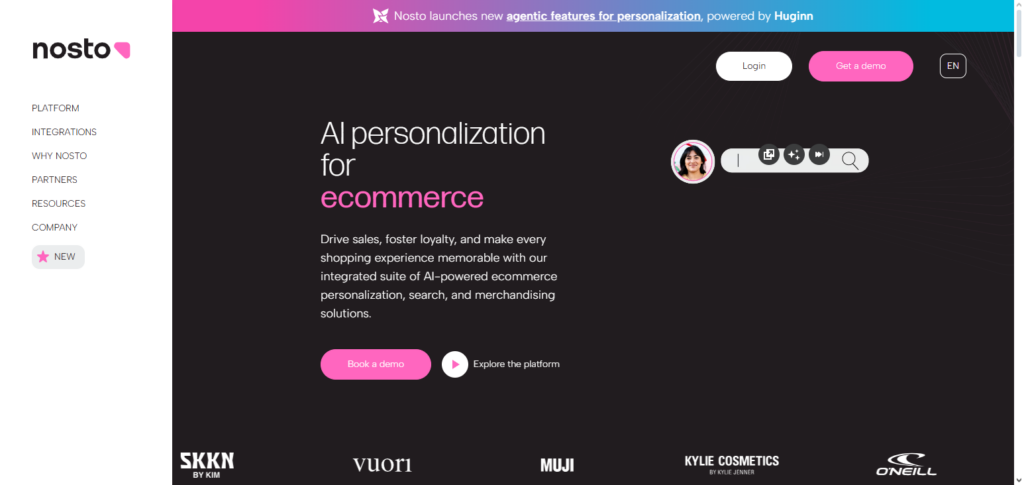
Retailers can dynamically segment audiences and immediately modify experiences using Nosto, guaranteeing that every visitor receives pertinent offers based on their preferences and intent.
Through intelligent, data-driven personalization across all digital touchpoints, Nosto’s scalable architecture, user-friendly interface, and strong analytics enable organizations to effectively optimize customer journeys, boost conversions, raise average order value, and cultivate long-term loyalty.
Nosto Features, Pros & Cons
Features:
- Personalization for e-commerce based on AI technologies
- Product recommendations based on behaviors and context.
- Campaigns deployed with pop ups, banners, and messaging.
- Tools available for A/B testing and optimization.
- Integrates with major e-commerce solutions like Shopify and Magento.
Pros:
- Streamlined processes allow for effective integration on e-commerce sites.
- Personalization in real time improves the likelihood of a purchase.
- Budget friendly for small and mid-sized enterprises.
- Grows easily in multiple product lines and categories.
- Reporting and analytics capabilities are above average.
Cons:
- Other than product recommendations, content personalization options are minimal.
- Other advanced AI capabilities could potentially require additional tier upgrades.
- Personalization options across several channels are more limited.
- Some integrations require more technical setups.
- Might not work well for enterprise-grade needs.
Conclusion
In conclusion, companies are able to provide highly relevant, real-time experiences that are customized for each individual user thanks to the best AI tools for website personalization at scale, including Dynamic Yield, Monetate, Evergage (Salesforce Interaction Studio), Qubit, Segment (Twilio), Personyze, Algolia Recommend, Kibo Personalization, Insider, and Nosto.
To maximize engagement, conversions, and customer loyalty across many channels, each platform makes use of cutting-edge machine learning, behavioral data, and predictive analytics.
These technologies are essential for companies looking to remain competitive in today’s customer-centric environment because they enable scalable personalization, robust testing, and data-driven insights. They also assist firms in creating meaningful digital interactions that dynamically adjust to user behavior.
FAQ
What is website personalization at scale?
Website personalization at scale refers to using AI and data-driven tools to deliver tailored content, recommendations, and experiences to each user in real time, even across millions of visitors.
Why are AI tools important for personalization?
AI tools analyze user behavior, preferences, and intent, enabling dynamic and predictive personalization that increases engagement, conversions, and customer loyalty.
Which are the top AI tools for website personalization?
Top tools include Dynamic Yield, Monetate, Evergage (Salesforce Interaction Studio), Qubit, Segment (Twilio), Personyze, Algolia Recommend, Kibo Personalization, Insider, and Nosto.
How do these tools differ?
Each tool has unique strengths—some focus on e-commerce recommendations (Nosto, Algolia), others on real-time behavioral targeting (Evergage, Personyze), or unified data management (Segment, Kibo).
Can small businesses benefit from these tools?
Yes, many tools are scalable and provide features suitable for small to large enterprises, helping businesses deliver personalized experiences without heavy IT resources.