




The Best AI Tools for Process Automation will be covered in this article, with a focus on platforms that assist companies in streamlining processes, cutting down on manual labor, and increasing productivity.
These solutions are crucial for businesses trying to increase productivity and scale operations successfully because they use AI to automate tedious activities, offer insightful analysis, and effortlessly interact with other apps.
Why Use AI Tools for Process Automation
Increasing Your Operational Efficiency: The value of AI tools is that they allow for the completion of repetitive tasks and assist in the running of smoother processes without the involvement of a user. This is a significant boost to productivity for every department.
Minimizing Human Error: With the automation of processes involving AI and the automation of their own rules and predictions, the chance for human error in a system is greatly reduced and the final result of a workflow is always consistent.
Improving Your Decision-Making: AI tools can produce real-time insights by sifting through large quantities of data and this can lead to making decisions in a business more quickly and of higher quality.
Increasing Scalability: Automation platforms powered by artificial intelligence possess the ability to further increase their productivity the more a business expands and can even go so far as to adjust to the amount of work that needs to be completed without the need for more employees.
Saving Time and Money: The automation of processes can result in the reduction of costs to acquire labor, the reduction of the time spent operationally, and the reduction of the time spent in the will result in a bottom-line ROI for the company.
Providing Real-Time Visibility: Users of the AI tools are equipped with dashboards, alerts, and analytics tools that give them visibility into how their work is performing and where the bottlenecks are.
Improving Customer Experience: The increased processing speed, the greater accuracy of execution and intelligent response to problems can improve the quality of the service and, therefore, satisfaction of customers.
Automation Without Code: Some AI tools allow users to design their own automation processes with minimal input from IT departments.
Key Point & Best AI Tools for Process Automation List
| AI Workflow Tool | Key Points |
|---|---|
| Pipefy AI Workflow | No-code automation platform; AI-powered task suggestions; process tracking; integration with apps; scalable for teams. |
| Kissflow AI Workflow | End-to-end workflow automation; AI-based approvals & insights; low-code; real-time reporting; multi-platform integrations. |
| Nintex Automation Cloud | Cloud-based workflow automation; AI-driven document processing; analytics & reporting; drag-and-drop designer; enterprise-ready. |
| IBM Watson Orchestrate | AI assistant for workflows; automates tasks across apps; AI suggestions; natural language commands; integrates with IBM ecosystem. |
| AWS Step Functions + Bedrock AI | Serverless orchestration of workflows; integrates generative AI models via Bedrock; scalable; event-driven automation; multi-service orchestration. |
| Google Cloud Workflows + Duet AI | Orchestrates cloud services; AI-assisted workflow design; automation across Google Cloud apps; real-time monitoring; secure execution. |
| Workato AI | Intelligent automation platform; AI-based workflow recommendations; connects 1000+ apps; low-code/no-code; analytics & process optimization. |
| Zapier AI | Easy automation for apps; AI-powered task suggestions; no coding required; multi-step workflows; user-friendly interface. |
| UiPath AI Center | Combines RPA & AI; deploy & manage AI models in automation; predictive analytics; integrates with UiPath Studio; scalable for enterprises. |
| Tallyfy AI Workflow | Workflow automation & process management; AI insights; no-code workflow builder; real-time tracking; collaboration-focused. |
1. Pipefy AI Workflow
The center for process automation also includes the best AI tools for process automation for simplicity and versatility. Pipefy AI Workflows offer no-code automation solutions for the entire breadth of an organization.

By providing AI driven Workflow Automation and intelligent Productivity operational boosts via the routing of real-time task recommendation and routing process.
Pipefy not only tailors its offerings to lower operational barriers through no-code automation, but also tallies seamless integration to third party applications to facilitate an unencumbered flow of data to and across isolated operational silos. Among the best AI tools for process automation, Pipefy ranks high for its seamless integration, automation.
Pipefy AI Workflow Features, Pros & Cons
Features
- No-code addition of workflows
- • Suggested tasks by AI
- • Automation of custom pieces
- • Business app integrations
- • Tracking of processes in real time
Pros
- Users don’t have to be tech savvy
- Systems are easy to manage
- Ecosystem of integrations is valuable
- AI boosts suggestions for process efficiency
- Is applicable for teams of all sizes
Cons
- More advanced features are lacking
- For big teams, it can be pricey
- Reports need added upgrades
- Complex pieces have a tough learning curve
- Less online support is available
2. Kissflow AI Workflow
Kissflow AI Workflow is one of the most fully featured low-code solutions for complete end-to-end process automation. It includes features like intelligent insights automation for task prioritization, approvals, process optimization, and real-time actionable analytics. Built on a user-friendly drag-and-drop interface, it allows both technical and non-technical users to construct workflows in minutes.
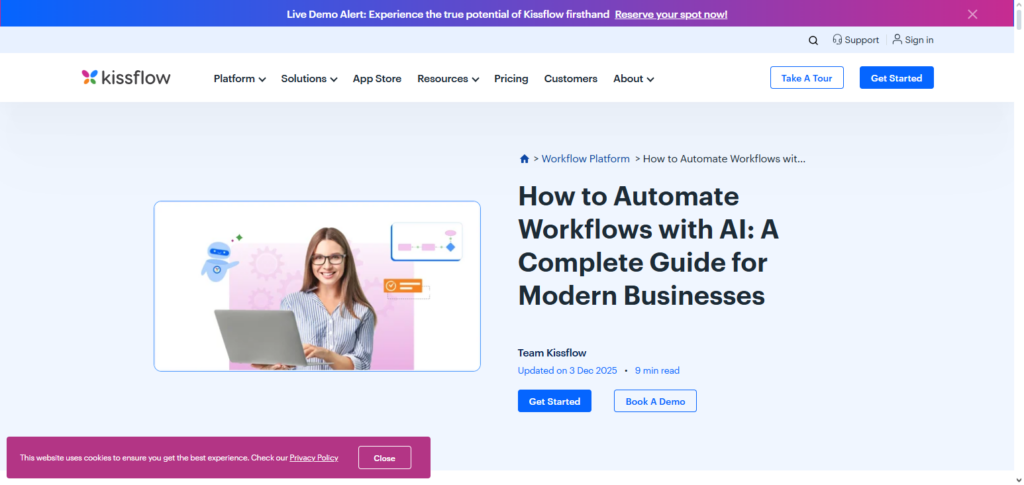
It is recognized as one of the Best AI Tools for Process Automation and is especially beneficial for organizations that require the collaboration of multiple teams along with AI-powered workflows, as it fully supports structured and adaptive workflows across multiple teams as well as agile process automation.
Kissflow AI Workflow Features, Pros & Cons
Features
- Editor with low-code
- • Automation of approvals using AI
- • Design of roles for access control
- • Dash boards and analytic’s
- • Multi-connection of apps
Pros
- Rapid set up of workflows
- AI supports in deciding order of tasks
- Excellent for processes that span multiple departments
- Business and IT users are equally supported
- Insights into processes are in real time
Cons
- Fewer advanced connections are available
- UI is difficult to use
- Less AI models that are prebuilt.
- Higher usage leads to higher costs
- On the lower of the pricing tiers, there are more limits to customization
3. Nintex Automation Cloud
Nintex Automation Cloud includes one of the most advanced cloud platforms for the automation of intricate business workflows. Process automation in business documents, advanced AI for automation of business documents, and workflow suggestions with predictive analytics are some of the features incorporated in the platform.
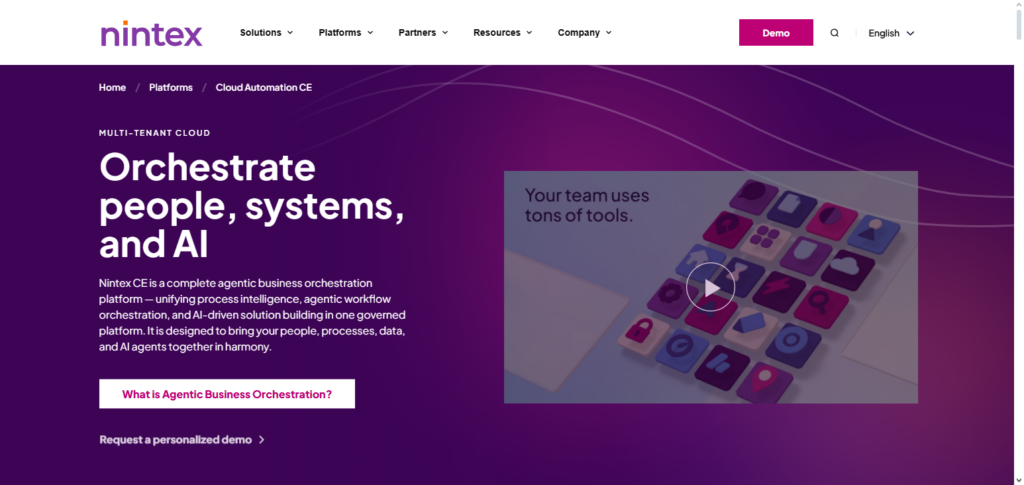
All users can construct workflows with the visual drag-and-drop method and are able to connect with multiple enterprise applications.
There is a high level of automation for approvals, content management, data capture, and the reduction of manual tasks. Due to its scalability, enterprise-level security, and strong analytics, it is one of the Best AI Tools for Process Automation and most suited for larger organizations requiring efficient digitization and optimization of operational workflows.
Nintex Automation Cloud Features, Pros & Cons
Features
- Workflow engine on the cloud
- • Processing of AI documents
- • Designer drop-and-drag
- • Reporting & analytics• Extensive connectors
Pros
- Good enterprise readiness.
- Good document automation.
- Good reporting capabilities.
- Good connector library.
- Good governance and security.
Cons
- Can be complex to configure.
- Can be too expensive for small teams.
- Takes time to learn for advanced use
- UI sometimes too cluttered.
- Not very intuitive.
4. IBM Watson Orchestrate
IBM Watson Orchestrate is one of the first intelligent virtual assistants, designed to automate repetitive activities and manage workflows across multiple systems. With the power of NLU, Orchestrate understands user requests and performs workflows. Employee onboarding, scheduling, and approval tasks can be automated, eliminating the manual effort.
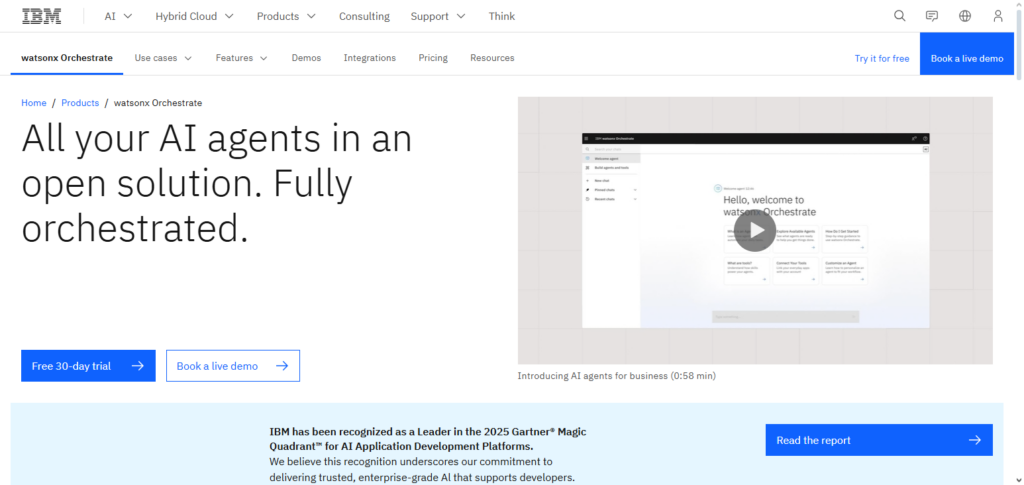
Watson Orchestrate is recognized as one of the Best AI Tools for Process Automation. It is intelligent, contextual, and focused, offering seamless automation throughout the IBM ecosystem and third-party applications, allowing organizations to boost productivity, lower costs, and improve operational efficiency across the board.
IBM Watson Orchestrate Features, Pros & Cons
Features
- Use regular english to make commands
- • Can automate tasks across multiple apps
- • Make ai suggest tasks
- • Can take actions based on context
- • IBM tools integration
Pros
- Good ai driven workflows.
- Good automation by just using language.
- Good for big companies.
- Good for eliminating repetitive work.
- Good for breaking down tasks and managing.
Cons
- Best when used with IBM tools.
- Can take time to learn.
- Price can be too high.
- Need experts for custom features.
- Need tech experts to use some functions.
5. AWS Step Functions + Bedrock AI
AWS Step Functions combined with Bedrock AI provides users with the opportunity to integrate generative AI models and orchestrate serverless workflow automation. Bedrock AI is event-driven automation, as it allows users to build workflows and automate processes based on predetermined system events.
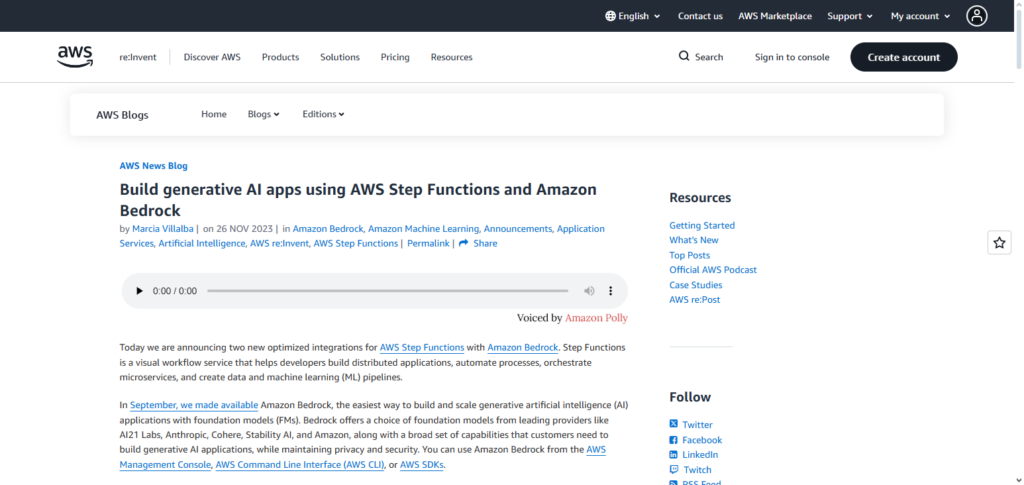
Bedrock AI grants users access to foundational models to help with tasks such as predictive analytics, document processing, and data extraction. As one of the Best AI Tools for Process Automation, it is a good choice for large-scale enterprises looking for seamless AI integrations with sophisticated workflow automation on AWS.
AWS Step Functions + Bedrock AI Features, Pros & Cons
Features
- Can manage workflows without a server.
- • Can automate tasks in response to certain events.
- • Can integrate with Bedrock AI.
- • Can execute on a large scale.
- • Can monitor and log tasks.
Pros
- Can scale very well.
- Can integrate well with AWS tools.
- Can use foundation AI models.
- Can manage complex tasks.
- Only pay for what you use.
Cons
- Need to know how to use AWS.
- Not good for people without tech experience.
- Need to know how to use AWS.
- Debugging can also be difficult.
- There is no simple UI design.
6. Google Cloud Workflows + Duet AI
Duet AI with Google Cloud Workflows helps users automate and streamline workflows across Google Cloud services. This means that users get AI-supported workflow construction, the ability to manage and monitor the execution of multi-step workflows, and the ability to manage and monitor the execution of workflows in real-time.
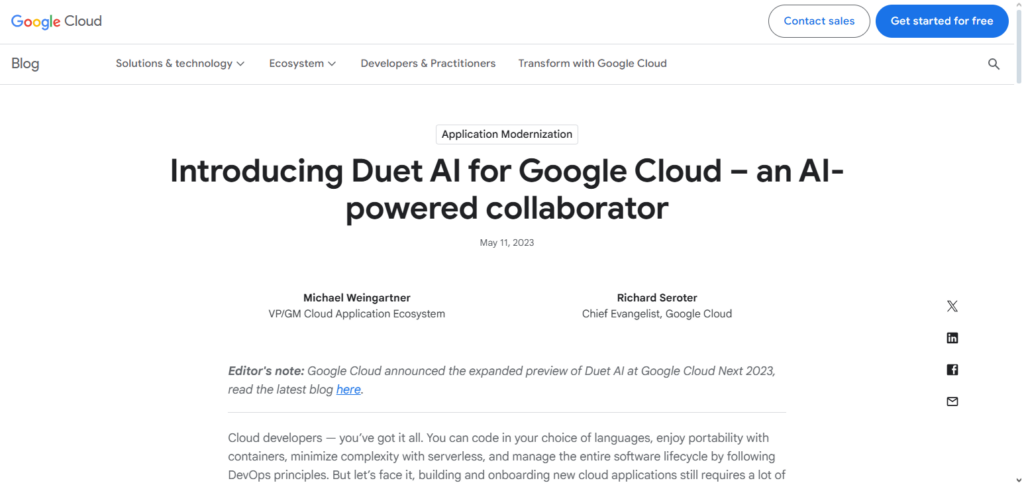
To help users improve efficiency and reduce mistakes, Duet AI provides contextual user support. This combined suite of tools is a good fit for organizations with significant investment in Google Cloud, due to its compliance, flexibility, and intelligent embedded automation and AI tools.
Out of the tools in the category of Best AI Tools for Process Automation, this combination is the best for facilitating automation of business processes and embedding intelligent automation and AI processes into everyday workflows.
Google Cloud Workflows + Duet AI Features, Pros & Cons
Features
- provisioned workflows
- • AI-assisted design
- • Execution logs
- • Google Cloud paired
- • Security and IAM
Pros
- AI shaping
- Google fits nicely
- Cloud scoping
- Enterprise Security
- Fine cross service pant automation
Cons
- Google Cloud is mandatory
- Bridless 3rd party
- Not cheap
- Services lack finesse.
- AI still needs its Duet.
7. Workato AI
Workato AI is a seamless automation platform that intelligently integrates applications, data, and workflows. Automation of processes, AI-powered workflow suggestions, and predictive analytics are provided across a variety of applications. Users get the automation they need for the best workflows across thousands of apps.
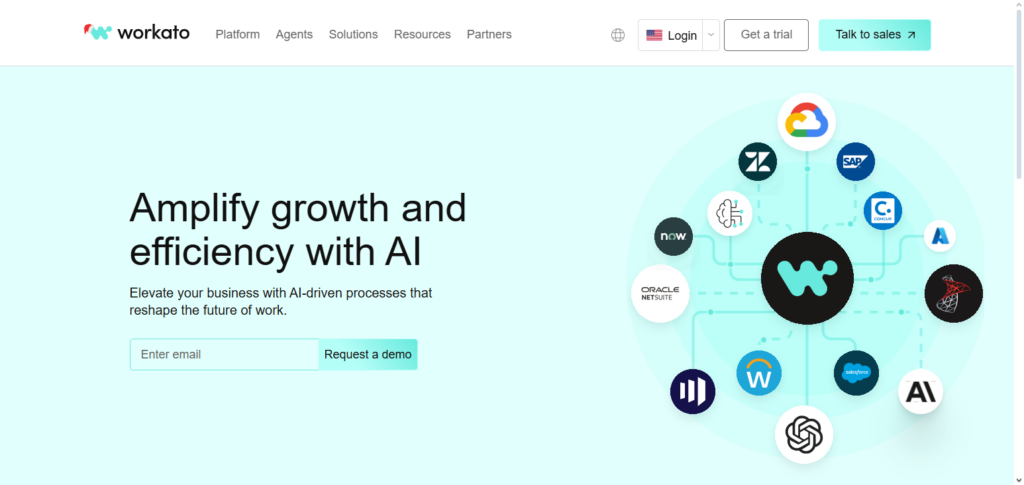
Workato AI has been recognized as one of the Best AI Tools for Process Automation, helping organizations achieve better automation, a reduction of manual processes, enhanced collaboration, and improved real-time visibility. This solution provides the ability for organizations to increase the level of automation in processes with minimal IT support.
Workato AI Features, Pros & Cons
Features
- Intelligent platform for automation
- • Suggestions for AI driven workflows
- • Marketplace for Connectors
- • Interfaces for low code
- • Dashboards with analytics
Pros
- Great support for integrations
- Workflows are optimized with AI
- Common tasks can be setup quickly
- Collaboration features are great
- Flexible logic with automation
Cons
- Costs rise with scaling
- Advanced features are need to be trained on
- Limited support when offline
- Some custom setups are required for connectors
- Complex runs can lag in the system.
8. Zapier AI
Zapier AI is an award-winning, no-code automation tool that allows users to quickly build workflows across different applications. It provides suggestions for tasks and optimizes actions to avoid performing repetitive tasks, saving time, and lowering mistakes. With features such as conditional logic, multi-step automation, and real-time monitoring, automation workflows can be kept fresh.
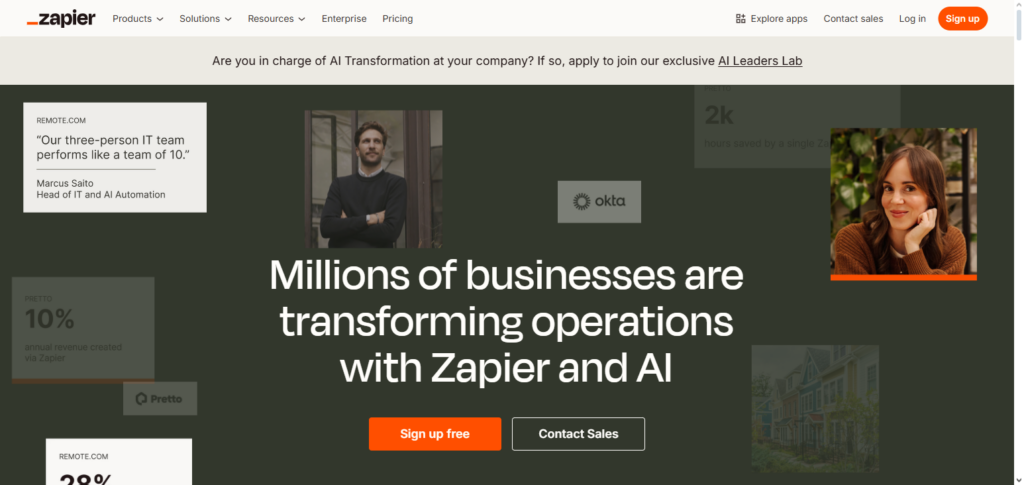
Among the Best AI Tools for Process Automation, Zapier is recognized for its flexibility, especially for small and medium businesses. It offers simple automation that can address complex issues so that teams can concentrate on higher-level activities rather than performing repetitive tasks.
Zapier AI Features, Pros & Cons
Features
- automation without code.
- • suggestions for AI driven tasks
- • “Zaps” of multiple steps
- • Actions and triggers of apps.
- • Logic of conditions.
Pros
- Extremely simple to use
- An ecosystem of large apps.
- Fast configurations for easy tasks
- Budget-friendly starting tier
- AI helps with building workflows
Cons
- Unsuitable for complicated enterprise processes
- Superficial native AI functionality
- Action limitations on plans
- Simple analytics features
- AI features are still developing
9. UiPath AI Center
UiPath AI Center is the first tool that provides an RPA (robotic process automation) + AI hybrid model. It allows organizations to automate workflows embedded with model deployment and AI automation. It offers predictive analytics, document understanding, and smart choices.

Model training, bot integration, and enterprise-wide automation scaling are available to users. Among the Best AI Tools for Process Automation, UiPath AI Center is the peak of bridging the gap for automation for AI, thus reducing the need for human interaction and increasing the complexity of processes, be it in the financial or healthcare sector, to name a few.—
UiPath AI Center Features, Pros & Cons
Features
- AI + RPA
- • Advanced analytics
- • Document comprehension
- • Deployment of models
- • Management centralized
Pros
- The best of AI & automation
- Excellent for enterprise RPA
- Deployment of models with scalability
- Excellent analytics
- Great for complex processes
Cons
- Difficult for beginners
- Needs tech people
- Expensive to implement
- Takes time to set up infrastructure
- Requires a full-time administrator
10. Tallyfy AI Workflow
Tallyfy AI Workflow is an example of AI, automation, and tracking in a process management system. It offers features like no-code workflow automation, real-time progress tracking, and AI suggestions to optimize workflow.
Teams facilitate collaboration, eliminate bottlenecks, and achieve maximum efficiency with automation. With the ability to improve operational transparency and consistent workflow, as well as AI-driven productivity enhancement across departments, Tallyfy is recognized as one of the Best AI Tools for Process Automation.
Tallyfy AI Workflow Features, Pros & Cons
Features
- Workflow builder with no coding required
- • Tracking of processes in real-time
- • Recommendations from AI
- • Library of templates
- • Tools for collaboration
Pros
- Workflows that are easy and visual
- Excellent for internal operations
- AI improves efficiencies
- Excellent team collaboration
- Audit logs that are transparent
Cons
- Not as robust as enterprise solutions
- Limited third-party integrations
- Limited AI models
- Fewer customization options
Conclusion
Using AI for process automation has become crucial in today’s hectic business climate to increase productivity, lower error rates, and speed up decision-making.
Diverse solutions catered to various organizational demands are offered by tools such as Pipefy, Kissflow, Nintex, IBM Watson Orchestrate, AWS Step Functions with Bedrock AI, Google Cloud Workflows with Duet AI, Workato, Zapier, UiPath AI Center, and Tallyfy.
These platforms, which are regarded as the Best AI Tools for Process Automation, integrate AI-driven insights, intelligent workflow management, and smooth integrations to enable teams to concentrate on strategic work rather than tedious activities. Scalable, effective, and future-ready operations are ensured by selecting the appropriate tool.
FAQ
What are AI tools for process automation?
AI tools for process automation are software platforms that use artificial intelligence to streamline repetitive tasks, optimize workflows, and improve operational efficiency. They combine automation, AI insights, and integrations to reduce manual effort and enhance productivity across teams.
Why should businesses use AI workflow tools?
Businesses use AI workflow tools to save time, reduce errors, gain real-time insights, and scale operations efficiently. These tools improve decision-making and allow employees to focus on strategic, high-value work rather than routine tasks.
Which are the best AI tools for process automation?
Some of the top AI tools for process automation include Pipefy AI Workflow, Kissflow AI Workflow, Nintex Automation Cloud, IBM Watson Orchestrate, AWS Step Functions with Bedrock AI, Google Cloud Workflows with Duet AI, Workato AI, Zapier AI, UiPath AI Center, and Tallyfy AI Workflow.
Can non-technical users use AI workflow tools?
Yes. Many platforms like Pipefy, Kissflow, Zapier, and Tallyfy offer no-code or low-code interfaces, making it easy for non-technical users to design, deploy, and manage automated workflows without programming knowledge.