



The Best AI Tools for Pricing Optimization that assist companies in making more intelligent, data-driven pricing decisions will be covered in this post.
These solutions enable dynamic pricing, better margins, and quicker reactions to market changes across retail, eCommerce, and B2B industries by using artificial intelligence and machine learning to evaluate demand, competition, and consumer behavior.
What Are AI Tools for Pricing Optimization?
AI tools for pricing optimization are software programs that use advanced analytics, machine learning, and artificial intelligence to assist companies in determining the best prices for their goods and services. To determine the best price strategies, these technologies examine vast amounts of data, such as past sales, consumer behavior, rival pricing, and market trends.
They allow businesses to dynamically modify prices, optimize earnings, and maintain their competitiveness by automating intricate computations and forecasting demand elasticity. These platforms, which are among the Best AI Tools for Pricing Optimization, enable retailers, eCommerce organizations, and B2B businesses to make more informed, quicker, and data-driven pricing decisions.
Benefits of Using AI Tools for Pricing Optimization
Increased Revenue and Profit Margins – AI takes into consideration customer behavior and demand, as well as competitor pricing, to make recommendations as to which prices maximize both sales and profits.
Dynamic and Real-Time Pricing – The ability to modify prices as a function of market conditions (e.g., trends, seasons, and inventory) keeps pricing structures competitive and responsive to demand.
Reduced Manual Effort – AI takes over much of the work involved in calculations and updates, meaning its pricing teams can devote their attention to more value-added activities.
Better Customer Segmentation – Improved pricing strategies can be developed for different customer groups, resulting in better conversion rates and increased customer loyalty.
Data-Driven Decision Making – The business strategies stemming from AI insights and predictive analytics are less prone to errors and more in line with pricing objectives.
Key Point & Best AI Tools for Pricing Optimization List
| Tool Name | Key Point |
|---|---|
| Pricefx | Cloud-native pricing platform offering AI-driven price optimization, configuration, and lifecycle management for complex B2B and B2C pricing models. |
| Revionics (by Aptos) | Retail-focused pricing optimization solution using AI to balance margin, demand, and competitive positioning across categories. |
| BlackCurve | Dynamic pricing software that combines competitor price tracking with profit-driven pricing recommendations for retailers. |
| Competera | Enterprise pricing platform leveraging machine learning to automate pricing decisions based on demand, competition, and elasticity. |
| Zilliant Price IQ | AI-powered B2B pricing intelligence solution focused on deal guidance, price optimization, and sales-driven pricing insights. |
| Omnia Retail | Unified pricing and promotion platform enabling retailers to automate pricing decisions across online and offline channels. |
| Prisync | Competitive price monitoring and dynamic pricing tool designed for eCommerce businesses to track rivals and adjust prices automatically. |
| Quicklizard | Real-time dynamic pricing engine that adjusts prices using AI based on demand signals, competitor data, and business rules. |
| Blue Yonder (JDA) | Advanced pricing and revenue management solution integrating AI forecasting, demand planning, and price optimization at scale. |
| Intelligence Node | AI-driven retail analytics platform delivering pricing, promotion, and competitive intelligence for data-backed pricing decisions. |
1. Pricefx
Pricefx is an integrated, one-stop pricing solution that assists companies in pricing complexity cross all products, channels, and markets. It offers price optimization, price management, CPQ (configure, price, quote), management of rebates and analytics all in one.
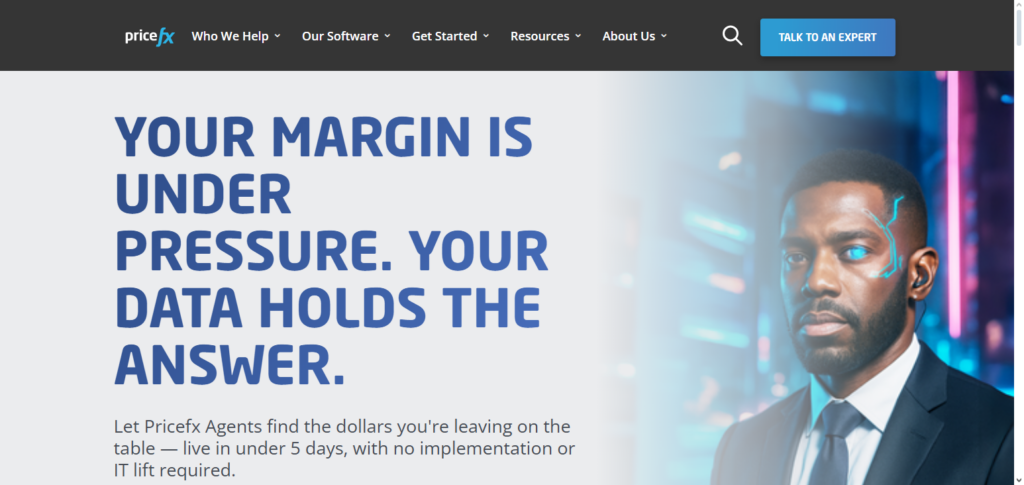
For companies needing end to end solutions, it is no wonder it is amongst the Best AI Tools for Pricing Optimization Pricefx. Its strong machine learning techniques analyze data for demand, competition and costs in real time.
Pricing teams use automation in decisioning while customizing to specific strategies for segments and geographies in their system.
Pricefx Features, Pros & Cons
Features
- Engine for the optimization of prices in the cloud
- Virtual price suggestion coupled with elastic modeling
- Management of discounts and rebates
- Configure, Price, and Quote (CPQ) integration
- Dashboard for real time analytics
Pros
- Scalable for use by large enterprises
- Adaptable to intricate B2B pricing frameworks
- Rapid implementation due to the cloud infrastructure
- Strong integration with ERP and CRM systems
- Superb analytics along with detailed reporting
Cons
- Pricey for smaller companies
- Learning curve more gradual for newbies
- Need configuration assistance for some extra features
- Out of the box retail templates are scarce
- Longer customization for implementation time
2. Revionics (by Aptos)
Revionics, now part of Aptos, is a pricing and promotions platform for retail that manages profit and competitive balance. Using advanced AI, demand forecasting, price optimization, and promotional impact evaluation, Revionics boosts profit and defends volume.

In Best AI Tools for Pricing Optimization Revionics (by Aptos), for real-time recommendations tailored to stock, season, and competitor price, Revionics earns the most trust from retailers.
Revionics pricing automation from rules and optimization models capture the full range of each retailer’s category, from perishables to apparel. Revionics also provides actionable insights and ROI for pricing teams through his reporting.
Revionics (by Aptos) Features, Pros & Cons
Features
- Monitoring of competitive prices
- AI for the optimization of prices and promotions
- Models for demand forecasting
- Assistance with category management
- Optimization of markdowns
Pros
- Predominantly focused on retail
- Insight on pricing promotions is very beneficial
- Built-in competitive benchmarking
- Dashboards with great usability
- Balanced supply-and-demand pricing helps to drive volume
Cons
- Full features with a higher initial price
- Outside retail, the tool is of limited use
- Not suited for basic pricing requirements
- Technical support is sometimes needed for integration
- The models for smaller datsets may not perform very well
3. BlackCurve
BlackCurve is considered a dynamic pricing and competitor intelligence solution for eCommerce and B2B sellers focusing on setting profitable and competitive price points. It analyzes real-time competitor pricing and internal costs and sales data to suggest price changes.
Among the Best AI Tools for Pricing Optimization BlackCurve, it is considered for its simple, rule-based pricing crafted along with machine learning, which adapts to changes in the pricing environment.
BlackCurve gives businesses the control to set margins, price ladders, and repricing intervals, be it for revenue-maximization or market share protection. With its streamlined dashboard, monitoring and execution is easy.
BlackCurve Features, Pros & Cons
Features
- Tracking competitor prices
- Automated dynamic pricing system
- Automated price suggestions
- Dashboard for pricing strategy & margins
- Controls for pricing automation frequency
Pros
- Pricing is budget friendly for smaller businesses
- User friendly & easy to navigate
- Transparent prioritization profit pricing
- Customizable pricing automation
- Easy to set up
Cons
- Less sophisticated AI than higher tier versions
- Does not cater to complex B2B pricing
- Basic visualization
- Minimal demand forecasting
- Does not work well with larger data sets
4. Competera
Competera is an AI pricing solution for demand forecasting, competitor pricing, price elasticity, and pricing decisions in the B2B and retail spaces. It merges competitive pricing and price optimization to maximize profit and conversion.
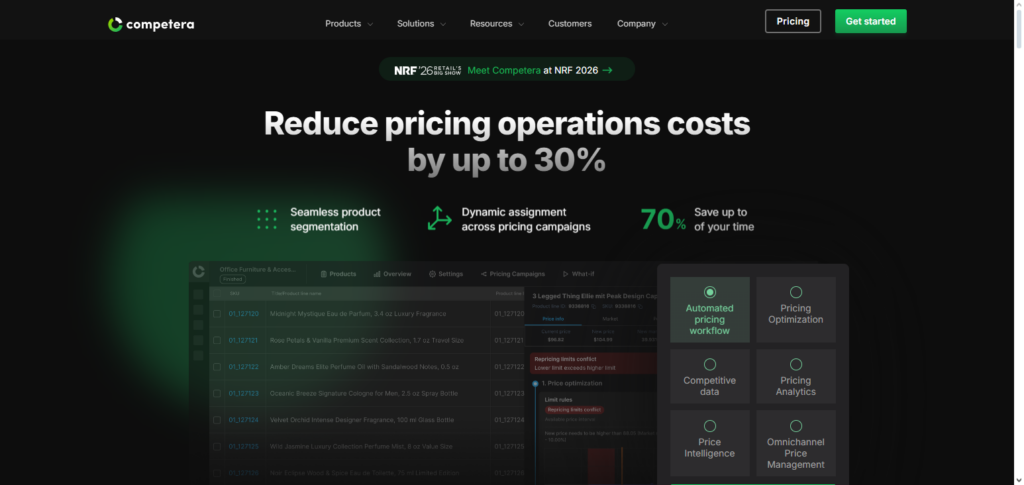
It is recognized as one of the Best AI Tools for Pricing Optimization Competera because it utilizes machine learning to overcome challenges of limited data, demand seasonality, and customer segmentation.
Competera’s offerings include Price Optimization, Competitive Data, and Markdown Optimization, which provide adjustments during every stage of a product’s life. With simulation of scenarios, it offers automated, large-scale execution of strategies alongside its API integration.
Competera Features, Pros & Cons
Features
- Collection of competitive data
- Demand forecasting & elasticity modeling
- Engine for price optimization
- Optimization of markdowns
- Systems integration through an API
Pros
- Solid competitive analytics
- Advanced machine learning
- Works within B2B and Retail
- Great for scenario simulation
- Price predictions are accurate
Cons
- May be expensive for mid-market services
- To utilize data it must be prepared
- Long onboarding process
- Cluttered interface
- Not recommended for small inventories
5. Zilliant Price IQ
Zilliant Price IQ is part of Zilliant’s AI-powered Pricing and Sales Optimization tools, designed for B2B pricing intelligence. It processes transaction data, customer interactions, and states of the marketplace, delivering recommendations for pricing and strategies for customer negotiations.
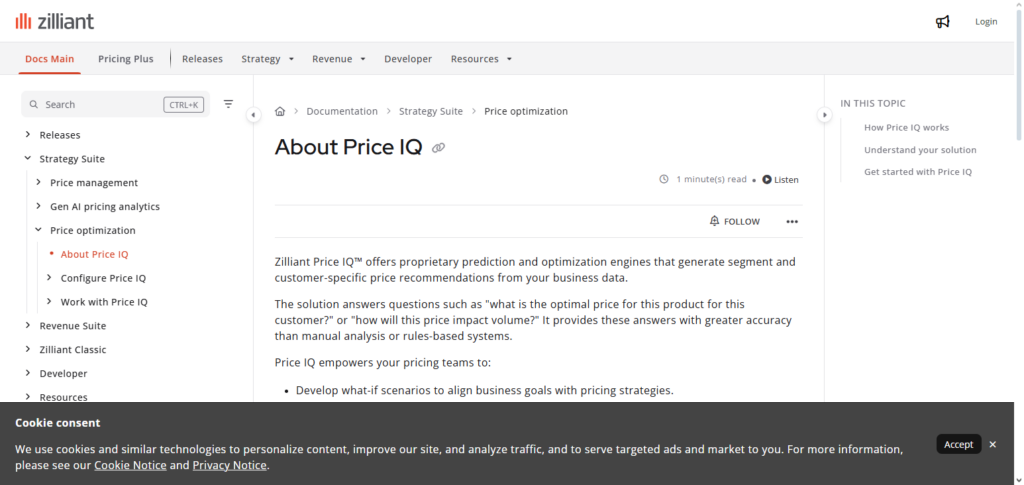
Zilliant Price IQ’s primary achievement in the category of Best AI Tools for Pricing Optimization – Zilliant Price IQ is in providing pricing recommendations that enable the alignment of sales representatives and directed pricing strategies in margin protection.
Zilliant’s Natural Language Processing (NLP) powered insights bring focus to important pricing drivers, customer groups, and profitability factors. His recommendations seamlessly fit into the workflows of users thanks to his integration with CRM and CPQ systems.
Zilliant Price IQ Features, Pros & Cons
Features
- Analytics and price intelligence of B2B
- Recommendations for prices by AI
- Integration of CRM and CPQ
- Guidance for deals to sales teams
- Analytics of price segmentation
Pros
- Effective for complicated B2B pricing
- Accurate guidance at deal levels
- Extensive integration with CRM/CPQ
- Sales margin performance boost
- Strong insights into customer pricing
Cons
- High cost for small businesses
- Requires expertise for integration/ setup
- Optimal performance with sufficient data
- Weaker offering for retail/eCommerce
- Technical interface for non-experts
6. Omnia Retail
Omnia Retail integrates pricing and promotion optimization tools to allow retailers to manage and automate pricing strategies for all channels, both online and offline.
Using competitive insights, demand forecasting, and business rules, it generates optimal prices consistent with internal pricing policies and external market conditions.
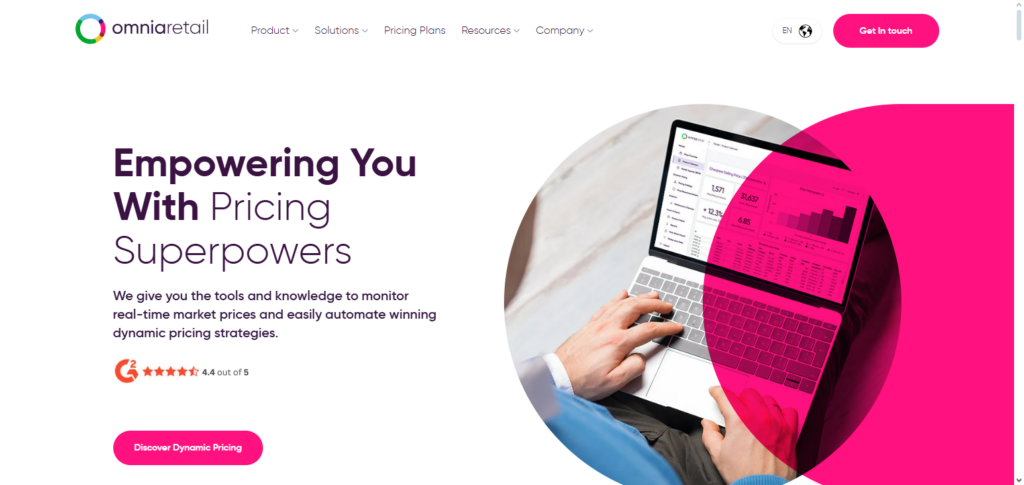
Featured in Best AI Tools for Pricing Optimization Omnia Retail, it stands out for its Rule Engine and Forecasting capabilities for both strategic and tactical pricing.
Omnia Retail’s AI models also ensure that pricing decisions will improve revenue and foot traffic by predicting customer behavior in response to price changes. Its interface promotes collaboration among pricing, category management, and commercial teams.
Omnia Retail Features, Pros & Cons
Features
- Pricing engine driven by business rules
- Monitoring prices of competitors
- Modeling of forecasting & elasticity
- Optimization of promotions
- Pricing per channel
Pros
- Superlative pricing support across channels
- Retail-focused AI models
- Collaboration features are robust
- Dashboards are user-friendly
- Pricing and promotion alignment is good
Cons
- Pricing targeted to smaller shops
- Need for training for advanced features
- Variable effort for integration
- Algorithms for optimizing require effort
- Modular features are add-ons
7. Prisync
Prisync is a price tracking and dynamic pricing software aimed at eCommerce businesses of all sizes. It tracks competitor prices, stock, and historical data, which informs repricing automation strategies.
Among the Best AI Tools for Pricing Optimization Prisync, it is noted for flexible pricing rules that adjust to margin thresholds and target position, as well as clear competitor visibility.
Prisync offers customizable reports and alerts to help pricing managers react to timely changes. Although especially used by small-to-mid-sized online retailers, the scalable architecture of Prisync is designed to help larger businesses with competitive agility.
Prisync Features, Pros & Cons
Features
- Tracking the pricing of competitors
- Automated repricing that is dynamic
- Trends over time with historical pricing
- An engine for margin rules
- Notifications and alerts
Pros
- Affordable for eCommerce business
- Deploying is very simple
- Competitor alerts in real time
- Several channels are supported
- Small and medium enterprises get good returns
Cons
- Basic AI comparisons with other enterprise-grade solutions
- Demand forecasting is limited
- Little to no advanced analytics
- Less useful for B2B Pricing
- Simple visualization
8. Quicklizard
Quicklizard offers a pricing engine that captures real-time data and uses machine learning to evaluate and determine the best price to offer, taking into account competitor activity, demand, and business rules. It can continuously repricing at scale with little manual effort.
It is listed in Best AI Tools for Pricing Optimization Quicklizard for its ability to quickly repricing and for its other robust tools that help in predicting which alternative pricing strategies would result in the best outcome.
Retailers appreciate granular rules to ensure that pricing falls within the company’s pricing policy while also taking advantage of margin or volume opportunities. Quicklizard’s solution is cloud-based, making it ideal for omnichannel operations that need to integrate.—
Quicklizard Features, Pros & Cons
Features
- Cloud-based dashboard
- Scenario simulation
- Demand and competitor signal integration
- Machine learning pricing rules
- Real-time dynamic pricing engine
Pros
- Great for high-volume retailers
- Fast repricing cadence
- Scenario testing for strategy shifts
- Adaptive machine learning algorithms
- Powerful real-time decisioning
Cons
- Best with full automation adoption
- Complex for small firms
- Premium pricing tier
- Robust interface learning curve
- Consistent data feed is required
9. Blue Yonder (JDA)
Blue Yonder (formerly JDA) focuses on revenue management and pricing solutions. Applying artificial intelligence and predictive analytics, they optimize pricing and build demand plans for components and retail supply chain management.
They help users build strategies and make decisions regarding retail and supply chain management. They analyze competitors, promotions, and seasonal changes to suggest price adjustments for increased profitability.

The platform is praised, and strangely enough, it has been noted among the Best AI Tools for Pricing Optimization – Blue Yonder (JDA) because it has significant reach on the demand, markdown, inventory, and planning systems.
They help price (and plans) systems to operationalize fully. They also help test prices, optimize markdowns, and lead users to develop insights around customer price sensitivity.
Blue Yonder (JDA) Features, Pros & Cons
Features
- Omni-channel pricing support
- Integrated supply chain analytics
- Predictive analytics engine
- AI-driven demand forecasting
- Price optimization and markdown tools
Pros
- Deep analytics across pricing and supply chain
- Support for large retailers
- End-to-end pricing strategy support
- High accuracy in demand prediction
- Strong enterprise-grade security
Cons
- Less agile for smaller inventories
- Some modules need separate licenses
- Complex implementation lifecycle
- Expensive for mid-market
- Requires data teams to maximize value
10. Intelligence Node
Intelligence Node offers retail analytics powered by artificial intelligence, providing analytical insights into global market pricing, promotions, and product performance.
Its competitive intelligence suite analyzes millions of SKUs, enabling brands and retailers to price benchmark and recognize revenue. As one of the Best AI Tools for Pricing Optimization Intelligence Node integrates market competition data with internal company sales data to create models of price elasticity and competitive effect.
Intelligence Node’s platform is top of the line when it comes to providing automated decision and plan supporting data. Pricing automation, strategic plans, and data access are improved due to the high quality, granular data provided by the platform.
Pricing teams can track competitor pricing changes, make quick pricing updates, and analyze the results due to the custom pricing strategies and impact analysis provided by the platform.
Intelligence Node Features, Pros & Cons
Features
- AI-powered competitive price data
- Demand modeling and elasticity
- Optimization at the SKU level
- Insights on Market and Competition
- Tailored Alerts and Dashboard Tracking Trends
Pros
- Comprehensive insights on competitors
- Pricing down to the individual SKU
- Quick identification of new trends in the market
- Excellent for retailers operating on a global scale
- Robust visualization of data
Cons
- Smaller retailers may find the expense a bit stretched
- Requires technician for integration
- Analytics results have a steep learning curve
- For smaller portfolios some functionalities are excessive
- Defining your own set of reporting requirements takes time
Conclusion
The finest AI solutions for pricing optimization enable companies to adopt smart, data-driven strategies that optimize profitability and competitiveness, going beyond static pricing models.
Organizations may evaluate demand trends, consumer behavior, and competitor movements in real time with the use of platforms like Pricefx, Revionics, Blue Yonder, and Zilliant Price IQ. These technologies guarantee uniformity across channels, automate pricing choices, and minimize manual labor.
AI pricing solutions enable businesses to improve customer value, maximize profitability, and react swiftly to changes in the market by utilizing machine learning, predictive analytics, and competitive intelligence. Business size, industry emphasis, and price complexity all play a role in selecting the best tool.
FAQ
What are AI pricing optimization tools?
AI pricing optimization tools are software solutions that use artificial intelligence, machine learning, and data analytics to recommend optimal product prices. They analyze internal data (like sales history and inventory) and external signals (such as competitor prices and market trends) to help businesses maximize revenue, margin, and competitiveness.
Why should businesses use AI tools for pricing optimization?
AI tools automate complex pricing decisions, reduce manual guesswork, and adapt to market changes in real time. They improve profitability by identifying pricing opportunities, predicting demand elasticity, and enabling dynamic pricing strategies tailored to customer segments and channels.
Which industries benefit most from AI pricing tools?
AI pricing tools are valuable across retail, eCommerce, B2B sales, manufacturing, travel, and hospitality. Retailers and online sellers benefit from dynamic pricing and competitor tracking, while B2B firms use AI for deal guidance and margin optimization in complex pricing environments.
What features should I look for in pricing optimization software?
Key features include competitive price monitoring, demand forecasting, price elasticity modeling, automated repricing, scenario simulation, integration with ERP/CRM systems, and clear analytics dashboards for actionable insights.
Can AI pricing tools work for small businesses?
Yes. Solutions like Prisync and BlackCurve are accessible for small to mid-sized eCommerce businesses, offering straightforward competitor tracking and dynamic pricing without requiring extensive IT resources.