




This article focuses on the Best AI Tools for Predictive Maintenance Planning. These impressive AI tools monitor equipment to predict failures, and determine the best schedules for maintenance.
Utilizing predictive analytics and data in real time, organizations can make maintenance smarter and more proactive by minimizing downtime, extending the life of the asset, and improving the overall operational efficiency, across various industries.
Criteria for Selecting the Best AI Predictive Maintenance Tools
Data Consolidation Capacity – Ability to link with IoT devices, ERP software, and historical maintenance records for comprehensive correlation.
Forecasting Precision – How well AI and machine learning algorithms are able to predict when pieces of equipment will fail.
Expansion Potential – Ability to retain and manage large datasets and implement across various (multiple) assets, sites, or industrial environments.
Ease of Use – Minimal training is required to use the software; also, the interface is streamlined, and software is easily installable.
Dependable Real-Time Observations and Notifications – Ability to monitor continuously and send alerts before failures occur.
Maintenance Workflow Integration – Automated work order and scheduling systems generated through link to CMMS or ERP systems.
Flexibility – Ability to modify the AI models and analytics for unique use cases regarding the industry, assets, or operational circumstances.
Value for Money – Balance of the software abilities, implementation effort, and expected ROI due to reduced downtime.
Support and Experience from the Developer – Access to assistance dedicated to software implementation and training, along with the introduction of AI.
Enhanced Analytics and Insights – Reports generated that provide maintenance strategies to be modified and maintained based on root cause failures and other issues.
Key Benefits of AI-Based Predictive Maintenance Tools
Reduced Unplanned Downtime – Anticipates failures of equipment and production downtimes before they happen.
Extended Asset Lifespan – Reduces operational wear and maintains equipment longer.
Cost Savings – Saves money due to decreases in maintenance and repair costs caused by emergency maintenance and unplanned part replacements.
Optimized Maintenance Scheduling – Allows maintenance to occur based on the real state of an asset, instead of on an arbitrary time frame.
Improved Operational Efficiency – Reduces operational costs via increased production through monitoring of equipment and keeping it operational.
Enhanced Safety – Faults are detected early so equipment failures do not result in accidents.
Data-Driven Insights – Produces actionable information for informed decision-making and process improvement.
Resource Optimization – Saves access use of maintenance tools and spare parts.
Scalability – Works across multiple assets and facilities, keeping pace with expanding industrial operations.
Predictive Analytics Advantage – More reliable because patterns and anomalies are captured, which are often missed by humans.
Key Point & Best AI Tools for Predictive Maintenance Planning List
| Tool | Key Points |
|---|---|
| Siemens MindSphere | Industrial IoT platform that connects machines and sensors to analyze equipment health, enable predictive maintenance, and optimize asset performance using real-time data. |
| GE Predix | Cloud-based industrial analytics platform focused on asset monitoring, anomaly detection, and predictive insights for heavy industries like energy and manufacturing. |
| SAP Predictive Maintenance and Service | Integrates IoT data with SAP ERP to predict equipment failures, automate maintenance scheduling, and reduce downtime across enterprise operations. |
| PTC ThingWorx | IoT and AR-enabled platform offering real-time monitoring, predictive analytics, and digital twins to improve equipment reliability and maintenance efficiency. |
| Uptake | AI-driven predictive analytics solution that uses machine learning to forecast failures, optimize maintenance plans, and improve asset productivity. |
| C3 AI Predictive Maintenance | Enterprise AI platform delivering advanced machine learning models to detect failures early, optimize maintenance strategies, and reduce operational risk. |
| SparkCognition | Deep learning–based predictive maintenance solution focused on failure prediction, anomaly detection, and root cause analysis for industrial assets. |
| Augury | AI-powered machine health and diagnostics platform using vibration and acoustic sensors to detect mechanical issues and prevent unplanned downtime. |
| Senseye Predictive Maintenance | Autonomous predictive maintenance software that applies machine learning to asset data for early fault detection and maintenance prioritization. |
| Ezo CMMS | Cloud-based computerized maintenance management system (CMMS) that supports preventive and predictive maintenance with asset tracking and work order automation. |
1. Siemens MindSphere
Because Siemens MindSphere directly integrates industrial assets, sensors, and machines into a single intelligent IoT environment, it stands out as one of the greatest AI tools for predictive maintenance planning. In order to anticipate equipment problems before they happen, its sophisticated analytics and artificial intelligence models continuously examine operational data from the past and present.

MindSphere’s extensive integration with Siemens industrial hardware and digital twin capabilities, which enable businesses to accurately plan maintenance and simulate asset behavior, are what set it apart. In complicated industrial settings, this leads to decreased unscheduled downtime, improved maintenance schedules, and increased equipment efficiency overall.
Siemens MindSphere Features, Pros & Cons
Features
- Platform for industrial IoT with connected assets.
- Data collection and analytics in real-time.
- Employs AI and machine learning for predictive maintenance.
- Simulations of digital twins for assets.
- Scalability on the cloud in multiple sites.
Pros
- Integrates well with Siemens hardware.
- Complex assets have predictive analytics with greater accuracy.
- Unplanned downtimes are reduced tremendously.
- Industrial operations are of larger scale.
- Fully asset management.
Cons
- Initial costs for implementation is high.
- Set up requires specialized knowledge.
- While more complex, larger teams tend to be overwhelmed.
- In order to use the features, complete dependency on Siemens is required.
- Some customization will be required when integrating with Siemens non-compatible systems.
2. GE Predix
Because GE Predix was specifically designed to manage complex industrial assets at scale, it is regarded as one of the best AI solutions for predictive maintenance planning. The technology employs asset-centric analytics and sophisticated machine learning to track equipment performance, identify early anomalies, and accurately predict possible failures.
Combining operational technology data with AI-driven insights specific to heavy industries like manufacturing, energy, and aviation is its particular strength. GE Predix helps businesses decrease unplanned malfunctions, increase asset longevity, and more strategically and economically schedule maintenance tasks by transforming unprocessed sensor data into practical maintenance advice.
GE Predix Features, Pros & Cons
Features
- An analytics platform for the industrial cloud.
- Continuous surveillance and detection of aberrations.
- Predictive failers forecast using AI.
- Asset-centric models for heavy industry.
- Integration with industrial internet of things devices.
Pros
- Predix is designed for the manufacturing sector, aviation, and energy.
- Predix has excellent AI capabilities to offer predictive analytics.
- Predix can be implemented on many different assets and locations.
- Costs related to emergency maintenance are reduced.
- Predix offers operational reporting and dashboards.
Cons
- Predix is expensive to subscribe to and to deploy.
- Predix has integration challenges with current ERP systems, and CMMS systems.
- Analytic requirements may necessitate technical skill.
- Very large installations will likely face longer deployment periods.
- Smaller industries may face unavailability of basic default features.
3. SAP Predictive Maintenance and Service
Because SAP Predictive Maintenance and Service effortlessly integrates IoT-driven equipment insights with essential business processes, it is regarded as one of the best AI tools for predictive maintenance planning. In order to anticipate failures before they interfere with operations, the platform uses machine learning to examine sensor data, usage trends, and past maintenance records.
Deep connection with SAP ERP and asset management systems, which enables automated maintenance planning, work order preparation, and real-time parts availability checks, is its primary distinction. In large-scale industrial settings, this end-to-end insight helps businesses transition from reactive to predictive maintenance, lower downtime, manage expenses, and boost service effectiveness.
SAP Predictive Maintenance and Service Features, Pros & Cons
Features:
- Combines IoT with SAP ERP systems.
- Employs AI to predict failures.
- Maintenance scheduling automation.
- Order and inventory control.
- Enterprise assets are stream monitored.
Pros:
- Integration with SAP ecosystem is seamless.
- Boosts efficiency in enterprise maintenance.
- Decreased operational costs and downtime.
- Planning is enhanced by informed decision making.
- Industrial operations at scale.
Cons:
- Limited outside ecosystem; optimal for SAP users.
- High complexity in implementation.
- Maintenance analytics involves trained personnel.
- Smaller and mid-sized businesses may find it costly.
- Lengthy for customization.
4. PTC ThingWorx
PTC ThingWorx integrates digital twin technologies, analytics, and industrial IoT data on a single platform, making it one of the top AI solutions for predictive maintenance planning. Using real-time sensor data, it continuously analyzes the state of the equipment and uses machine learning to spot trends that can indicate impending breakdowns.

ThingWorx is special because of its robust integration with connected product lifecycle data and augmented reality, which enables maintenance teams to see problems and take quicker action. PTC ThingWorx helps businesses reduce downtime, increase asset reliability, and plan maintenance with more precision and confidence by converting raw machine data into predictive insights and actionable maintenance plans.
PTC ThingWorx Features, Pros & Cons
Features:
- Augmented reality and IoT-enabled.
- Monitors connected assets in real-time.
- Includes machine learning predictive analytics.
- Equipment with digital twin.
- Interfaces with enterprise systems and dashboards.
Pros:
- Unique pairing of predictive maintenance with AR.
- Robust assistance to industrial IoT.
- Accelerates response of maintenance teams.
- Useful for many different industries.
- Dashboards provides real-time decision making.
Cons:
- Slow onboarding process previously reported by non-technical users.
- Smaller companies have to deal with increased expenses.
- Customization of features needed for more complex offerings.
- Quality of predictions may suffer as one gets more reliant on sensors.
- Can be difficult to merge with older systems.
5. Uptake
Because Uptake focuses on providing asset-specific intelligence through sophisticated machine learning, it is considered one of the top AI tools for predictive maintenance planning. Large amounts of operational, sensor, and maintenance data are analyzed by the platform in order to forecast faults and suggest the best time to perform maintenance.
Instead of depending on generic models, Uptake’s primary advantage is its capacity to contextualize data based on actual operational conditions, asset usage, and environmental factors. As a result, maintenance plans are prioritized and forecasts are more accurate. Uptake helps businesses schedule maintenance ahead of time and enhance operational performance by lowering unplanned breaks and increasing asset availability.
Uptake Features, Pros & Cons
Features:
- Predictive analytics platform driven by AI.
- Machine learning frameworks available for specific assets.
- Monitors conditions of equipment in real-time.
- Provides forecast of failures and suggestions for maintenance.
- Provides valuable insights for asset performance.
Pros:
- More accurate predictions achieved through data contextualization.
- Unplanned downtime and maintenance costs significantly lowered.
- Risk-based maintenance has been prioritized.
- Designed for ease of use by operational teams.
- Can be deployed in various sectors for multiple assets.
Cons:
- Best results come from sufficient historical data.
- Subscription and set-up costs are expensive.
- Offline use and functionality is limited.
- Custom models may require additional technical skills.
- Can be difficult to integrate with anomalous systems.
6. C3 AI Predictive Maintenance
Because of its enterprise-grade AI architecture and scalable machine learning models, C3 AI Predictive Maintenance is regarded as one of the top AI tools for predictive maintenance planning. In order to identify early indicators of equipment deterioration and forecast possible breakdowns, the platform incorporates data from sensors, historians, and enterprise systems.
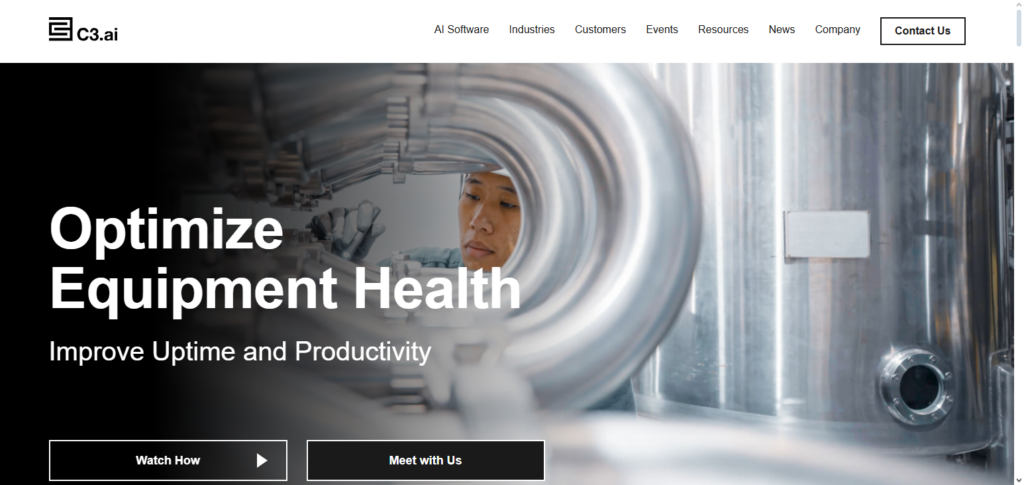
Model-driven AI, which enables quick deployment of industry-specific predictive maintenance use cases without significant customisation, is its special strength. C3 AI helps businesses reduce unscheduled downtime, increase asset longevity, and develop data-driven maintenance strategies across big and complex operations by providing precise failure forecasts, risk rating, and maintenance suggestions.
C3 AI Predictive Maintenance Features, Pros & Cons
Features:
- Predictive maintenance offered through enterprise AI platform.
- Failure detection through machine learning models.
- Operational and sensor data integration.
- Maintenance is prioritized and risk is scored.
- Cross industry and asset analytics are scalable.
Pros:
- Instant implementation for use cases specific to industries.
- Predictive analytics is highly accurate.
- Lowers maintenance and downtime costs.
- Fosters large-scale functions.
- Enterprise-level security and adaptability with growth.
Cons:
- High costs of implementation and subscription.
- Complexity may need AI and data science expertise.
- Not suitable for smaller operations.
- Customization might consume considerable time.
- Reliant on data quality for forecasts.
7. SparkCognition
Because SparkCognition uses sophisticated deep learning and pattern-recognition techniques to complicated industrial data, it is regarded as one of the greatest AI solutions for predictive maintenance planning.

In order to spot minute irregularities that conventional rule-based systems frequently overlook, the platform continuously examines sensor readings, operational trends, and previous failure data. Its heavy emphasis on automated root cause analysis and early problem identification, which enables maintenance teams to comprehend not only when a breakdown may occur but also why, is its primary distinction.
SparkCognition assists businesses in avoiding expensive malfunctions, streamlining maintenance plans, and enhancing equipment dependability by providing accurate forecasts and useful insights.
SparkCognition Features, Pros & Cons
Features:
- Predictive maintenance based on deep learning.
- Anomaly detection and root cause analysis.
- Monitoring of assets in real-time.
- AI-driven forecasts of failures.
- Operational insights and dashboards.
Pros:
- Complex equipment failures detected early.
- Saved time via automating root cause analysis.
- Asset reliability and uptime increased.
- High AI capability for industrial uses.
- Can be deployed across several locations.
Cons:
- Specialized technical knowledge required for implementation.
- Smaller businesses see increased costs.
- Sensor quality and data accuracy dependency.
- Difficult integration with older systems.
- Non-technical groups face a learning curve.
8. Augury
Because Augury specializes in real-time machine health monitoring utilizing sophisticated vibration and sound analysis, it is among the best AI solutions for predictive maintenance planning.
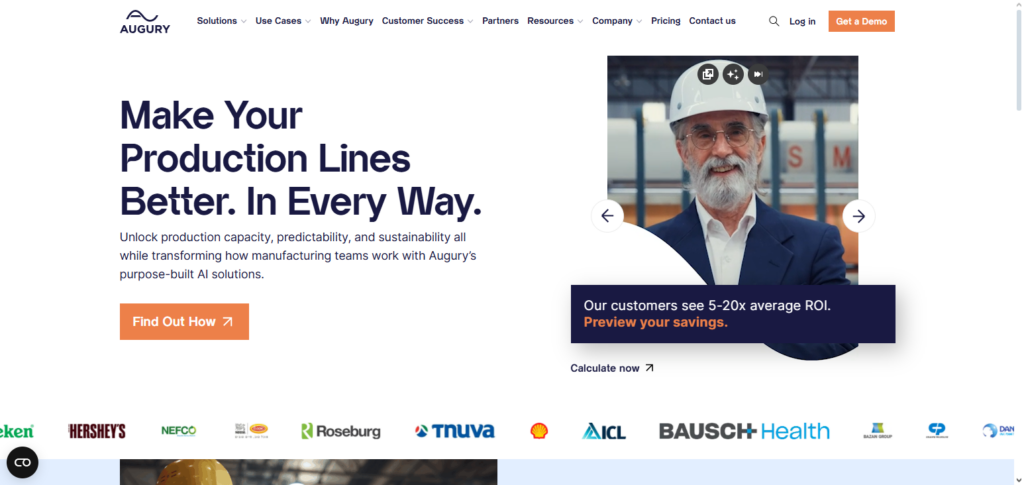
To identify early indicators of mechanical problems including imbalance, misalignment, and bearing wear, the platform blends AI algorithms with specially designed sensors. Augury’s special strength is its capacity to convert complicated machine signals into understandable, practical diagnostics for maintenance crews.
Augury helps businesses avoid unscheduled downtime, prolong equipment life, and more efficiently manage maintenance activities throughout industrial operations by offering early warnings and accurate fault detection.
Augury Features, Pros & Cons
Features:
- Monitoring machine health with vibration and acoustic sensors.
- AI-based failure detection and diagnostics.
- Real-time notifications regarding mechanical issues.
- Predictive maintenance planning.
- Actionable insights with visual dashboards.
Pros:
- Mechanical faults detected early.
- Actionable diagnostics for teams.
- Decreased unplanned downtimes.
- Quick implementation with IoT sensors.
- Increased asset reliability and efficiency.
Cons:
- Largely focused on mechanical assets.
- Sensor installation is no cheap task.
- Subscription costs can be significant.
- Limited ERP/CMMS integration options.
- Sensor Placement and quality are detrimental.
9. Senseye Predictive Maintenance
Because Senseye Predictive Maintenance provides autonomous, self-learning analytics for industrial assets, it is considered one of the top AI tools for predictive maintenance planning.
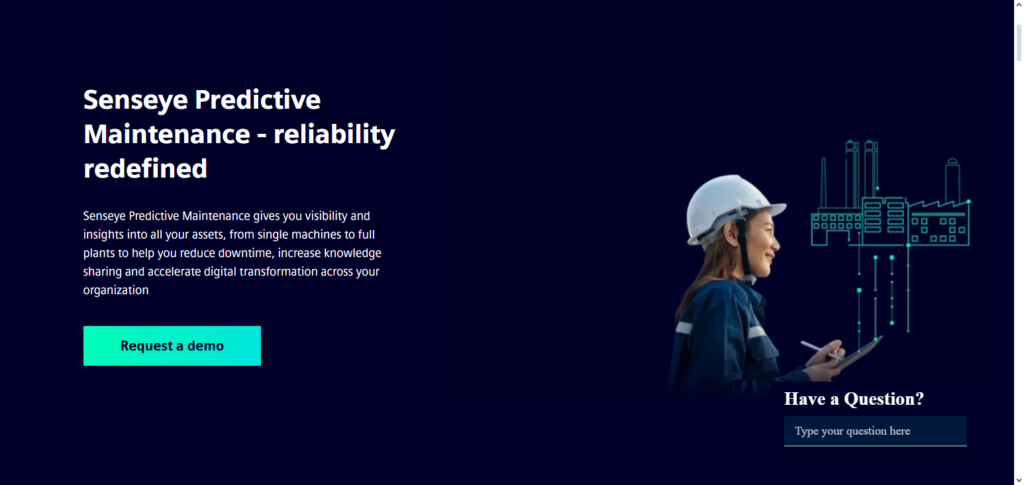
Without requiring a great deal of data science knowledge, the platform employs machine learning to continuously evaluate equipment behavior, identify anomalies, and predict breakdowns. Its primary distinction is automated maintenance prioritizing, which helps teams concentrate on what really matters by ranking assets based on risk and business impact.
Senseye helps businesses transition from reactive to proactive maintenance, minimize downtime, and more confidently allocate resources by converting raw machine data into precise forecasts and suggested actions.
Senseye Predictive Maintenance Features, Pros & Cons
Features:
- Moreover, autonomous Artificial Intelligence powered predictive maintenance software.
- Detects anomalies through the learning of the computer.
- Maintenance risk determines the order of priority.
- Monitoring the asset’ condition in real-time.
- Compatible with already installed maintenance management applications.
Pros
- This software is simple and easy to use; high-level data science knowledge is not required to use it.
- Critical assets maintenance gets prioritization.
- Emergency repairs and the entire maintenance downtime gets to be reduced.
- Over time, the AI gains more knowledge and the self-learning adaption improves.
- Works well with most industrial applications.
Cons
- Prediction accuracy relies on the availability of historical data.
- Certain complex assets might call for software customization.
- Subscription costs can be considerable.
- Prediction accuracy relies on the quality of the installed sensors.
- Offline functions might be lacking.
10. Ezo CMMS
Because Ezo CMMS blends intelligent maintenance automation with user-friendly asset management, it is regarded as one of the top AI solutions for predictive maintenance planning. The platform uses information from condition monitoring, maintenance records, and equipment usage to find trends that point to possible malfunctions.
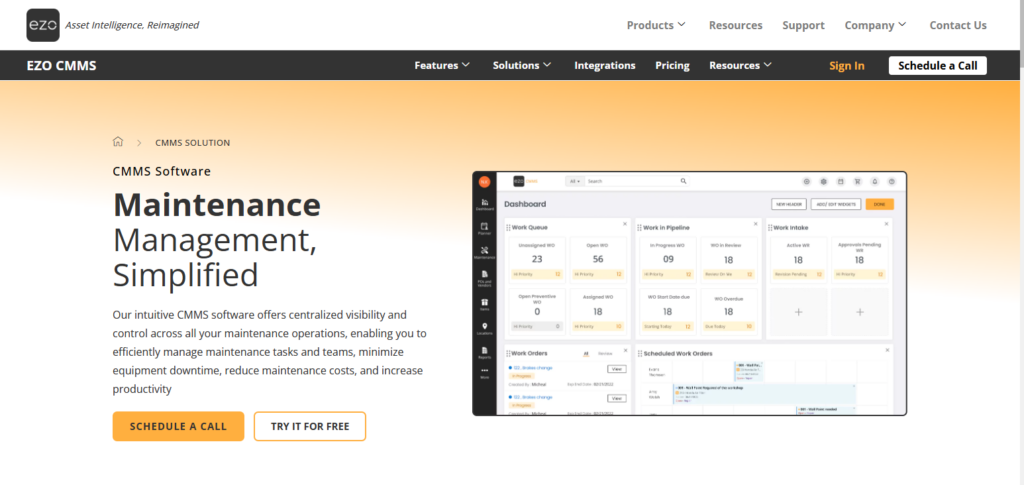
Its special strength is the integration of scheduling, inventory monitoring, work order administration, and predictive analytics into a single system.
As a result, maintenance staff may respond to AI-driven suggestions right away without having to switch tools. Ezo CMMS helps businesses save downtime, manage expenses, and maintain equipment more effectively by streamlining predictive maintenance execution and enhancing asset visibility.
Ezo CMMS Features, Pros & Cons
Features
- In the cloud, computerized maintenance management system.
- Both predictive and preventive maintenance scheduling.
- Management of the asset with tracking, and control of the stock.
- Automation of work orders and the production of reports.
- Merge with the data from the sensors and the Internet of Things.
Pros
- Makes the task of predictive maintenance a lot simpler.
- Improved the tracking and control of maintenance across the various assets.
- Decreased costs of maintenance and reduced unplanned system downtimes.
- Simple to integrate in organizations of medium size.
- Consolidates operations and maintenance.
Cons:
- Not as many advanced AI functionalities as other niche software.
- Input data quality affects precision.
- Industry-specific analytics are few.
- Might need adjusting for intricate assets.
- Costs can accumulate with many users.
Challenges and Limitations
Expensive Implementation – AI technologies along with sensors and other infrastructural tools usually cost a lot of money.
Flawed Data – The quality of the data used can be a major determining factor as to how accurate the predictions can be.
Integration Issues – The merging of AI with other tools like ERP, CMMS, and IoT software may come with a lot of technical difficulties.
Expertise – AI and data analysis needs to be combined with maintenance engineering to get the system working.
Difficult to Scale – The system may find it tricky to complete predictive maintenance for several sites or a large fleet of vehicles.
Sensor Dependency – Predictive tools may not be accurate if the sensors are faulty or if there is a lack of them.
Staff Resistance – Staff who are used to performing maintenance duties in a reactive or preventive way might resist the new tools.
Little Data – The system needs a good amount of data on the asset along with past data on failures for good predictions.
Increased Cyber Risk – Incorporating AI and IoT platforms into industrial assets raises the risk of a cyber attack.
Missing or Incorrect – Predictions made by the AI may lead to maintenance work that is not truly needed or may fail to identify issues that need to be addressed.
Conclusion
Tools that implement AI predicitve maintenance help users move from a Reactive Maintenance strategy to a Predictive Maintenance strategy to help transform the way analyze and metrics.
Tools such as Siemens MindSphere, GE Predix, SAP Predcitve Maintenance, PTC ThingWorx, Uptake, C3 AI, SparkCognition, Augury, Senseye, Ezo CMMS toolset to analytics, and monitoring levels to predic and diagnose downtim and optimize maintenance.
Integrating to and balancing estimated maintenance evealuative predictive and cost functional capabilities to help users select best tool per organization. Tools to enhance optimize and improve provide best safety and help users achieve best from value operational to financial return.
FAQs
What is predictive maintenance?
Predictive maintenance uses AI and data analytics to monitor equipment conditions and predict potential failures before they occur, reducing downtime and maintenance costs.
Why should businesses use AI for predictive maintenance?
AI improves accuracy in failure prediction, optimizes maintenance schedules, extends asset life, reduces unplanned downtime, and increases overall operational efficiency.
Which industries benefit most from AI predictive maintenance tools?
Industries such as manufacturing, energy, oil & gas, aviation, transportation, and utilities gain significant benefits from predictive maintenance.
What are the top AI predictive maintenance tools?
Leading tools include Siemens MindSphere, GE Predix, SAP Predictive Maintenance, PTC ThingWorx, Uptake, C3 AI, SparkCognition, Augury, Senseye, and Ezo CMMS.
How do I choose the right predictive maintenance tool?
Consider factors like data integration capabilities, predictive accuracy, scalability, user-friendliness, real-time monitoring, and cost-effectiveness when selecting a tool.