



I’ll go over the top AI tools for predictive analytics in this post, which assist companies in turning past and present data into precise projections and more intelligent choices.
These tools, which range from enterprise-grade analytics solutions to automated machine learning platforms, enable businesses to identify patterns, lower risks, and obtain a competitive advantage through data-driven insights and clever, scalable prediction technologies.
Key Point & Best AI Tools for Predictive Analytics
| Platform | Key Point |
|---|---|
| IBM Watson Studio | Provides an integrated environment for building, training, and deploying AI models with strong support for data preparation, AutoAI, and enterprise-grade governance. |
| Microsoft Azure Machine Learning | Offers end-to-end MLOps capabilities, enabling scalable model training, deployment, and monitoring directly within the Azure cloud ecosystem. |
| Google Cloud Vertex AI | Combines AutoML and custom model development into a unified platform, optimized for high-performance AI workflows using Google’s advanced infrastructure. |
| Amazon SageMaker | Delivers a fully managed service for building, training, and deploying machine learning models at scale with built-in tools for automation and optimization. |
| Salesforce Einstein Analytics | Embeds AI-driven insights directly into CRM workflows, helping businesses make data-driven decisions within the Salesforce ecosystem. |
| Qlik Sense AI | Uses augmented analytics and natural language insights to help users explore data, detect trends, and generate automated visualizations. |
| DataRobot | Automates the entire machine learning lifecycle, enabling fast model development, deployment, and governance for enterprise users. |
| SAS Advanced Analytics | Provides robust statistical modeling and advanced AI tools for complex predictive analytics and enterprise-grade decision-making. |
| TIBCO Spotfire AI | Focuses on real-time data visualization and AI-powered analytics to uncover insights from streaming and historical data sources. |
| Alteryx Intelligence Suite | Enhances data preparation and analytics with automated machine learning, text analytics, and predictive modeling capabilities. |
1. IBM Watson Studio
Data scientists, analysts, and developers can create, train, and implement predictive models at scale with IBM Watson Studio, a potent enterprise-grade platform.
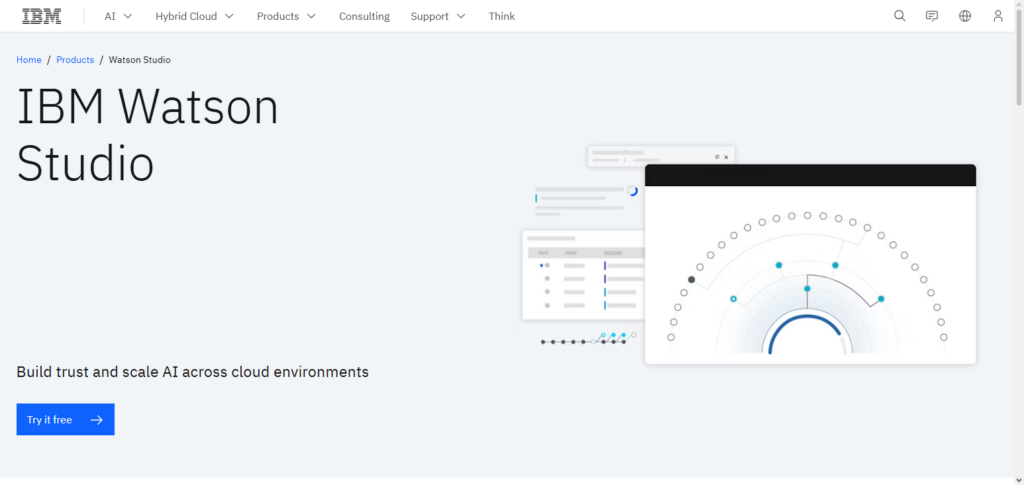
It offers powerful data preparation, visualization, and AutoAI functions in addition to supporting several programming languages, including as Python, R, and Scala. Because of its robust governance, model explainability, and compliance controls, enterprises frequently rank it among the Best AI Tools for Predictive Analytics in the mid-workflow.
Watson Studio’s seamless integration with IBM Cloud and on-premise technologies facilitates safe team collaboration while speeding up the extraction of complicated dataset insights.
IBM Watson Studio Features, Benefits & Drawbacks
Features
- AutoAI for automated model building and optimization
- Support for multiple programming languages (Python, R, Scala, SQL)
- Integrated tools for data preparation and data visualization
- Enterprise-grade governance and model explainability
- Support for deployment in the Cloud and on-premise
Benefits
- Strong compliance and security for regulated industries
- Automation speeds up model development
- Easily scales to Enterprise-level environments
- Enables team collaboration with version control
- Model transparency and auditability
Drawbacks
- Steep learning curve for beginners
- Cost of Enterprise licensing can be high
- More complex setup for on-premise deployments
- Less intuitive user interface than some competitors
- Performance highly variable depending on the configured infrastructure
2. Microsoft Azure Machine Learning
A complete cloud-based environment for developing, training, deploying, and tracking machine learning models is offered by Microsoft Azure Machine Learning. It allows both sophisticated custom model construction with well-known frameworks like TensorFlow and PyTorch and no-code AutoML.
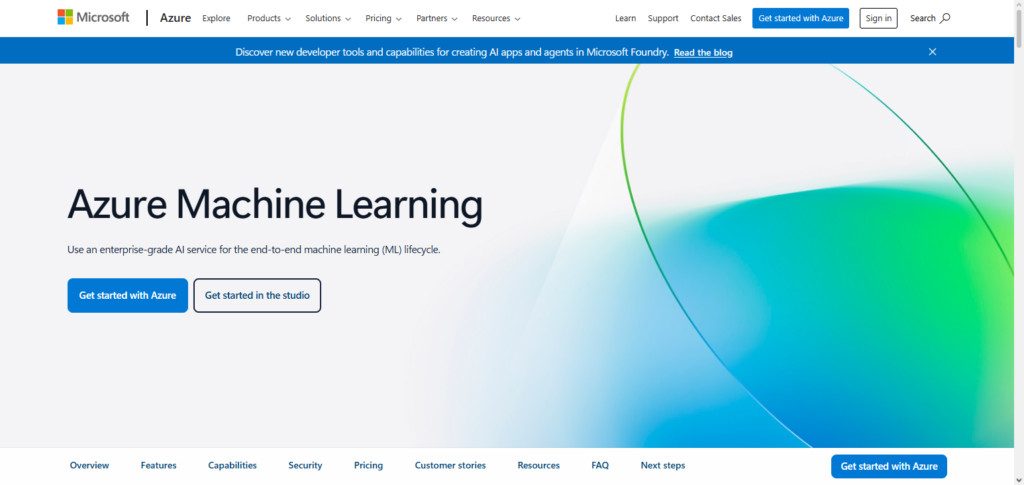
Many companies rate it as one of the Best AI Tools for Predictive Analytics because to its extensive connection with the Azure ecosystem, enabling smooth data intake from services like Azure Data Lake and Power BI. Its built-in MLOps tools streamline version control, model tracking, and continuous deployment, assuring scalability, security, and reliability.
Microsoft Azure Machine Learning Features, Benefits & Drawbacks
Features
- Built in AutoML and MLOps tools
- Compatibility with TensorFlow, PyTorch, and Scikit-learn
- Integration with Azure Data Lake and Power BI
- Model versioning with monitoring dashboards
- Scalable resources for cloud computing
Benefits
- Integration in the Azure ecosystem is seamless
- Enterprise-grade security and compliance is robust
- Support for no-code and advanced users is flexible4. Worldwide cloud accessibility and scalability
- Streamlined deployment procedures
Drawbacks
- Skyrocketing expenses with extensive cloud consumption
- Having need of Azure expertise for optimal configuration
- Complicated interface for inexperienced users
- Risk of vendor lock-in
- Performance tuning can be intricate
3. Google Cloud Vertex AI
The entire machine learning lifecycle is made simpler with Google Cloud Vertex AI, which combines AutoML and custom model training into a single platform. It provides sophisticated tools for hyperparameter tuning, data labeling, model training, and deployment on Google’s high-performance infrastructure.
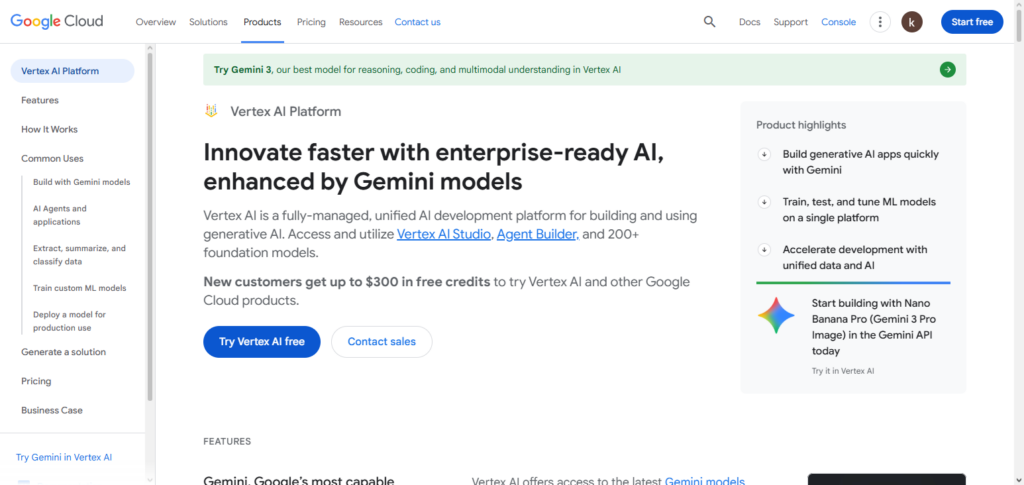
Because of its smooth integration with BigQuery, Dataflow, and TensorFlow, it is often regarded as one of the Best AI Tools for Predictive Analytics in the midst of intricate data workflows. With Vertex AI, businesses can automate pipelines, create extremely accurate predictive models, and use Google’s advances in AI research to make batch and real-time predictions.
Google Cloud Vertex AI Features, Benefits & Drawbacks
Features
- Integrated AutoML and bespoke model creation
- Integration with BigQuery and TensorFlow
- Automated data labeling and pipeline
- Prediction services for real-time and batches
- Tools for tuning hyperparameters
Benefits
- Elevated performance and scalability
- Seamless incorporation with Google’s data ecosystem
- Powerful tech fueled by AI research
- Quick deployment of model
- Strong support for payloads associated with big data
Drawbacks
- Complexity of pricing
- Wider learning scope for users coming from outside of Google Cloud
- Integration of third parties is limited
- Cloud expertise is a prerequisite
- User interface is not business friendly
4. Amazon SageMaker
A fully managed machine learning service, Amazon SageMaker assists companies in rapidly and effectively developing, training, and implementing models. In addition to built-in algorithms for forecasting, classification, and anomaly detection, it supports well-known frameworks like PyTorch, MXNet, and TensorFlow.
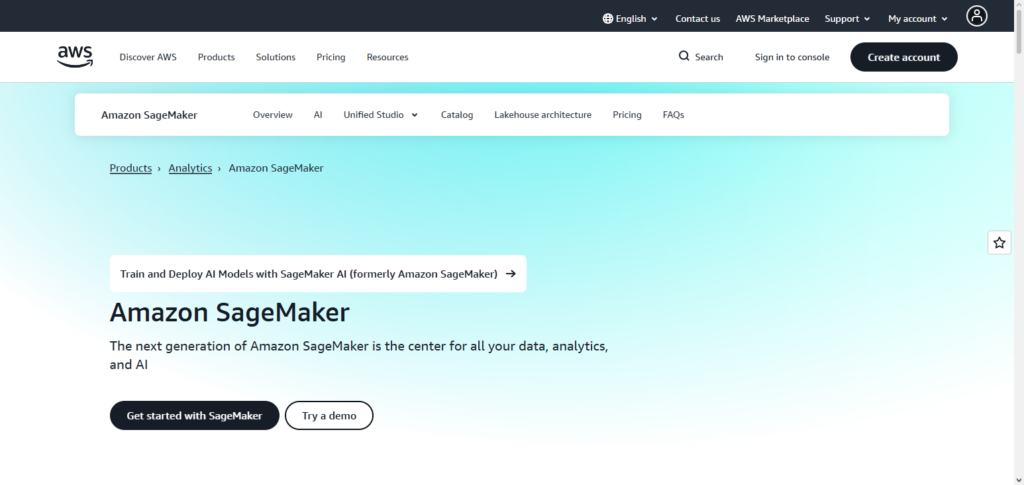
SageMaker is regarded as one of the Best AI Tools for Predictive Analytics because of its strong interaction with AWS services like Redshift, Lambda, and S3, as well as its scalability. SageMaker Pipelines and Model Monitor are two of its automation capabilities that guarantee efficient workflows, performance monitoring, and ongoing development.
Amazon SageMaker Features, Benefits & Drawbacks
Features
- Provisioned algorithms for forecasting and classification
- Managed Jupyter notebooks
- MLOps model monitoring and pipelines
- Integration with AWS services (Redshift, Lambda, S3)
- Automated training and deployment
Benefits
- Reliability and scalability
- Expansive support for algorithms and frameworks
- Strong automation
- Enterprise grade secure cloud infrastructure
- Variety of pricing options
Drawbacks
- Steep learning curve
- Complex pricing structure
- Requires AWS expertise
- Interface can be overwhelming
- Limited visualization features
5. Salesforce Einstein Analytics
Salesforce Einstein Analytics enables sales, marketing, and service teams to make data-driven choices by integrating AI-powered predictive insights right into the CRM environment. It uses integrated machine learning algorithms to assess consumer behavior, predict trends, and suggest actions.
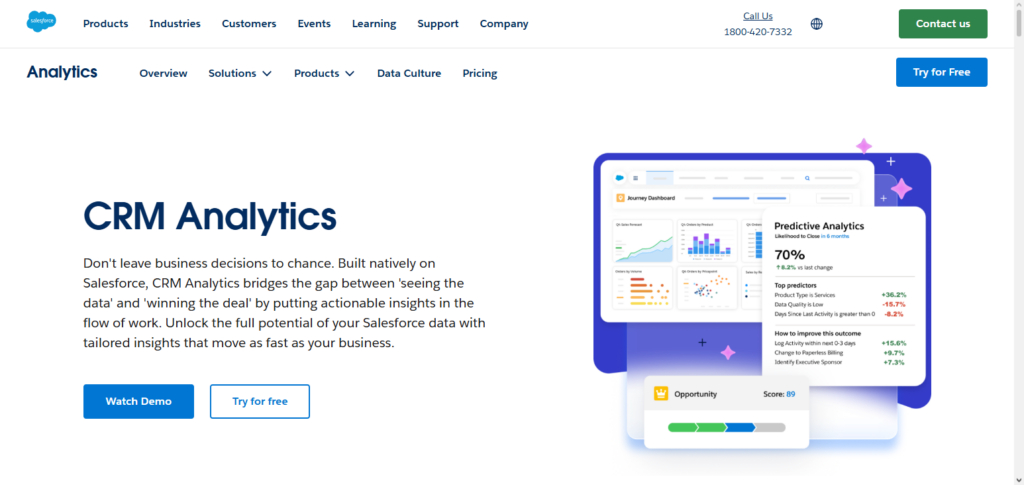
Einstein Analytics, which is regarded as one of the Best AI Tools for Predictive Analytics in business-focused use cases, is excellent at converting complicated data into comprehensible dashboards and natural language insights. Real-time updates, more client involvement, and more intelligent business strategies are guaranteed throughout the company thanks to its smooth interface with Salesforce data.
Salesforce Einstein Analytics Features, Benefits & Drawbacks
Features
- Analytics for CRM enriched with artificial intelligence
- Sales and marketing insights with predictive analytics
- Queries using natural language
- Dashboards and reports that are automated
- Integration of Salesforce data in real-time
Benefits
- Simple for users in business
- Enhances strategies for engaging with customers
- No substantial technical configuration needed
- Integration with CRM is seamless
- Generates insights quickly
Drawbacks
- Limited functionality outside the Salesforce ecosystem
- Fewer sophisticated modeling alternatives
- Substantial costs for subscriptions
- Limits on customization
- Not suitable for large-scale data science teams
6. Qlik Sense AI
In order to find predicted insights, Qlik Sense AI is an augmented analytics platform that integrates artificial intelligence, natural language processing, and interactive data visualization. It allows users to browse data naturally while generating automatic forecasts and trend analysis.
Qlik Sense AI’s associative data engine, which uncovers hidden links between datasets, makes it stand out among the Best AI Tools for Predictive Analytics. Real-time dashboards, guided analytics, and integrated AI capabilities help businesses make confident, data-driven decisions by enabling both technical and non-technical users.
Qlik Sense AI Features, Benefits & Drawbacks
Features
- AI insights and augmented analytics
- Search with natural language processing (NLP)
- Interactive visualization of data
- Automation of trend detection
- Deployment in the cloud and on-premises
Benefits
- UI is simple
- Visualization features are strong
- Rapid discovery of insights
- Non-technical users can use it
- Real-time analytics are available
Drawbacks
- Limited advanced machine learning features
- License costs are on the higher end
- Knowledge of data modeling is required
- Complex custom integrations
- Performance issues with large data sets
7. DataRobot
DataRobot helps to automate the analytics lifecycle, covering all stages from prep to monitoring, while building enterprise-grade ML models; and it makes it a point to not lock out people from valuable features due to lack of coding skills. Removing this restriction widens the scope of the users that could leverage the platform.
It’s not surprising that DataRobot is a prominent player in the Best AI Tools for Predictive Analytics arena. Its excellence in feature engineering, model selection, and explainability sets it apart. The features that aid in predictive analytics for enterprise applications that governance and compliance monitoring add in order to ensure models don’t lose performance over time give it the edge over competitors.
DataRobot Features, Benefits & Drawbacks
Features
- Machine learning Platform end to end automation
- Model explainability tools
- Governance and compliance controls
- Deployment and monitoring automation
- Multi-cloud support
Benefits
- Fast model development
- No-code and low-code options
- Strong transparency and auditability
- Enterprise scalability
- Reduces dependency on data scientists
Drawbacks
- High enterprise pricing
- Limited customization for advanced users
- Complex licensing structure
- Heavy system requirements
- Over-automation risk
8. SAS Advanced Analytics
Leading the way in statistical modeling and enterprise analytics, SAS Advanced Analytics provides strong capabilities for prescriptive and predictive insights. It provides deep learning, sophisticated machine learning, and optimization methods for challenging business issues.
SAS is a standout among the Best AI Tools for Predictive Analytics due to its strong data management skills, regulatory compliance, and dependability. Businesses in sectors including government, healthcare, and finance depend on SAS to provide precise forecasts, risk assessment, and useful intelligence with robust security and governance features.
SAS Advanced Analytics Features, Benefits & Drawbacks
Features
- Advanced statistical modeling tools
- Machine learning and deep learning support
- Enterprise data management
- Regulatory compliance features
- Visualization and reporting dashboards
Benefits
- Highly reliable and trusted
- Strong for regulated industries
- Robust predictive accuracy
- Scalable enterprise deployment
- Excellent technical support
Drawbacks
- Expensive licensing
- Complex interface
- Steep learning curve
- Limited cloud-native features
- Slower innovation cycle
9. TIBCO Spotfire AI
TIBCO Spotfire AI merges artificial intelligence with state-of-the-art data analytics and data visualization. With Spotfire AI, users can perform data analyses on both historical and live data streams. It offers users an easy-to-use interface for identifying patterns and creating forecasting models.
Spotfire AI is often listed as one of the Best AI Tools for Predictive Analytics due to its seamless integration with IoT and other enterprise platforms. Interactive dashboards, automation, and AI-powered suggestions allow users to adapt to new circumstances and identify valuable insights in data by revealing previously obscured opportunities.
TIBCO Spotfire AI Features, Benefits & Drawbacks
Features
- Real-time data visualization
- Streaming analytics support
- Predictive modeling tools
- Interactive dashboards
- Enterprise system integration
Benefits
- Excellent for live data monitoring
- Strong visual analytics
- Fast data exploration
- IoT and sensor data compatibility
- Flexible deployment options
Drawbacks
- High licensing costs
- Minimal advanced ML automation
- Needs training for optimal utilization
- Complicated integration
- Limited user base
10. Alteryx Intelligence Suite
Alteryx Intelligence Suite offers the base Alteryx platform additional machine learning and artificial intelligence functionalities to enhance predictive analytics. With its streamlined data preparation, feature engineering, and model deployment, users can use the process as a guide to create basic workflows.
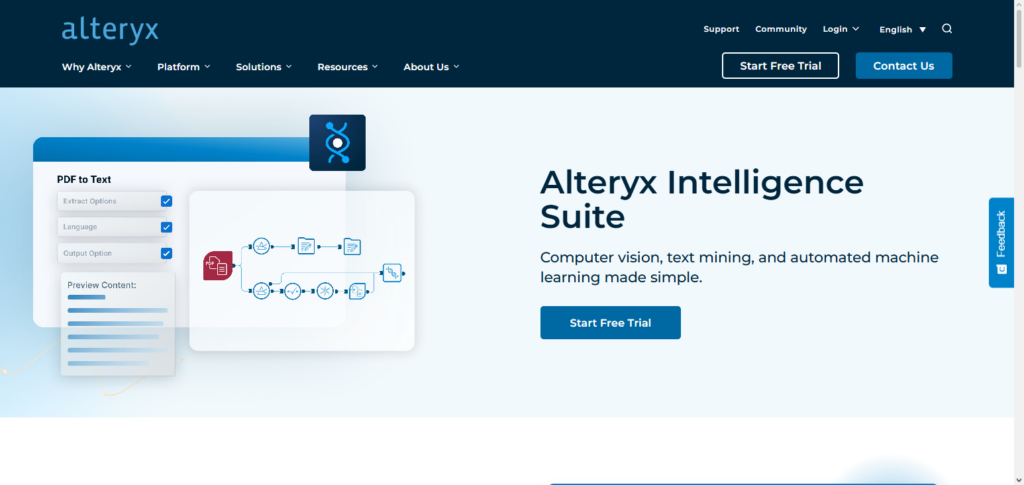
Alteryx has won multiple awards as one of the Best AI Tools for Predictive Analytics because it allows users to create predictive models with a minimal amount of programming.
Text analytics, forecasting, and automation provide insight and enhance the overall speed of the decision-making process. Integrating BI tools with cloud services streamlines teamwork, and the automation improves the overall speed of the decision-making process.
Alteryx Intelligence Suite Features, Benefits & Drawbacks
Features
- Predictive workflows with drag-and-drop functionality
- Automated ML
- Forecasting and text analytics
- Data blending and preparation
- Integration with BI tools
Benefits
- Novice-friendly
- Models develop quickly
- Effective features for data preparation
- Excellent integration for visualization
- Usage across the enterprise is scalable
Drawbacks
- Plans for enterprises are expensive
- Limited capabilities for deep learning
- Big data performance is lacking
- Insufficient custom coding
- Separate BI tools are needed for dashboards
Conclusion
Selecting the best AI tools for predictive analytics is crucial in today’s data-driven environment to convert unprocessed data into precise forecasts and strategic insights.
While solutions like DataRobot, Qlik Sense AI, and Alteryx Intelligence Suite make advanced modeling easier for a wider range of business users, platforms like IBM Watson Studio, Azure Machine Learning, Google Cloud Vertex AI, and Amazon SageMaker offer enterprise-grade scalability, automation, and governance.
By converting predictive intelligence into practical business value, these solutions enable firms to enhance decision-making, lower risk, and obtain a competitive advantage.
FAQ
What are AI tools for predictive analytics?
AI tools for predictive analytics use machine learning and statistical models to analyze historical and real-time data, identify patterns, and forecast future outcomes such as customer behavior, sales trends, and operational risks.
Which are the best AI tools for predictive analytics in 2026?
Some of the best AI tools for predictive analytics include IBM Watson Studio, Microsoft Azure Machine Learning, Google Cloud Vertex AI, Amazon SageMaker, DataRobot, SAS Advanced Analytics, Qlik Sense AI, and Alteryx Intelligence Suite.
How do businesses choose the right predictive analytics platform?
Businesses should evaluate data integration, ease of use, scalability, security, model explainability, cloud compatibility, and cost. Industry-specific needs and technical expertise also play a major role in selection.
Are no-code or low-code predictive analytics tools effective?
Yes, no-code and low-code platforms like DataRobot and Alteryx Intelligence Suite allow non-technical users to build and deploy predictive models, speeding up adoption while maintaining reliable performance and governance.
What industries benefit most from predictive analytics tools?
Industries such as finance, healthcare, retail, manufacturing, marketing, and logistics benefit greatly by using predictive analytics to forecast demand, detect fraud, personalize customer experiences, and optimize operations.