




The Top AI Tools for Knowledge Discovery in Big Organizations will be covered in this post. These solutions enable businesses to effectively manage and access enormous volumes of data, find insights, and enhance decision-making.
Organizations may simplify knowledge management and enable teams to operate more efficiently by utilizing AI-powered search, natural language processing, and intelligent suggestions.
Why Knowledge Discovery Matters in Large Organizations
Greater control over large volumes of data: In large organizations, there is a continuous flow of both structured and unstructured data. Knowledge discovery tools assist in controlling and obtaining order in the data by allowing vital information to be available through the data when and where it is required.
Timeliness in Data Driven Decision Making: Knowledge discovery tools in Artificial Intelligence provide instant information and analytics to the team and leaders which streamlines their decision-making process as they do not have to spend time searching data manually for the information required.
Decreasing Information Silo: Knowledge discovery promotes the flow of information and high level knowledge in the entire organization by synthesizing and integrating data from and in the various departments.
Increased Efficiency: Employees are facilitated to spend their time in more productive tasks as they do not waste time searching for information.
Knowledge Continuous Learning and Adaptation: The tools in organizations utilizes Artificial Intelligence to understand the interaction of the user with the tools to identify the information required and provide useful actionable insights in order to adapt the organizations in knowledge continuous learning and to innovate.
Knowledge Discovery Improves the Quality and Reliability of Information: Knowledge discovery reduces business process errors by ensuring the knowledge which is drawn from the databases is relevant, sufficient, and current.
Key Point & Best AI Tools for Knowledge Discovery in Large Organizations
| AI Tool | Key Points |
|---|---|
| IBM Watson Discovery | Advanced AI-powered search and content analytics, natural language processing, scalable across industries, integrates with enterprise data, robust security features. |
| Coveo AI | Personalizes search results using AI, boosts conversion and engagement, integrates with CRM & eCommerce platforms, real-time analytics, supports multi-language search. |
| Lucidworks Fusion AI | AI-driven search and recommendations, natural language understanding, customizable pipelines, machine learning model integration, analytics-driven insights. |
| Sinequa AI | Cognitive search for enterprises, semantic search capabilities, handles structured and unstructured data, natural language processing, AI-powered relevance tuning. |
| Starmind AI | Expertise discovery and knowledge sharing, connects employees with experts, AI-driven suggestions, increases productivity, collaborative learning platform. |
| Yext AI Search | AI-powered search for websites and apps, improves user experience, natural language understanding, analytics on search performance, integrates with knowledge graphs. |
| Knowmax AI | Knowledge management automation, AI suggestions for FAQs, reduces response time, improves customer support efficiency, analytics-driven insights. |
| Slite AI | AI-assisted note-taking and documentation, content summarization, collaborative editing, smart search across knowledge base, integration with productivity tools. |
| Tettra AI | Knowledge management for teams, AI-powered content suggestions, easy onboarding for new employees, integrates with Slack & Google Workspace, maintains up-to-date knowledge. |
| Amazon Kendra | Enterprise search service, natural language queries, integrates with multiple data sources, machine learning relevance tuning, secure and scalable. |
1. IBM Watson Discovery
Because it combines sophisticated natural language processing with potent AI analytics to extract valuable insights from massive, unstructured data, IBM Watson Discovery stands out as one of the top AI solutions for knowledge discovery in large enterprises.
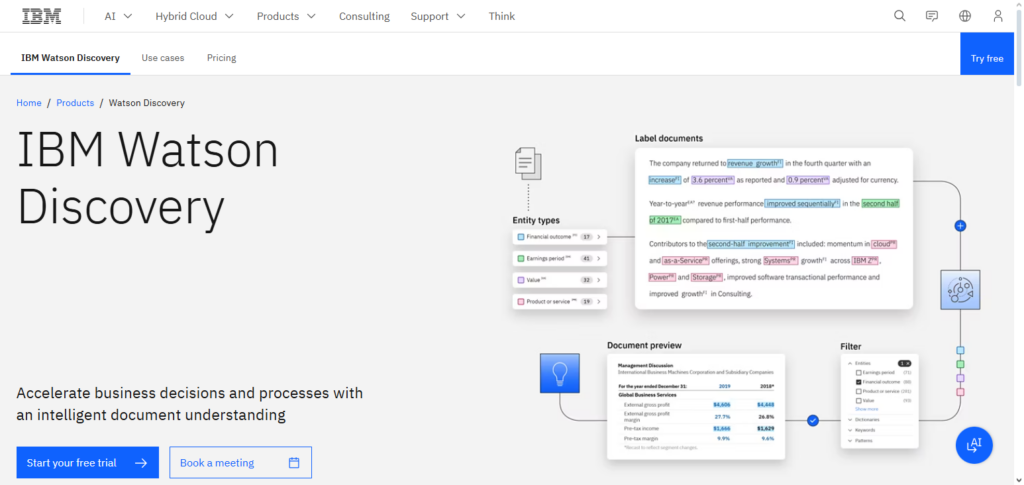
Teams can make data-driven decisions more quickly thanks to its capacity to comprehend context, identify patterns, and condense complex texts. In contrast to traditional search engines, Watson Discovery ensures a unified picture of knowledge by easily integrating with various enterprise systems.
It is perfect for managing sensitive company data and providing accurate, useful insights across departments because of its strong security, scalability, and adaptable AI models.
IBM Watson Discovery Features
- Natural Language Processing (NLP): Extracts accurate insights from unstructured data residing in different documents, emails, and databases.
- AI-Powered Search: Uses semantic search for knowledge retrieval to provide results and understanding in less time.
- Customizable Data Connectors: Functionally elastic to configure and link to different data sources from cloud and enterprise systems.
- Insight Extraction: Automatically finds and reports patterns, trends, and relations chronicled in extensive datasets.
- Advanced Analytics & Visualization: Data-driven dashboards and visual analytics ease and support decision making.
IBM Watson Discovery Pros & Cons
| Pros | Cons |
|---|---|
| Advanced NLP for extracting insights from unstructured data | Steeper learning curve for non-technical teams |
| Integrates with Watson ecosystem (Assistant, Studio) | Pricing can be complex and high for SMEs |
| Supports multilingual search and analysis | Requires tuning for optimal accuracy |
| Strong for enterprise-scale knowledge discovery | Fewer pre-built connectors compared to rivals |
2. Coveo AI
Because Coveo AI can provide highly personalized and contextually relevant search experiences, it is a leading tool for information discovery in large enterprises.
It continuously examines user behavior using sophisticated machine learning to highlight the most relevant content, improving the speed and accuracy of information retrieval. Coveo AI ensures that knowledge is integrated across departments by easily integrating with enterprise systems such as CRM, eCommerce platforms, and collaboration tools.
Its real-time analytics give businesses useful information on how clients or staff engage with content, allowing them to improve knowledge management tactics. It is particularly effective because it combines intelligence, integration, and customisation.
Coveo AI Features
- Personalized Search & Recommendations: Results and recommendations are contextually modified to suit each individual user.
- Machine Learning Insights: Search results for users become more relevant and accurate by ML improving search insights.
- Omnichannel Integration: Integrates knowledge across CRM, knowledge bases, and digital tools.
- Analytics Dashboard: Engagements and their usage are monitored to fine-tune knowledge access.
- Intelligent Case Deflection: Reduces the number of support tickets raised by surfacing relevant knowledge at the right time.
Coveo AI Pros & Cons
| Pros | Cons |
|---|---|
| Delivers personalized search and recommendations | Implementation can be resource-intensive |
| Strong e-commerce and customer support use cases | Costs rise with scale and personalization depth |
| Cloud-native, scalable architecture | Limited flexibility outside supported industries |
| AI relevance tuning improves user experience | Requires ongoing optimization for best results |
3. Lucidworks Fusion AI
Because Lucidworks Fusion AI combines AI-powered search, machine learning, and data indexing to give accurate, context-aware insights across huge and complex datasets, it is an excellent information discovery solution for large businesses.
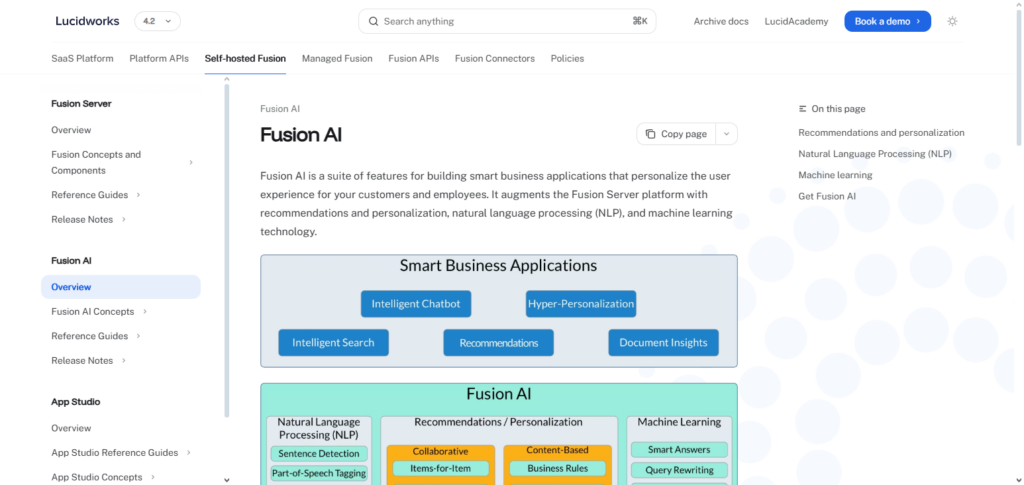
Its special capacity to build adaptable search pipelines enables businesses to customize results to particular business requirements, enhancing operational effectiveness and decision-making. Fusion AI bridges the gaps between structured and unstructured data by automatically interpreting queries using natural language comprehension.
Continuous learning and real-time analytics guarantee that the system adjusts to changing organizational knowledge. It is essential for businesses looking for meaningful insights from scattered data because of its scalability, adaptability, and smart recommendations.
Lucidworks Fusion AI Features
- AI-Powered Search & Query Understanding: knowledge discovery is augmented by enterprise bullet search.
- Data Indexing & Connectors: Combines and manages both structured and unstructured datasets in a systematized manner.
- Relevance Tuning: Adjusts how search results are displayed based on the organization’s specific needs.
- Behavioral Analytics: Understands how users interact to improve the delivery of insights and the quality of recommendations.
- Scalable Architecture: Handles very large data sets and continues to index and search in real-time.
Lucidworks Fusion AI Pros & Cons
| Pros | Cons |
|---|---|
| Combines search, AI, and analytics in one platform | Complex setup for large organizations |
| Highly customizable with machine learning pipelines | Requires technical expertise to configure |
| Strong support for enterprise search | Licensing costs can be high |
| Good integration with big data ecosystems | May be overkill for smaller teams |
4. Sinequa AI
Sinequa AI’s strong cognitive search and analytics capabilities make it a great tool for knowledge discovery in large enterprises. In order to find hidden insights throughout the company, it may process both structured and unstructured data, such as documents, emails, and databases.
It can read complicated searches and provide highly relevant results thanks to its semantic comprehension and natural language processing, which cuts down on the amount of time spent looking for important information.
Sinequa’s distinctive characteristic is its capacity to easily integrate with various data sources while continuously learning from user interactions, guaranteeing that knowledge gradually gets more precise and useful. It is perfect for complicated companies because of its intelligence and scalability.
Sinequa AI Features
- Cognitive Search Employs the use of Natural Language Processing as well as machine learning to ascertain both intention and context.
- Enterprise Knowledge Graph Provides better insights by linking and organizing information to eliminate silo-ing.
- Customizable Dashboards Provides the ability to visualize analytics and support decisions.
- Connector Library Provides ease of integration with tools and repositories within the enterprise.
- Actionable Recommendations Based on patterns in the data, as well as the behavior of users, next best actions that can be taken are suggested.
Sinequa AI Pros & Cons
| Pros | Cons |
|---|---|
| Enterprise-grade cognitive search across multiple data sources | Deployment complexity for global organizations |
| Strong NLP and semantic search capabilities | Pricing is premium compared to mid-market tools |
| Supports compliance-heavy industries (finance, pharma) | Requires skilled admins for optimization |
| Handles structured and unstructured data | UI less modern than newer SaaS competitors |
5. Starmind AI
Because it focuses on matching employees with the appropriate expertise at the appropriate moment, Starmind AI is a top option for knowledge discovery in large enterprises.
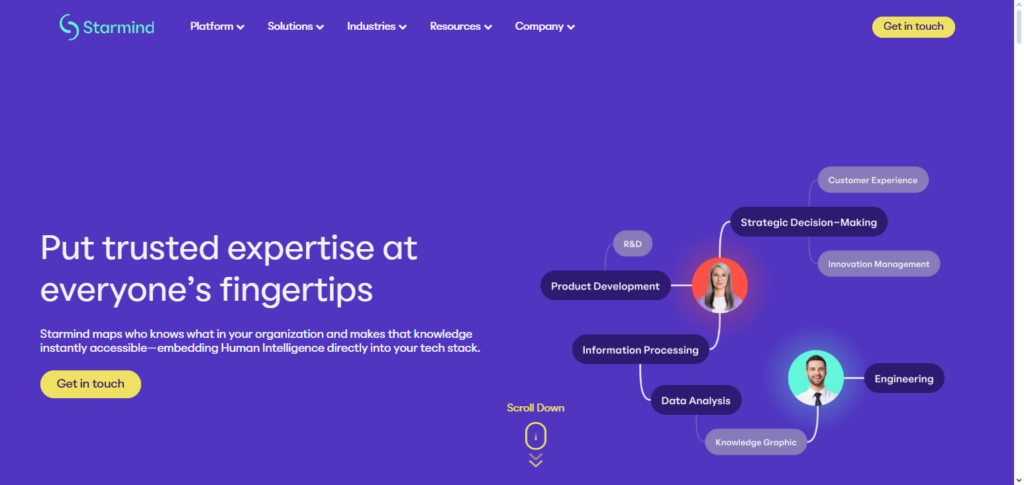
It makes it simple to find specialists across departments and regions by mapping organizational knowledge using sophisticated neural network algorithms that identify who possesses particular talents and insights.
In contrast to conventional information management technologies, Starmind continuously improves its network intelligence by actively learning from interactions, queries, and responses. Its capacity to promote teamwork, eliminate information silos, and offer real-time, AI-driven suggestions guarantees that workers have rapid access to vital information, boosting output and enabling well-informed decision-making.
Starmind AI Features
- Expert Network Mapping Finds the internal experts with the right knowledge and experience.
- AI Powered Collaboration For quicker resolution of issues, employees are matched with appropriate peers.
- Knowledge Capture & Sharing For organizational memory, the expertise in interactions is recorded.
- Analytics For Talent Insights Offers insights on the distribution of expertise and engagement levels.
- Integration With Communication Tools For smooth knowledge transfer, it integrates with Slack, Teams, and email.
Starmind AI Pros & Cons
| Pros | Cons |
|---|---|
| Focuses on connecting employees to internal expertise | Narrower scope compared to general-purpose search |
| AI-driven knowledge routing reduces silos | Effectiveness depends on employee engagement |
| Strong for tacit knowledge discovery | Limited integrations with external data sources |
| Easy to use for collaboration | May not scale well for highly regulated industries |
6. Yext AI Search
Yext AI Search is able to assist organizations with knowledge search at scale by synthesizing large amounts of disparate information into digestable insights that employees can readily access and respond to.
Employees can access relevant and timely information through conversational search queries that allow employees to move beyond systems used for responding to queries to a a search-based informtoion retrieval paradigm.
The ability of Yext to connect knowledge databases internally and externally through websites and applications to a knowledge graph is unmatched. Continuous and real-time search and useable analytics for knowledge databases. These characteristics and features make Yext AI Search even more useful than for knowledge search.
Yext AI Search Features
- Natural Language Search Asks questions in their natural everyday language to get the exact answers.
- Knowledge Graph Integration Provides easy access to centralized organizational knowledge.
- Answer Engine: Customers receive instant responses rather than links. Save time and increase productivity.
- Search Analytics: Monitors query and performance \ in order to improve search relevance.
- Multi-Channel Deployment: Available on websites, applications, and internal portals.
Yext AI Search Pros & Cons
| Pros | Cons |
|---|---|
| Natural language search for websites and enterprise portals | Best suited for customer-facing search, less for internal |
| Strong integration with marketing and SEO | Limited depth for complex knowledge discovery |
| Easy deployment and cloud-native | Customization options are narrower than competitors |
| Improves customer self-service | May not handle highly technical documents well |
7. Knowmax AI
Because it automates the organizing, retrieval, and sharing of vital information among teams, Knowmax AI is a top knowledge discovery solution for large enterprises. Employees always have access to the most accurate and pertinent information because to its AI-driven platform, which generates dynamic knowledge bases that adjust to changing company needs.
Knowmax AI’s special strength is its contextual content distribution and intelligent recommendations, which drastically cut down on the time it takes to resolve customer inquiries and internal operations.
It helps businesses optimize their information management strategies by integrating with various enterprise systems and offering statistics on knowledge utilization, making it an essential tool for productivity and well-informed decision-making at scale.
Knowmax AI Features
- Knowledge Management: Employees can locate and retrieve FAQs, SOPs and best practices in a centralized system.
- Contextual AI Search: Relevant content is suggested based on user query and context.
- Workflow Automation: Resolution is automated by integrating with CRM and helpdesk.
- Analytics & Insights: Monitors the usage patterns and identifies missing pieces in knowledge.
- Content Versioning: Ensures the upmost correct and most recent information is available to users.
Knowmax AI Pros & Cons
| Pros | Cons |
|---|---|
| Designed for customer support knowledge bases | Limited scope outside support workflows |
| AI-driven guided workflows improve agent efficiency | Requires structured content for best results |
| Easy to deploy for call centers and CX teams | Less suited for broad enterprise knowledge discovery |
| Strong focus on reducing resolution times | Narrower ecosystem compared to global players |
8. Slite AI
Slite AI is such an amazing knowledge discovery tool for large corporates, and it’s even more amazing because of the extensive capabilities of Slite AI. It understands the knowledge players engage in and transforms that knowledge work in real time and in collaboration with players and recommends the knowledge players should work.
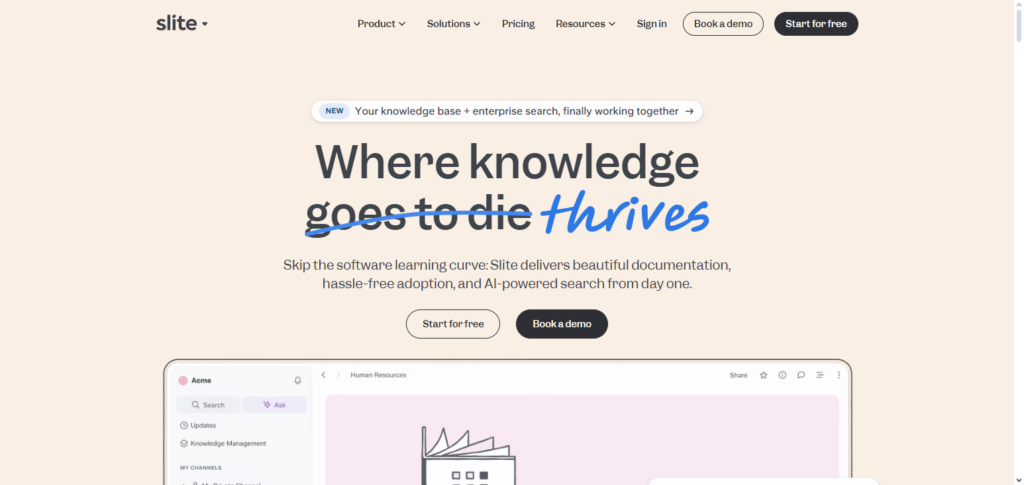
Slite AI understands the knowledge players are creating in real time and with changes in the organization and recommends the knowledge to the players so that they can work it and improve the recommendation to realize knowledge in a real time with collaborative work.
Slite AI generates summaries in real time, categorizes the knowledge, understands knowledge and recommends knowledge, and can even interact with the knowledge work and recommendations that other productivity tools facilitate. It is truly an amazing tool to facilitate enterprise knowledge discovery.
Slite AI Features
- Collaborative Knowledge Base: Team members can create and share documentation; editing and reviewing processes is a breeze.
- AI Summarization: Helps users quickly understand documents by condensing them into core pieces.
- Search & Organization: Helps use tagging and search to locate the information quickly.
- Integration with Tools: Functions collaboratively with Slack, Notion and various project management tools.
- Real-Time Collaboration: Update documents with a group by editing them at once.
Slite AI Pros & Cons
| Pros | Cons |
|---|---|
| Simple, collaborative knowledge management | Limited enterprise-grade features |
| Easy onboarding and user-friendly interface | Not ideal for highly complex data environments |
| Good for small-to-mid teams | Lacks advanced NLP and semantic search |
| Encourages documentation culture | Scalability challenges for very large organizations |
9. Tettra AI
Tettra AI is one of the best knowledge harnessing tools used by enterprise businesses to consolidate employees’ knowledge into one, accessible tool. The AI provides employees recommendations to what they were looking for.

It also helps the team identify weak points or gaps in the content to keep it relevant. What sets Tettra AI apart, is the integration with team collaboration tools such as Slack or Google Workspace. This allows employees to harness the knowledge, without workstation or \inconvenienced segregation away from other corporate tasks.
The content is organized in such a way that employees can constantly build off of it to strengthen the organizations knowledge base even further. The combination of relevance, cohesive integration and simplifying corporate work tasks makes the tool optimal for knowledge management.
Tettra AI Features
- Internal wiki & Knowledge sharing: Functions to consolidate and organize the knowledge in a single location.
- AI-Assisted Suggestions: Based on the user query, the system identifies and recommends relevant documents.
- Slack Integration: Provides users with access and allows them to make stops and changes in Slack easily.
- Content Approval Workflow: Additional steps in the approval process help to ensure that knowledge and content quality is preserved.
- Version Control: Edits and history of the document are preserved and can be referred to in later points in time.
Tettra AI Pros & Cons
| Pros | Cons |
|---|---|
| Knowledge base tool integrated with Slack/Teams | Narrower scope compared to enterprise search tools |
| Easy to use for team documentation | Limited AI sophistication compared to larger platforms |
| Strong for internal FAQs and onboarding | Not designed for large-scale knowledge discovery |
| Encourages collaboration and transparency | May lack compliance features for regulated industries |
10. Amazon Kendra
Because of its robust, enterprise-grade search capabilities that produce extremely accurate results from a variety of data sources, Amazon Kendra is a top AI tool for knowledge discovery in large businesses.

Employees can ask questions in normal language and get accurate, context-aware answers thanks to its special ability to interpret natural language. Kendra creates a cohesive information environment by effortlessly integrating with various sources, including as databases, intranets, and document management systems.
Sensitive data is protected by integrated security, and real-time learning from user interactions continuously enhances search relevancy. Amazon Kendra is perfect for complicated corporate information discovery because of its intelligent search, scalability, and safe integration.
Amazon Kendra Features
- Intelligent Enterprise Search: Machine Learning to responsive and context-aware answers.
- Natural Language Queries: People can receive responses to their inquiries or questions in straightforward terms.
- Data Source Connectors: Integration with SharePoint, Salesforce, S3, and other databases.
- Security & Access Control: Only the entitled users are able to access the confidential data.
- Continuous Learning: From the interaction data and patterns, it continues to advance.
Amazon Kendra Pros & Cons
| Pros | Cons |
|---|---|
| Enterprise search powered by AWS | Requires AWS expertise for integration |
| Strong NLP for natural language queries | Costs scale with usage volume |
| Connects to multiple data sources | Setup complexity for non-technical teams |
| Cloud-native scalability | Limited customization compared to open-source search |
Benefits of Using AI Tools for Knowledge Discovery
Speed of Information Retrieval: Employees do not have to spend time manually searching the various documents themselves; AI tools do this for them so that they can get to the more fruitful parts of their day.
Enhanced Decision-Making: Knowledge discovery for leaders of the teams is made more efficient as AI provides the necessary insights from complicated data to empower them to make decisions in a speedy and data-rich environment.
The Demise of Information Silos: Isolated knowledge traps within departments is avoided as AI provides the knowledge integration to enrich the data from diverse sources to ensure that all pertinent teams can utilize the insights.
Operational Effectiveness: Employees utilize their time searching information at a more strategic level as the tools create an environment of greater operational effectiveness.
Insighting and Learning: AI tools help motive organization to streamline their operations as they uncover knowledge that has been hidden in the very processes of their organization.
Knowledge of AI is Accurate and Reliable: Improved business processes are a result of the absence of erroneous data as the information is automated from a knowledge base that is current, consistent, and reliable.
Conclusion
In conclusion, turning massive, dispersed data into useful insights requires huge businesses to use the greatest AI technologies for knowledge discovery.
From sophisticated natural language understanding and personalized search to expert mapping, real-time analytics, and smooth integration with enterprise systems, tools like IBM Watson Discovery, Coveo AI, Lucidworks Fusion AI, Sinequa AI, Starmind AI, Yext AI Search, Knowmax AI, Slite AI, Tettra AI, and Amazon Kendra each bring special strengths.
Organizations may lower information silos, increase productivity, make data-driven decisions more quickly, and guarantee that knowledge is accurate, accessible, and always changing by implementing these intelligent platforms.
FAQ
What is knowledge discovery in large organizations?
Knowledge discovery is the process of identifying, organizing, and extracting meaningful insights from large volumes of structured and unstructured data within an organization. AI-powered tools help automate this process, making it faster and more accurate.
Why are AI tools important for knowledge discovery?
AI tools can analyze complex data, understand natural language queries, and deliver contextually relevant results. They reduce manual effort, minimize information silos, and ensure employees have access to the right knowledge at the right time.
Which AI tools are best for knowledge discovery?
Top AI tools include IBM Watson Discovery, Coveo AI, Lucidworks Fusion AI, Sinequa AI, Starmind AI, Yext AI Search, Knowmax AI, Slite AI, Tettra AI, and Amazon Kendra. Each tool offers unique features such as AI-driven search, semantic understanding, expert mapping, and integration with enterprise systems.
How do these tools improve productivity?
By providing instant access to relevant knowledge, automating document analysis, and connecting employees to experts, these AI tools reduce time spent searching for information and enable faster, data-driven decision-making.
Can these tools integrate with existing systems?
Yes. Most AI knowledge discovery tools support integration with CRM platforms, intranets, document management systems, collaboration tools, and other enterprise software to create a unified knowledge ecosystem.