




The Best AI Tools for consumer Intent Prediction that assist companies in comprehending and predicting consumer behavior will be covered in this post. To find high-intent prospects, these AI-powered tools examine past data, interactions, and engagement trends.
Businesses may increase conversions, tailor communication, and make more effective sales and marketing decisions by utilizing these technologies.
Why It Is AI Tools for Customer Intent Prediction Matter
Spot High-Intent Leads: AI tools examine activity data, including behaviour, connections, and engagement signals to recognize which leads are more likely to convert. This helps sales and marketing efforts to concentrate on bigger opportunities.
Customize Customer Engagement: With knowledge of intent, businesses can customize communication, messaging, offers, and content to fulfill the unique needs of customers, which encourages engagement and satisfaction.
Streamline Sales and Marketing Activities: AI-driven intent prediction is a better resource optimizer as it helps focus efforts and minimizes time wasted on leads with little interest.
Higher Conversion Rates: Conversion and increased revenues can be achieved by targeting the right leads with appropriate communication at ideal timing.
Evidence-Based Decision Making: AI tools present actionable insights and historical data which helps establish better sales and marketing strategies.
Foresee Customer Actions: AI tools can predict next possible actions such as buy, churn, or upgrade which helps businesses prepare the right actions.
Customer Experience Improvement: AI tools allow teams to meet the needs of customers using predictive actions which facilitates the seamless engagement of customers.
Key Point & Best AI Tools for Customer Intent Prediction List
| AI Tool | Key Features / Keypoints |
|---|---|
| Salesforce Einstein AI | AI-powered insights for sales, service, and marketing; predictive lead scoring; automation of workflows; sentiment analysis; personalized recommendations. |
| HubSpot AI CRM | Automated contact insights; predictive lead scoring; email and chat assistance; content suggestions; workflow automation; AI-driven sales and marketing analytics. |
| Gong.io AI | Conversation intelligence; call transcription and analysis; deal and revenue insights; AI-driven coaching suggestions; sales performance tracking. |
| Chorus.ai (ZoomInfo) | AI-based conversation analytics; call transcription; deal tracking; team collaboration insights; keyword and sentiment analysis for sales improvement. |
| Drift AI | Conversational AI for chatbots; lead qualification; personalized messaging; automated scheduling; real-time website engagement; AI-driven customer support. |
| Intercom Fin AI | AI-powered customer support; automated responses; lead routing; customer segmentation; analytics for product and support teams; chat and email automation. |
| Outreach Kaia AI | Sales engagement AI; email and call recommendations; task prioritization; automated follow-ups; analytics for improving sales workflows. |
| 6sense Revenue AI | Predictive revenue intelligence; account-based marketing insights; opportunity scoring; buying intent detection; multi-channel engagement recommendations. |
| Demandbase AI | AI-driven account-based marketing; intent data analysis; personalized content delivery; predictive analytics for sales and marketing alignment. |
| Freshworks Freddy AI | AI assistant for CRM, support, and marketing; predictive lead scoring; automated responses; workflow automation; AI-driven insights across customer touchpoints. |
1. Salesforce Einstein AI
When it comes to understanding the Best AI Tools for Customer Intent Prediction, Salesforce AI gets it the best by performing advanced predictive analytics, then using machine learning to understand the engagement type and customer behavior cross-channel and predicting the customer’s likely behavior toward converting a lead on closing a deal.
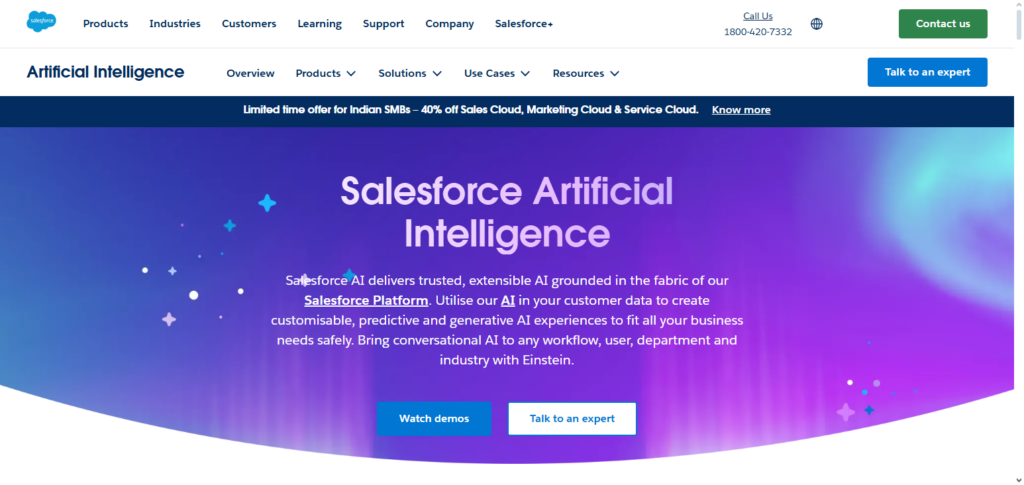
Somewhere along the process, Einstein AI recommends the best next steps, scores the qualified prospects, and automates personalized outreach that aims to better engagement. Its complete integration into the Salesforce ecosystem provides seamless functionality for users on the selling, marketing, and servicing sides and performing the most customer intent activities real-time.
Salesforce Einstein AI Features
- Predictive lead scoring to determine which leads are most likely to convert to customers.
- Automated recommendations for workflow optimization to improve the sales and marketing efficiency.
- Customer behavior and engagement analysis via sentiment analysis.
- Customer insights to tailor marketing and sales outreach.
- Sales, service, and marketing analytics with ecosystem integrations from the Salesforce platform.
Salesforce Einstein AI Pros & Cons
| Pros | Cons |
|---|---|
| Advanced predictive analytics for leads and deals. | Can be expensive for small businesses. |
| Deep integration with Salesforce ecosystem. | Requires Salesforce knowledge for full utilization. |
| Automated workflow and task recommendations. | Customization can be complex. |
| AI-driven sentiment and opportunity scoring. | Limited flexibility outside Salesforce CRM. |
| Enhances sales, marketing, and service efficiency. | Initial setup and learning curve can be steep. |
2. HubSpot AI CRM
HubSpot AI CRM helps businesses understand and analyze customer behaviors to identify high-value prospects using machine learning to Best AI Tools for Customer Intent Prediction activities. HubSpot AI CRM does this by analyzing customers’ previous interactions like website visits, emails, and purchases, and then highlights which contacts are likely to convert.
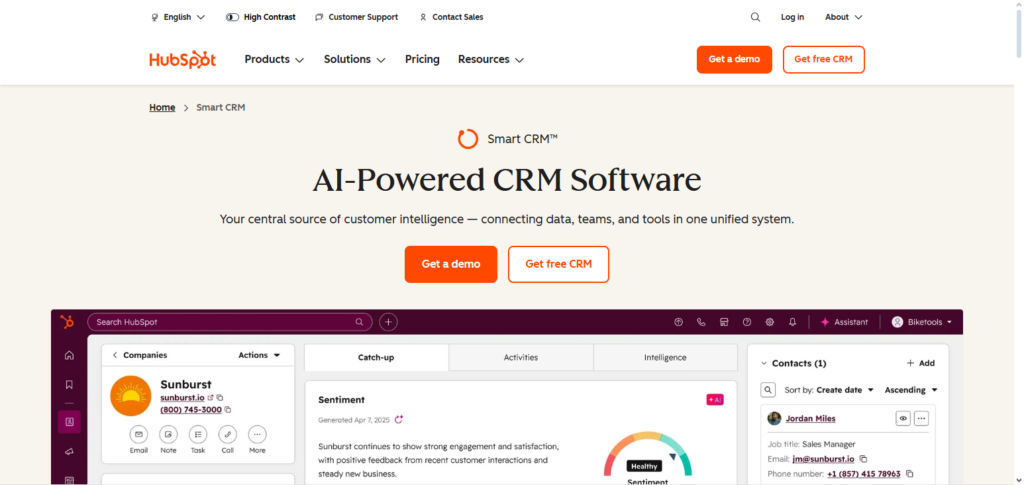
The AI provides personalized content, scores leads, and recommends next steps for sales automation. These actionable insights are merged with other HubSpot marketing and sales tools to enhance immediacy and responsiveness. As a result, businesses are able to improve customer targeting, lower churn rate, and effectively improve lead nurturing using real-time intent data.
HubSpot AI CRM Features
- Predictive lead scoring to determine which potential customers to focus on.
- Automated activity tracking for contacts to gain insights on engagement.
- AI-generated recommendations for campaign and email content.
- Automated marketing and sales task workflows to improve efficiency.
- Sales and marketing analytics and performance optimization reporting.
HubSpot AI CRM Pros & Cons
| Pros | Cons |
|---|---|
| Predictive lead scoring and automated insights. | Some advanced AI features require paid plans. |
| AI-powered content suggestions for emails and campaigns. | Limited in-depth analytics compared to enterprise solutions. |
| Workflow automation reduces manual effort. | Can be less powerful for very large teams. |
| Integrated with HubSpot marketing and sales tools. | Custom reporting may need extra configuration. |
| Easy-to-use interface for small and medium businesses. | Certain AI capabilities need consistent data input. |
3. Gong.io AI
Gong, provides customer experience intelligence, Gong analyzes sales using ai, email, meetings and differently detected customer sales intent. Gong analyzes language and sentiment use to measure for profitable converts in sales process.
Gong sends recommendations to sales teams. Conversational analytics are used to measure sales. They provide accurate sales forecasts and sales in previously underserved market segments. Customers are able to understand their prospects with high sales demand. Clip used with short to improve conversion.
Gong.io AI Features
- Intelligent analysis of conversational content from calls, emails, and meetings.
- Accurate record-keeping via call and meeting transcriptions.
- Sales performance forecasting with insights on deals and the pipeline.
- Sales team coaching recommendations made by AI.
- Customer intent analysis via sentiment and keyword evaluation.
Gong.io AI Pros & Cons
| Pros | Cons |
|---|---|
| Excellent conversation intelligence and call analytics. | Higher pricing may deter smaller teams. |
| AI-driven coaching suggestions improve sales performance. | Focused primarily on sales calls; limited outside of conversations. |
| Deal tracking and pipeline insights enhance forecasting. | Integration setup can be complex for some CRMs. |
| Keyword and sentiment analysis for actionable insights. | Data-heavy platform may require time to adapt. |
| Helps identify hidden opportunities in conversations. | May be overkill for very small sales teams. |
4. Chorus.ai (ZoomInfo)
Chorus.ai leverages sales and customer conversation data to assess buyer interest and engagement Best AI Tools for Customer Intent Prediction. Chorus automatically records and analyzes conversations to determine sentiment and objections, and measures interest in products and services.
Chorus summarizes findings to determine interest level and highlights accounts with multiple records. This allows sales and marketing to concentrate on accounts with potential positive buying signals.
Chorus prioritizes deals based on predicted value using conversation data. Integrating intent data with CRM systems allows businesses to customized outreach, resulting in better decisions and sales outcomes.
Chorus.ai (ZoomInfo) Features
- Automatic sales call transcription and analysis.
- Analytics of conversations to identify key trends and potential high-interest leads.
- Insights for deal tracking and the sales pipeline.
- Sales coaching and follow-up recommendations for actionable next steps.
- Seamless workflow integration with most CRM systems.
Chorus.ai (ZoomInfo) Pros & Cons
| Pros | Cons |
|---|---|
| Strong conversation analytics and transcription capabilities. | Expensive for startups and small businesses. |
| Highlights trends and high-intent opportunities. | May require training to fully utilize insights. |
| Provides actionable recommendations for sales teams. | Focused mainly on calls; limited other engagement channels. |
| Enables team coaching and collaboration. | Some users find the interface slightly complex. |
| Integrates with major CRM systems. | Large volume of data can be overwhelming initially. |
5. Drift AI
Drift AI is a conversational AI that analyzes interactions on websites and messaging channels to predict customer intent. Using machine learning, Drift AI analyzes the behavioral patterns of bid visitors to determine potential high-value leads based on the content they engage with and use the chat functionality.
Drift AI personalizes chat messages and assists in guiding the prospect to human representatives or other appropriate content seamlessly. The use case chatbots improve user response times and overall experience while helping businesses become more effective by accelerating the entire sales pipeline with automated customer support anticipations.
Drift AI Features
- Real-time conversational AI chatbots that engage and assist visitors on your website.
- Automated Lead Qualification to Help Rank Prospects by Level of Interest
- Customized communication informed by visitors’ activities.
- Automated scheduling and smart allocation of leads to sales.
- Engagement metrics and conversion enhancement analytics.
Drift AI Pros & Cons
| Pros | Cons |
|---|---|
| Real-time conversational AI for lead engagement. | Can be costly for advanced features. |
| Automated lead qualification and routing. | Chatbot may feel impersonal if not customized. |
| Personalized messaging improves conversion rates. | Requires regular monitoring to optimize bot performance. |
| Supports website engagement and scheduling. | Limited analytics for offline interactions. |
| Reduces manual effort for sales and support teams. | Some integrations require technical setup. |
6. Intercom Fin AI
Intercom Fin AI monitors user activity to calibrate the specific behaviors each customer exhibits. By analyzing product usage and engagement over time in chats and emails, the AI Best AI Tools for Customer Intent Prediction specific actions, like upgrading to a higher tier in your product or making a purchase.
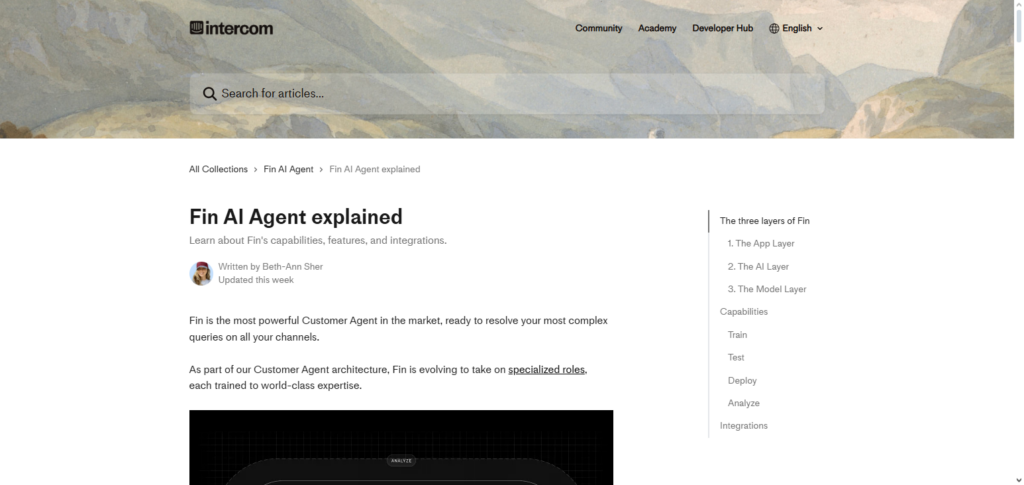
The AI is somewhat in the middle of the process, as it automates responses, qualifies, and routes high intent leads to the respective team members, while replying and engaging with the lower intent ones. It predicts behaviors and automates the responses to improve the business’s conversion rates and lower the churn.
It is a great tool that provides intent actionable insights (from business prediction models) to optimize campaigns and improve the overall business performance. The business is enhanced due to the actionable intent signals informing the efficiency of prediction models.
Intercom Fin AI Features
- Automated chat and email support powered by AI.
- Intent-driven lead assignment to appropriate teams.
- Client group classification for specialized engagement.
- Anticipatory analytics for predicting behaviors.
- Engagement and product usage metrics.
Intercom Fin AI Pros & Cons
| Pros | Cons |
|---|---|
| AI-driven automated support for chat and email. | Advanced predictive features require premium plans. |
| Lead routing and customer segmentation improves efficiency. | Can be complex for new users to configure. |
| Predictive analytics for behavior and engagement. | Focused more on SaaS and finance use cases. |
| Enhances customer retention and satisfaction. | Limited deep reporting for enterprise-level insights. |
| Reduces response time with automated workflows. | Customization may require technical expertise. |
7. Outreach Kaia AI
Outreach Kaia AI analyzes intent signals, which is achieved by monitoring and analyzing customer communications and engagement behaviors Best AI Tools for Customer Intent Prediction.
The AI scores prospects and based on that predicted likelihood of conversion, it takes business and customer engagement and action recommendations to prioritize follow ups, and suggest strategic messages to deploy, in addition to recommending task prioritizations.
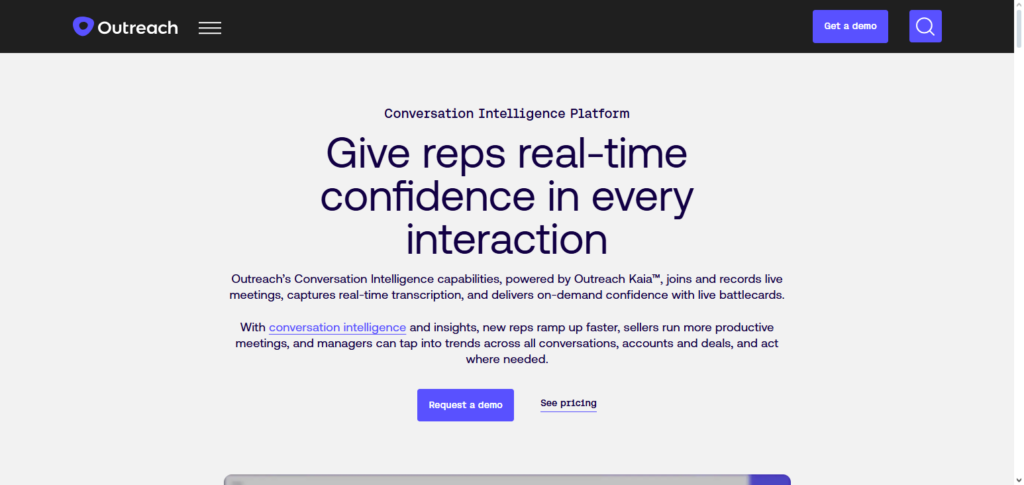
Kaia also provides recommendations on optimal engagement, timing, and content strategies that can be deployed to enhance the likelihood of closing the deal.
The predictive insights empower the sales team to prioritize high value prospects, and because of that the overall closing rates increase, hence driving better efficiency, effective revenue growth, and improved overall growth. The intent signals enhance the potential of available resources.
Outreach Kaia AI Features
- Recommendations for sales engagement powered by AI.
- Automated next-step action suggestions and follow-ups.
- There is task assignment to ease the focus on key prospects.
- More effective outreach through email and call suggestions.
- Performance metrics and analytics for strategy development.
Outreach Kaia AI Pros & Cons
| Pros | Cons |
|---|---|
| AI-driven sales engagement and follow-ups. | Primarily focused on sales; less useful for marketing teams. |
| Provides next-best-action recommendations. | Requires CRM integration for full functionality. |
| Prioritizes high-intent leads effectively. | Learning curve for new users. |
| Task automation improves productivity. | Smaller teams may not fully utilize all features. |
| Analytics help optimize outreach strategies. | Some advanced insights need paid tiers. |
8. 6sense Revenue AI
6sense Revenue AI utilizes account-level data, interaction details, and purchase history to predict customer intent. 6sense AI determines which accounts and contacts are currently in the buying consideration stage, prompting marketing and sales to prioritize those contacts.
During the process, it offers predictive intent insights and actionable recommendations, determining which campaigns to run, resource allocation, and messaging focus. 6sense consolidates historical and current data to accurately predict the future opportunity, improving closing rate and ROI on marketing spend. Users of 6sense are able to know the customer journey end to end and tailor engagement to.
6sense Revenue AI Features
- Forecasting revenue through analytics for details on each account.
- Behavior analysis of potential buyers to find high-intent accounts.
- Engagement across various channels for tailored communication.
- Enhanced pipeline accuracy through opportunity prediction.
- TA Prioritization for accounts and leads – higher intent scores equal higher priority.
6sense Revenue AI Pros & Cons
| Pros | Cons |
|---|---|
| Predictive revenue intelligence and account scoring. | Can be expensive for smaller organizations. |
| Multi-channel engagement recommendations. | Implementation can be complex and time-consuming. |
| Real-time insights into buying behavior. | May require dedicated resources to manage. |
| Forecasts opportunities to improve pipeline accuracy. | Some learning required for optimal use. |
| Helps prioritize high-intent accounts. | Focused on B2B; limited B2C application. |
9. Demandbase AI
Demandbase AI targets account based marketing and intent AI. It tracks cross-channel engagement with its AI and uses intent prediction to determine what accounts are in the market. It alerts marketers and sales professionals mid process with recommended messaging, suggested marketing and sales actions, and recommended prospects to focus on.
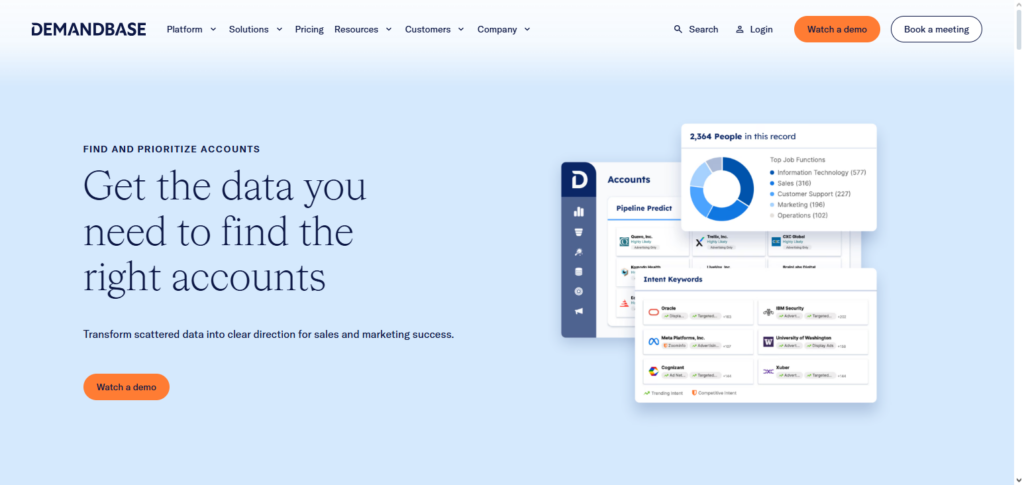
This predicted intent helps teams optimize their ABM strategies to become aligned and tackle high intent opportunities. Companies on the Demandbase AI model are able to target accounts at the right time, with the right message more efficiently, driving revenue impact.
Demandbase AI Features
- Account based marketing paired with intent prediction through AI.
- Behavioral tracking for digital engagement across various channels.
- Recognition of accounts with high-value potential and high intent.
- Outreach suggestions for personalized communication.
- Enhanced ABM tactics with suggestions for relevant and actionable conversions.
Demandbase AI Pros & Cons
| Pros | Cons |
|---|---|
| Strong account-based marketing and intent prediction. | Pricing may be high for smaller companies. |
| Tracks engagement across multiple channels. | Setup and integration can be complex. |
| Prioritizes high-value accounts for outreach. | Primarily B2B-focused; less useful for B2C. |
| Provides actionable insights for sales and marketing alignment. | Data-driven approach may require clean, organized data. |
| Enhances ABM strategies and improves conversion rates. | Some advanced analytics need technical expertise. |
10. Freshworks Freddy AI
Freshworks Freddy AI focuses on predicting customer intent via user behaviors through their CRM, customer support, and marketing software Best AI Tools for Customer Intent Prediction.
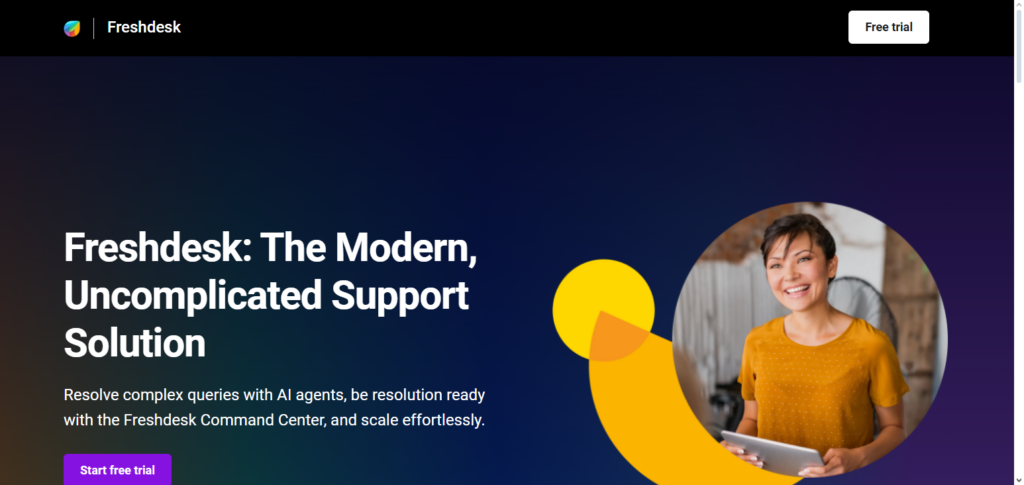
Freddy predicts customer purchasing and churn behaviors through their user transactions, engagement history, and channel of interaction. He provides automated recommendations and lead scores to sales and marketing teams to help them determine their next likely action on their prospect.
Freddy provides AI insights to help companies spend their sales and marketing efforts on high intent customers along with improving customer churn. Companies leveraging Freddy AI increase customer engagement through data-driven decisions and automated workflows ensuring the right steps are taken to maximize customer satisfaction.
Freshworks Freddy AI Features
- Anticipatory lead scoring to funnel focus on high potential prospects.
- Automated workflow integration across sales, assistance, and CRM support.
- Personalized AI suggestions to enable tailored communication.
- Customer journey touchpoints allow for clearer insights and improved decision-making.
- Lead and account conversions can be elevated through prioritization.
Freshworks Freddy AI Pros & Cons
| Pros | Cons |
|---|---|
| Predictive lead scoring and AI assistant capabilities. | Some advanced features require paid tiers. |
| Workflow automation for CRM, sales, and support. | Limited reporting in lower-tier plans. |
| Provides actionable insights across touchpoints. | Smaller businesses may not need full suite. |
| Helps prioritize high-intent prospects. | AI recommendations depend on data quality. |
| Improves customer engagement and conversions. | Setup may require initial learning. |
Benefits Of Best AI Tools for Customer Intent Prediction
Lead Prioritization: AI analyzes past customer interactions, engagement, and actions to predict intent and encourage and assist sales and marketing departments to focus on the leads which are the most likely to buy for the best use of time.
Sales Process Optimization: AI tools support sales teams by engaging and scoring leads automatically instead of requiring someone to do it manually.
Tailored Customer Communication: AI analyzes customer behavior and purchases to enhance customer relationships with personalized messages, offers, and content.
Improved Revenue Generation: Revenue increases as businesses focus on converting prospects with the highest intent levels.
Optimized Marketing: Based on marketing intent data, marketers no longer need to guess. They can optimize for better content, effective campaign delivery, appropriate budget spending, and campaign purpose.
Pre-Emptive Customer Engagement: Predictive tools reduce customer churn and improve customer satisfaction by predicting customer engagement.
Insight Generation: Teams can create actionable strategies from the tools actionable insights based on historical and real time data.
Conclusion
AI solutions are now essential for predicting client intent, which is crucial for contemporary sales, marketing, and customer success initiatives. While Gong.io and Chorus.ai are excellent at identifying intent signals in conversations, platforms like Salesforce Einstein AI and HubSpot AI CRM offer deep predictive analytics and tailored suggestions.
While Outreach Kaia AI and 6sense Revenue AI maximize sales outreach and account-based targeting, Drift AI and Intercom Fin AI improve real-time interaction with intelligent chat and automatic responses.
Intent data is used by Demandbase AI and Freshworks Freddy AI to efficiently prioritize leads and customize conversations. By precisely identifying and addressing customer intent, these solutions enable businesses to take advantage of predictive insights, boost conversion rates, improve customer experiences, and increase revenue.
FAQ
What are customer intent prediction AI tools?
Customer intent prediction AI tools use machine learning, predictive analytics, and behavioral data to identify which prospects or customers are most likely to take specific actions, such as making a purchase, upgrading a service, or engaging with content. These tools analyze past interactions, engagement patterns, and account-level data to provide actionable insights for sales, marketing, and customer success teams.
Why is predicting customer intent important?
Predicting customer intent helps businesses prioritize high-value leads, personalize outreach, optimize marketing campaigns, and improve conversion rates. By understanding what customers are likely to do next, teams can focus resources efficiently, reduce churn, and increase revenue while enhancing the overall customer experience.
Which AI tools are best for customer intent prediction?
Some of the top AI tools include Salesforce Einstein AI, HubSpot AI CRM, Gong.io AI, Chorus.ai (ZoomInfo), Drift AI, Intercom Fin AI, Outreach Kaia AI, 6sense Revenue AI, Demandbase AI, and Freshworks Freddy AI. Each offers unique capabilities like conversation analysis, account-level predictions, lead scoring, and automated engagement.
How do these AI tools predict customer intent?
These tools use algorithms to analyze historical data, customer interactions, web behavior, email engagement, and CRM activity. They detect patterns and signals that indicate readiness to buy, churn, or engage, and then generate scores, recommendations, or automated actions to guide sales and marketing strategies.
Can AI tools improve conversion rates?
Yes. By prioritizing high-intent leads and providing actionable insights, AI tools help sales and marketing teams focus on the prospects most likely to convert. Personalized engagement and timely interventions based on intent prediction significantly increase conversion rates and optimize the sales pipeline.