




The best AI tools for business intelligence that are revolutionizing data analysis and decision-making will be covered in this article.
These platforms offer automated insights, predictive forecasts, and real-time dashboards by utilizing artificial intelligence, machine learning, and natural language analytics. AI-powered BI solutions may boost productivity and spur data-driven growth for companies of all sizes.
What is AI-Powered Business Intelligence?
AI-Powered Business Intelligence (BI) produces more intelligent, quicker, and automated insights by fusing traditional BI features with artificial intelligence. AI-powered BI analyzes massive amounts of data in real time using machine learning, natural language processing, and predictive analytics, in contrast to traditional BI, which depends on manual reporting and dashboards.
Without much human assistance, AI can recognize patterns, predict trends, and offer practical advice. AI-powered BI helps businesses make data-driven choices more effectively by automating data preparation, anomaly identification, and report generation. In today’s data-driven world, this technology is becoming crucial for companies looking for precision, agility, and a competitive edge.
Benefits of Using AI in Business Intelligence
Reduced Time to Decide – AI analyzes large amounts of data and delivers real-time, actionable insights, allowing companies to make decisions faster.
Foreknowledge – AI algorithms can help to see potential future trends and/or shifts in customer and market behavior and help businesses adjust accordingly.
Process Automation – AI saves time by preparing data, identifying data inconsistencies, and drafting comprehensive reports.
Increased Reliability – AI reduces the chances of erroneous data analyses, resulting in more dependable and consistent insights.
Advanced Interpretation and Visualization – AI can provide reports and dashboards, including language-based interpretations that allow stakeholders to more thoroughly grasp complex data.
Advantage Over Competition – Organizations that implement AI-fueled business intelligence can anticipate changes in the market and make more data-based decisions, which allows them to stay ahead of their competitors.
Adaptability – AI can support decision-making processes for businesses of all sizes and efficiently manage the increased data volume that comes with business growth.
Deeper Customer Behavior Understanding – AI aids in optimizing marketing and personalizing customer interactions by evaluating their data.
Key Point & Best AI Tools for Business Intelligence List
| Platform | Key Point |
|---|---|
| Sisense Fusion AI | Combines embedded analytics with AI-driven insights, enabling businesses to integrate real-time, predictive analytics directly into applications with minimal technical complexity. |
| ThoughtSpot Sage AI | Uses natural language search and generative AI to let users ask complex business questions conversationally and receive instant, automated insights without SQL knowledge. |
| Zoho Analytics + Zia AI | Delivers affordable AI-powered analytics with smart alerts, automated data preparation, and conversational BI, making advanced insights accessible to SMBs and enterprises alike. |
| SAP BusinessObjects + AI | Enhances enterprise reporting with AI-assisted data discovery, predictive analysis, and governance-focused analytics tailored for SAP-centric ecosystems. |
| Oracle Analytics Cloud | Integrates machine learning across the analytics lifecycle, offering automated insights, forecasting, and scalable cloud-native BI for large enterprise environments. |
| IBM Cognos Analytics + Watson AI | Leverages Watson AI to automate data modeling, generate natural language insights, and provide explainable AI analytics for regulated industries. |
| Domo AI | Provides real-time, cloud-based analytics with embedded AI that supports predictive alerts, data storytelling, and executive-level decision intelligence. |
| Google Looker + Duet AI | Combines Looker’s semantic modeling with generative AI to deliver trusted, governed insights and natural language explanations across Google Cloud ecosystems. |
| TIBCO Spotfire + AI | Excels in advanced data science and visual analytics, enabling AI-driven pattern detection, geospatial analysis, and real-time operational intelligence. |
| MicroStrategy AI | Focuses on enterprise-grade AI analytics with Auto ML, hyper-intelligence, and secure semantic layers for large-scale, data-driven decision automation. |
1. Sisense Fusion AI
Sisense Fusion AI caters to businesses that need robust analytics integrated seamlessly into their applications and workflows.
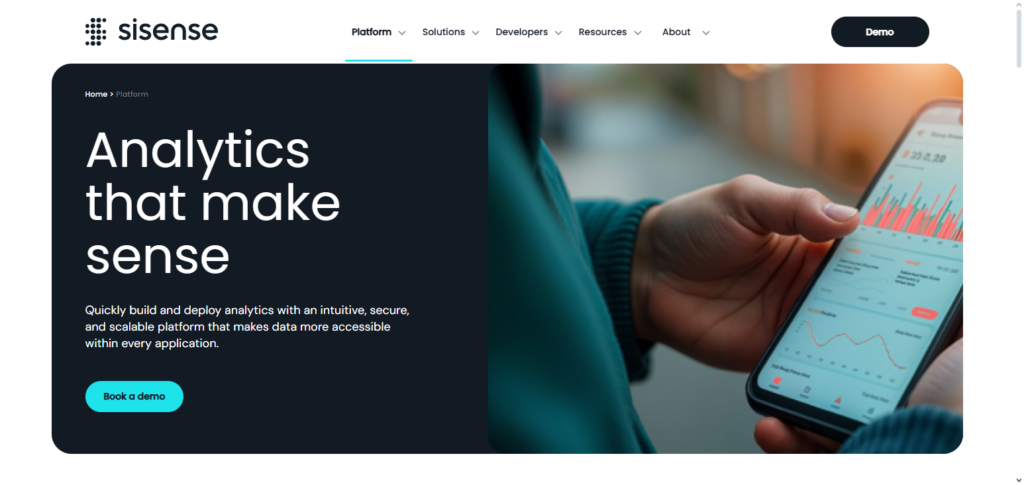
Fusion AI equips users with the ability to dissect complex data in real-time using AI-powered insights, automated forecasting, and predictive analytics. With the ability to connect and integrate data from the cloud, on-premise, and hybrid models, Fusion AI is scalable.
Sisense is often considered among the Best AI Tools for Business Intelligence because of its analytics engine that provides contextual insights without users having to cross any interaction thresholds. Sisense’s API-first architecture is a perfect fit for product-led, data-driven companies.
Sisense Fusion AI Features, Pros & Cons
Features
- Dashboards able to be customized and display in real time
- Analytics which is embedded and usable across applications
- Insights which are predictive and prescriptive
- Recommendations and alerting powered by AI
- Flexible APIs and data connectivity
Pros
- Enterprise workloads that are highly scalable
- Embedding workflows is seamless
- Insights that are generated rapidly using AI
- Integration that is simple with a variety of sources
- Analytics that are product-led
Cons
- Beginner’s high learning is required
- Higher priced tiers
- Complex configurations and setup
- Templates for built in features are limited
- Advanced features that require high knowledge
2. ThoughtSpot Sage AI
ThoughtSpot Sage AI integrates business intelligence with AI-driven natural language conversation and search. Business users can receive visual insights, trends, and explanations by asking questions, eliminating the need for complex SQL and data science scripting.
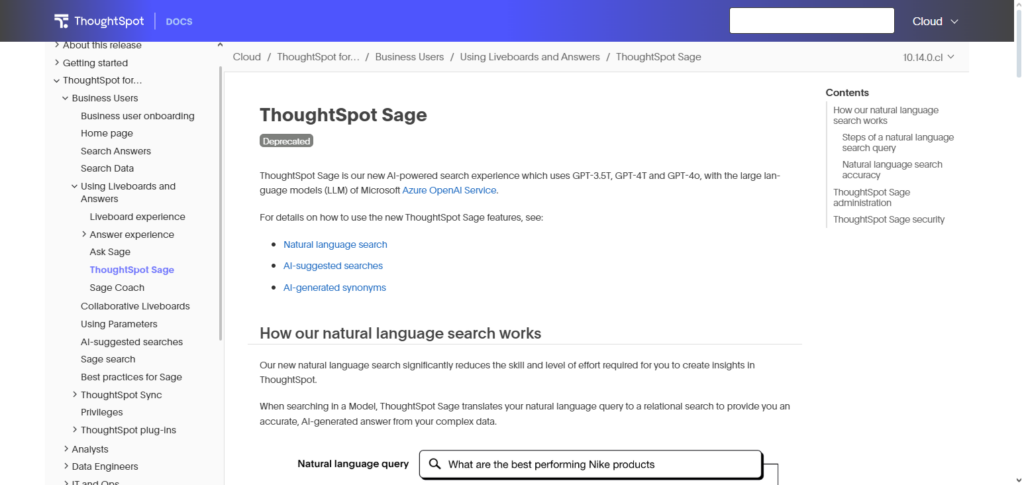
It provides automated insights and search-driven analytics. As one of the Best AI Tools for Business Intelligence, ThoughtSpot Sage AI streamlines decision-making by eliminating BI obstacles. ThoughtSpot Sage AI’s data governance and self-service analytics features make it appropriate for large, rapidly scaling companies and small to mid-sized companies.
ThoughtSpot Sage AI Features, Pros & Cons
Features
- Search with queries in natural language
- Insights, explanations are AI generated
- Automated suggestion of visualizations
- Dashboards live with alerts
- Models of data for enterprises that are governed
Pros
- Search interface that is friendly to business users
- No SQL is needed for insights
- Patterns and trends are detected quickly
- Analytics full service
- Governance of data is strong
Cons
- Licensing is expensive
- Visuals are less customizable
- NLP is not always perfect
- Models that require high data may need to be used
- Advanced training may be required for usage
3. Zoho Analytics + Zia AI
Zoho Analytics with Zia AI provides flexible and low-cost analytics for every business. Zia’s AI-powered technology helps users understand data by identifying trends, anomalies, and predictive insights via data preparation and intuitive analytics coupled with AI-driven alerts.
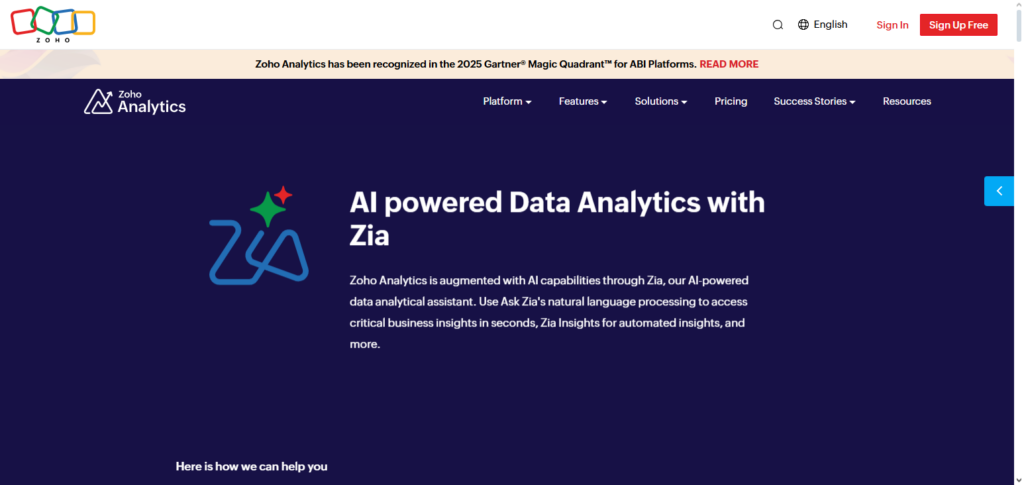
Zia AI even facilitates analytics through natural language and allows users to interrogate data. As one of the Best AI Tools for Business Intelligence, Zoho’s ease of use and analytics coupled with conversational AI make it attractive for small to mid-sized businesses requiring sophisticated analytics.
Zoho Analytics + Zia AI Features, Pros & Cons
Features
- Analytics conversation and Zia
- Predictive analytics and trend forecasting
- Alerts for smart mistakes
- Dashboarding drag and drop
- Integration with Zoho apps
Pros
- Reasonable price
- Simple to use for small and medium-sized businesses
- Strong integration ecosystem
- Ideal for cross-team reporting
- Rapid execution
Cons
- Advanced analytics depth is restricted
- Less powerful visualization options
- Bad for huge data lakes
- Less enterprise governance features
- Basic insights are sometimes AI
4. SAP BusinessObjects + AI
SAP BusinessObjects with AI capabilities focuses on reporting, analytics, and governance at an enterprise grade. It supports analysis with prediction, intelligent data discovery, and AI-assisted insights within advanced SAP environments.
The platform is great for companies who have invested in SAP ERP and data warehouses. SAP BusinessObjects is recognized in Best AI Tools for Business Intelligence. BusinessObjects focuses on data accuracy, compliance, and scalability.
Its AI features give automated insight generation and assist reporting, in the finance, manufacturing, and other regulated industries where analytics and structure controls are important, this is valuable. Suggesting data based insights is an important feature.
SAP BusinessObjects + AI Features, Pros & Cons
Features
- Reporting multi suite enterprise
- Data discovery with AI assistance
- Predictive and statistical analytics
- Centralized governance and security
- Integration with SAP ERP systems
Pros
- SAP-centered companies are wonderful for
- Compliance and governance are strong
- Reporting enterprise is reliable
- Platform analytics mature
- Control of data is consistent
Cons
- Complexity on the user interface
- Cost and licensing are high
- Time with steep implementation
- SAP Knowledge is needed
- Not very suitable for small businesses
5. Oracle Analytics Cloud
Analytics with Oracle Cloud is powered end to end with AI, this includes machine learning, automated insights, and more advanced forecasting. It provides data prep, analytics, visualization, and predictive modeling in one cloud-native platform. The solution integrates with Oracle enterprise apps and databases and supports multi-cloud.
Analytics Cloud scores within the Best AI Tools for Business Intelligence for its enterprise readiness and scalability. Analytics Cloud provides AI based suggestions and natural language for Oracle users. The complex data is simpler to understand, and more strategic and operational decisions are possible for large organizations.
Oracle Analytics Cloud Features, Pros & Cons
Features
- Analytics with engine in surveillance machine learning
- Insights in Natural Language
- Capabilities of predicting and cognitive
- Infrastructure in the cloud for scaling
- Preparation of data integrated
Pros
- Performance for enterprise grade
- Cloud scalability in strong
- Tools for deep modeling data
- Options for forecasting advanced
- Outstanding security posture
Cons
- Premium pricing
- Complex setup for new users
- Can be overwhelming for SMBs
- Best with Oracle ecosystem
- Requires training for advanced features
6. IBM Cognos Analytics + Watson AI
IBM Cognos Analytics Powered by Watson AI understands intelligent, explainable, and governed analytics. Watson AI streamlines the automation of data modeling, produces insights through natural language, and discovers patterns in hidden large datasets.
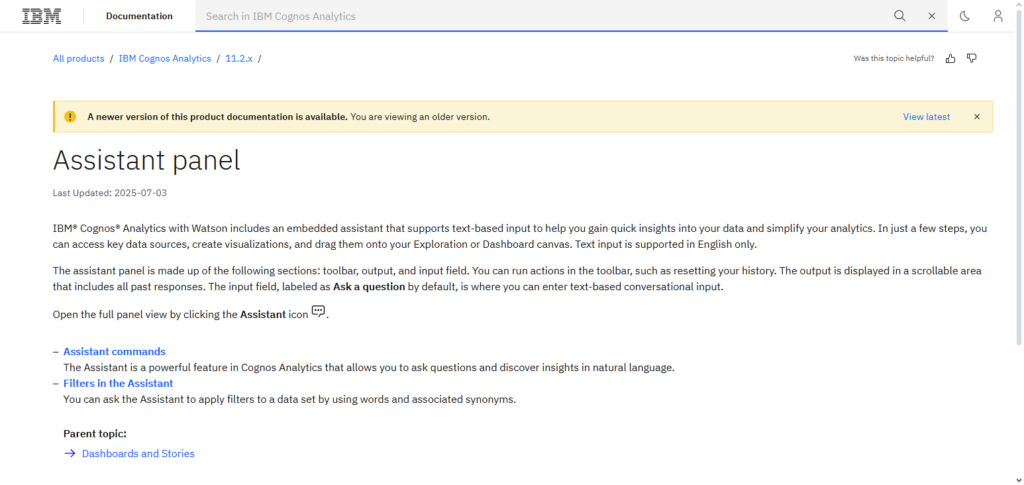
Cognos Analytics is heavily favored in the analytics realm, especially when it comes to compliance in regulated, high-risk industries. Cognos is consistently recognized as one of the Best AI Tools for Business Intelligence.
AI Assistant encourages exploration, fostering self-driven analytics that is especially useful for large enterprises that hinge their analytics on trust, compliance, and consistency in their decision-making processes.
IBM Cognos Analytics + Watson AI Features, Pros & Cons
Features
- AI‑assisted data modeling
- Natural language insight generation
- Explainable AI recommendations
- Self service analytics
- Customizable dashboards and reports
Pros
- Strong enterprise governance
- Trusted insights with Watson
- Good for regulated industries
- Scalable for large datasets
- Helps democratize reporting
Cons
- Can be difficult to learn
- Higher cost threshold
- UI can feel dated
- Can be difficult to set up in a cloud environment
- Advanced AI features need expertise
7. Domo AI
Domo AI is a cloud-native analytics platform built to support real-time business intelligence and executive decision support. It offers a combination of data integration, visualization, and AI-driven alerts all in one place. Domo’s AI capabilities offer predictive insights, the identification of anomalies, and automatically generated data storytelling across all business units.

Domo is recognized as one of the Best AI Tools for Business Intelligence and is a leader in operational intelligence and live dashboards. Domo is often the best choice for organizations that require real-time visibility into performance metrics and instant, data-driven actions due to its mobile-first design and collaboration capabilities.
Domo AI Features, Pros & Cons
Features
- Analytics bond platform
- Real Time reached KPI’s
- Predictive alerting
- AI‑powered data storytelling
- Collaboration
Pros
- Real Time actionable insights
- Collaboration platform
- User friendly Dashboards
- Good Mobile Access
- Analytical operational design
Cons
- Price is high
- Limited Custom
- Data prep work
- Learning curve
- Large data
8. Google Looker + Duet AI
Google Looker and Duet AI provide governed and semantic-driven analytics augmented with generative AI. Duet AI streamlines the analytics process and offers natural language explanations and summaries, while Looker’s modeling layer guarantees the same metric across all analyses.
Because it is directly integrated with Google Cloud, Looker + Duet AI offers analytics across contemporary data frameworks, and due to its position as one of the Best AI Tools for Business Intelligence, it has proven to be effective for data-centric organizations that need reliable analytics. The AI embedded into the system aids both advanced and novice users in completing data-centric tasks.
Google Looker + Duet AI Features, Pros & Cons
Features
- Narratives
- Metrics Modeling
- Data Exploration
- Google Cloud
- Dashboarding
Pros
- Metrics are trusted
- Scales easily
- Generative insights
- Data is governed well
- Real-time insights
Cons
- High costs
- Requires LookML
- Google Cloud dependent
- Limited on-prem
- Learning curve
9. TIBCO Spotfire + AI
TIBCO Spotfire with AI has garnered considerable attention for its smart mashups and advanced visual analytics, data science real-time intelligence, and augmentation. Spotfire also incorporates predictive modeling and smart pattern recognition and geospatial analytics for complex datasets.
Heavily used analytics in the energy, manufacturing, and life sciences industries also place it in the category of Best AI Tools for Business Intelligence for its predictive modeling and smart pattern recognition to suggest potential solutions for complex datasets. Its robust analytical capabilities, advanced scripting, and strong analytical engine also makes it highly valued by data scientists and analysts.
TIBCO Spotfire + AI Features, Pros & Cons
Features
- Visual analytics
- AI pattern detection
- Data science
- Real-time insights
- Geospatial analytics
Pros
- Visualization
- Analytical
- Data science
- Real-time
- Industry solutions
Cons
- Complexity
- Pricing
- Expertise
- Setup
- Powerful
10. MicroStrategy AI
MicroStrategy AI implements enterprise-level analytics that center on semantic modeling, automation, and security, including AutoML, hyper-intelligence, and AI dashboards that embed insights into workflows.
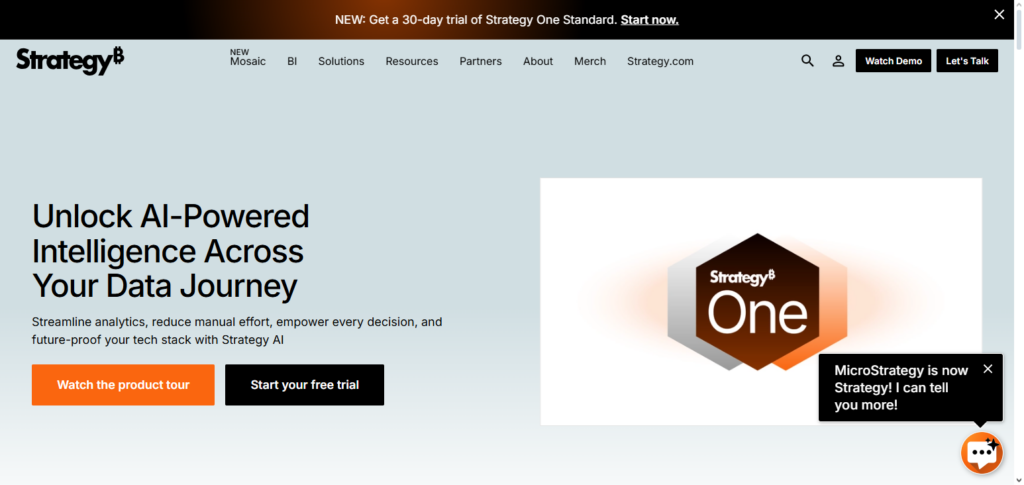
The analytics support large-scale deployments and critical analytics. MicroStrategy is known as one of the Best AI Tools for Business Intelligence due to its analytics consistency and its demand for high metrics. The analytics allow the automation of decision-making processes while keeping enterprise-level control, which is why global companies, and those with high data volume, use it a lot.
MicroStrategy AI Features, Pros & Cons
Features
- Machine Learning of AutoML
- Insights with hyper-intelligence
- Dashboards that are AI driven
- Security at the level of enterprise class
- Layering of semantic data
Pros
- Strong governance and great security
- Engine of analytics that are deep
- Metrics of the enterprise that are consistent
- AI analytics that are scalable
- Deployments that are large with good quality
Cons
- Implementation that is expensive
- Needs specialized knowledge
- High obstacles to learning
- May be unapproachable UI
- Not suited for basic reporting
Key Features to Look for in AI BI Tools
Natural Language Processing – AI enables users to query data in simple terms and get answers without knowledge of SQL.
Prescriptive and Predictive Analytics – AI provides insights to grow a business by identifying trends and making recommendations.
Dashboards and Alerts in Real-Time – Users can receive live updates and alerts to track performance.
Data Integration and Connectivity – It helps in analysis by supporting all data sources, whether cloud-based, on-premise, or third-party apps.
Superior Visualization – It makes data analysis simple by providing interactive reports and analytics in graphs and charts.
Reporting and Insights Automation – Without any human supervision, AI can produce reports, draw conclusions, and discover trends.
Security and Governance – Data and role-based access security, along with industry regulation compliance, are all provided.
Scalability and Flexibility – Efficient management of changing business needs and increasing datasets.
Collaboration Tools – Users can share insights, reports, and dashboards across teams in no time
User-Friendly Design – The interface is designed to accommodate all users, including non-technical personnel, for self-service analytics.
Conclusion
Artificial intelligence software for Business Intelligence is revolutionizing how enterprises assess data, extract meaningful insights, and scale decision-making. Companies such as Sisense, ThoughtSpot, Zoho Analytics, and others are demonstrating the various ways AI powered automation, Natural Language Processing (NLP) driven analytics, and predictive intelligence lessen the intricacy and enhance the precision with which automation and technology analyze data.
While the BI analytics tools mentioned previously use automation and advance technology to conduct versatile and complex analysis, they allow both analytical and non-analytical audiences to obtain reliable insights to analyze data and make important strategic decisions Loosely based on the previously mentioned insights, selecting an AI Business Intelligence (BI) analytical tool is dependent on an entity’s data maturity, scalability expectations, and governance.
Regardless of the dependency, the necessity for AI powered Business Intelligence tools to make decisions at an unprecedented rate and maintain a competitive edge is essential for the organization’s sustainable growth.
FAQ
What are the Best AI Tools for Business Intelligence?
The Best AI Tools for Business Intelligence include Sisense Fusion AI, ThoughtSpot Sage AI, Zoho Analytics with Zia AI, SAP BusinessObjects with AI, Oracle Analytics Cloud, IBM Cognos Analytics with Watson AI, Domo AI, Google Looker with Duet AI, TIBCO Spotfire with AI, and MicroStrategy AI. These platforms use machine learning, automation, and natural language analytics to deliver faster and more accurate business insights.
How do AI tools improve business intelligence?
AI enhances business intelligence by automating data preparation, identifying patterns, predicting trends, and generating natural language insights. This reduces manual analysis and enables real-time, data-driven decision-making.
Are AI business intelligence tools suitable for small businesses?
Yes, tools like Zoho Analytics + Zia AI and Domo AI are especially suitable for small and mid-sized businesses due to their affordability, ease of use, and cloud-based deployment.
What features should I look for in AI-powered BI tools?
Key features include automated data modeling, natural language queries, predictive analytics, real-time dashboards, data governance, scalability, and integration with existing data sources.
How do I choose the right AI tool for business intelligence?
Choose a tool based on your organization’s data complexity, budget, scalability needs, industry compliance requirements, and whether you prioritize self-service analytics or enterprise-grade governance.