

The top AI technologies for creating internal company chatbots that assist businesses in automating staff support, streamlining processes, and enhancing internal communication will be covered in this post.
Businesses can develop intelligent chatbots for HR, IT, and operations with these AI-powered platforms, improving productivity, efficiency, and employee experience across departments.
Why Use AI Tools for Building Internal Company Chatbots
Automate Repetitive Tasks: AI tools can assist in automating routine employee queries like password resets, policy checks, and onboarding queries, providing time and cost efficiency.
Increase Operational Efficiency: Internal chatbots enhance operational efficiency as they minimize request routing delays, trigger actions automatically, and lessen the need for manual processes.
Provide Instant, Accurate Answers: AI chatbots interpret and respond to queries in natural language and in real time, which facilitates better internal answering and office communication.
Support Employees 24/7: AI chatbots provide support regardless of time zones or time of day which ensures they remain uninterrupted.
Reduce IT and HR Workload: AI chatbots provide first level service so that HR and IT personnel can redirect their attention to higher order matters.
Improve Knowledge Accessibility: AI tools integrate chatbots with internal documents and knowledge bases to simplify information retrieval.
Ensure Consistent Communication: Chatbots deliver the same communication with no variations, which eliminates confusion and misinformation to the teams.
Scale Easily with Business Growth: AI tools can absorb additional volume of employee interactions cost free as no additional staff are required.
Enhance Employee Experience: Improved employee experience is a direct result of more conversational support that is prompt, and less frustration is noted.
Key Point & Best AI Tools for Building Internal Company Chatbots List
| Platform | Key Point |
|---|---|
| Microsoft Copilot Studio | Best for enterprises building AI copilots tightly integrated with Microsoft 365, Power Platform, Azure OpenAI, and Teams, offering low-code chatbot development with strong security. |
| IBM Watson Assistant | Ideal for regulated industries needing advanced NLP, intent recognition, and on-prem or hybrid deployment with enterprise-grade AI governance and analytics. |
| Google Dialogflow CX | Best for designing complex, state-based conversational flows with powerful Google NLP, visual flow builder, and seamless integration with Google Cloud services. |
| Amazon Lex | Suitable for AWS-centric businesses needing scalable voice and chat bots using the same AI as Alexa, with deep AWS service integration and pay-as-you-go pricing. |
| Salesforce Einstein Bots | Best for Salesforce users looking to automate customer support and CRM workflows directly within Service Cloud using AI-driven chat and case deflection. |
| SAP Conversational AI | Designed for SAP-centric enterprises to build chatbots that automate business processes and integrate deeply with SAP S/4HANA and SAP CX solutions. |
| Oracle Digital Assistant | Ideal for enterprises using Oracle Cloud, enabling AI chatbots that automate HR, finance, and ERP workflows with prebuilt skills and strong security. |
| Zoho Desk AI | Best for small to mid-sized businesses using Zoho ecosystem, offering AI-powered support bots for ticket deflection, sentiment analysis, and customer self-service. |
| Freshworks Freddy AI | Suitable for fast-growing support teams needing AI chatbots, predictive insights, and automation across Freshdesk and Freshchat platforms. |
| Cognigy.AI | Best for large enterprises building omnichannel, enterprise-grade conversational AI with advanced automation, NLP orchestration, and voice + chat capabilities. |
1. Microsoft Copilot Studio
Copilot Studio has recently become one of the Best AI Tools for Building Internal Company Chatbots due to its unique combination of generative AI, integration with Microsoft 365 and Azure, and its robust offerings for enterprise IT customers.
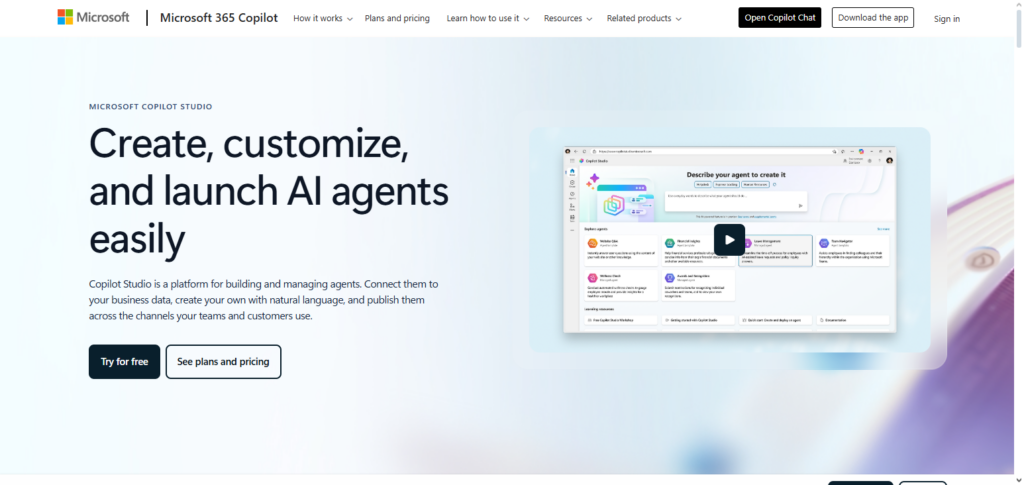
Copilot Studio allows clients to build contextually aware copilots which are able to understand and interact with 365 documents, calendars, emails, and other business data. As low-code offerings go, the developers on Microsoft Copilot Studio are able to create scalable, secure, enterprise internal chatbots which are able to automate employee workflows, respond to employee queries, business insights, and enterprise systems.
Copilot’s governance, and integration with Microsoft’s other offerings rank it one of the best tools for building internal company chatbots.
Microsoft Copilot Studio Features , Pros & Cons
Features
- Full integration with Microsoft 365 and Teams.
- Offers low-code solutions for building chatbots.
- Provides context and understands natural speech.
- Compliant secure enterprise governance.
- Provides insights on analytics and usage.
Pros
- Ability to work seamlessly with the Microsoft ecosystem.
- Offers a high level of security and confidentiality.
- Creates low-code solutions.
- Company data is analyzed and insights are provided.
- Integrates seamlessly with Teams and Outlook.
Cons
- Best optimized if integrated with Microsoft services.
- Licensing can be lengthy and complicated.
- Less adaptable outside of the Microsoft ecosystem.
- Building advanced bots may require some knowledge of Azure.
- Voice-first bots are not the best fit for Microsoft Copilot Studio.
2. IBM Watson Assistant
Unlike all of the providers of Best AI Tools for Building Internal Company Chatbots, IBM Watson Assistant is the only one that has advanced NLU and intent recognition capabilities. Watson Assistant can teach internal communication Chatbots context, customizable dialogues, and integrations with backend systems so that Chatbots can respond accurately to HR, IT, or operational inquiries.
Enterprises, analytics, and hybrid deployment help to ensure watson’s data governance practices and to keep sensitive corporate data secure. IBM Watson is one of the most optimal options for enterprises who need internal conversational AI to bolster productivity and improve the employee experience, given its watson Assistant capabilities and hybrid deployment along with its governance practices for sensitive corporate data.
IBM Watson Assistant Features, Pros & Cons
Features
- Supported advanced natural language understanding and intent detection.
- Flexibility to choose between hybrid and on-premise deployment.
- Ability to create custom dialog flows.
- Provides analysis and reporting on chatbots.
- Offers deployment on multiple channels.
Pros
- Highly secure data and information confidentiality.
- Good for internal complex corporate work and flows.
- Questions and concerns are responded to quickly and efficiently.
- Allows flexibility in corporate and organizational structures.
- Excellent natural language processing capabilities.
Cons
- More complicated and circular learning is to be expected.
- Overall pricing tends to be on the higher end.
- More complex for those with little to no experience.
- Layout and UI can be quite confusing for some users.
- Knowledge and expertise are required to build advanced bots.
3. Google Dialogflow CX
Creating complex conversational tasks and automating processes using a flow builder and natural language processing system is what Dialogflow CX does Best AI Tools for Building Internal Company Chatbots .
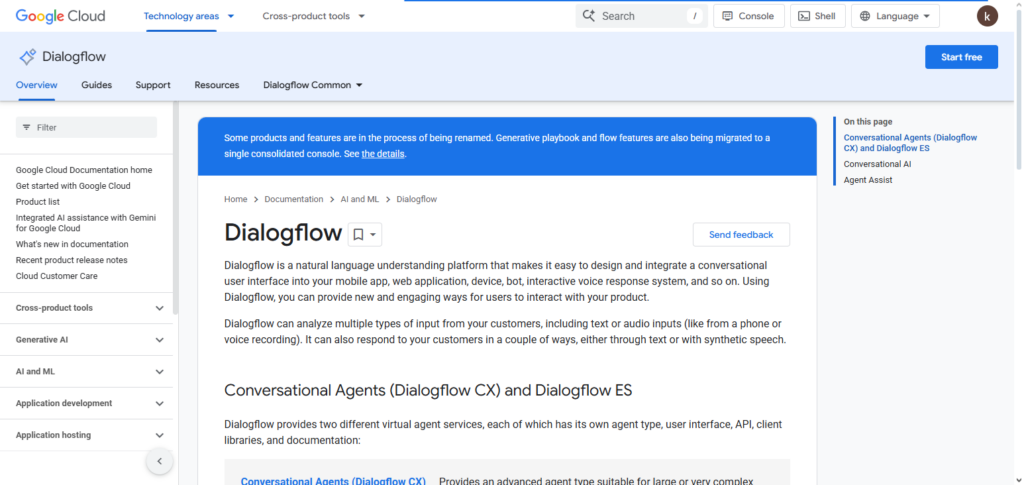
For internal company chatbots, Dialogflow CX enables teams to create complex conversational automations to provide employee support, automate access, and knowledge bases tasks. The ability to automate these is integrated into the Google Cloud for deployment.
Being able to gently manage these automations without friction is in the core value of Dialogflow CX. Having the automations deeply integrated into cloud and natively deploying across apps creates value in internal chatbot corporate solutions. The ability to customize puts Dialogflow CX is among the best solutions for corporates to use.
Google Dialogflow CX Features, Pros & Cons
Features
- Conversational flow builder tool
- Stateful conversations & context management
- Natural Language Processing using Google Cloud
- Several supported languages
- Channels can be integrated easily
Pros
- Natural language understanding of user text is top-tier
- Supports bots of various complexity
- Flow of the bot can be edited visually thus simplifying the design
- Google Cloud can be relied on for robust infrastructure
- Google Cloud can easily accommodate apps as they grow
Cons
- Steep learning curve for entry-level users
- Cost can be excessive depending on usage
- Understanding cloud technology is a requirement
- Can be difficult to track and fix bugs
- Main service users will be Google Cloud
4. Amazon Lex
Amazon Lex is the AWS machine learning platform that powers Amazon Alexa, enabling organizations to develop voice and text Best AI Tools for Building Internal Company Chatbots. Lex has the potential to automate support desk queries and streamline help-desk support functions for internal chatbots, While assisting employees with IT or HR tasks.
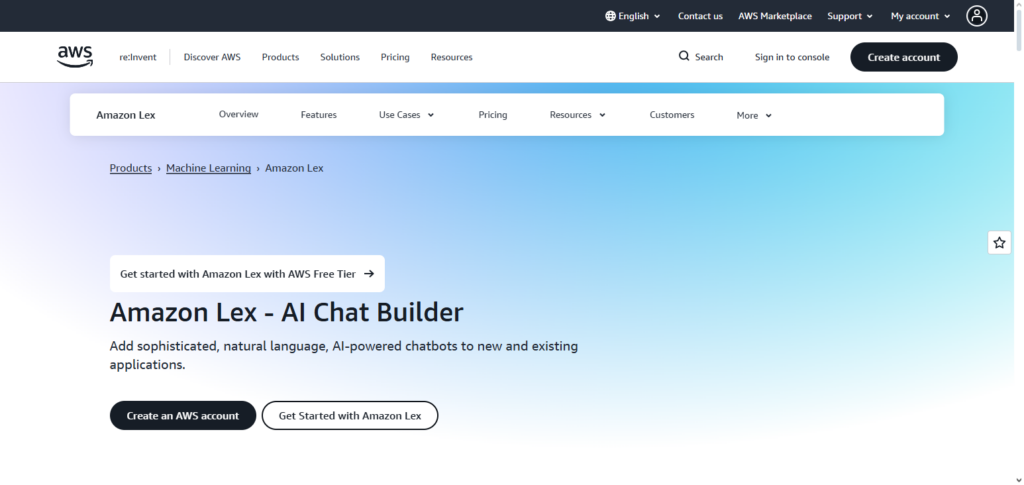
Lex is compatible with numerous AWS services such as Lambda and DynamoDB for backend logic, data storage, and CloudWatch for monitoring functions.
The service is scalable and has a pay-as-you-go pricing model visible throughout the entirety of the AWS cloud infrastructure. Lex is one of the top speech and text processing tools enabling companies to develop internal chatbots.
Amazon Lex Features, Pros & Cons
Features
- Supports both text and voice
- Integrates with the AWS Ecosystem
- Multi-intent and slot fulfilling capabilities
- Supports serverless logic using AWS Lambda
- Integrates with CloudWatch
Pros
- Same technology as voice-activated Alexa
- Fantastic technology for voice bots
- Service can be extended easily
- Integrates with lots of AWS services
- Costs per use
Cons
- Most benefits when used with AWS Ecosystem
- Costs can become excessive with scale
- Requires understanding of AWS services
- Doesn’t support a visual bot builder
- Same for integrated services, analytics are limited
5. Salesforce Einstein Bots
The goal of Einstein Bots is to enhance CRM workflows using intelligent chat automation within Salesforce Service Cloud. For company internal chatbots, they can be used to automate employee service requests, assist in case creation, and retrieve relevant data from the CRM without an agent.
Being closely integrated within the Salesforce objects, flows, and analytics, the bots can tailor their responses to individual users depending on their role, activity history, and the internal processes they are involved in.
Organizations can improve their response time and overall employee satisfaction with the AI prediction capabilities and access to Salesforce data. These features are what make Einstein Bots stand out as top-tier AI solutions for developing internal chatbots integrated with enterprise CRM systems.
Salesforce Einstein Bots Features, Pros & Cons
Features
- Automation of CRM tasks by use of bots
- Integration with Salesforce is seamless
- Workflows allowing for case deflection
- AI to suggest answers
- Analytics provided
Pros
- Best and most useful for those with access to Salesforce
- Better employee support operations
- Pre-built access to CRM data
- Low-code configurations
- Reporting and dashboards
Cons
- Limited outside Salesforce
- Limited advanced NLP
- Service Cloud required
- Less customization
- Licensing costs stack up
6. SAP Conversational AI
SAP Conversational AI provides a wide range of services encompassing designing, training, and implementing AI-enabled chatbots that seamlessly connect with various SAP systems like S4/HANA and SuccessFactors Best AI Tools for Building Internal Company Chatbots.
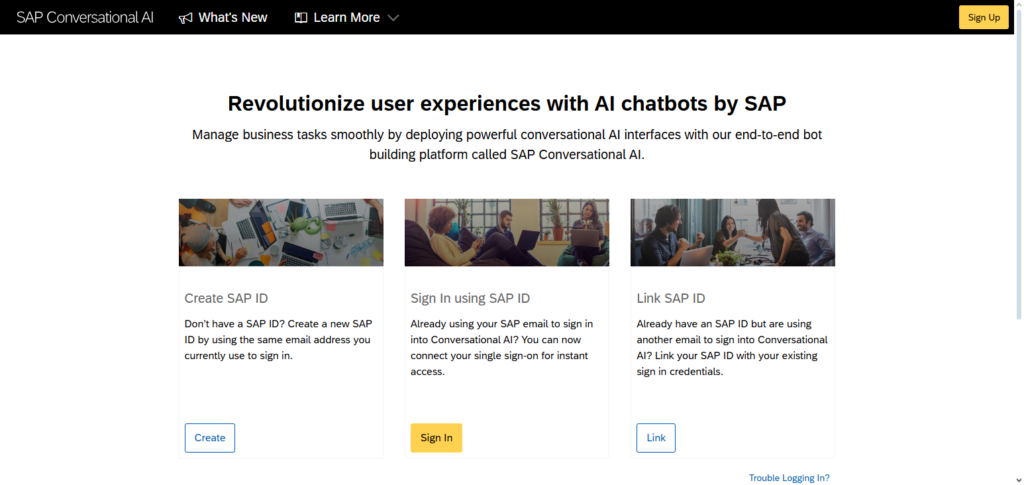
For internal tasks, it automates HR related queries, authorization of finance requests, and operational assistance with the SAP data contextual. Collaborative building of bots and lifecycle management features streamline cross departmental scaling of conversational solutions.
From training intent models to overseeing multilingual bots, Conversational AI addresses the sophistication of large enterprises. This is why it is widely recognized as the best AI chatbots for internal use, particularly in SAP organizations.
SAP Conversational AI Features, Pros & Cons
Features
- Deep SAP stack integration
- Joint bot development
- Training in multiple languages
- Management of intents and entities
- Tools for managing lifecycle
Pros
- Made for SAP customers
- Advanced automation for enterprises
- Internal HR and finance bots
- Training of bots centralized
- Excellent support for multiple languages
Cons
- Best within SAP ecosystem
- Technical setup
- Limited outside SAP applications
- Enterprise-priced
- For beginners, there is a learning curve
7. Oracle Digital Assistant
An all-encompassing AI Best AI Tools for Building Internal Company Chatbots , Oracle Digital Assistant, creates conversational bots that interconnect HR, finance, and CRM business systems.
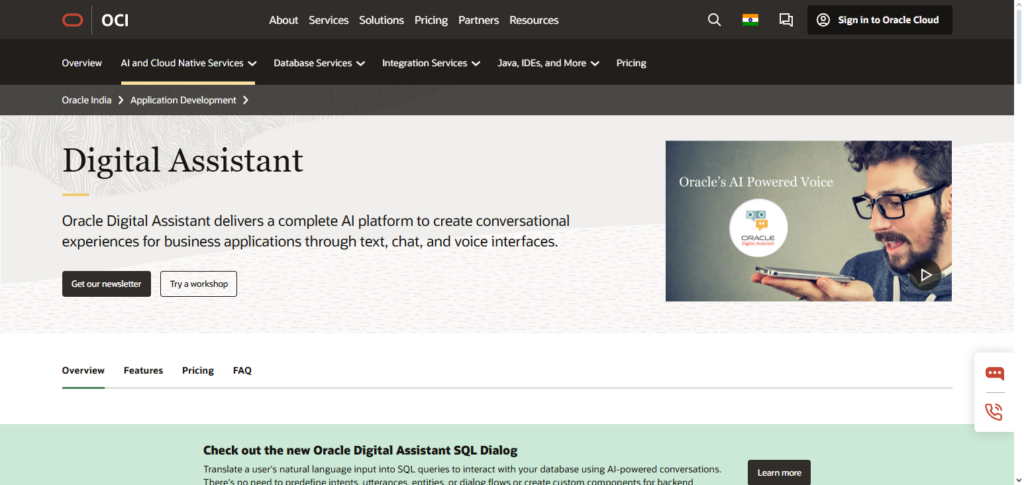
It has pre-configured, industry-specific skills and templates that streamline the automation of internal chatbots that answer employee inquiries, automate administrative tasks, and facilitate task routing. Oracle Digital Assistant combines sophisticated multi-channel functioning, internal chatbot shielding, and corporate policy adherence for reliable chatbot performances.
Integration with Oracle Cloud applications built information accessibility and process automation. These factors promoted Oracle Digital Assistant to the upper echelon for the automation of internal company chatbots.
Oracle Digital Assistant Features, Pros & Cons
Features
- Skills for assistants are pre-built
- Integration with Oracle Cloud
- Deployment on multiple channels
- Provides insights and analytics
- Enterprise-grade security
Pros
- Excellent security & compliance
- HR and finance use cases are good
- Cross-channel deployment is easy
- Supports Oracle Cloud services
- Skills customization is flexible
Cons
- Best with Oracle stack
- Could be expensive
- Not very user-friendly
- Needs customization and training
- Less support for third-party integration
8. Zoho Desk AI
Zoho Desk AI automates functions in the help desk suite to allow for the customers to employ internal chatbots for their employees IT service requests, searches in the knowledge base, and updates status of tickets. Desk AI automates the categorization of service desk issues using AI, solution recommendation, and response training.
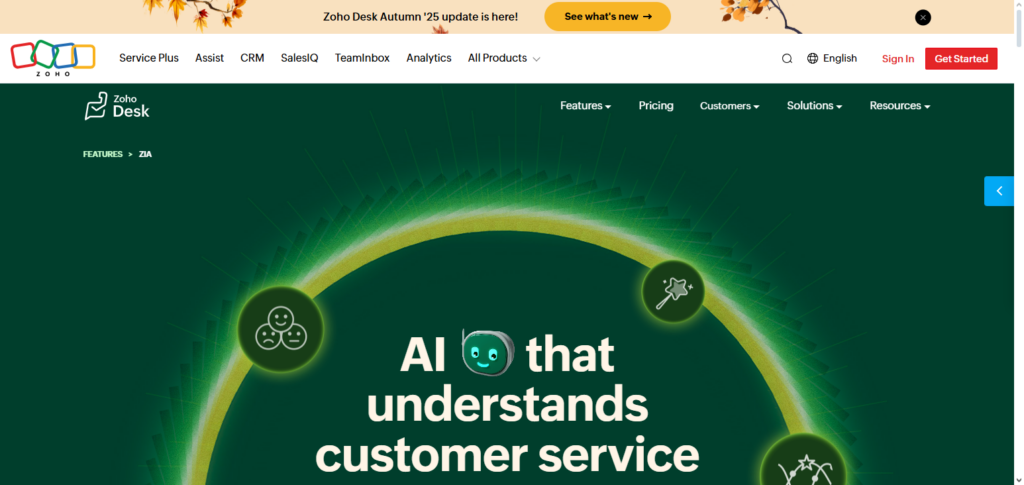
For customers in the Zoho ecosystem, Desk AI requires low effort to set up, offers built in data analysis and allows for internal software integration. Low cost and user friendly features appeal to small and medium size businesses that want to implement internal conversational support without extensive software development. Such strong advantages of the product make the AI and its internal Chatbots for the desk suite automation stand out in the market.
Zoho Desk AI Features, Pros & Cons
Features
- Classifying tickets with AI
- Providing auto-response suggestions
- Integrating with the knowledge base
- Providing sentiment insights
- Quick and easy set up
Pros
- Very helpful for small and medium business
- Low pricing
- Quick deployment
- Works well in the Zoho ecosystem
- Improves internal help desk productivity
Cons
- Insufficient advanced natural language processing
- Works best with the Zoho suite
- Less effective than the bots made for bigger enterprises
- Analytics are basic
- Not suited for complicated workflows
9. Freshworks Freddy AI
Freshworks Freddy AI allows companies to create AI chatbots with predictive analytics and conversational AI across support Best AI Tools for Building Internal Company Chatbots . For company internal chatbots, Freddy can self-service common queries, automate repetitive workflows, and escalate advanced queries to the appropriate team.
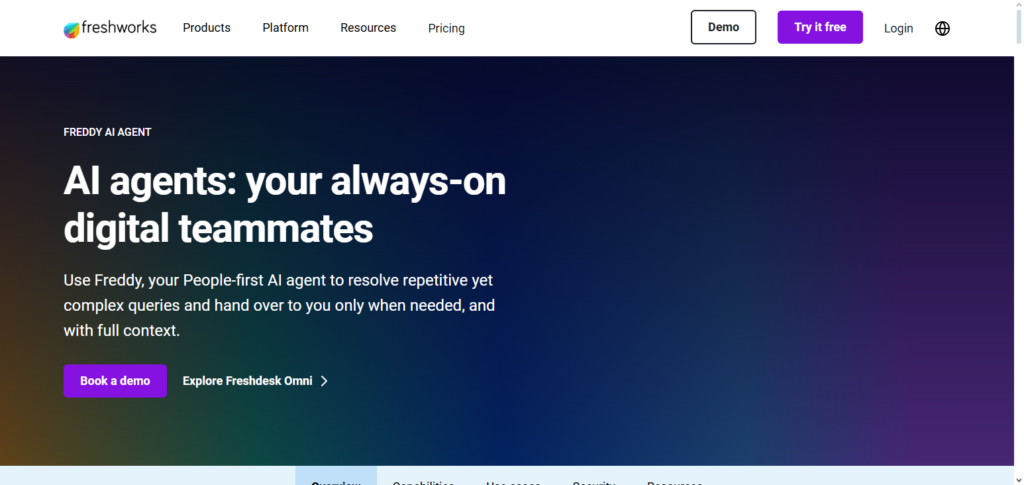
Connected to Freshdesk and Freshchat, Freddy offers internal support automation with contextual analytics, process automation and sentiment analysis. Freddy is easy to use, with a modern design and template acceleration, and is fast to configure with powerful automation to support employee self-service. This makes Freshworks Freddy AI one of the top contenders for internal enterprise chatbots.
Freshworks Freddy AI Features, Pros & Cons
Features
- Auto suggestions, powered by AI
- Connects with Freshdesk & Freshchat
- Assists with predictions
- Support across multiple channels
- Automation bots
Pros
- Simple interface for users
- Great for service desk automation
- Quick configuration
- Analytics is included
- Low cost
Cons
- Not as in-depth NLP as the top competitors
- Best when paired with the Freshworks ecosystem
- Fewer options for customization
- Limited in voice features
- Lacks controls for large businesses
10. Cognigy.AI
Cognigy.AI is a leading enterprise solution for the development of conversational AI across voice and digital touchpoints with automation and orchestration of NLP that exceeds industry Best AI Tools for Building Internal Company Chatbots .
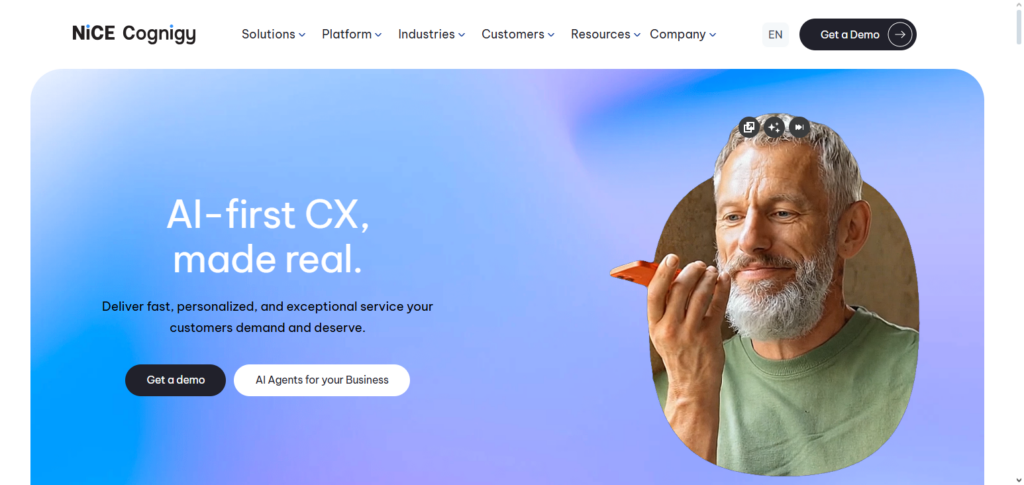
For internal company chatbots, Cognigy allows disparate teams to create sophisticated dialog flows, automate workflows, and seamlessly connect to backend systems for scaled bot management.
With a unified architecture for omnichannel support, enterprise-grade context switching, and fluid integration with internal systems, Cognigy is enterprise focused and tailored for high-complexity internal use cases like HR chatbots, IT helpdesks, and process assistants. These factors combined make Cognigy.AI a leading choice for sophisticated internal chatbots and enterprise AI.
Cognigy.AI Features, Pros & Cons
Features
- Platform for all messaging channels
- Excellent orchestration of NLP
- Security and compliance for enterprises
- Integrates with internal systems
- Dual support for voice and text
Pros
- Best fit for large complex bots
- Great for integrations
- Managing context is advanced
- Support for multiple regions
- Can use both voice and text
Cons
- Costly for large companies
- Small companies won’t benefit as much.
- Experience required for setup.
- Takes time to learn.
- Additional education needed.
Benefits Of AI Tools for Building Internal Company Chatbots
Enhanced Productivity: Internal company chatbots help to enhance overall workforce productivity by allowing employees to receive self-service answers to HR, IT, and operational queries, thus minimizing the time spent looking for company information.
Support at All Times: Employee AI chatbots never go offline, meaning that the employees will not have to wait for support hours to receive assistance.
Less IT and HR Workload: Chatbots AI reduces the burden for HR and IT support personnel by answering queries that can easily be automated and by resolving routine tasks.
Improved Speed: The use of AI chatbots are more effective than support traditional channels as they accurately respond to queries without the need to queue for a ticket to be created.
Integration: AI chatbots are able to respond to queries due to easy integration with other company systems such as HRMS, CRM, ERP and knowledge bases.
Equal and Accurate Responses: Chatbots AI reduces the discrepancy of information provided to employees as the bots respond to queries at the same time and have set parameters that they have to utilize in answering queries.
Flexible Availability: AI chatbots can respond to unlimited queries which is why they are great for big companies.
Less Cost: By automating internal support there is a decrease in employment, training and repetitive admin tasks.
Better Employee Experience: Employees will be more engaged and satisfied with the company when they get assistance quickly.
Conclusion
Your organization’s size, current technology stack, security requirements, and automation objectives all play a role in selecting the best AI technologies for developing internal company chatbots.
Large enterprises benefit greatly from platforms like Microsoft Copilot Studio, IBM Watson Assistant, and Google Dialogflow CX because of their superior enterprise-grade NLP, scalability, and secure integrations.
For small and mid-sized organizations, products like Zoho Desk AI and Freshworks Freddy AI provide affordable, simple-to-implement solutions. For intricate workflows and extensive corporate system integration, cutting-edge solutions like Oracle Digital Assistant, SAP Conversational AI, and Cognigy.AI stand out.
All things considered, an effective internal chatbot platform increases worker productivity, simplifies processes, and provides quicker information access within the company.
FAQ
What are internal company chatbots?
Internal company chatbots are AI-powered assistants designed to help employees with routine tasks, answer questions, automate workflows (e.g., HR, IT support, knowledge access), and improve overall productivity within an organization.
Why use AI tools for internal chatbots?
AI tools add natural language understanding, automation, and context awareness to chatbots. They help employees get accurate answers quickly, reduce support overhead, and streamline business processes across departments.
Which platforms are best for enterprise-level internal chatbots?
Platforms like Microsoft Copilot Studio, IBM Watson Assistant, Google Dialogflow CX, and Cognigy.AI are excellent choices for large enterprises due to their advanced NLP, scalability, and robust integrations with backend systems.
Are there tools suited for small to mid-sized businesses?
Yes, solutions like Zoho Desk AI and Freshworks Freddy AI offer affordable, easy-to-use chatbot capabilities that integrate well with existing business tools and require minimal development expertise.
Can these chatbots integrate with company systems like HR or CRM?
Absolutely. Most modern chatbot platforms support integrations with HR systems, CRM tools, knowledge bases, ticketing systems, and databases—making them highly useful for internal operations.