



The top AI orchestration platforms for end-to-end automation will be covered in this article, with an emphasis on solutions that combine RPA, workflow automation, and AI to simplify intricate business procedures.
These systems assist businesses in scaling intelligent automation, improving accuracy, and doing away with human labor. You’ll learn which solutions offer the best AI-driven performance, efficiency, and integration.
Key Point & Best AI orchestration platforms for end-to-end automation List
| Platform | Core Function | AI Capabilities | Best For | Key Strength |
|---|---|---|---|---|
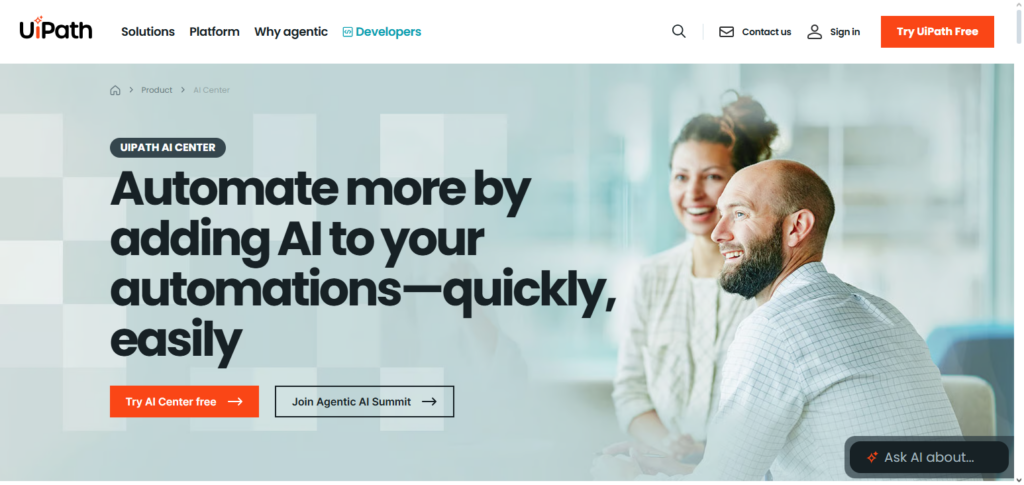
| UiPath AI Center | End-to-end automation with AI model deployment | ML model training, document understanding, AI skills | Enterprises scaling RPA with embedded AI | Strong integration with UiPath ecosystem |
| IBM Watson Orchestrate | Digital worker orchestration | NLP, conversational AI, workflow automation | HR, sales & operations teams | Pre-built skills for enterprise functions |
| Microsoft Power Automate + Copilot | Low-code automation + generative AI | Copilot AI prompts, NLP automation, connectors | Microsoft-centric workflows | Deep Office 365 & Azure integration |
| Automation Anywhere + AARI | Cloud-native RPA & AI assistant | NLP bots, predictive insights, process intelligence | Large enterprises with distributed teams | Human-bot collaboration through AARI |
| ServiceNow AI Orchestration | Workflow automation for IT & enterprise ops | AI search, predictive intelligence, generative AI | ITSM, ITOM, enterprise service workflows | Unified Now Platform integration |
| WorkFusion AI Digital Workers | Pre-built AI digital workforce | NLP, ML, decision automation | Compliance, KYC, financial institutions | Ready-to-use digital workers for regulated tasks |
| Cognizant Neuro AI | AI-powered automation framework | GenAI, process discovery, AI orchestration | Complex enterprise transformation | Consulting-led automation with scalable AI |
| Appian AI Process Automation | Low-code process automation | AI-assisted modeling, data fabric AI, genAI | Process-heavy industries needing speed | Unified low-code + workflow + AI platform |
| DataRobot AI Platform | Enterprise AI/ML lifecycle automation | AutoML, MLOps, predictive AI | Data-driven automation & analytics | Strong predictive modeling & deployment tools |
| TIBCO AI Orchestrator | Integration-driven automation | Real-time analytics, ML orchestration | Enterprises needing data orchestration | Strong connectivity & analytics layer |
1. UiPath AI Center
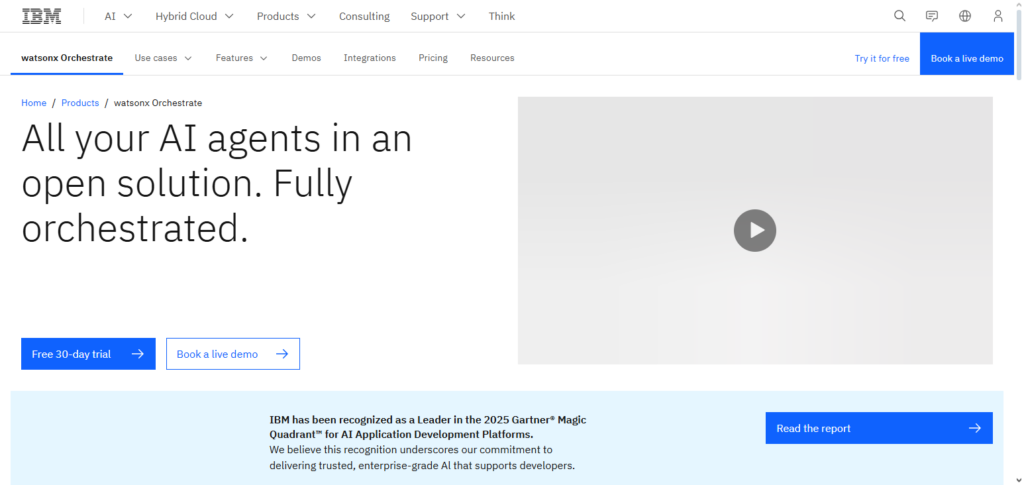
IBM Watson Orchestrate is an Orchestraction AI tool specializing in automating everyday operational functions in HR, sales, and enterprise services. Fully capable of utilizing conversational AI and Natural Language Processing (NLP), Watson Orchestrate assists digital employees in comprehending and completing tasks without any human intervention.
Watson Orchestrate is considered one of the best AI Orchestraction tools for end-to-end Automation due to employees’ ability to automate workflow in seconds by simply requesting the system to do so. It is fully integrated with enterprise applications such as Salesforce, SAP, and Workday and offers strong AI reasoning, decision, and compliance-making abilities to suit any Fortune 500’s needs.
Pros & Cons UiPath AI Center
Pros
- Has a strong relationship and link with UiPath RPA ecosystem.
- Able to support specialized ML models and has advanced understanding and comprehension of documents.
- Outstanding level of industry monitoring, governance, and efficiency.
Cons
- AIs and ML knowledge about its workings to be able to use it for advanced use.
- For small business teams, pricing can be quite steep.
- Complexity of deployment within hybrid environments.
2. IBM Watson Orchestrate
Microsoft Power Automate with added Copilot functionality offers low-code process automation with the support of Generative AI. Automation of workflows by users can be accomplished with simple natural language prompting, using connectors throughout Microsoft 365, Microsoft Dynamics, and Microsoft Azure, in addition to thousands of other third-party applications.
Copilot stands as one of the Best AI orchestration platforms for end-to-end automation due to its ability to interpret and respond to user prompts designed to create complex automations in seconds.
The suite also encompasses Robotic Process Automation, Cloud Flows, AI Builder models, and enterprise-grade security and compliance governance. Unsurpassed integration with Microsoft’s software applications enhances its appeal to customers for whom digital operational transformation is a priority.
Pros & Cons IBM Watson Orchestrate
Pros
- One of the leading in NLP and conversational AI.
- Has specialized features and functions in HR, sales and operational activities.
- Outstanding business protective measures, strong compliance and security.
Cons
- Less workflow moderation for smaller and less complex.
- Varying integration depth encompasses the different tools.
- Hefty pricing for businesses that are in the mid-range.
3. Microsoft Power Automate + Copilot
Copilot and Power Automate is best suited for low-code automation among Microsoft offerings. With the incorporation of generative AI, users can build their own workflows in natural language. Microsoft 365, Dynamics, Azure, and thousands of third-party applications can be used with the connectors available to users.
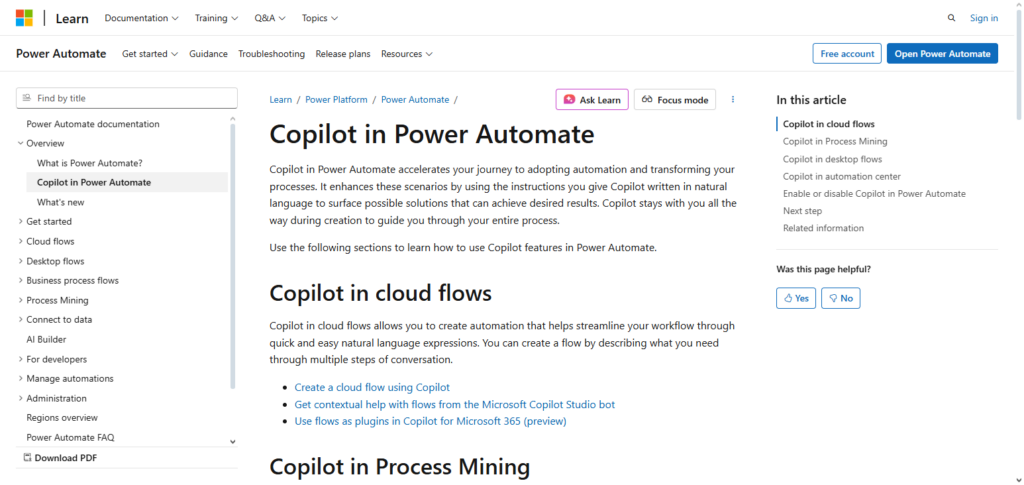
The Copilot’s interpretation of users’ automation design prompts makes it one of the best AI orchestration platforms for end-to-end automation as it helps users build their workflows in seconds. Microsoft’s deep integration of multiple applications makes it a preferred choice among organizations in need of digital operation modernization.
Pros & Cons Microsoft Power Automate + Copilot
Pros
- Has the simplest form of low-code automation which can be done by the use of conversational prompts.
- Super integrated with the use of Microsoft 365 and azure cloud.
- Has a very large library of connectors that can be used to create cross-platform workflows
Cons
- Productivity level is highly compromised due to the complexities of automation.
- Availability of features in the lower tiers of a given plan can be scarce.
- A high level of reliance on Microsoft ecosystem.
4. Automation Anywhere + AARI
Automation Anywhere with its AARI digital assistant provides a cloud-native automation environment that facilitates business processes with automation and AI bots.
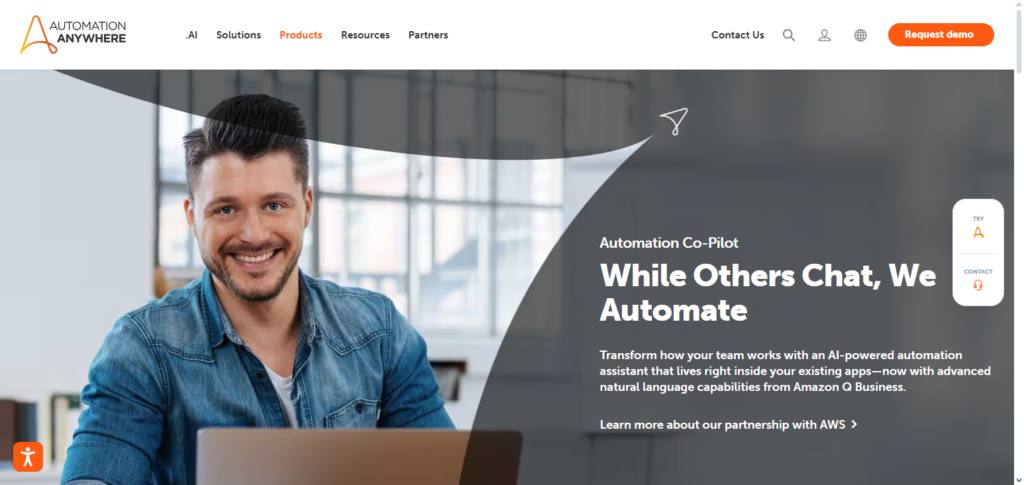
AARI synapses enhance real-time analytics. AARI allows front and back-office teams to communicate with automation and AI bots through a graphical user interface. This characteristic makes AARI one of the Best AI orchestration platforms for end-to-end automation in organizations.
AARI automation can be scaled for extensive automation processes along with demand for automation and cloud capabilities. Enterprises can monitor the automation for large-scale deployments due to Automation Anywhere’s cloud architecture.
Pros & Cons Automation Anywhere + AARI
Pros
- Has a cloud-native structure that aids and facilitates rapid deployment of systems.
- For AARI assistants, collaboration of seamless human and intelligent bots is made possible.
- Has advanced level of bot management and analytics.
Cons
- Might be resource-heavy when managing several bots.
- There is a learning curve with the development tools concerning the bots.
- There is a chance that the pricing will stack up as you scale up.
5. ServiceNow AI Orchestration
ServiceNow AI Orchestration expands the Now Platform with sophisticated artificial intelligence and automation for workflows designed for ITSM, ITOM, HR, and enterprise operations.
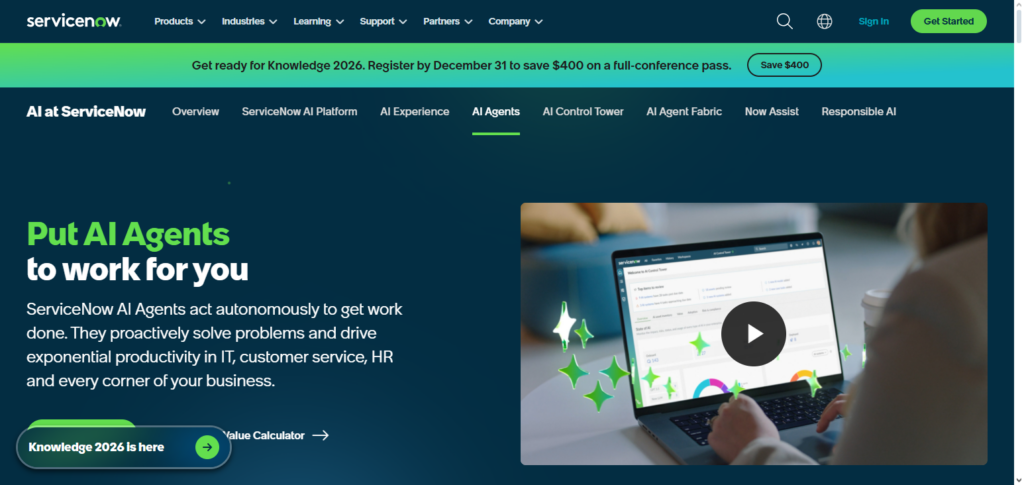
It provides the integration of predictive intelligence, AI search, generative AI, and process automation to service process automation at a higher level. Among the Best AI orchestration platforms for end-to-end automation, it enables organizations to converge and integrate their systems, mitigate manual workloads, and enhance service process automation.
Its unified data model with strong governance integrates deeply with other ServiceNow modules helping enterprises in their digital transformation effort with dependable and secure AI workflow.
Pros & Cons ServiceNow AI Orchestration
Pros
- There is one platform for ITSM, ITOM, and enterprise operations.
- Predictive intelligence with an advanced AI search.
- There is governance with workflow control and standardization.
Cons
- Most appropriate for ServiceNow clients.
- A long time is often required for the implementation.
- There is a premium for their pricing.
6. WorkFusion AI Digital Workers
Virtually indistinguishable from real employees, WorkFusion sells AI Digital Employees which can be activated automatically to handle compliance, KYC, AML, and financial operations.
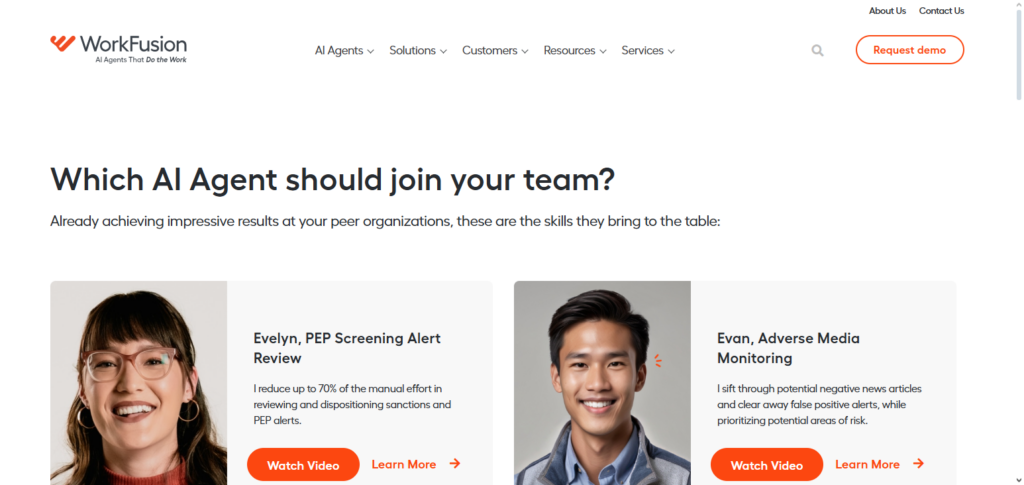
These digital employees use NLP, machine learning, and workflow automation to perform complex regulated tasks.
These employees are considered among the best AI orchestration platforms for end to end automation because WorkFusion automates and rapidly deploys complex systems with no model training. WorkFusion is known for intelligent automation, which greatly reduces operational workloads, and for its accuracy and regulatory compliance service in financial services.
Pros & Cons WorkFusion AI Digital Workers
Pros
- Digital workers that are pre-built for KYC, AML, and compliance.
- Their NLP and ML capabilities are strong and geared to finance.
- There is rapid deployment with little to no customization.
Cons
- There are limited use cases outside of compliance-heavy industries.
- Tasks that need high accuracy will require constant monitoring.
- A lot of small businesses could be limited with enterprise pricing.
7. Cognizant Neuro AI
Cognizant Neuro AI is an enterprise AI orchestration technology that brings together generative AI, machine learning, process discovery, and automation tools into one automation architecture. Organizations use it to spot automation opportunities, implement AI models, and rapidly scale operational processes.
Neuro AI has been recognized for its ability to support complex and multi-dimensional transformation initiatives across a variety of industry sectors and is known to be one of the Best AI orchestration platforms for end-to-end automation.
It seamlessly integrates into legacy enterprise frameworks and offers governance, risk management, and scalability. Advanced AI technology combined with consulting skills makes the platform particularly beneficial to organizations undergoing substantial digital modernization.
Pros & Cons Cognizant Neuro AI
Pros
- There is integration of GenAI, ML, automation, and process discovery.
- This will be great for digital transformation at scale.
- There is strong governance and enterprise-grade AI orchestration.
Cons
- Not small businesses, they are best suited for enterprises.
- Lots of rule-based processes.
- Can be difficult to configure systems across the board.
8. Appian AI Process Automation
With Appian AI Process Automation, you can do low-code development, automate workflows, and manage cases, all with AI and on one platform. Process design takes a few minutes with AI-assisted process modeling.
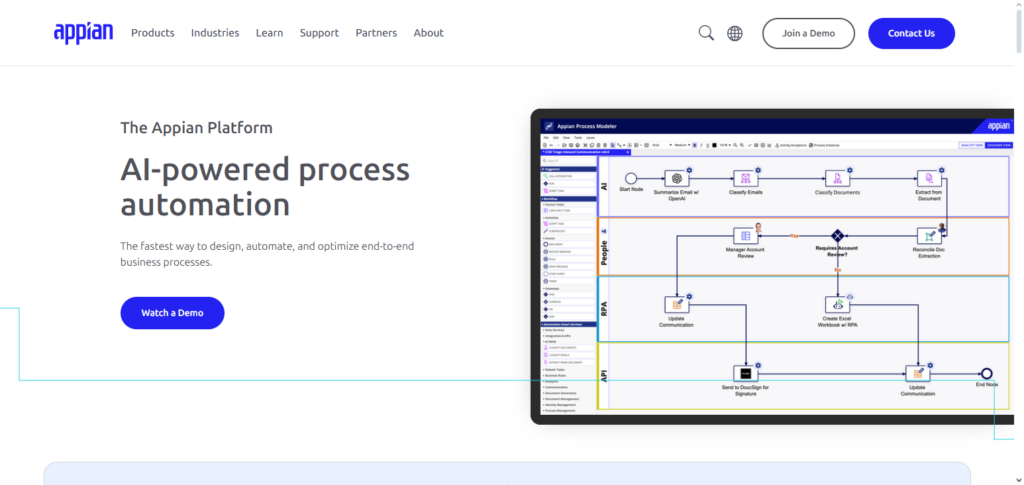
Users can use AI services for classification, extraction, and prediction. Rated one of the Best AI orchestration platforms for end-to-end automation, Appian helps enterprises optimize and automate processes in real time, scaling across all operational departments simultaneously.
Appian’s data fabric allows for quick and simple integrations for any external tools. Operational governance is built in to aid compliance. Appian is best for enterprise process designers, as it efficiently and quickly addresses new situation automation.
Pros & Cons Appian AI Process Automation
Pros
- Low-code platform that is complete with workflow and AI.
- Accelerates process modeling and assists in deployment
- For data management and integration across multiple systems
Cons
- For larger teams, the expense of licensing can be problematic
- Compared to other dedicated systems, the advanced machinery learning functionality is slowed
- Tailoring of the process can be needed with more knowledgeable Appian developers
9. DataRobot AI Platform
DataRobot AI Platform offers enterprises the best AutoML, MLOps, predictive analytics, and enables complete machine learning lifecycle automation. It allows for feature engineering, model training, deployment, monitoring, and retraining all in a single closed loop environment.
Rated one of the Best AI orchestration platforms for end-to-end automation, DataRobot allows enterprises to operationalize predictive intelligence in workflows. DataRobot provides excellent governance and explainability with seamless integration, enabling enterprises to scale data AI initiatives with precision, clarity, and trust across various levels.
Pros & Cons DataRobot AI Platform
Pros
- The best predictive analytics and AutoML in the field
- Monitoring and retraining have solid MLOps support
- For automation flows, AI modules can be integrated with ease
Cons
- It doesn’t support the entire workflow automation.
- For more complicated models, data science know-how is required.
- For startups, it can become very costly.
10. TIBCO AI Orchestrator
TIBCO AI Orchestrator brings together data, systems, and AI models to automate real-time decision-making. TIBCO has analytics, machine learning, event processing, and automation to unify orchestration across complex enterprise ecosystems.
TIBCO is recognized as one of the Best AI orchestration platforms for end-to-end automation and has been assisting organizations in optimizing operational efficiency. The platform is highly connected, offers low-latency processing, and is very scalable, fitting for organizations that require real-time insights and seamless system-to-system orchestration.
Pros & Cons TIBCO AI Orchestrator
Pros
- Excellent data integration and analysis in real time.
- For high-volume automation, it is easily scalable.
- Supports automation across multiple systems.
Cons
- Compared to the latest platforms, the UI is less modernized.
- Configuration can take technical skills.
- Compared to other companies, AI pre-built modules are less extensive.
Conclusion
For businesses looking to decrease manual labor, streamline operations, and scale intelligent processes throughout the company, selecting the best AI orchestration platforms for end-to-end automation is crucial.
RPA, AI, machine learning, and workflow automation are combined into single systems by platforms such as UiPath AI Center, Microsoft Power Automate + Copilot, IBM Watson Orchestrate, ServiceNow AI Orchestration, and others.
They enable companies to automate everything with precision, speed, and governance, from easy jobs to crucial procedures. Businesses can boost productivity, expedite digital transformation, and future-proof their operations in an increasingly AI-driven environment by implementing the appropriate AI orchestration platform.
FAQ
What is an AI orchestration platform?
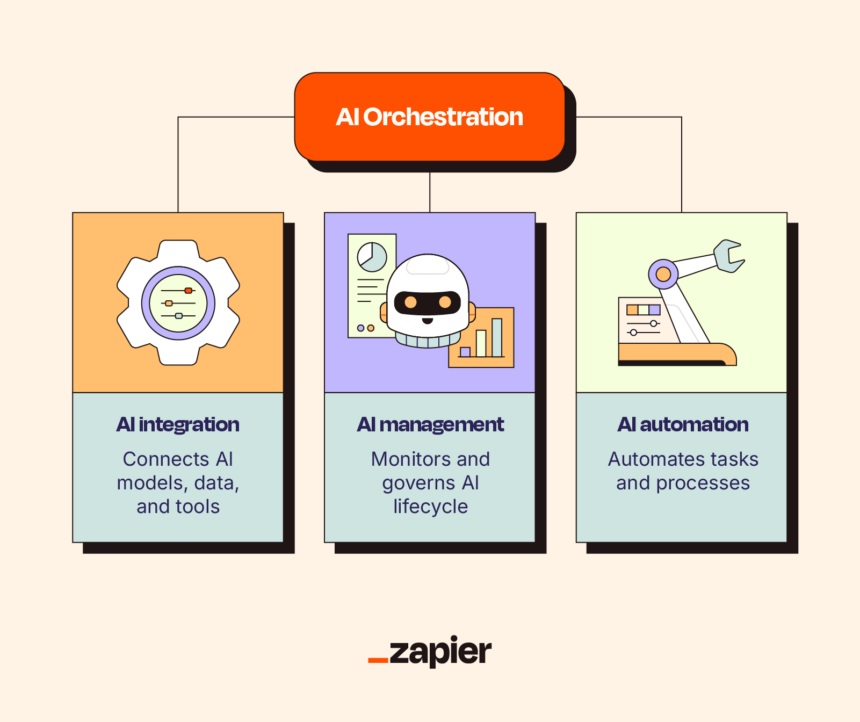
An AI orchestration platform is a system that combines automation, AI/ML models, workflow management, and data integration to automate end-to-end business processes. It coordinates bots, AI models, and human actions to deliver intelligent, scalable automation across the enterprise.
Why do businesses need AI orchestration for end-to-end automation?
Businesses need AI orchestration to reduce manual workloads, eliminate inefficiencies, improve accuracy, and automate complex processes that require decision-making. It also ensures scalable automation with governance, analytics, and seamless integration across different tools and departments.
Which industries benefit the most from AI orchestration?
Industries like banking, finance, healthcare, telecom, retail, manufacturing, insurance, and IT services benefit greatly from AI orchestration. These sectors rely heavily on repetitive workflows, regulatory compliance, and data-intensive operations—making end-to-end automation highly impactful.