




I’ll talk about AI for Churn Prediction in this post and how it helps companies find at-risk clients before they depart.
You will discover how artificial intelligence evaluates behavior, engagement, and transaction data to provide more intelligent insights, enhance customer retention, and accelerate long-term growth through proactive, tailored tactics that transform possible losses into enduring client relationships for long-term business success.
What is Churn Prediction?
Predicting churn entails figuring out which customers are most likely to stop utilizing a company’s services or products within a predicted timeframe. That is very important to provide customer retention strategies as losing customers is usually more costly than gaining customers.

Predicting churn is concerned with behavioral analysis in conjunction with other transactional data/information, as well as customer engagement and even external data like competitor activity and market trends to figure out why customers are likely to leave.
Businesses calculate their churn rate, CLV (customer lifetime value), and retention rate to evaluate and keep track of churn. Machine learning and AI are advanced techniques that provide more precise predictions due to their ability to evaluate more data and determine variables that other ways won’t.
AI can see a pattern of low engagement and low product use or negative comments and then determine a more likely customer churn scenario. Businesses provide more precise and proactive retention methods by predicting customers that are most likely to leave with targeted methods like personalized support and offers, loyalty programs, or customer support, which will increase value and relationships with customers.
AI for Churn Prediction
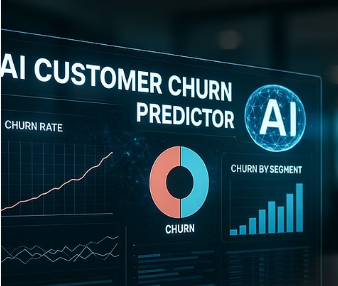
Predicts Customer Attrition
AI pinpoints those customers who are most likely to disengage or will no longer use the services offered.
Analyzes Large Data
The AI considers the customer’s demographic information, history of transactions, patterns of service usage, service offered feedback, and the level of engagement.
Uses Advanced Models
Uses machine-learning models and AI algorithms such as Logistic Regression, Random Forest, Gradient Boosting, and Neural Networks.
Detects Subtle Patterns
Identifies early warning signs for customer churn, which may include decreased usage, negative feedback, etc. These signs may be overlooked by other models and traditional churn prediction calculations.
Enables Proactive Action
Businesses are empowered to promote retention by acting on personalized offers, loyalty, and engagement initiatives.
Improves Customer Lifetime Value (CLV)
Increasing revenue and improving the company’s financial position is possible through customer retention.
Reduces Revenue Loss
Revenue churn is at a lower level due to the timely predictive churn models noting market changes.
Integrates with CRM Tools
Based on AI predictions, actions are suggested for marketing integrations and CRM toolsets.
Continuous Learning:
The customer models retain knowledge for ongoing refinements based on the evolving customer datasets and associated market models.
Importance of predicting churn to retain customers
Prevents Revenue Loss: Predicting churn impacts lost revenue by addressing at-risk customers.
Boosts Customer Retention: Businesses get the chance to engage customers before they churn.
Refines Marketing Budget: Retention marketing efforts can be directed to at-risk customers for a better return.
Increased Customer Lifetime Value (CLV): More customers are retained, meaning the long-term business value of customers increases.
Deepens Customer Connections: Interactions are tailored to the customer, which fosters trust.
Guides Business Strategy: Use of AI to provide insights along with strategic decisions to enhance the business’s customer engagement.
Spotless System: Predictive churn & subsequent risks help improve a business’s processes.
Promotes Market Edge: businesses that act on churn have a better market position.
Tips For Safe AI for Churn Prediction
Adhere to Privacy Regulations: Be compliant with privacy regulations such as GDPR and CCPA. Avoid storing customer data in an identifiable manner and ensure that sensitive data is anonymized and stored securely.
Incorporate Quality Data: Prediction is reliable when the data incorporated in the prediction process is of high quality, and is organized, accurate, and timely.
Ensure No Bias Exists in the Models: AI models should be checked to ensure that no bias exists that would result in negative targeting of a customer segment.
Use Explainable AI: AI should be able to provide an explanation as to why it predicts a customer is at risk.
Ensure Safe Data Storage: Storage of data should incorporate data loss prevention, encryption, and access control measures to ensure customer data is safe from breaches.
Establish a Process for Updating Models: Models should be designed in a way that they can be easily updated. AI should be trained repeatedly with new customer data to ensure that the model’s accuracy does not diminish with time.
Test Prior to Implementation: AI should be tested against reference datasets to ensure there are no false from the positive to negative prediction spectrum.
Augment AI with Human Judgement: AI should provide decision support for Human intervention, not be the sole decision maker.
Evaluate AI: Evaluate AI in terms of prediction accuracy, precision, and recall to check whether it is able to achieve its goals.
Use AI Responsibly: Do not use AI to manipulate situations to achieve goals which are not in the best interest of the customer. Instead, use AI to ensure that the experience of the customer is enhanced, and their level of satisfaction is increased.
Risk & Consider
Concerns with Data Quality
Data which is not current, data which lacks completion, or incorrect data can lead to invalid predictions.
AI Model Bias
Models may not be fair to certain customers unless there are segments that are underrepresented or missing in the training data.
Privacy and Compliance
More relaxed and insufficient protection of private data can lead to breaches of the GDPR and CCPA.
Interpretability of the Model
More intricate, intertwined deep learning models are ever more difficult to explain. Effectively limiting and losing prediction trustworthiness.
Excessive Dependence on AI
Too much automation in the application of AI can lead to poor retention decisions.
Integration Obstacles
Barriers to incorporating AI forecasts with CRM, marketing, or support systems.
Resource and Cost
Quality AI systems are expensive and require a lot of highly qualified personnel, valuable computing capacity, and resources for day-to-day operations and additional maintenance.
Behavior of Customers is Fluid
AI model predictions can quickly become obsolete when behavioral patterns of customers change.
False Positives/Negatives
Misclassification of committed customers as churners and failing to identify actual churners can negatively affect retention activities.
AI inappropriateness
The use of AI to intervene in problems and processes that customers expect or believe they should be unanswered may damage customer trust or the brand.
Real-World Use Cases
Telecommunications: Predicting churn for subscribers and offering retention/dedication opportunities.
Software as a Service (SaaS) and Software Services: Predicting churn for inactive users and/or trial customers by engaging them, promoting, or offering upgrades.
E-commerce: Predicting customers at risk of churn by decreasing purchase frequency, and engaging them with a relevant offer, discount, or reminder.
Banking and Financial Services: Predicting churn of high-value clients by monitoring account activity and retention.
Video Streaming Services: Predicting subscribers that are likely to churn and engaging them with personalized recommendations and incentives.
Insurance: Predicting churn for customers’ policy and providing tailored plans to retain them.
Retail Loyalty Programs: Predicting churn by disengagement and driving retention through increased purchase frequency.
Telemedicine and Health Services: Predicting churn by dropping patients in subscription and/or appointment, and driving retention through increased engagement and continuity of care.
Challenges and Considerations
Data Quality and Availability
Not having the right data leads to having less accurate predictions.
Bias and Fairness
Many training data sets fail to address the appropriate customer segments.
Privacy and Compliance
Handling data in AI must comply with GDPR and CCPA.
Model Interpretability
The more complex the model, the less trust there is to incorporate the model into business units.
Integration Complexity
These AI capabilities make for a more complex integration with existing systems including customer relationship management (CRM) systems, marketing tools, and customer support tools.
Cost of Implementation
AI capabilities require a more sophisticated set of tools, infrastructure, and trained personnel.
Scalability Issues
Most models do not adequately address the challenges and problems associated with an ever-increasing volume of customer data.
Model Drift
Changes in customer behavior impact the ongoing effectiveness of a model to the extent it is not updated regularly.
False Predictions
High levels of resource expenditure and impact on retention is incurred by a prediction of an incorrect churn.
Organizational Readiness
Leveraging AI is a more complex business operation that will require training and revisions to existing business processes.
Future Trends

More proactive, tailored, and instantaneous customer interaction will be the main focus of AI in churn prediction in the future. Businesses will be able to predict the precise causes of possible customer attrition and automatically suggest the optimal retention strategies as AI models develop beyond merely identifying at-risk clients.
End-to-end retention workflows will be made possible by integration with CRM, marketing automation, and customer experience systems.
AI will be able to quickly modify forecasts as consumer behavior shifts thanks to real-time data streams from applications, IoT devices, and digital touchpoints. Simultaneously, a higher focus on explainable and ethical AI will guarantee transparency, equity, and legal compliance, assisting companies in fostering better trust and implementing more intelligent, human-centered retention strategies.
Conclusion
AI for churn prediction has developed into a potent tool for companies looking to increase long-term value and improve client retention. AI helps businesses take proactive, tailored steps that lower revenue loss and enhance customer experiences by evaluating vast amounts of consumer data and seeing early warning indicators of disengagement.
The advantages of better decision-making, increased customer lifetime value, and competitive advantage greatly exceed the risks, even while issues like data quality, privacy, and model transparency must be properly addressed. Businesses that use AI-driven churn prediction will be better positioned to create enduring client connections and experience sustainable development as AI technology advances.
FAQ
What is AI for churn prediction?
AI for churn prediction uses machine learning and data analytics to identify customers who are likely to stop using a product or service. It analyzes customer behavior, transaction history, and engagement patterns to forecast churn risk and help businesses take preventive action.
How does AI improve churn prediction accuracy?
AI processes large and complex datasets, detecting subtle patterns and trends that traditional methods often miss. It continuously learns from new data, improving prediction accuracy over time.
What data is needed for AI-based churn prediction?
Common data includes customer demographics, purchase history, product usage, customer support interactions, feedback, and digital engagement metrics such as website or app activity.
Which industries benefit most from AI churn prediction?
Industries like telecom, SaaS, e-commerce, banking, insurance, streaming services, and subscription-based businesses benefit greatly from AI-driven churn prediction.
Is AI for churn prediction expensive to implement?
Costs vary based on data size, model complexity, and infrastructure needs. While initial setup can require investment, long-term savings from improved retention and reduced acquisition costs often outweigh the expense.