

I’ll talk about AI-Driven client Lifetime Value (CLV) Prediction in this post, which is a potent method used by companies to predict the overall value a client will provide over time.
Businesses may evaluate activity trends, tailor marketing, improve retention tactics, and make data-driven decisions by utilizing AI and machine learning. This increases overall consumer involvement, boosts loyalty, and maximizes revenue.
Understanding Customer Lifetime Value (CLV)
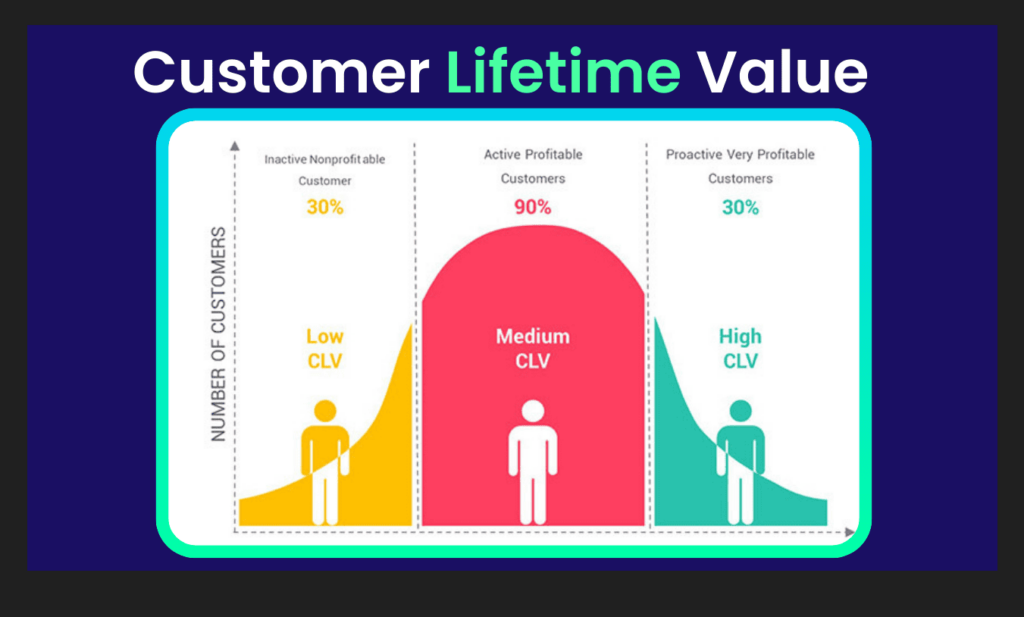
Customer Lifetime Value (CLV) quantifies revenue streams from fully engaged individual customers in a business’s lifetime. It captures beyond a singular transaction in dollars, such as repeat purchases and loyalty.
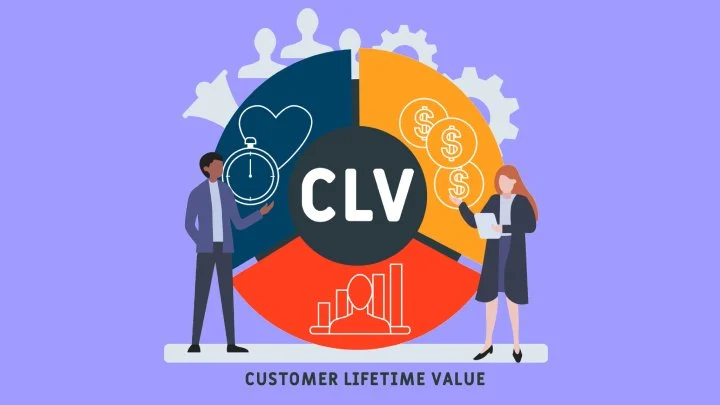
The company needs to know the mean spend of the customer, the frequency of the spend and the expected years a customer buys from the company to estimate the CLV. Asset optimization and spend efficiency in marketing and retention activities are derived from estimating the CLV.
Resources can be allocated better, customer experience improved, a better offer can be made, and surplus and growth of the company can be enabled. CLV is likely to get even better in the future with the combination of customer segmentation, predictive analytics, advanced machine learning, and artificial intelligence which looks beyond historical data.
AI-Driven Customer Lifetime Value Prediction
Step 1: Collect & Prepare Customer Data
- Identify historical data: What customers purchased, how often, and what products they bought.
- Collect data: customer age, location, income level, and engagement behaviors.
- Process data: Fill missing values, remove duplicates, and align data with a standard format.
- Feature engineering: develop new variables such as average order value” andtime since last purchase”.
Step 2: Choose the Right AI Model
- Use simple prediction models such as Linear and Logistic Regression.
- Use Decision / Random Forest Models to manage sophisticated interactions.
- For structured data, use Gradient Boosting and XGBoost for optimal accuracy.
- Use Neural Network for large data sets and complex non-linear relationships.
Step 3: Split Data for Training & Testing
- Split the data into training, validation, and test sets.
- For the test set, use real-life situations to prevent overfitting.
Step 4: Train the Model
- Feed historical data into the selected AI model.
- Find optimum settings for models to improve accuracy.
- Use methods such as cross-validation to test for consistency.—
Step 5: Evaluation of Model Performance
- For accuracy measurement use:
- RMSE (Root Mean Squared Error)
- MAE (Mean Absolute Error)
- R² score
- Choose the best among the different models
Step 6: Model Deployment
- Model integration with CRM, marketing automation, or sales systems.
- Customer lifetime value predictions (real-time or batch)
- Targeted marketing, retention, and personalization actions.
Step 7: Monitoring and Continuous Improvement
- The accuracy of the predictions needs to be evaluated.
- Model updates must be done regularly to reflect changes in customer data.
- Based on the insights, high CLV customers get loyalty rewards, whereas low CLV customers receive nurturing campaigns.
Step 8: Using Predictions to Inform Decisions
- Target high-value customers with premium offers.
- Allocate marketing budget to expected revenue.
- Improve customer acquisition and retention.
Why AI Matters in CLV Prediction
Higher Accuracy
Unlike traditional methods, AI is able to pick up on and analyze many complex micro and macro patterns in customer behavior that leads to a higher and more accurate prediction of CLV.
Scalability
Performing manual calculations and analyzing datasets is impossible and AI is able to effectively analyze datasets with thousands to millions of customers.
Predictive Power
AI is able to detect future customer behavior and predict purchasing patterns while other CLV models use static historical averages and definitely analyze and predict past purchasing and other behavioral patterns.
Personalization
AI helps drive insights that means businesses can develop and implement more sophisticated campaigns and more targeted and personalized offers and loyalty programs to advocates and other high value customers.
Cost Efficiency
Marketing to customers that a business will deem as less value is definitely a waste of resources and an ineffective spend and when AI is used to predict customer value, it helps businesses spend more effectively to drive down cost.
Real-Time Insights
Businesses can react and make decisions faster because AI models can predict CLV in real-time with the most up to date information.
Integration with Other Systems
AI-driven CLV predictions can integrate with your other analytics, marketing automation, and CRM systems to provide actionable insights.
Benefits of AI-Driven CLV Prediction
Revenue Predictability – Forecasts Customer Value over time with high accuracy. Assist in planning revenue.
Customer Retention – Pinpoints customers at risk/some of high worth, so retention plans can be focused.
Marketing Strategy – Predicts Consumer Value, aids in designing Sustainable Value-based offers, and crafting marketing activities.
Marketing Resource Allocation – Extends marketing activities to high value customers and eliminates marketing resource waste on low customers.
Customer Classification – Categorizes customers based on Value, Behavior, and Engagement for optimal business planning.
Actionable Insights – Supports product/sales, loyalty, and affiliated programs on the marketplace.
Sustainable Competitive Advantage – AI CLV Predictive business model leads to higher Customer Engagement and Profits than competitors.
Excellent Broad and Agile – Deploys a large variety of customers, updated with flows of new customer data to make more predictions.
Real-World Use Cases
E-Commerce Personalization
Personalize product suggestions and offers/discounts for value customers to drive repeat purchases.
SaaS Subscription Management
Forecast customer churn to inform market retention strategies and plan/optimize subscriptions for value over time.
Retail Inventory Management
Predict and plan stock inventory to optimize sales from high value customers.
Financial Services
For loans/credit cards/investments, evaluate the profitability and risk of the customer.
Loyalty and Reward Programs
Determine which customers to spend on exclusive loyalty perks and offers.
Marketing Campaigns
Direct spend on higher expected lifetime value customer segments to improve campaign ROI.
Cross Selling and Up Selling
Recommend additional products and services to customers with high CLV.
Telco and Utilities
Anticipate subscriber value over time to improve customer retention and more effective engagement programs.
Challenges and Considerations
Data Quality Issues
A prediction model for CLV is only as good as the data that drives it.
Data Privacy & Compliance
Machine learning and AI models require the application of critical data-use frameworks such as GDPR or CCPA.
Model Complexity
Having non-technical individuals drive AI-powered models can lead to poor business outcomes.
Integration with Business Systems
Prediction models for AI work best when connected with other AI or business management systems like CRM, marketing, and business analytics systems.
Changing Customer Behavior
Predictive analytics is only good for specific business timeframes.
Bias in Predictions
Even with the best models, there is always an element of human intuition that must be considered.
Resource Requirements
Creating AI or data-driven solutions can be difficult and time-consuming.
ROI Measurement
A business outcome that justifies the investment is always the goal of predictive analytics, but how to measure its value in business terms is the challenge.
Future of AI in CLV Prediction
AI technology in Customer Lifetime Value (CLV) prediction will help a lot of businesses understand their customers better. Models will be faster and more accurate, predicting customer behavior and being able to assist a lot of different businesses.
Machine learning will be able to keep businesses ahead of the competition by predicting and simulating. They will be able to see the potential customer value of different strategies chosen. omnichannel data sources will create a holistic view of customer behavior allowing businesses to see the potential value in their strategies.
With the help of AI, strategies across different departments will be aligned to drive CLV. adaptive strategies will be able to assist businesses in sustaining growth by loyal customers and a higher profit margin. Fair, unbiased, and transparent, aligned with privacy regulations, will be the focus of AI technologies.
Conclusion
AI-powered Customer Lifetime Value prediction is revolutionizing how companies comprehend, interact with, and keep consumers.
Businesses may precisely predict long-term client value, tailor marketing campaigns, maximize resources, and make data-driven decisions that increase revenue and loyalty by utilizing sophisticated machine learning models.
Although there are obstacles like bias, data quality, and integration, they are greatly outweighed by the advantages, which provide a scalable, effective, and strategic way to maximize customer connections.
Adopting AI for CLV prediction enables companies to maintain their competitiveness in a market that is changing quickly and to forge better, more lucrative relationships with their clients.
FAQ
What is AI-driven CLV prediction?
AI-driven CLV prediction uses machine learning and advanced analytics to forecast the total revenue a customer will generate over their lifetime with a business, enabling smarter marketing and retention strategies.
Why is AI better than traditional CLV calculation?
AI can analyze large datasets, detect complex patterns, predict future behavior, and continuously update predictions, making it far more accurate and scalable than traditional methods based on historical averages.
What types of AI models are used for CLV prediction?
Common models include regression analysis, decision trees, random forests, gradient boosting, and neural networks, chosen based on data complexity and business needs.
How can businesses use CLV predictions?
Predictions help in personalized marketing, retention campaigns, loyalty programs, cross-selling and upselling, resource allocation, and revenue forecasting.
What data is needed for AI-driven CLV prediction?
Data includes customer transaction history, purchase frequency, engagement metrics, demographic information, and behavioral patterns across channels.