



In this article, I will examine AI Agents That Can Run Your Business and their impact on current operational practices resulting from enhanced automation, smarter decision making, and better workflow management.
AI tools such as AutoGPT Enterprise and Microsoft Copilot are enabling operational cost reductions, improved efficiency, and faster scalability while aiding in addressing the challenges posed by the competitive digital economy.
What Are AI Agents in Business?
AI agents in business are software systems that can perform tasks, make decisions, and oversee workflows with little human involvement. In contrast to conventional automated systems, AI agents can use analytics to assess situational context and adjust their behavior accordingly.
With tools such as AutoGPT Enterprise and LangChain, businesses can create agents to perform roles in customer service, marketing, analytics, and operations. These agents leverage machine learning and natural language processing to enhance operational efficiency, decrease expenses, and increase output across multiple business functions.
Key Features of Business AI Agents
Automation of Repetitive Tasks
Business agents can perform automated repetitive tasks like data entry, email replies, and report generation. For example, Zapier reduces human error and saves time by automating workflows across applications.
Intelligent Decision-Making
Business agents make decisions based on the data they analyze. For example, data-reliant strategies can be formulated quickly and accurately through reasoning on the GPT Enterprise platform.
Natural Language Processing (NLP)
AI business agents can interpret and respond to human language, allowing the creation of chatbots and virtual assistants. For example, Claude’s business agents can hold human-like conversations, enhancing customer support and engagement.
Integration with Tools and APIs
AI agents can be integrated with different software, databases, and APIs. For example, business agents can be integrated with multiple applications to streamline processes through LangChain.
Real-Time Data Processing
Business agents analyze data and processes in real-time. Relevance AI assists businesses by providing data-driven insights to support quick and effective decision-making.
Scalability and Flexibility
AI agents can expand functionality without needing to add staff. Microsoft Copilot and similar solutions accommodate business growth at all levels.
Autonomous Task Execution
Some AI agents can think for themselves and may break down complex goals into smaller constituent steps. To achieve this, Enterprise AutoGPT utilizes Agile to maximize output, which in turn opens up many more business avenues.
Key Point & AI Agents That Can Run Your Business
| AI Agent Platform | Key Point |
|---|---|
| AutoGPT Enterprise | Autonomous AI agent designed to automate complex business workflows and complete multi-step tasks with minimal human input. |
| AgentGPT | Web-based platform that allows users to deploy AI agents to perform tasks, research, and automate processes directly in the browser. |
| LangChain Agents | Framework for building intelligent AI agents that connect LLMs with APIs, databases, and tools for advanced automation. |
| Microsoft Copilot Agents | AI-powered assistants integrated into Microsoft ecosystem to automate documents, emails, coding, and business operations. |
| OpenAI GPT-Enterprise Agents | Enterprise-level AI agents built on advanced GPT models to automate workflows, analyze data, and support decision-making. |
| Anthropic Claude Business Agents | AI assistants designed for enterprise productivity, capable of handling research, analysis, and complex reasoning tasks. |
| Cognosys AI Agents | Autonomous AI agents that can plan, execute, and complete long-term tasks using multiple tools and data sources. |
| Relevance AI Agents | AI platform that builds custom agents for automating business processes, customer support, and data analysis. |
| Adept ACT Agents | AI agents that interact with software tools like humans, automating digital tasks across different applications. |
| Pinecone Vector Agents | AI agents powered by vector databases that enable intelligent search, knowledge retrieval, and AI memory systems. |
| Zapier AI Agents | Automation agents that connect thousands of apps to streamline workflows and automate repetitive business tasks. |
| ServiceNow AI Agents | Enterprise AI agents that automate IT service management, workflows, and business operations across organizations. |
1. AutoGPT Enterprise
AutoGPT Enterprise is a sophisticated autonomous AI that can carry out multi step business processes with little to no assistance from a human. It can assist with planning, analyzing, and executing processes like market research, content writing, and data analysis.
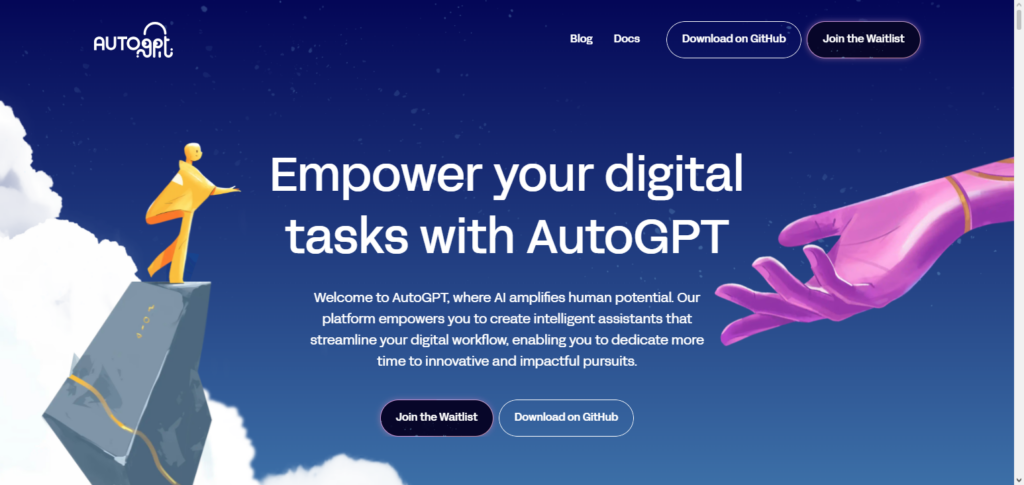
It is used to automate processes and increase productivity, especially for data-heavy and repeatable tasks. While a task is being conducted, AutoGPT Enterprise can connect with other software and APIs to evaluate and make decisions, thus minimizing the need for human supervision.
Because of its self-prompting and task iteration, it is a useful tool for startups and large businesses that want to simplify processes, cut costs, and improve decision making across divisions.
AutoGPT Enterprise Features, Pros & Cons
Features:
- Task execution autonomously
- Workflow automation for multiple steps
- Capability of self prompting
- Integration of API and tools
- Processing data in real time
Pros:
- Greatly diminishes manual work
- Independent handling of elaborate tasks
- Business scalability is high
- Task improvement is enhanced
- Productivity increases
Cons:
- May be monitoring intensive
- Task incorrectly producing is a possibility
- Complexity in setup
- Limited control with autonomy
2. AgentGPT
AgentGPT is a web-based service that offers users the ability to create and deploy autonomous AI agents with no programming involved. It streamlines the automation of business processes by allowing the users to set objectives so that the AI can autonomously work to achieve these goals. During a process, AgentGPT interfaces with other APIs, collects information, and produces deliverables like reports and action plans.
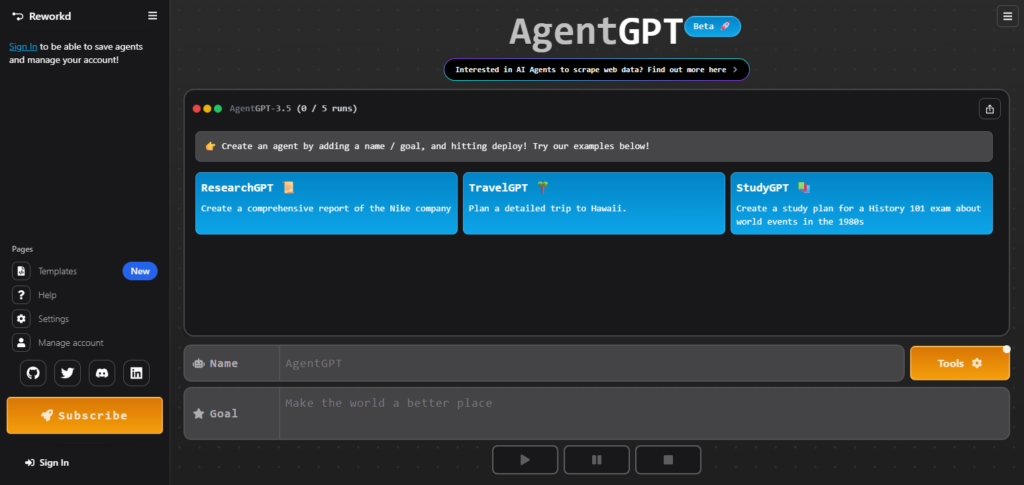
It is a great solution for solo entrepreneurs and small businesses as it can automate research, marketing, and business development. With AgentGPT, users can easily create and deploy powerful autonomous agents to increase efficiency in their businesses, and reduce the need for oversight to complete tasks.
AgentGPT Features, Pros & Cons
Features:
- Interface based on browsers
- Automation of tasks with goal driven motivation
- Coding is unnecessary
- Creation of autonomous agents
- Keeping track of tasks
Pros:
- Simple use is a benefit
- First timers/beginners are able to do it
- A fast rollout is possible
- No need for a download
- Savings are to be had
Cons:
- Extra features are not present
- Not a lot of choices for adjustability
- No use of a wired Internet means limitation
- Capabilities of a system may be less than
- Small businesses are not ideal for use
3. LangChain Agents
LangChain Agents form an integral part of the LangChain framework, which allows builders of hgi intelligent applications using large language models to create Agents that perform reasoning across multiple steps. These agents are capable of interacting with external data, APIs, and other tools. LangChain Agents are able to make decisions on the fly in the middle of a business workflow, and are therefore very flexible.
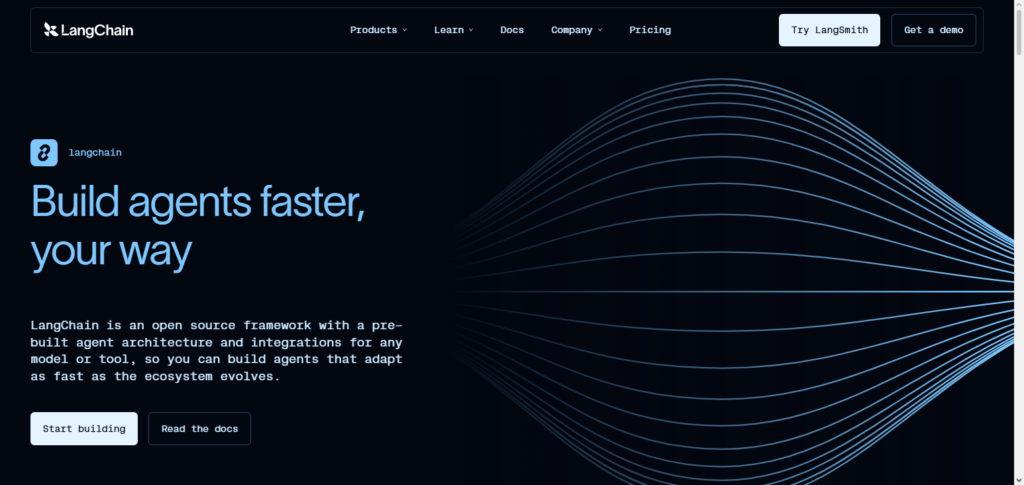
They are used by businesses in chatbots, automated workflows, and other decisioning applications. Their modular architecture allows them to be tailored to a specific business use case, which increases their scalability and flexibility. Using LangChain, businesses can build AI-powered ecosystems that intelligently automate customer support, data processing, and other internal business functions.
LangChain Features, Pros & Cons
Features:
- Architecture is Modular
- Tool management
- Memory
- Workflows of multiple agents
- Connectivity of APIs
Pros:
- Greatly adjustable
- Flexibility for the developer
- Community assistance is strong
- Achievable with less work to add
- Other integrations are flexible
Cons:
- To add adjustments a coder is needed
- A developer should do the setup
- More work to add adjustments
- Performance tuning required
- Not suited for beginners
4. Microsoft Copilot Agents
Microsoft Copilot Agents enhance Microsoft Copilot by adding automation for tasks across the Microsoft ecosystem (Office, Teams, and Azure). These agents help with document authoring, spreadsheet analysis, and workflow management.
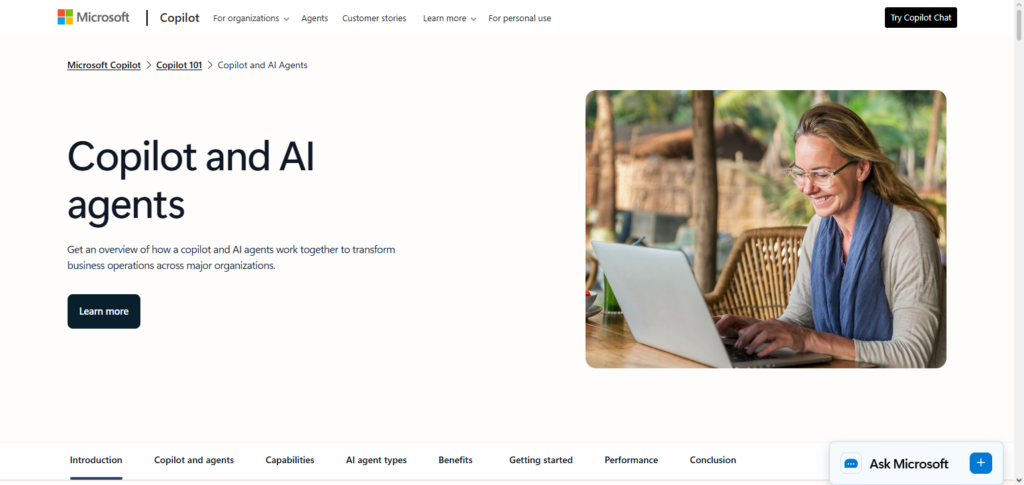
During mid execution, Microsoft Copilot Agents create deep integrations with enterprise data for contextual decision-making and automation. Businesses see increased productivity, decreased manual work, and improved collaboration.
These Agents are especially useful in corporate settings where tool integration is a must. Using AI in existing digital workplace ecosystems, organizations improve productivity without the need for new IT investments.
Microsoft Copilot Features, Pros & Cons
Features:
- Integration in office
- Generation of AI documents
- Document analysis
- Automated workflow
- Security for enterprises
Pros:
- Integration drives productivity
- Simple and fast adoption
- Performance
- Secure
Cons:
- Subscription fee
- Ecosystem versatility
- Less customization
- Microsoft tools required
- Feature learning gap
5. OpenAI GPT‑Enterprise Agents
OpenAI GPT-Enterprise Agents have customizable AI capabilities that adapt to your needs for providing customer service, performing data analytics, and creating content, all while keeping data safety and compliance standards through mid-level workflow integration with internal systems.
They have been developed with premium features that include high responsiveness and strong reasoning capabilities. Companies utilize these agents to refine workflows, improve the overall customer experience, and derive meaningful information from extensive data sets. For organizations that are looking for strong, dependable AI automation, these agents, with enterprise-level protection and personalization, are the best fit.
GPT Enterprise Features, Pros & Cons
Features:
- AI for enterprises
- Advanced reasoning
- Secure
- API
- Speed
Pros:
- High performance
- Secure and scalable
- Excellent language understanding
- Versatile
- Reliable
Cons:
- High cost
- Setup requirements
- API dependent
- Monitoring required
- Offline use limitations
6. Anthropic Claude Business Agents
Claude Business Agents by Anthropic are built with a concentration on safety, dependability, and the responsible use of AI. These agents are ideal for dealing with delicate business functions like document processing, compliance, and customer operations. In the middle of a process, Claude Business Agents give responses that are correct and situational – this improves and provides consistency about the work.

Businesses depend on them for AI deployment in environments that require significant trust and transparency. Agents are especially useful to enterprises that want to integrate AI responsibly into their operations, as they can process information while remaining aligned with the business’s internal policies.
Anthropic Claude Business Agents Features, Pros & Cons
Features:
- Ethical AI
- Safety in design
- Document context
- Large document management
- AI for business
Pros:
- High accuracy
- Reliable and safe
- Excellent reasoning
- Handles larger content
- Trustworthy outputs
Cons:
- Fewer integrations
- Pricing
- Less customizable
- More slack and
- Output slow API
7. Cognosys AI Agents
Cognosys AI Agents simplify intricate workflows by integrating reasoning, planning, and execution. They can accomplish project management, research, and data analytical tasks. At the mid execution stage, Cognosys AI Agents engage with different tools and data sets to provide precise results.
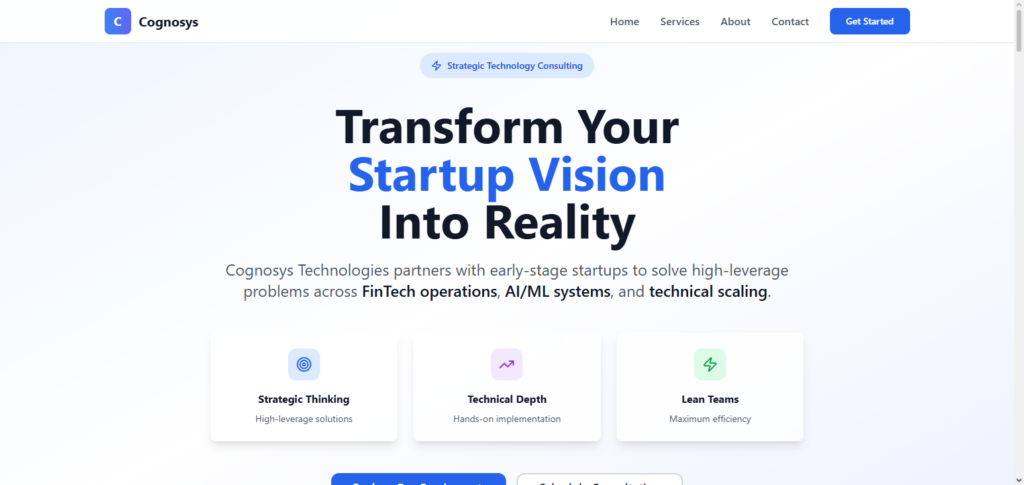
They are used by businesses to simplify manual tasks and boost operational efficacy. The ability to decompose tasks into functional components can help long-term project management. Given their ability to learn, Cognosys agents can tailor themselves to suit the business requirements and thus, improve productivity over time.
Cognosys AI Agents Features, Pros & Cons
Features:
- Automation of tasks
- Planning over multiple steps
- Analysing Data
- Managing Workflows
- Learning Continuously
Pros:
- Increased efficiency
- Ability to accomplish complicated tasks
- Learning is adaptive
- Work load is reduced
- Good for long term projects
Cons:
- Awareness is limited
- Supervision is required
- Difficulty in integrating
- Learning takes time
- Performance is inconsistent
8. Relevance AI Agents
Relevance AI Agents center on the automation of business processes through the use of data, including insight extraction and decision-making automation. These agents focus on unstructured data such as text, images, and comments.
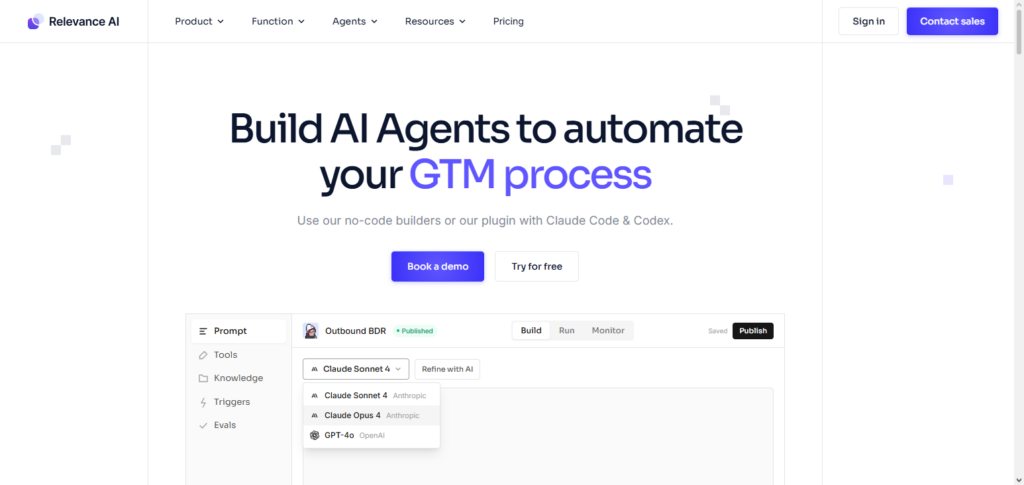
Mid workflow, Relevance AI Agents review datasets’ structures and patterns to provide data-driven recommendations to fuel strategic decisions. Firms apply them for marketing research, customer categorization, and process streamlining.
Their capacity to handle big data swiftly gives them importance in data-heavy sectors. With the use of AI-driven insights, companies can streamline processes and make data-driven decisions to enhance customer satisfaction.
Relevance AI Features, Pros & Cons
Features:
- Data analysis
- Search by Vectors
- Pipelines of Automation
- Components of ML
- Access to APIs
Pros:
- Insight is enhanced through data
- Data is processed rapidly
- Can be expanded
- Very useful when analysing data
- Automation is strong
Cons:
- Difficult to set up
- Needs familiarity with the data
- Data price is expensive
- User interface is limited
- Learning takes time
9. Adept ACT Agents
Adept ACT Agents have been designed to perform digital tasks in the real world by engaging with software interfaces as humans would. These agents can navigate programs, enter information, and perform a variety of functions across different systems.
In the middle of the operational stage, Adept ACT Agents automate portions of the workflow by engaging directly with business applications, thus decreasing the necessity of human intervention.
Businesses utilize these agents to facilitate work related to data input, customer management, and general administration. Their operational understanding of software environments is what makes them particularly useful in the automation of recurring tasks, and the enhancement of efficiency.
Adept ACT Agents Features, Pros & Cons
Features:
- Interacts with Software
- Automation of tasks
- Navigation of user interfaces
- Execution in real time
- Usage across multiple applications
Pros:
- Can perform tasks like a human
- Manual work is reduced
- Automation is practical
- Cross application operation
- Efficiency is increased
Cons:
- Developing
- Unavailability
- Difficult to set up
- Low accuracy
- Monitoring is required
10. Pinecone Vector Agents
Pinecone Vector Agents harness the power of vector database technology to drive intelligent search and personalized recommendation engines, and contextual AI services. These Agents intelligently manage the storage and retrieval of high-dimensional data and aid in the AI-driven search and custom personalization.
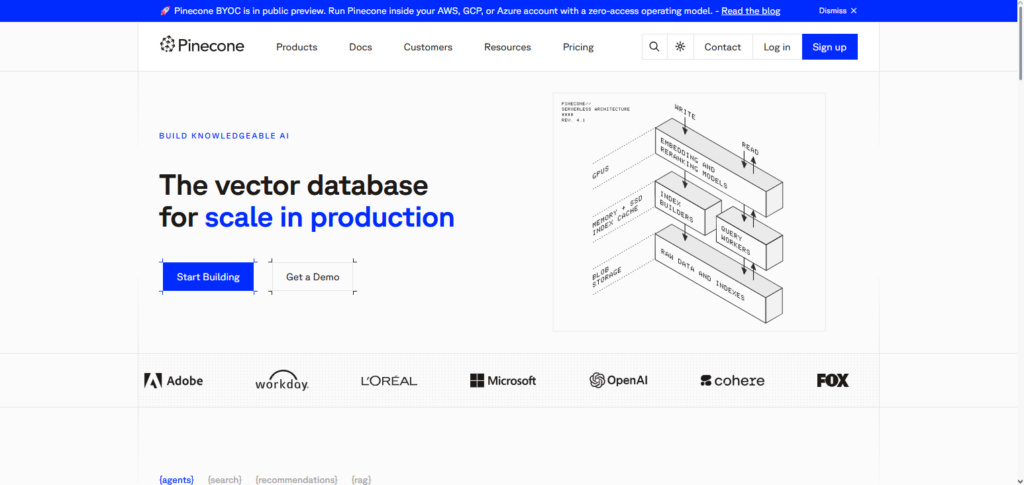
Mid-workflow, Pinecone Vector Agents interface with ML models to produce user-query-compliant outputs. Businesses deploy them for recommendation engines, semantic search, and knowledge management. Their enhanced performance and horizontal scalability enable the optimal management of large data sets, allowing organizations to maximize the quality of user interactions and the quantity of actionable insights.
Pinecone Vector Agents Features, Pros & Cons
Features:
- Database of vectors
- Search by request for semantics
- Retrieval in real time
- Can be expanded
- ML is integrated
Pros:
- Data is retrieved rapidly
- Can be expanded by a high amount* Enhances the quality of the search results for end-users
- Ideal for artificial intelligence applications
- Trusted dependability
Cons:
- AI technology on its own is insufficient
- Machine learning is necessary
- More complicated setup
- Money scaling
- UI relatively thin
11. Zapier AI Agents
Zapier AI Agents focus on no-code process automation across apps and services. Using AI Agents, businesses streamline processes like sending emails, updating databases, and task management. In the middle of execution, Zapier AI Agents ensure smooth management by executing actions that meet imputed criteria.
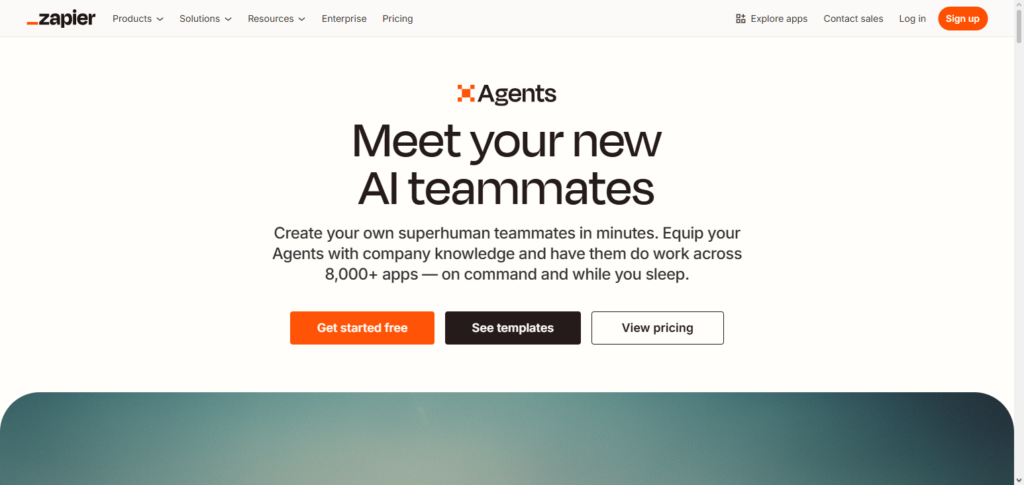
Agents simplify integration and workflow streamlining, specifically to target SMBs. Non-tech-savvy personnel have the flexibility of AI Agents to maximize productivity by cutting down repetitive work and errors.
Zapier Features, Pros & Cons
Features:
- Software applications connectors
- Automated processes
- Actions triggered by events
- No programming needed
- AI activities
Pros:
- Simple
- Time efficient
- Many integrations
- No programming
- Generally inexpensive
Cons:
- Logic is advanced
- Limited amount of activities
- Application reliant
- Money scaling again
- AI is minimally functional
12. ServiceNow AI Agents
ServiceNow AI Agents are built for enterprise-grade workflow automation, especially regarding IT services, customer services, and operational business processes.
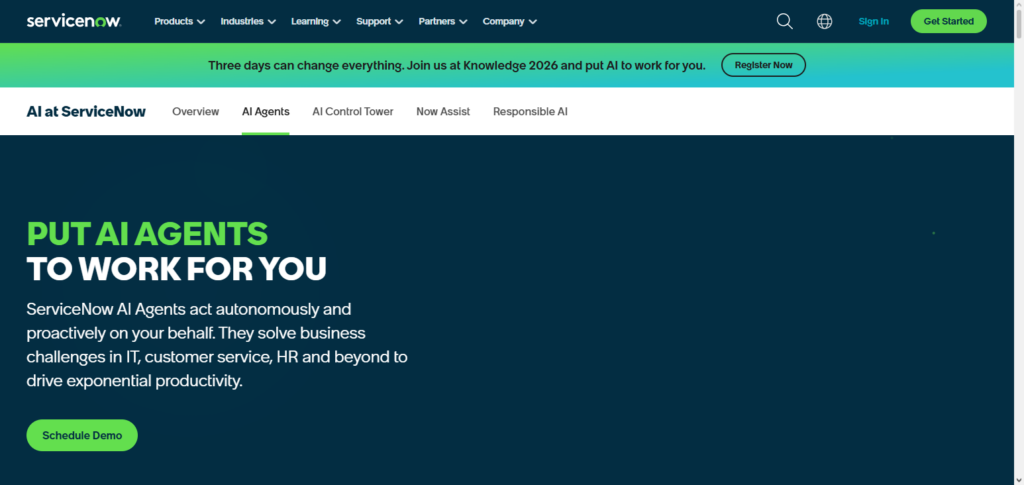
These agents leverage AI technology to process incoming requests, automate responses, and resolve issues. While processing requests, ServiceNow AI Agents connect to enterprise systems for real-time processing and automation.
Companies gain service improvement, faster response times, and better operational efficacy. ServiceNow AI Agents are built to process complex workflows and large volume operations, making them suited for enterprises that want to optimize business processes and enhance customer services through AI automation.
AI Agents from ServiceNow Features, Pros & Cons
Features:
- IT process automation
- Workflow oversight
- Insight driven by AI
- Enterprise Service Management
- Integration across the Enterprise
Pros:
- Solution for Enterprise
- Value for Money
- Effortless
- Platform provides strong automation
- Scalable
- Consistent dependability
Cons:
- Elevated pricing
- Implementation complexity
- Need for training
- Not appropriate for Small Enterprises
- High customizability
Conclusion
AI agents in the operations of a business automate workflows, enhance decisions at the managerial level, and reduce workload in all departments. AutoGPT Enterprise, AgentGPT, and LangChain aid in the execution of cognitive tasks.
Further, Microsoft Copilot, GPT Enterprise, and ServiceNow offer business-grade automation, and their business counterparts are Microsoft Copilot, GPT Enterprise, and ServiceNow. Lastly, Zapier and Pinecone provide improved intelligence and data integration.
In the future, agents will possess the ability to understand and operate autonomously in all facets of a business.
Early adopters of these technologies will distinguish themselves through enhanced operational efficiency, reduced operational costs, and accelerated iterative processes. AI agents are beyond simple technologies; they are now digital colleagues. AI agents will operate and optimize businesses at a level of efficiency, speed, and accuracy that has previously never been witnessed.
FAQ
What are AI agents in business?
AI agents are intelligent software systems that can perform tasks, make decisions, and automate workflows with minimal human intervention. Tools like AutoGPT Enterprise and AgentGPT can plan, execute, and optimize business operations such as marketing, customer service, and data analysis, helping companies improve efficiency and productivity.
How can AI agents run a business?
AI agents automate repetitive tasks, analyze large datasets, and execute multi-step processes. Platforms like LangChain and Zapier connect with different tools to manage workflows, while enterprise solutions like Microsoft Copilot help streamline communication, reporting, and collaboration across teams.
Are AI agents suitable for small businesses?
Yes, AI agents are highly beneficial for small businesses because they reduce costs and improve efficiency. Tools such as AgentGPT and Zapier are user-friendly and require little to no coding. They help small businesses automate marketing, customer support, and administrative tasks, allowing owners to focus on growth.
What industries can benefit from AI agents?
AI agents can be used across multiple industries, including e-commerce, finance, healthcare, marketing, and IT services. Platforms like ServiceNow are widely used in IT and customer support, while Pinecone supports data-driven applications such as recommendation systems and search engines.
Are AI agents secure for business use?
Most modern AI platforms, such as GPT Enterprise and Claude, are designed with enterprise-grade security, data privacy, and compliance features. However, businesses must still follow best practices like secure integrations, access control, and data governance to ensure safe usage.
What are AI agents in business?