



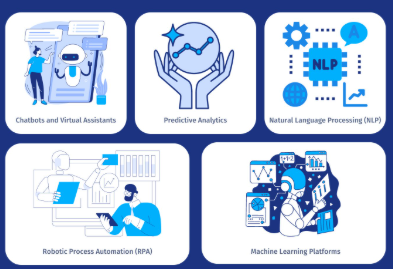
The Best AI Tools for Customer Behavior Analysis that assist companies in comprehending how consumers engage, make choices, and navigate digital journeys will be covered in this article.
These AI-powered systems allow wiser tactics, better customer experiences, and higher conversion rates in today’s competitive, data-driven marketplace global business growth, from real-time tracking and predictive analytics to heatmaps and personalized recommendations.
How To Choose AI Tools for Customer Behavior Analysis
Specify Your Business Objectives
- Specify what you would like to analyze (for example, journeys, conversions, retention, personalization).
- Align your objectives with the strengths of the tool (ex. Hotjar for UX vs. Mixpanel for funnel analysis)
Consider Data Sources & Integration
- Use platforms that seamlessly connect with your existing tools (CRM, CMS, advertising, database).
- Assess integrations for the primary platforms (web, mobile, email, product) you support.
Assess the Analytics Features
- Determine if the tool offers real-time analytics, cohort analysis, predictive insights, and segmentation.
- Assess if you need the service to provide qualitative (heatmaps, session recordings) or quantitative (events, funnels) data.
AI & Predictive Power
- Choose platforms with advanced AI features to derive insights such as pattern recognition and predictive forecasting for customer behavior.
- Assess the tool’s AI capabilities, such as predictive analytics and automated suggestions, versus more simplistic features like dashboards that do not require AI.
Simplicity
- Evaluate the platform’s user interface for tools that require more user expertise if your team lacks the technical know-how.
- Analytics tools that provide customizable dashboards and natural language queries require less training.
Customization & Reporting
- Customization should include custom reports, alerts, dashboards, and data exports, if it allows that.
- Flexible reporting is useful for different teams (marketing, product, sales) and for different levels of reporting.
Scalability
- Choose solutions that range from basic analytics to advanced AI workflows.
- Check if the pricing is reasonable as the volume of data grows.
Data Privacy & Compliance
- Data privacy and compliance of having sensitive or geo-based customer data (GDPR/CCPA) and data handling should be confirmed.
- Piwik PRO is an example of privacy-first analytics.
Support & Community
- Assess the quality of support from the vendor, including documentation, tutorials, and customer support.
- User communities and knowledge bases are useful for problem resolution.
Total Cost of Ownership
- Assess the costs of licenses, add-ons, and the total costs for the future.
- Before making a commitment, look for free tiers or trial options to test accessibility.
Key Point & Best AI Tools for Customer Behavior Analysis
| Tool Name | Key Point |
|---|---|
| Mixpanel | Advanced event-based analytics that tracks user actions in real time to optimize product engagement, retention, and conversion funnels. |
| Heap Analytics | Automatically captures every user interaction without manual tagging, enabling retroactive analysis and deep behavioral insights. |
| Kissmetrics | Focuses on individual user journey tracking to link marketing campaigns directly to customer behavior and lifetime value. |
| Hotjar | Uses heatmaps, session recordings, and feedback tools to visualize how users interact with website elements and content. |
| Crazy Egg | Provides scroll maps and A/B testing visuals to identify where users click, stop, or drop off on web pages. |
| Qlik Sense AI | AI-powered data discovery platform that delivers automated insights, natural language queries, and predictive analytics. |
| HubSpot AI | Integrates AI-driven CRM analytics to personalize marketing, sales, and customer service workflows for higher lead conversion. |
| Zoho PageSense | Combines website analytics with A/B testing and personalization to improve user experience and conversion rates. |
| Piwik PRO | Privacy-focused analytics suite offering GDPR-compliant tracking, consent management, and secure on-premise data hosting. |
| SAS Customer Intelligence 360 | Omnichannel AI platform that unifies customer data to deliver personalized, real-time marketing and customer engagement insights. |
1. Mixpanel
Mixpanel is a robust product analytics tool for monitoring and evaluating user behavior in mobile and web applications. It focuses on event-based data, which enables companies to track real-time client interactions with certain features, funnels, and touchpoints.
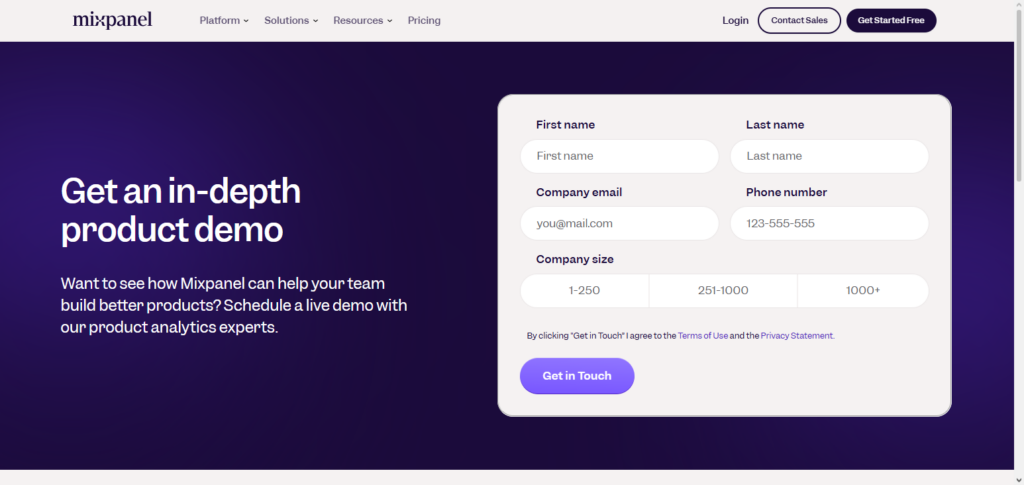
Teams may find trends that increase engagement and conversions by using advanced cohort analysis, retention tracking, and predictive insights. Mixpanel stands out as one of the Best AI Tools for Customer Behavior Analysis in the middle of its analytical workflow, assisting product managers and marketers in making data-driven decisions, streamlining onboarding processes, and customizing experiences to boost long-term customer value and loyalty.
Mixpanel Characteristics, Benefits & Drawbacks
Characteristics
- Event based tracking
- Real time data
- Funnel and cohort analysis
- Custom dashboards
- Predictive analytics
Benefits
- Insightful data for product optimization
- User funnel tracking
- Segmented data for marketing
- Support for real time decisions
- Recommendations for predicted actions
Drawbacks
- Hard for beginners to learn
- Can be costly
- Difficult setup for technical people
- Knowledge gaps (no heatmaps)
- Would benefit from data strategy
2. Heap Analytics
By automatically recording each user interaction without the need for manual event labeling, Heap Analytics streamlines the process of gathering behavioral data.
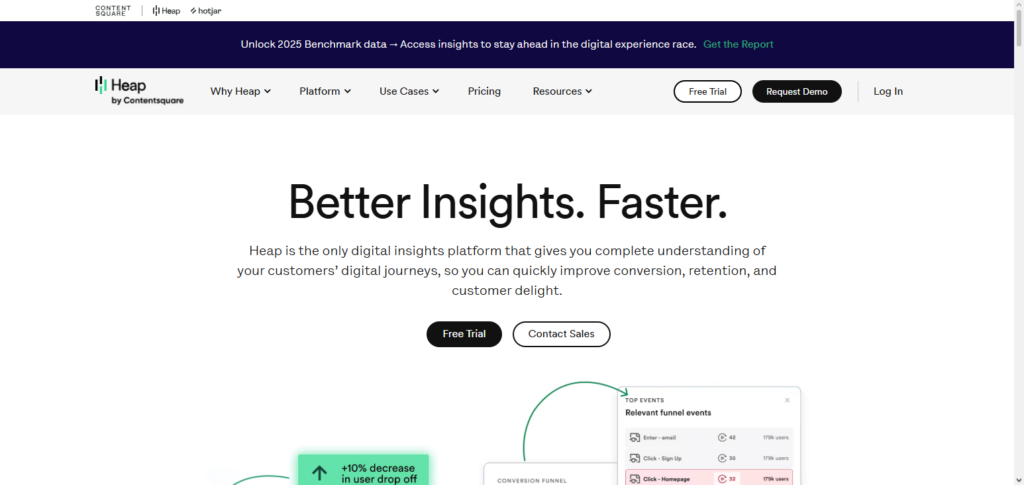
This enables companies to find hidden patterns and performance gaps by retroactively analyzing activities, clicks, and page visits. Its accessible dashboards and AI-powered insights help teams understand how users navigate around digital sites.
Heap, which is regarded as one of the Best AI Tools for Customer Behavior Analysis, helps product teams, UX designers, and marketers create comprehensive user journeys, pinpoint drop-off locations, and enhance conversion funnels. It facilitates more intelligent personalization tactics and ongoing development for mobile apps and websites by offering clean, organized data.
Heap Analytics Characteristics, Benefits & Drawbacks
Characteristics
- Interaction auto-capture
- No manual tagging
- Analysis retroactive
- Userinterface is not complex
- Data segmentation by behaviour
Benefits
- Event tagging to save time
- Data exploratioin is flexible
- Analytics of hidden user behaviour
- Broad analytics teams
- Reliable data
Drawbacks
- Data noise A
- Lacks advanced predictive AI
- Fewer features for collaboration
- Not easy to use to funnel optimization
- Simple dashboards with little customization
3. Kissmetrics
Kissmetrics is a customer-focused analytics tool that tracks individual user journeys instead of just page views or sessions. It provides a comprehensive picture of lifetime value and behavior patterns by connecting revenue data, product usage, and marketing activities to particular customer profiles.
Kissmetrics, which is regarded as one of the Best AI Tools for Customer Behavior Analysis, assists companies in comprehending the user journey from acquisition to conversion and retention. Marketers can find high-performing channels and customize engagement strategies with its sophisticated segmentation and funnel statistics.
Long-term development across digital platforms, improved decision-making, and deeper relationships are all facilitated by this profound understanding of customer motives.
Kissmetrics Characteristics, Benefits & Drawbacks
Characteristics
- Tracking on user level
- Analytics on customer lifetime
- Comparison in cohort
- Optimization of revenue and conversion
- Campaign tracking that is integrated
Benefits
- Behavior that is connected to ROI
- In-depth analysis of user journey
- Simplifies tying in campaigns
- Optimizes retention strategies
- Solid features for segmentation
Drawbacks
- Competitors have more modern UI
- Learning it takes more time
- Pricing is based on usage
- Heatmaps / visual analytics are weaker
- Limited flexibility in dashboards
4. Hotjar
Hotjar shows exactly how consumers engage with a website by combining visual feedback features with standard analytics. It shows where users click, scroll, and abandon pages using heatmaps, session recordings, and on-site surveys.
These qualitative insights complement quantitative data, making it one of the Best AI Tools for Customer Behavior Analysis for improving user experience. Hotjar assists companies with real-time consumer frustration analysis, design change testing, and usability problem identification.
It enables designers, marketers, and product managers to produce more captivating, user-friendly, and conversion-focused digital experiences by bridging the gap between data and human behavior.
Hotjar Characteristics, Benefits & Drawbacks
Characteristics
- Recordings of sessions
- Heatmap analysis
- Polls for feedback on site
- Visualizing conversion funnels
- Widgets for user sentiment
Benefits
- User behavior insights
- feedback on qualitative ux decisions
- Implementation is simple
- UX problem diagnosing
- Teams of small size cost less
Drawbacks
- Missing analytics on quantitive aspects
- Insight on deep predictive AI is absent
- Scale for enterprises is not suitable
- Plans at lower level have limited data storage
- Not for analytics of the products
5. Crazy Egg
Crazy Egg is a visual analytics tool that focuses on figuring out how people interact with websites. It provides A/B testing tools, heatmaps, and scroll maps that show where users click, hover, and stop scrolling.
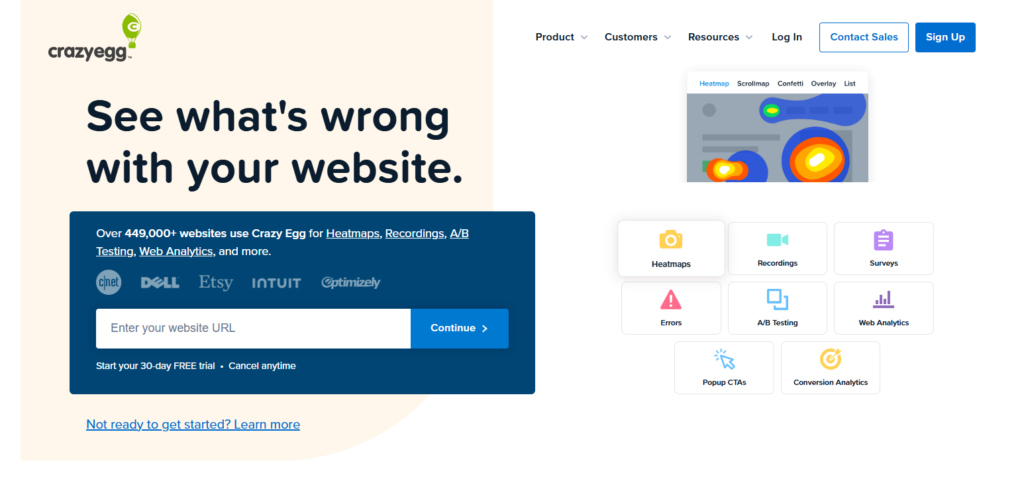
Crazy Egg, which is ranked as one of the Best AI Tools for Customer Behavior Analysis, assists companies in optimizing layouts, calls to action, and content placement. Marketers and designers can easily test site variations and determine what increases engagement and conversions thanks to its user-friendly interface.
Crazy Egg facilitates quicker decision-making and ongoing enhancement of website performance and customer happiness by simplifying complex user behavior into understandable images.
Crazy Egg Characteristics, Benefits & Drawbacks
Characteristics
- Heatmaps on Clicks
- Heatmaps on Scroll
- Tools for A/B testing
- Reporting on Snapshots
- Setup is straightforward
Benefits
- Engagement of user is visualized
- Barriers on UX are identified fast
- Page performance is improved
- Improvements on conversion are supported
- Teams without technical expertise find it easy
Drawbacks
- Visuals are the only limited data
- No analytics using advanced Artificial Intelligence
- Analysis of cohorts not deep? it is not suitable for that.
- Lack of granularity is present in the reports
- Integrations with CRM are limited.
6. Qlik Sense AI
Qlik Sense AI is a sophisticated data analytics tool that provides automated insights and predictive analysis through artificial intelligence.
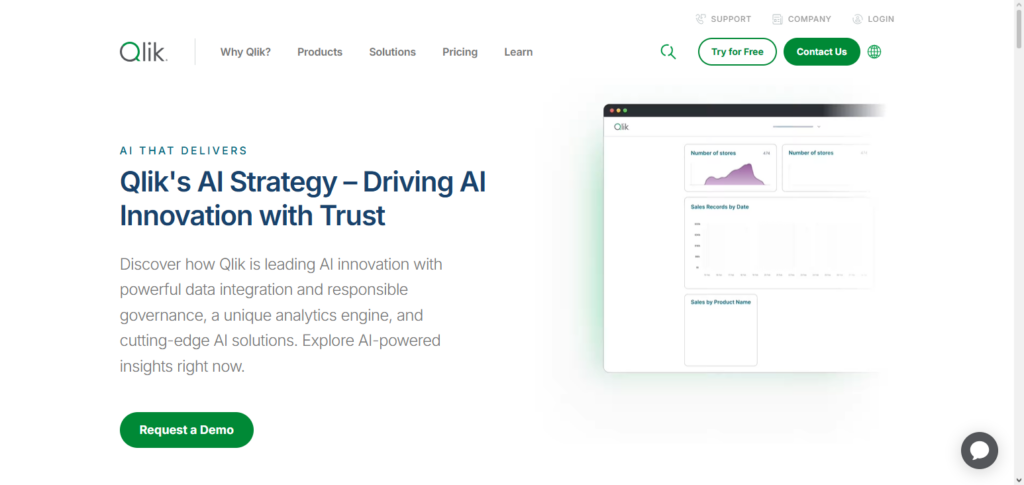
It enables users to examine customer data through natural language queries, making complicated analytics accessible to non-technical teams. As one of the Best AI Tools for Customer Behavior Analysis, Qlik Sense AI helps firms uncover hidden trends, forecast customer actions, and identify chances for customisation.
Businesses may combine several data sources into a single perspective because to its strong data visualization and integration capabilities. Strategic planning, enhanced consumer involvement, and more intelligent, data-driven departmental decision-making are all supported by an all-encompassing strategy.
Qlik Sense AI Characteristics, Benefits & Drawbacks
Characteristics
- Natural language understanding
- Predictive analytics
- Dashboards
- Integration from multiple sources
- AI analytics
Benefits
- Quicker understanding of trends
- No-code querying
- Analytics across merged datasets
- Enterprise-grade real-time analytics
- Interactive analytics
Drawbacks
- More accessible analytical features are costly
- Complexity may deter usage
- A steep learning curve exists
- Imposing implementation effort
- It doesn’t center solely on behavioral analytics
7. HubSpot AI
By incorporating clever insights from marketing, sales, and customer support channels, HubSpot AI improves the HubSpot CRM ecosystem. To suggest tailored actions, it examines consumer interactions, email engagement, website behavior, and campaign results.
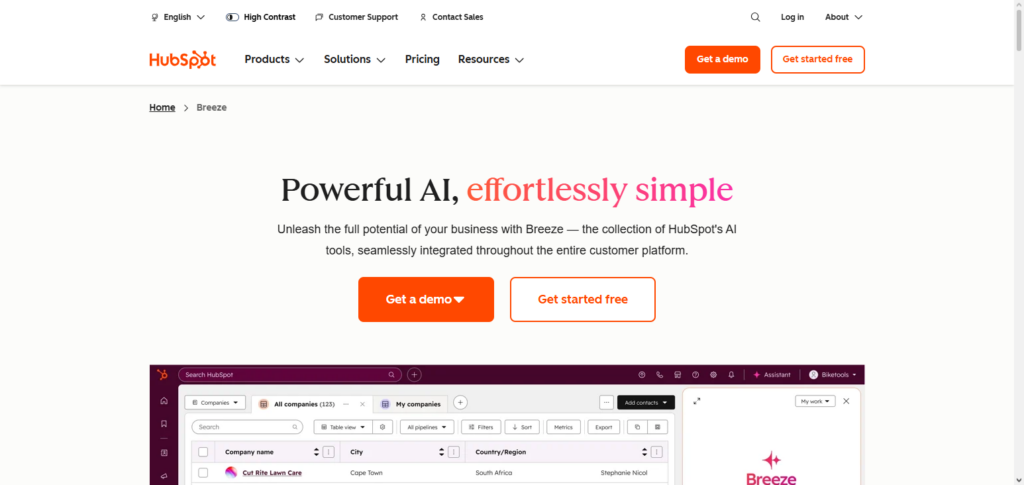
HubSpot AI, which is regarded as one of the Best AI Tools for Customer Behavior Analysis, assists companies in automating lead scoring, anticipating customer demands, and customizing communication tactics.
A single customer profile that facilitates consistent interaction across touchpoints is ensured by its smooth connection with CRM data. HubSpot AI enables teams to strengthen relationships, boost conversions, and enhance customer retention by fusing automation with behavioral insights.
HubSpot AI Characteristics, Benefits & Drawbacks
Characteristics
- Integration with CRM
- Scoring of leads enhanced with AI
- Insights of behavior on contacts
- Scoring of engagement that is predictive
- Recommendations that are automated
Benefits
- A single view of the customers
- Increased conversion of leads
- Workflows of marketing that are personalized
- Automation of segmentation
- Integratively simple among sales and service
Drawbacks
- Best value is found inside the HubSpot ecosystem
- Basic tiers have limited AI functionality
- Analytics are not dedicated
- Additional costs for advanced features
- Slow custom reporting
8. Zoho PageSense
Zoho PageSense is an all-inclusive analytics and optimization tool for websites that tracks visitor activity and increases conversions. In order to comprehend how users interact with web pages, it offers heatmaps, session records, A/B testing, and form analytics.
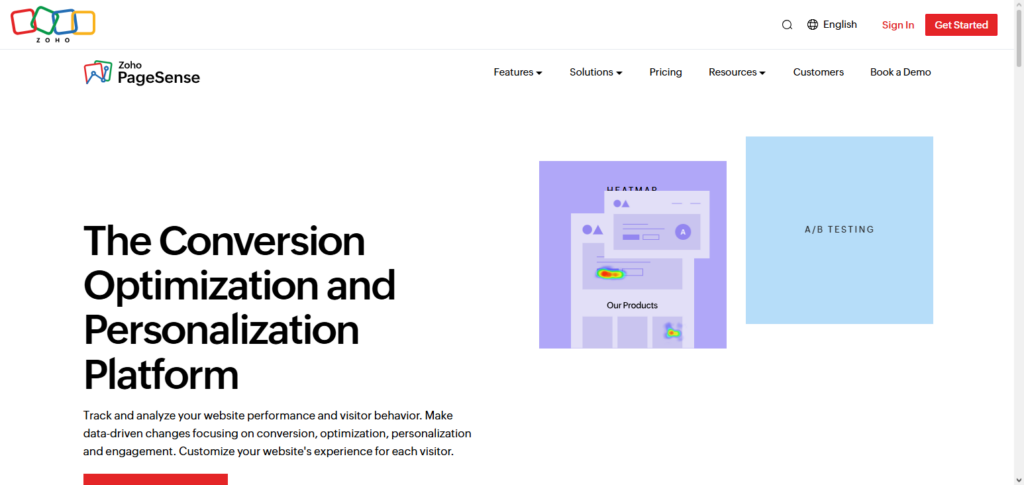
As part of the Best AI Tools for Customer Behavior Analysis, Zoho PageSense helps organizations to tailor content, test design modifications, and detect friction areas in user journeys.
Data interchange between CRM, marketing, and sales platforms is made easy by its connection with the Zoho ecosystem. Teams may develop data-driven plans that improve user experience and provide quantifiable business growth with the aid of this cohesive strategy.
Zoho PageSense Characteristics, Benefits & Drawbacks
Characteristics
- Recording of sessions
- Analytics of forms
- Visitor segmentation
- A/B split testing
- Funnels and heat maps
Benefits
- Integration of customer experience and conversion analytics
- Simple testing of page variants3. Identifies friction points
- Zoho app integration
- Budget-friendly pricing
Drawbacks
- Reduced ability to utilize AI
- Fewer analytics
- Integration options are less than competitors
- Not applicable to larger businesses
- Limited detail in reports
9. Piwik PRO
Piwik PRO is an analytics platform that prioritizes privacy and offers safe and legal client behavior tracking. It is perfect for businesses that must adhere to stringent data protection laws because it provides capabilities for tag management, consent management, and website and app analytics.
Piwik PRO, which is ranked as one of the Best AI Tools for Customer Behavior Analysis, gives companies complete control over data ownership and hosting while allowing them to obtain profound insights.
Teams may better analyze user journeys, optimize campaigns, and enhance digital performance with the aid of its sophisticated dashboards and configurable reports. It increases consumer trust and transparency by striking a balance between robust privacy standards and potent analytics.
Piwik PRO Characteristics, Benefits & Drawbacks
Characteristics
- Tracking integrated with GDPR
- Complete data ownership
- Compliance management
- Analytics on both website and apps
- Managing tags
Benefits
- Strong privacy compliance
- Great for regulated industries
- Secure on-premise hosting option
- Clear user journey analytics
- Customizable reporting
Drawbacks
- Complexity of setting it up
- Costs can be elevated on entry
- The organization(s) of data must be planned
- Interface is less modern
- Predictive artificial intelligence is less focused
10. SAS Customer Intelligence 360
Powered by cutting-edge AI and machine learning, SAS Customer Intelligence 360 is an enterprise-level omnichannel marketing and analytics platform. In order to provide real-time personalization across email, web, mobile, and in-store encounters, it integrates customer data from offline and online sources.
It facilitates journey orchestration, dynamic content distribution, and predictive modeling and is regarded as one of the best AI tools for customer behavior analysis. Companies are able to precisely measure campaign effectiveness, optimize marketing techniques, and predict customer wants. Large businesses can create consistent, individualized, and data-driven client experiences at scale with the help of its powerful analytics and automation capabilities.
SAS Customer Intelligence 360 Characteristics, Benefits & Drawbacks
Characteristics
- AI and machine learning analytics
- Personalization delivered in real-time
- Orchestration across multiple channels
- Scoring customers predictively
- Unified data platform
Benefits
- Insights provided by artificial intelligence are enterprise-grade.
- Experience across all channels is seamless and constant.
- Customer behavior is predicted with a high degree of accuracy.
- Customization access is plentiful.
- ROI optimization allows for deep segmentation.
Drawbacks
- Pricing is expensive for enterprise-level customers.
- A setup by an expert is a prerequisite.
- Extensive implementation time is required.
- Small businesses are over serviced.
- Extensive training time required.
Conclusion
To sum up, the Best AI Tools for Customer Behavior Analysis enable companies to go beyond simple metrics and get a more profound and significant grasp of their clientele. By combining real-time tracking, predictive analytics, visual insights, and privacy-focused data management, these solutions enable firms uncover patterns, tailor experiences, and improve every stage of the customer journey.
Using AI-driven behavior analysis helps businesses, whether they are expanding startups or large corporations, make better decisions, build closer relationships with their customers, and increase conversion rates. In the end, long-term competitiveness in a data-driven digital environment is ensured by investing in the appropriate instrument.
FAQ
What are the Best AI Tools for Customer Behavior Analysis?
The Best AI Tools for Customer Behavior Analysis include platforms like Mixpanel, Heap Analytics, Kissmetrics, Hotjar, Qlik Sense AI, HubSpot AI, Zoho PageSense, Piwik PRO, and SAS Customer Intelligence 360, which use AI to track, predict, and optimize user interactions.
How do AI tools help analyze customer behavior?
AI tools collect and process large volumes of customer data, identify behavioral patterns, predict future actions, and provide actionable insights through dashboards, visualizations, and automated recommendations to improve engagement and conversions.
Are these AI tools suitable for small businesses?
Yes, many tools like Hotjar, Zoho PageSense, and HubSpot AI offer scalable plans that suit small and medium-sized businesses, allowing them to start with basic analytics and upgrade as their needs grow.
What features should I look for in customer behavior analysis tools?
Key features include real-time tracking, predictive analytics, user journey mapping, heatmaps, segmentation, CRM integration, data privacy controls, and customizable dashboards for better decision-making.
How do these tools improve customer experience?
By understanding how customers interact with your website, app, or campaigns, AI tools help identify friction points, personalize content, optimize design, and deliver more relevant communication across all touchpoints.