


I’ll go over the Best AI Platforms for Internal Knowledge Automation in this post, emphasizing how businesses may simplify knowledge management and give staff members immediate access to reliable information.
These AI systems make knowledge readily available and useful in any business setting by utilizing sophisticated search, context-aware suggestions, and automated content organization to decrease human labor, boost output, and improve team decision-making.
Why Use AI Platforms for Internal Knowledge Automation
Faster Access to Information – AI understands the user’s intent and searches for information by context and provides the right information almost instantly.
Employees are More Productive – The system automates knowledge discovery which in turn reduces the amount of time spent looking for documents, policies, and even misplaced solutions.
Context-Aware Recommendations – AI brings knowledge to the surface that is most important for the user based on their position, task, and activity.
Consistency in Knowledge Sharing – Knowledge is provided, and the most current information is available and used by all members of a team and across departments.
Reduced Dependency on Experts – Self-service access to repetitive information decreases the reliance on important people for such queries.
Automatic Content Organization – AI sorts, organizes, and refreshes documents and knowledge systems without human effort.
Scalable Knowledge Management – The system is able to manage an ever-increasing amount of both organized and disorganized data.
Better Decision Making – The system converts disorganized information to insights that are useful and actionable in real-time.
Key Point & Best AI Platforms for Internal Knowledge Automation List
| Tool | Key Points |
|---|---|
| IBM Watson Discovery | AI-powered enterprise search, NLP-based content understanding, document enrichment, semantic search, strong compliance and security |
| Salesforce Einstein Knowledge | AI-driven article recommendations, automated case resolution, seamless Salesforce CRM integration, predictive insights, improved agent productivity |
| ServiceNow AI Knowledge Management | Contextual knowledge suggestions, AI-powered content creation, workflow automation, self-service optimization, ITSM-native integration |
| Workday People Experience + AI | Personalized employee knowledge delivery, skills-based recommendations, AI-driven learning insights, HR analytics integration, employee engagement focus |
| Zoho Desk + Zia AI | AI-powered ticket insights, smart knowledge base suggestions, sentiment analysis, chatbot-driven self-service, cost-effective SMB solution |
| Confluence + Atlassian Intelligence | AI-assisted content creation, smart summaries, contextual search, collaboration-focused knowledge sharing, seamless Jira integration |
| Notion AI | AI-generated documentation, intelligent search, auto-summaries, flexible workspace organization, ideal for agile teams and startups |
| Sinequa Intelligent Search | Advanced cognitive search, deep NLP and ML models, secure enterprise-wide data access, multilingual support, compliance-ready |
| Lucidworks Fusion AI | AI-driven search relevance, real-time analytics, personalization engines, scalable data ingestion, strong ecommerce and enterprise use cases |
| Coveo AI Search & Recommendations | Context-aware search, personalized recommendations, behavioral analytics, omnichannel deployment, enterprise-grade scalability |
1. IBM Watson Discovery
Because of its potent combination of enterprise-grade search capabilities and natural language comprehension, IBM Watson Discovery stands out as one of the top AI systems for internal knowledge automation.
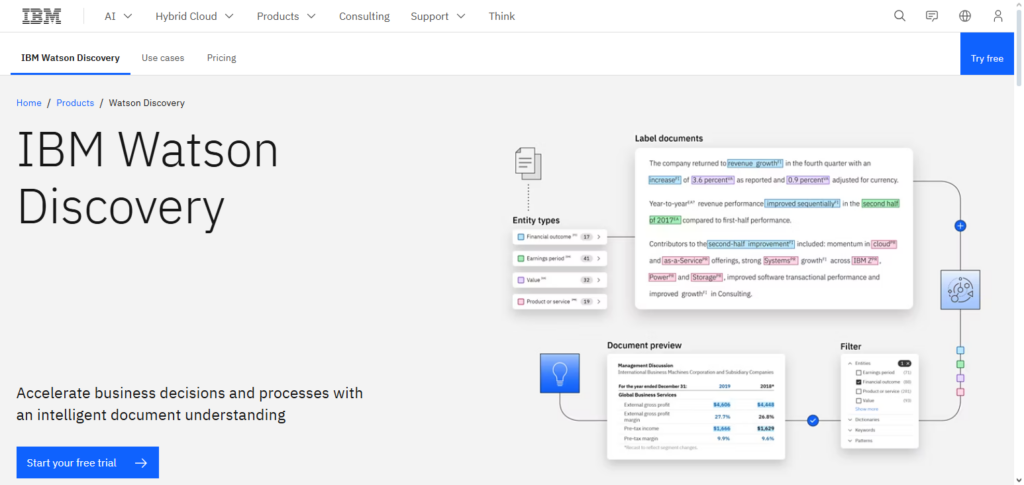
By analyzing context and purpose across enormous document collections, it goes beyond keyword matching and provides quicker access to pertinent insights. Real-time analysis of both structured and unstructured data, intelligent categorization, and automatic content enrichment are its strongest points.
Customizable AI models adjust to particular company demands, and built-in security and compliance support make it perfect for regulated businesses. Watson Discovery greatly lowers manual knowledge search through smooth interaction with current systems, increasing team productivity and decision-making.
IBM Watson Discovery Features, Pros & Cons
Features
- Ability to understand natural language.
- Ability to perform semantic searches and relevance ranking.
- Ability to enrich documents and extract entities.
- Ability to ingest data of various formats.
- Ability to customize AI models.
Pros
- Extremely good understanding of the context.
- Very good enterprise security and compliance.
- Can easily scale with large datasets.
- Highly flexible model training.
- Can integrate with numerous other systems.
Cons
- Setup & tuning require expertise.
- Full features require higher investment.
- Learning curve can be steep.
- Additional connectors may be required.
- Performance is dependent on the quality of data.
2. Salesforce Einstein Knowledge
Because Salesforce Einstein Knowledge fully integrates AI with CRM workflows to transform organizational data into actionable insights, it is one of the top AI systems for internal knowledge automation.
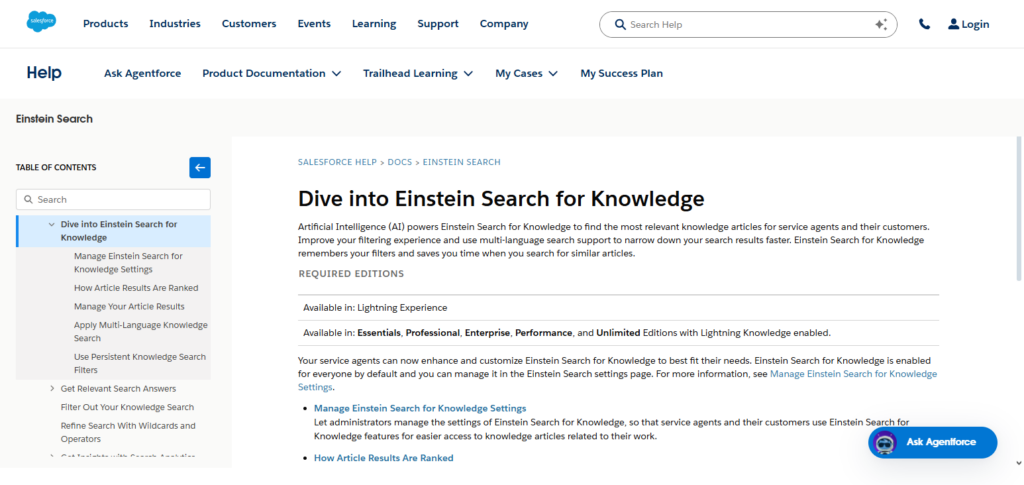
Its special feature is its ability to automatically suggest pertinent articles and responses based on user context and past case patterns, greatly cutting down on employees’ search time. In order to increase accuracy and enable more intelligent self-service and quicker case resolution, Einstein continuously learns from encounters.
It guarantees that knowledge is constantly linked to actual business scenarios through smooth alignment with Salesforce objects and processes. This customized intelligence increases output, improves consistency in customer care, and gives teams the knowledge they need at the appropriate time.
Salesforce Einstein Knowledge Features, Pros & Cons
Features
- Recommendations of articles using AI.
- Suggestions for case deflection.
- Salesforce contextual search.
- Insights predictions using data from CRM.
- Automatic content scoring.
Pros
- Integration within Salesforce ecosystem is seamless.
- Helps to improve resolution of customer cases.
- Uses actual behavior patterns to improve.
- Helps reduce workload of agents.
- Salesforce UI is user-friendly.
Cons
- Offers best value only when used within Salesforce.
- Limited scope outside of CRM data.
- Requires admin skills for customization.
- Relies on quality of CRM data.
- Additional licensing costs may be incurred.
3. ServiceNow AI Knowledge Management
One of the greatest AI systems for internal knowledge automation is ServiceNow AI Knowledge Management, which reduces the barrier between information and action by seamlessly integrating intelligent support into business operations.
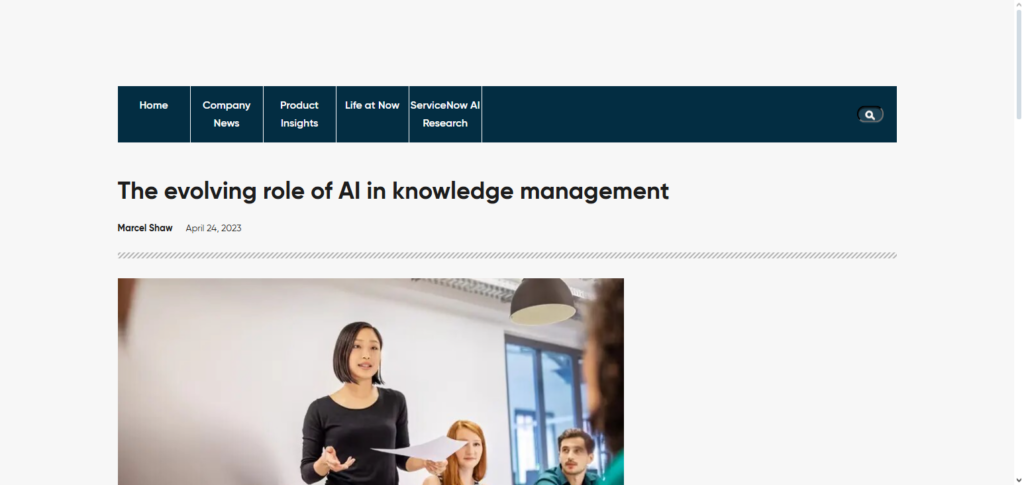
Its capacity to automatically recommend pertinent knowledge articles and solutions based on real-time context from incidents, requests, and user behavior is what gives it its special capability. Without the need for human labeling, the AI continuously improves suggestions, increasing accuracy over time.
It ensures uniform responses across departments by connecting knowledge to IT, HR, and customer service processes through a single service delivery platform. It promotes quicker resolution and increased operational efficiency by reducing manual search and enabling more intelligent self-service.
ServiceNow AI Knowledge Management Features, Pros & Cons
Features
- AI Optimized Search
- Automated Content Suggestions
- Context-Aware Content Suggestions
- Integration with ITSM/HR Workflows
- Optimizations through Feedback
Pros
- Analytics and Insights
- Improved Self-Service Success
- Manual Ticket Handling Reductions
- Enterprise-Grade Reliability
- Seamless Integration with ServiceNow
Cons
- Best Suited for ServiceNow Users
- Custom NLP Tuning Required
- High Platform Cost
- Limited Functionality Outside Native Modules
- May Require Professional Services for Setup
4. Workday People Experience + AI
Because Workday People Experience + AI intelligently provides individualized information and assistance throughout the employee lifecycle, it is among the top AI systems for internal knowledge automation.
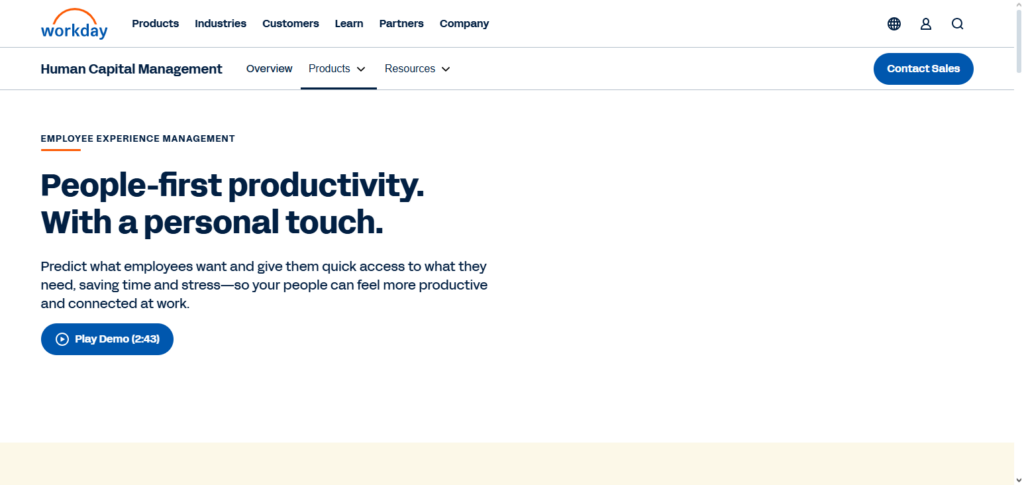
Understanding individual responsibilities, interests, and behavior to present the most pertinent policies, resources, and learning materials when and where employees need them is its special strength.
Workday’s AI reduces search time and boosts engagement by anticipating knowledge demands through the analysis of organizational data and interactions. It delivers a cohesive experience that streamlines complicated procedures by seamlessly integrating with talent, finance, and HR platforms.
This customized, context-aware automation increases productivity and satisfaction throughout the company by providing workers with the appropriate solutions in a timely manner.
Workday People Experience + AI Features, Pros & Cons
Features
- Analytics to Predict Content
- Analytics to Predict Training Needs
- Integrated Suggestions for Learning
- Insights for HR and Employee Lifecycle
- Recommendations Based on Role
Pros
- Centralized Knowledge Hub for HR
- Predicts Training Needs
- Strong Personalization
- Employee Engagement is Enhanced
- Deep Workday Data Integration
Cons
- Limited Outside Employee Experience
- Premium Pricing Tier
- Primary Focus on HR Use Cases
- Implementation Complexity
- High-Quality HR Data is Needed
5. Zoho Desk + Zia AI
Because it combines clever AI insights with user-friendly help desk operations to optimize information availability, Zoho Desk + Zia AI is among the top AI systems for internal knowledge automation.
Zia’s ability to proactively recommend the most pertinent knowledge articles by analyzing previous tickets and user interactions is its most notable strength, since it reduces the need for repeated searches.
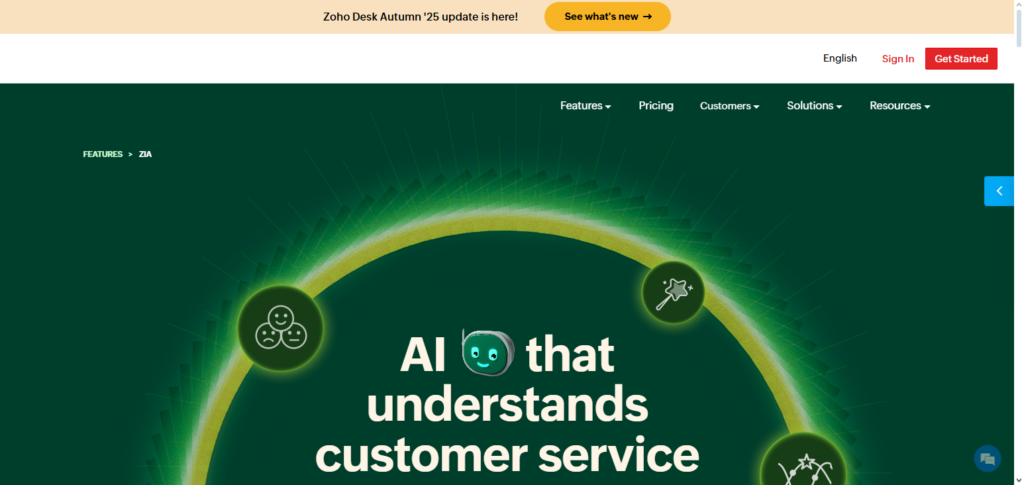
In order to assist teams improve knowledge material and answer more quickly, Zia also detects sentiment and patterns in questions.
It serves small and expanding enterprises with no technical overhead thanks to its simple customization and seamless integration with Zoho’s ecosystem. This useful, context-aware automation improves internal cooperation and speeds up problem solving.
Zoho Desk + Zia AI Features, Pros & Cons
Features
- AI-Assisted Chat
- Contextual Knowledge Suggestions
- Ticket Trend Detection
- Sentiment Analysis
- Article Relevance Scoring
Pros
- Affordable Pricing for SMBs
- Improves Self-Service
- Easy Setup and Use
- Enhances Agent Productivity
- Works via the various Zoho apps
Cons
- Less breadth compared to enterprise tools
- Smaller ecosystem integrations
- Advanced paid products have more developed AI insights
- Optimal performance with clean data
- Feature gaps for very complex environments
6. Confluence + Atlassian Intelligence
Confluence + Atlassian Intelligence converts collaborative documents into instantly available intelligence, making it one of the top AI systems for internal knowledge automation. Its special strength is adding AI-driven summaries, intelligent search, and contextual suggestions to Confluence’s rich information so users can get the answers without having to do any manual research.
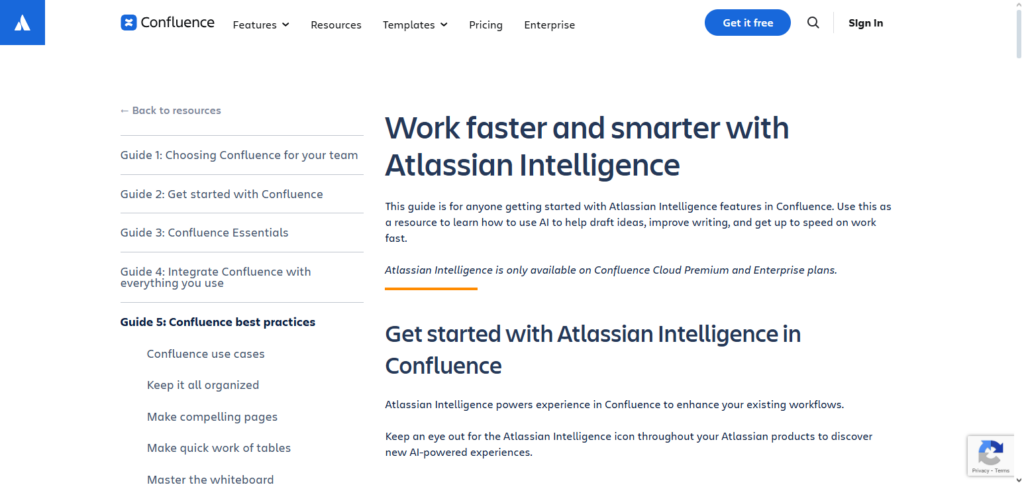
Atlassian Intelligence makes sense of complex, cross-team knowledge and surfaces the most pertinent information depending on context by comprehending workplace language and structure. It connects information and job execution through seamless integration with Jira and other Atlassian applications. This speeds up onboarding, cuts down on unnecessary paperwork, and gives teams quick, precise insights that are specific to their work.
Confluence + Atlassian Intelligence Features, Pros & Cons
Features
- AI created summaries of documents
- Enhanced search capabilities
- Suggestions for relevant content
- Recommendations for automated pages
- Integration with Jira
Pros
- Helps create more clarity in documents
- Supports collaboration of different teams
- Native ease of use for Confluence users
- Improves search relevance
- Works well in Agile environments
Cons
- Gains/losses primarily based around Confluence use
- Inputs can be basic
- Other features still under development
- Varies with the type of data used
- Less apt to more structured enterprise search
7. Notion AI
Because it skillfully combines intelligent content intelligence with intuitive workspace design, Notion AI is among the top AI systems for internal knowledge automation. Its distinctive feature is its ability to improve standard workspaces—notes, databases, and documents—with AI-generated summaries, astute recommendations, and context-aware content creation, allowing teams to spend more time doing rather than searching.
Notion AI makes organizing simple by understanding the flexible structure of user information and adapting to a variety of formats, in contrast to inflexible knowledge systems. It guarantees that information flows smoothly across teams and speeds up collaboration by automatically finishing ideas, highlighting pertinent pages, and improving written knowledge. This increases productivity without requiring technical complexity.
Notion AI Features, Pros & Cons
Features
- Automatic summaries or write-ups of documents
- Suggestions for other potentially relevant content
- Intelligent linking of content
- Various different content types
- User defined content prompts for generation
Pros
- Very easy to use
- Increases speed of work
- Good for a variety of content types
- Easy to start using
- Use cases across different teams
Cons
- Not a search engine built for enterprise
- Less defined control features
- May not align with user security needs
- Has to do with the input of users
- Less powerful when data set is large
8. Sinequa Intelligent Search
One of the greatest AI platforms for internal knowledge automation is Sinequa Intelligent Search, which is excellent at providing individuals with the appropriate insights from a wide range of data sources.
Advanced natural language processing and machine learning that comprehend meaning—not just keywords—across structured data, documents, emails, and corporate systems are its special strengths. Highly relevant, context-rich search results that are suited to particular jobs and queries are made possible by this semantic intelligence.
Sinequa can adapt to complicated, international situations thanks to its robust support for multilingual content and adaptable deployment choices. It greatly shortens search times, improves decision accuracy, and gives teams greater organizational insights by transforming disparate information into cohesive, useful knowledge.
Sinequa Intelligent Search Features, Pros & Cons
Features
- In-depth search based on semantics.
- Ability to support different languages.
- Multi-faceted extraction of entities and concepts.
- Integrated searching through different systems.
- Profiling of real-time relevance.
Pros
- Excellent for analyzing complicated datasets.
- Extensive linguistic capabilities.
- Scales efficiently with business growth.
- Indices available with data security in mind.
- Lessen data isolation.
Cons
- Complicated to implement.
- Pricing shows alignment with focus on larger enterprises.
- Needs expertise for implementation of NLP.
- Needs time for setup and tailoring to requirements.
- For first-time users, the system is not very user-friendly.
9. Lucidworks Fusion AI
One of the greatest AI platforms for internal knowledge automation is Lucidworks Fusion AI, which combines deep analytics with sophisticated AI-driven search relevancy to provide precisely the appropriate information when teams need it.
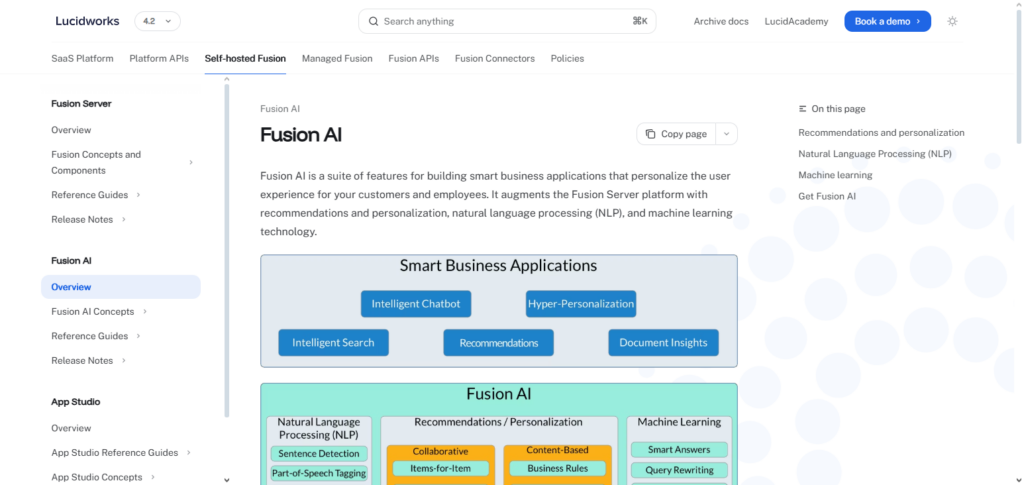
Its capacity to continuously learn from user behavior and improve search algorithms, guaranteeing that results get more precise and tailored over time, is its special strength. Fusion AI uses machine learning to interpret intent, integrates and connects many data sources with ease, and provides suggestions that are context-aware.
This dynamic adaptability lowers manual labor, speeds up problem-solving, and improves knowledge discovery throughout huge organizations, giving teams quicker access to insights that help them make better decisions.
Lucidworks Fusion AI Features, Pros & Cons
Features
- Re-ranking through machine learning.
- Personalization through user behavior.
- Analytics in real-time.
- Integration of data from different sources.
- Increased visibility of chosen results.
Pros
- Grows in understanding and characterizes user behavior.
- Flexible relevance is very high.
- Personalization sets the product apart.
- Analytics stability is very good.
- Works effectively for big corporations.
Cons
- Specialist implementation may be required.
- Budgeting for the system can be challenging.
- Required an adjustment period to be effective.
- Increased complexity in the user interface for new users on the team.
- Non-standard data sources can be difficult to integrate.
10. Coveo AI Search & Recommendations
One of the greatest AI platforms for internal knowledge automation is Coveo AI Search & Recommendations because it is excellent at providing highly customized, context-aware information that corresponds with the job and goal of each user.
Its special strength is its ability to dynamically customize search results and recommendations by fusing real-time behavioral data with potent machine learning, which cuts down on the amount of time staff members must spend sorting through irrelevant stuff.
Coveo creates a uniform knowledge layer that adapts to changing business needs by effortlessly integrating with various enterprise systems. It improves relevance and speeds up problem-solving by continuously learning from interactions, giving teams immediate access to the most significant insights throughout the company.
Coveo AI Search & Recommendations Features, Pros & Cons
Features
- Analytics based on user behavior.
- Ability to search based on the situation.
- Searches that are tailored toward the user.
- Supports knowledge across all channels.
- Ranking produced by AI.
Pros
- Results that are tailored to the user’s needs.
- Helps with both searching and making suggestions.
- Search results show real-time relevance.
- Covers a wide range of channels.
- Based on deep learning, the ranking is effective.
Cons
- Premium pricing structure
- Setup complexity for first-time users
- Best outcomes need clean data
- Custom analytics skills helpful
- Integration work required for complex stacks
Benefits Of AI Platforms for Internal Knowledge Automation
Instant Knowledge Retrieval: AI searches and interprets the intent and context of the query to provide rapid and correct solutions.
Higher Employee Efficiency: Employees are able to stop wasting time looking for the information required to carry out the tasks at hand and subsequently become much more productive.
Personalized Knowledge Experience: Knowledge that is received is customized and adjusted to the employee’s role, actions and requirements.
Improved Knowledge Accuracy: Outdated knowledge and information is minimized as AI absorbs data and focuses on relevancy.
Lower Operational Costs: Redundancy such as repetitive questions and manual information handling are decreased.
Enhanced Collaboration: Knowledge is consolidated and made available to all members of an organization allowing for information to be transferred and shared across units.
Scalable Automation: Without deterioration of system performance, data sets of any size can be stored and processed.
Better Onboarding & Training: Faster access to required knowledge allows new employees to complete their information searches and as a result, their learning curve is shortened.
Conclusion
The top AI platforms for internal knowledge automation, such as IBM Watson Discovery, Salesforce Einstein Knowledge, ServiceNow AI Knowledge Management, Workday People Experience + AI, Zoho Desk + Zia AI, Confluence + Atlassian Intelligence, Notion AI, Sinequa Intelligent Search, Lucidworks Fusion AI, and Coveo AI Search & Recommendations, change how businesses handle, access, and use knowledge.
These solutions improve decision-making, increase staff productivity, and streamline information flow by combining context-aware recommendations, intelligent search, and automated content categorization. By reducing manual labor and ensuring consistent, accurate, and scalable information sharing, AI-driven knowledge automation enables teams to operate more quickly and intelligently across all departments.
FAQ
What is internal knowledge automation?
Internal knowledge automation uses AI to organize, manage, and deliver information within an organization automatically, helping employees access the right knowledge at the right time without manual searching.
Why should businesses use AI for knowledge automation?
AI speeds up information retrieval, improves accuracy, personalizes content, reduces manual effort, enhances collaboration, and boosts overall employee productivity.
Which are the top AI platforms for internal knowledge automation?
IBM Watson Discovery, Salesforce Einstein Knowledge, ServiceNow AI Knowledge Management, Workday People Experience + AI, Zoho Desk + Zia AI, Confluence + Atlassian Intelligence, Notion AI, Sinequa Intelligent Search, Lucidworks Fusion AI, and Coveo AI Search & Recommendations.
How do these AI platforms improve decision-making?
By delivering context-aware insights, personalized recommendations, and real-time access to accurate information, they empower employees to make faster and smarter decisions.
Can AI knowledge platforms handle large volumes of data?
Yes, these platforms are scalable and capable of managing both structured and unstructured data across multiple sources efficiently.